“What is going on in this city?” The exasperated cry of a man confronting Berlin Mayor Kai Wegner about conditions in an emergency shelter earlier this week made it onto several news bulletins and countless social media accounts.
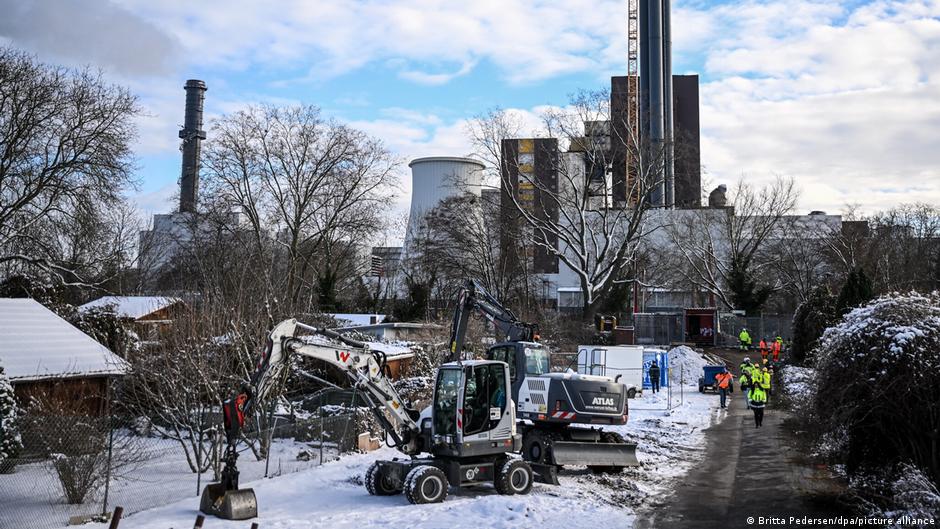
Following an arson attack in the early hours of January 3 that left about 45,000 households in the southwestern suburbs of Berlin without power for several days, thousands of increasingly frustrated people, many of them elderly, disabled and in need of care, were left to depend on the city’s emergency disaster relief services — and they were unimpressed.
German media outlets reported of Berliners complaining that they were not adequately informed about where to go, that there were not enough emergency generators available, that they were dependent on charities such as the Red Cross rather than the government itself.
Other states pitched in to help. Berlin sent out requests to the state of North Rhine-Westphalia, which supplied generators and firefighters to bring power to the affected area.
Disaster protocols
But it wasn’t just local residents who were baffled by Berlin’s handling of the blackout. Hans-Walter Borries, deputy chairman of the Federal Association for the Protection of Critical Infrastructure (BSKI), told DW that there are plenty of questions to be asked, chief among them: Why weren’t the authorities quicker to recognize the scale of the problem?
“Who knew what when?” wondered Borries, who is also director of the Institute for Economic and Security Studies at Witten University and a reservist officer in the German military. “Based on what information were which decisions made?”
“I would say that in a winter situation, where 100,000 people are without electricity, the crisis team should have recognized the scale of the event immediately,” Borries said. This was especially true in Berlin, he added, because almost all of the German capital’s 36,000 kilometers (22,400 miles) of electricity cables are buried underground, so reestablishing power to the affected area was always likely to take days.
Not only that, but, given that this outage was caused by an act of sabotage (by a suspected left-wing group), it should’ve been clear early how serious the situation was. As it happens, a state of emergency was only declared on Sunday afternoon. Doing that earlier, Borries said, would have given state authorities the right, for instance, to requisition generators from private companies and to allow volunteers to leave work to help.
Response and prevention
Germany has a central disaster relief agency, the Federal Office of Civil Protection and Disaster Assistance (BBK), which is tasked, among other things, with coordinating the country’s crisis response efforts. “Overall, Germany enjoys a very high level of security of supply in the electricity sector,” the BBK said in a statement to DW, though it pointed out that immediate responses to crises are organized at local and state level.
Timm Fuchs, of the German Association of Towns and Municipalities (DStGB), told DW that Germans could have confidence in their local councils. “Almost all the local authorities have disaster protection and prevention plans,” Fuchs said. “But it’s clear that the power cut in Berlin has offered an occasion to check all the plans, especially for power cuts.”
This does appear to be happening across Germany in response to events in Berlin. Bavaria’s Interior Minister Joachim Herrmann assured the population that the state “is well-equipped to ensure the security of supply for the population and the protection of critical infrastructure even in crisis situations.” The city-state of Hamburg also said that it had budgeted about €25 million for a new crisis management department in the Interior Authority for 2025-26. According to Hamburg’s government, the existing structures, which are primarily geared toward disasters, were no longer adequate.
But Germany’s regional authorities are notoriously underfunded, with some on the verge of bankruptcy, though the federal government does appear to be aware of the issue. Federal Interior Minister Alexander Dobrindt promised last September that some €10 billion ($11.6 billion) would be invested in disaster protection and prevention until 2029.
The lack of resources is only half the problem: Making sure the disaster response structures are efficient is another matter. Martin Voss, a professor of crisis and disaster research at the Free University of Berlin, spent several days this week going out with his team to interview people involved in dealing with Berlin’s blackout.
“What we learned is what we sort of already knew: Disaster protection is organized in a very complicated way in Germany,” Voss told DW. “There are several different authorities with different jurisdictions at different levels, who are responsible for so many different situations and have different responsibilities. So, when something happens, the processes can quickly get stuck somewhere.”
Voss said any disaster was likely to create a complicated situation — but that doesn’t mean you can’t prepare for them. After all, power cuts are more or less inevitable in the long-run. “And if you know that it will happen sometime, you can plan for it resolutely, and that clearly hasn’t happened yet,” he said.
Surrounded by friends?
Voss is skeptical about the resilience of Germany’s critical infrastructure. “I’m anything but confident,” he told DW. “The protection of critical infrastructure has been completely neglected in the last few decades. At least since 1989, the mindset here has been: We’re surrounded by friends, our liberal market economic model has won out, and the main thinking has been: We build the infrastructure and can leave it to the operators to make sure it’s safe.”
Voss believes the guidelines for that security were so loosely defined and so rarely checked over the years that the operators essentially did the absolute minimum to maintain security. “The mindset was: There’s no risk, there’s no danger, so I don’t have to invest,” he said. “And that’s the case in all areas of infrastructure.”
But that culture is changing, and there’s an increasing awareness among the Germany population that they can’t rely on the state. The BBK has issued a list of what households should keep on hand at all times, and local authorities know that an essential part of disaster planning is making sure that the population itself is well-prepared. “Do people have enough drinking water, food, do they know where they can find information?” said Timm Fuchs. “Those are all things that every single town and municipality now needs to check.”
“What is good is that there has been a paradigm shift on the issue of population protection,” Fuchs added. “The received opinion used to be that one shouldn’t inform people too much about preparedness, because that would panic them, and there would be unrest.” That has now changed: “People now want to be better prepared. That’s good, because it makes it easier to inform people.”
Edited by: Rina Goldenberg
While you’re here: Every Tuesday, DW editors round up what is happening in German politics and society. You can sign up here for the weekly email newsletter, Berlin Briefing.
Source link
-

-

-

-

-