

A new study challenges a decades-old explanation for how bacteria change direction, revealing that the process may be driven by active, energy-dependent forces rather than passive protein interactions.
Scientists have identified a new way to explain how swimming bacteria change direction, offering fresh insight into one of the most closely studied molecular systems in biology.
Bacteria move through liquid using propeller-like structures called flagella. These tiny tails rotate either clockwise or counterclockwise, allowing the cell to navigate its environment. For many years, scientists believed this switching behavior followed an equilibrium “domino effect” model, where proteins along the tail influence their neighbors to shift direction.
A new study published in Nature Physics by Flatiron Institute researchers Henry Mattingly and Yuhai Tu presents a different explanation. Based on structural measurements of the flagellar motor and analysis of its motion, the team suggests the switch is not passive. Instead, it is driven by an active mechanical competition among proteins that are not necessarily adjacent.
“People have known this switching behavior since the 1950s, but now having this simple molecular-level mechanism to explain it is very exciting,” says Tu, a senior research scientist at the Flatiron Institute’s Center for Computational Biology (CCB) and Center for Computational Neuroscience (CCN).
The Problem With the Domino Effect
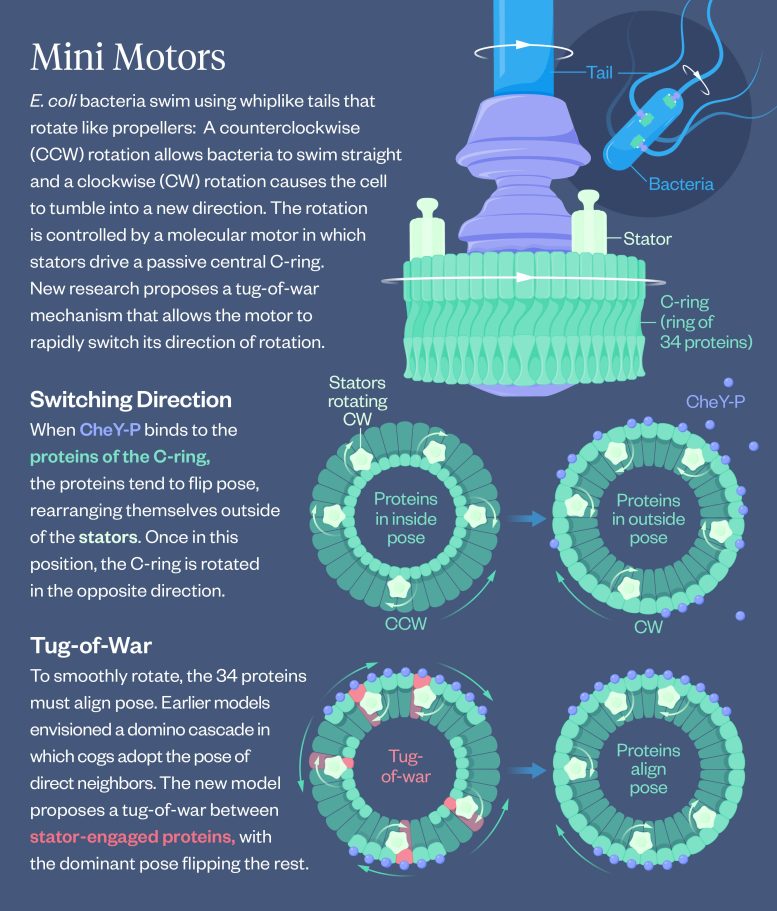
The flagellar motor has been studied for decades and is often described as one of nature’s most elegant molecular machines. It is made up of 34 proteins arranged in a ring, powered by structures called stators. These stators act as channels that allow charged atoms to flow through, generating the force needed for rotation.
Proteins in the ring determine the direction of movement based on signals from a molecule called CheY-P. When CheY-P binds to a protein, it changes the protein’s shape, which influences whether the motor turns clockwise or counterclockwise.
“CheY-P concentration depends on what the cell is experiencing outside, in its environment,” says Mattingly, an associate research scientist at the CCB. “It’s like a relay from what the cell senses to how it responds with changes in behavior.”
Because different proteins can receive different signals, the ring can contain a mix of states. Some proteins favor clockwise motion, while others favor the opposite direction. The traditional model suggested that neighboring proteins gradually align through a domino-like process, eventually forcing the entire system to switch.

“The proteins cooperate with each other. If I’m in one state, my neighbor has a higher probability of joining me in that same state,” says Tu. “Once enough of them change state, the motor flips.”
However, real-world measurements of how often flagella switch direction do not match this idea. In an equilibrium system, switching should follow a memoryless pattern, meaning the timing of a flip would not depend on how long the motor has already been rotating in one direction.
Instead, experiments show a peak in how long the motor stays in one state before switching. This pattern cannot be explained by an equilibrium process. “If you see this pattern, then the effect cannot be a purely equilibrium phenomenon,” says Tu. “There had to be something else going on.”
A Tug-of-War Inside the Tail
Mattingly and Tu reasoned that switching the motor’s rotational direction couldn’t be a passive equilibrium process — there must be energy injected into the system that somehow influences how and when the motor switches.
Several recent discoveries about the physical structure of the motor informed Mattingly and Tu’s theory. First, the ring of proteins in the flagellar motor, known as the C-ring, acts as one big central gear, with each protein acting as one tooth of the gear. Second, the stators aren’t just a general power source; they also function as smaller gears. These stators always rotate clockwise and make contact with the teeth of the large gear. How these teeth touch the stators determines which way they try to get the motor to turn.
The teeth of the large gear can change position to touch the small gears — the stators — on the stators’ outer edge or their inner edge. When the teeth touch the outer edge, the stators push the large gear clockwise; when they touch the inner edge, the stators push them counterclockwise. As a result, even though the small gears always rotate clockwise, the flagellum can rotate either way.
However, conflicts can arise when different teeth adopt different conformations. Some may contact their stators on the outside and favor a clockwise direction, while others contact their stators on the inside and try to turn the other way. According to the new model, this is where the tug-of-war emerges.
“Imagine all the teeth are in the same outer conformation. Then one of them flips,” says Mattingly. “As the gear turns, that lone dissenter eventually comes in contact with a stator that now pushes it in the opposite direction from all the others. Because the teeth are mechanically linked, that one tooth is feeling five active gears pushing one way and one pushing the other. Since it’s out of sync with the rest, the torque on it is much larger. It’s like a mechanical tug-of-war. If the mechanical force on it is too strong, it flips to join the majority. But if enough teeth dissent, then the entire motor changes direction.”
The team calls this process “global mechanical coupling.” The name is meant to underscore that the forces driving each tooth to turn one way or the other aren’t determined solely by the teeth’s interactions with their neighbors; rather, all teeth touching stators will impact one another across the motor in a collective process.
Global mechanical coupling can also produce the peak in the distribution seen in the earlier experiments. Since the stators are active players in the direction switching, not just general power sources for rotation, they inject energy into the system and drive it out of equilibrium.
“Global mechanical coupling explains what the earlier, purely equilibrium theory couldn’t, that switching is energy-driven, directional and cooperative,” says Tu.
Unraveling Mysteries in the Flagella and Beyond
With a new model in place, the team hopes it will inform our understanding of other nonequilibrium systems in living organisms.
“Our results make sense to me because I believe living systems always operate out of equilibrium,” says Tu. “They dissipate energy, and that energy is essential for biological function. This is a beautiful example of that principle.”
The researchers will continue to refine their model to integrate more experimental data. For example, their model predicts a peak in the distribution of counterclockwise durations, but on a shorter timescale than in experiments.
Understanding the flagella can also influence how scientists understand more complex systems.
“It’s so well studied that it becomes a perfect system to test ideas — and what we learn here often helps us think about more complex biology,” says Mattingly.
Tu adds that the new research is also exciting for the field of bacterial chemotaxis. “Every so often people say, ‘This is a dead field.’ Every time that turns out to be wrong. There’s always another layer.”
Reference: “Mechanical origin for non-equilibrium ultrasensitivity in the bacterial flagellar motor” by Henry H. Mattingly, and Yuhai Tu, 7 January 2026, Nature Physics.
DOI: 10.1038/s41567-025-03105-2
Never miss a breakthrough: Join the SciTechDaily newsletter.
Follow us on Google and Google News.
Source link
-

-

-

-

-


