Caltech’s new fiber-like photonic chips achieve record-low visible-light loss, enabling more coherent lasers and next-generation quantum and sensing technologies.
Caltech researchers have created a technique that allows light to travel across silicon wafers with extremely low signal loss, nearing the performance of optical fiber even at visible wavelengths. Achieving this level of efficiency on a chip marks an important step forward for photonic integrated circuits (PICs), enabling devices that maintain exceptional coherence while minimizing energy loss.
These advances could significantly expand the capabilities of on-chip technologies, supporting high-precision tools such as optical clocks for timekeeping and gyroscopes for measuring rotation, along with improving AI data-center communications and advancing the development of quantum computing systems.
Although most people rarely think about it, optical fiber forms the backbone of modern communication. It carries vast amounts of information around the globe almost instantly. Its effectiveness comes from its composition and design. Optical fiber is made from exceptionally pure glass and engineered to be extraordinarily smooth. When light enters one end, almost all of it travels to the other end with minimal absorption or scattering. Scientists refer to this capability as ultralow-loss performance.

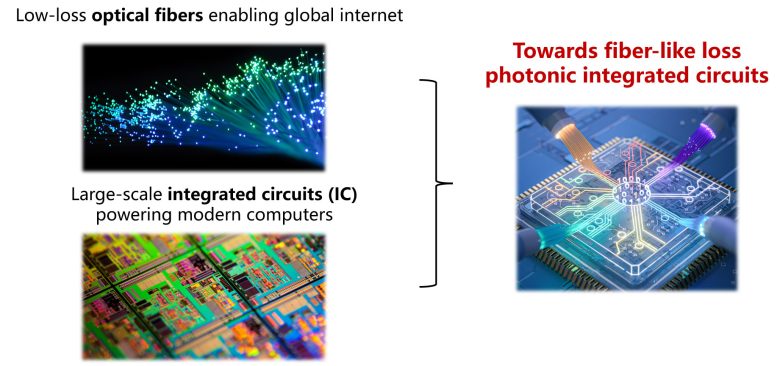
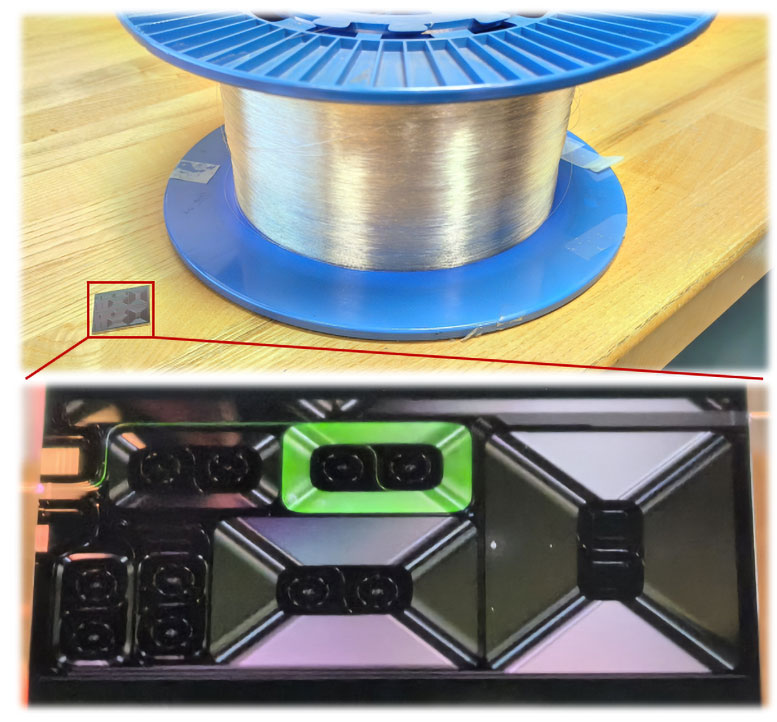
“For years, we have been working to translate the spool-based fabrication of optical fiber onto silicon wafers, while trying to preserve the fiber’s hallmark of ultralow loss,” says Kerry Vahala (BS ’80, PhD ’85), the Ted and Ginger Jenkins Professor of Information Science and Technology and Applied Physics at Caltech. “We have developed a method to print optical circuits, made from the same material as optical fiber, directly onto the same 8- and 12-inch wafers used for computer chips. This shift toward fiber-like performance, especially in the visible bands, will enable new technologies that benefit from negligibly low circuit energy loss.”
Nature Paper Details Fiber-Based Fabrication Method
The researchers detailed their approach in a paper published in Nature. The lead authors are Caltech postdoctoral scholar Hao-Jing Chen and graduate student Kellan Colburn (MS ’25), who conducted the work in Vahala’s lab.
To build the light-guiding structures, known as waveguides (nanoscale on-chip pathways that channel light), the team used germano-silicate, the same glass found in optical fiber. They shaped this material using a lithography-based fabrication process. The resulting waveguides are arranged in a spiral pattern that lengthens the distance light can travel on the chip, similar to how light moves through a coiled fiber, but compressed into a much smaller area through nanofabrication.
“Germano-silicate waveguides demonstrate extremely low loss and are also readily adaptable to efficiently transfer light between optical fibers and semiconductor lasers, which is of paramount importance in reducing the overall energy cost of server infrastructure,” says Henry Blauvelt (PhD ’83), a visiting associate in applied physics and material science at Caltech; chief technology officer at Emcore, a company specializing in photonic circuits; and an author of the recent paper.
At near-infrared wavelengths, devices built on this new platform perform on par with leading silicon nitride technologies, a material widely used for its low-loss data transmission properties. At visible wavelengths, however, the germano-silicate platform performs significantly better than silicon nitride.
Atomic-Level Surface Smoothing Boosts Coherence
“Due to the comparatively low melting temperature of the material, we can put our devices into a furnace to ‘reflow’ the surface of our waveguides to get their smoothness down to the level of individual atoms, which largely suppresses the severe scattering loss that has limited conventional visible PICs,” Chen says. “At visible wavelengths, our recent platform exceeds silicon nitride’s record by a factor of 20, and we have more room to improve.”
Reducing loss has a major impact on device behavior. For instance, lasers produced with this approach maintain coherent light for more than 100 times longer than earlier versions.

“The expanded wavelength coverage our method offers will support many important atomic operations, making chip-scale atomic sensors, optical clocks, and ion-trap systems possible,” Chen says.
Colburn notes that striving for losses measured over kilometer-scale distances might seem excessive for chips that are only about 2 centimeters wide. “After all, our chips are only 2 centimeters across. But, in reality, there are a lot of applications where this would be very powerful,” he says. He points to the ring resonator, a widely used optical component in both research and telecommunications. In a ring resonator, light is coupled into a circular pathway where it can circulate repeatedly, amplifying specific frequencies.
Ring Resonators, Quantum Sensors, and Future Applications
Even though these rings measure just millimeters across, the total distance light effectively travels depends on how little energy is lost along the way. “That’s where low loss over meters, or ultimately kilometers, really matters,” Colburn says. “The longer light can circulate, the higher the performance of resulting devices can be.” For lasers that use these resonators to improve coherence, every factor of 10 reduction in loss translates to a factor of 100 improvement in coherence.
More broadly, achieving ultralow-loss waveguides in the visible spectrum enables a wide range of technologies. “One of the reasons this is so compelling is that it has a Swiss Army–knife quality—it can be applied in a wide range of settings,” Vahala says. To illustrate this point, the Caltech team describes in the paper several optical devices they built with the new material. This includes ring resonators, different types of lasers, and nonlinear resonators that generate a range of frequencies.
According to Vahala, this progress represents an important step forward, but more advances are ahead. “We haven’t gone as far as we want to go, but we’ve made significant progress over the last five years, and that’s what we’re reporting on here,” he says.
Reference: “Towards fibre-like loss for photonic integration from violet to near-infrared” by Hao-Jing Chen, Kellan Colburn, Peng Liu, Hongrui Yan, Hanfei Hou, Jinhao Ge, Jin-Yu Liu, Phineas Lehan, Qing-Xin Ji, Zhiquan Yuan, Dirk Bouwmeester, Christopher Holmes, James Gates, Henry Blauvelt and Kerry Vahala, 7 January 2026, Nature.
DOI: 10.1038/s41586-025-09889-w
The work was funded by grants from the Defense Advanced Research Projects Agency, the Air Force Research Laboratory, the Engineering and Physical Sciences Research Council, and the Kavli Nanoscience Institute at Caltech.
Never miss a breakthrough: Join the SciTechDaily newsletter.
Follow us on Google and Google News.
Source link