

For the Solemnity of the Nativity of Our Lord Jesus Christ, we look back at the Christmas reflections of previous popes, which renew hope even in the midst of suffering.
By Amedeo Lomonaco
Christmas is joy, light, and peace. The birth of a poor Child, lying in a manger, illuminates the world even in the midst of war, famine, calamities, and tragic events that affect the history of nations, peoples and families. The Popes urge us to welcome and embrace this little human child, born in Bethlehem, who comforts suffering humanity.
Pius XII and those destined for death due to nationality or race
A particularly dark and tragic moment – experienced especially by European Jews – occurred during the Second World War.
On 20 January 1942, some of the most senior officials of the Nazi party and the German government gathered in a villa in the Berlin suburb of Wannsee to discuss a topic that was referred to in the minutes of that conference as the “final solution to the Jewish question.”
A little less than a year later, on 24 December 1942, “a lonely voice” rose from the microphones of Vatican Radio, according to an editorial in The New York Times at the time, “crying out of the silence of a continent.” It was the voice of Pope Pius XII delivering his radio-message on Christmas Eve.
The Pope expressed his hope that “the star shining over the grotto of Bethlehem” would shed its “comforting and encouraging” light upon “suffering humanity” in a world marked by the horrors of war.
Among the atrocities of the Second World War, Pope Pacelli also denounced the tragedy that in the vocabulary of the Nazis corresponded to the expression “final solution.”
Hundreds of thousands of people, who, through no fault of their own, sometimes only because of their nationality or ancestry, are destined to die or to suffer progressive deterioration.

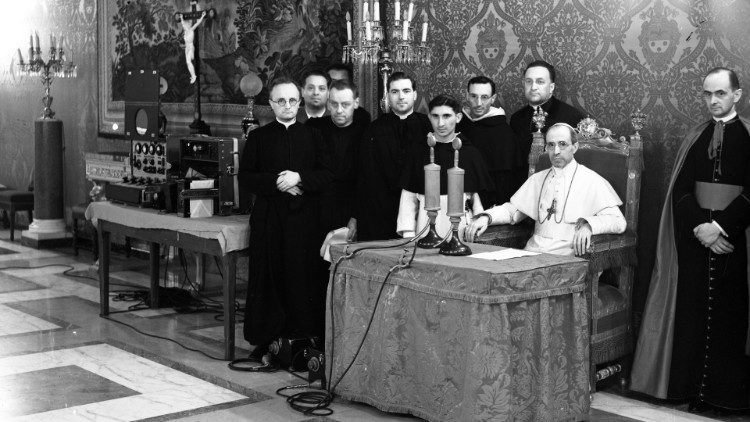
Pope Pius XII at the microphones of Vatican Radio
John XXIII and the sick children
Humanity is marked by war, but also by suffering and illness. On Christmas Day 1958, the Bambino Gesù Children’s Hospital welcomed Pope John XXIII. He was the first Pope to climb the Janiculum Hill to visit “his hospital”.
During that visit, the Holy Father greeted and blessed the young patients. In one of the last rooms, a child confided to the Pope that his name was Emanuele. “Here,” said John XXIII, “is a name that sums up today’s solemnity. It means: God with us.”


Pope John XXIII visits children at the Bambino Gesù Hospital, Christmas Day 1958
Paul VI and the struggles of workers
In Italy, 1968 was a year marked by strong social tensions in the world of labour. That year, Pope Paul VI celebrated Christmas Mass among the workers. The Holy Father went to the steelworks in the Italian city of Taranto to heal a seeming rift between the working class and the Church. The “nativity scene” backdrop for that Christmas was the steelworks, which the Holy See’s daily newspaper, L’Osservatore Romano, described as “the new stable of the technological age.”

Christmas 1968: Pope Paul VI visits the steelworks in Taranto
In his homily, Pope Paul addressed the workers, urging them to look to “the Christ of the Gospel”:
Workers, listen to us: Jesus, the Christ, is for you. We speak to you from the heart. We will tell you something very simple, but full of meaning. And it is this: We find it difficult to talk to you. We find it difficult to make ourselves understood by you. Or perhaps we do not understand you enough? The fact is that the discourse is quite difficult for us. It seems to us that there is no common language between you and us. You are immersed in a world that is foreign to the world in which we, men of the Church, live. You think and work in a way that is so different from the way the Church thinks and works! We spoke to you, we greeted you, who are our brothers and friends: but is this true in reality? Because we all feel this obvious fact: work and religion, in our modern world, are two separate, detached, and often even opposing things. It was not always like this.
John Paul II and humanity’s first steps into the third millennium
Humanity’s historic transition between two millennia is encapsulated in an image etched in the collective memory: the opening of the Holy Door on 24 December 1999. On that day, Pope John Paul II symbolically crossed the threshold into the third millennium. At that moment, time resonated with a unique tone: “It is not only the commemoration of the birth of the Redeemer; it is the solemn beginning of the Great Jubilee.”

Pope John Paul II at Midnight Mass, 24 December 1999
Humanity, marked by deep wounds such as wars and injustices, clings to hope, to a Person. No one, Pope John Paul said, should be excluded from the Father’s embrace:
You are the Christ, the Son of the living God! On the threshold of the third millennium, the Church greets you, the Son of God, who have come into the world to triumph over death. You have come to illuminate human life through the Gospel. The Church greets you and with you she wishes to enter the third millennium. You are our hope. You alone have words of eternal life… Be for us the Door which leads us into the mystery of the Father. Grant that no one may remain outside his embrace of mercy and peace!
Benedict XVI, migrants and making space for God
There is a humanity that seeks a better future, fleeing poverty and persecution. It is the people of migrants. After a long and arduous journey from Nazareth to Bethlehem, Joseph and Mary saw the Messiah born in a stable, because there was no room for them elsewhere. If Mary and Joseph knocked on our door, would there be room for them?

Pope Benedict XVI presides at Midnight Mass, 24 December 2012
This question, posed by Pope Benedict XVI during Holy Mass on 24 December 2012, becomes an exhortation to pray that a space may be created in our hearts for the Lord, and “that we may recognize Him also in those through whom He speaks to us: children, the suffering, the abandoned, those who are excluded and the poor of this world.”
The great moral question of our attitude towards the homeless, towards refugees and migrants, takes on a deeper dimension: do we really have room for God when He seeks to enter under our roof? Do we have time and space for Him? Do we not actually turn away God Himself? We begin to do so when we have no time for God. The faster we can move, the more efficient our time-saving appliances become, the less time we have. And God? The question of God never seems urgent. Our time is already completely full.
Francis and bringing hope where it has been lost
Jesus was born for us, for every man and woman. He was born, above all, among misery and in the existential peripheries.

Pope Francis celebrates Midnight Mass, 24 December 2024 (VATICAN MEDIA Divisione Foto)
Christmas 2024 was marked by the opening of the Holy Door and the beginning of the Holy Year of Hope. During Mass on the solemnity of the Nativity of the Lord, Pope Francis urged Christians to commit themselves to transforming the world:
All of us have received the gift and task of bringing hope wherever hope has been lost, lives broken, promises unkept, dreams shattered and hearts overwhelmed by adversity. We are called to bring hope to the weary who have no strength to carry on, the lonely oppressed by the bitterness of failure, and all those who are broken-hearted. To bring hope to the interminable, dreary days of prisoners, to the cold and dismal lodgings of the poor, and to all those places desecrated by war and violence. To bring hope there, to sow hope there.
Leo XIV and Christmas, a celebration of light
The time to celebrate the birth of Jesus is approaching. On 24 December, Pope Leo XIV will preside at Mass in St Peter’s Basilica. On the solemnity of the Nativity of the Lord, the wounds that afflict humanity are many and still painful. In 2020, in a period marked by the pandemic, Bishop Robert Prevost, at the time bishop of Chiclayo and apostolic administrator of the diocese of Callao in Peru, sent a message for Christmas. His greeting is published on the YouTube channel of the Diocese of Callao. When there is still no end in sight to this time marked by illness and so many deaths, the then-bishop of Chiclayo emphasised, the feast of hope arrives. Christmas is always “a feast of light on earth,” even in moments that seem dominated by darkness.
Source link
-

-

-
-
-


