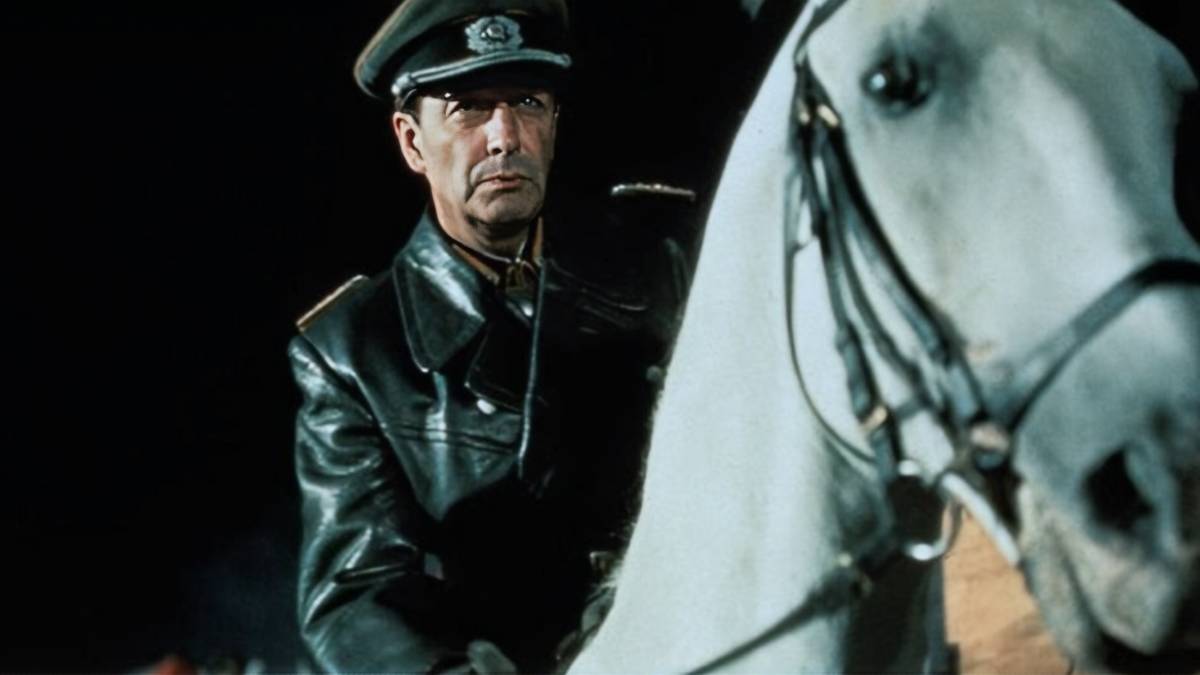
When you think of Disney’s 1960s output, technicolor fairy tales, cartoon animals, and whimsical coming-of-age stories likely come to mind. Meanwhile, bombed-out Europe probably doesn’t ring a bell as one of the studio’s specialties that decade. Yet Disney’s 1963 World War II film, Miracle of the White Stallions, makes for a surprising entry in the studio’s canon. Directed by Arthur Hiller, the film sidesteps gunfire and life-altering grand deeds of war in favor of a tale about defiance, tradition, and the preservation of culture. Miracle of the White Stallions is based on Alois Podhajsky’s memoir The Dancing White Horses of Vienna, and it tells the real story of how Austria’s treasured Lipizzaner horses were rescued with the help of American soldiers during World War II.
From its very first frame, you can tell Miracle of the White Stallions is a different kind of war movie. It opens in a remote village in Austria, where we are introduced to the beauty and cultural significance of the Lipizzaner horses juxtaposed with the prevailing war chaos threatening them. In place of bombers and tanks, Hiller paints a romanticized portrait of the horses. He shows us how graceful they are, whether in their dance performances or in their intimate relationships within their handlers and each other. Hiller truly makes the horses co-stars alongside his human leads.
‘Miracle of the White Stallions’ Breaks the War-Movie Mold
The film follows Colonel Podhajsky (Robert Taylor in a striking performance), head of the Spanish Riding School, who is keen on protecting the Lipizzaner stallions from destruction and, thus, preserving centuries-old symbols of Austrian culture. With war drawing closer to Vienna, Colonel Podhajsky’s first hurdle is convincing the Nazi army superiors to allow him to evacuate the horses. But even as he navigates one obstacle, several new ones spring up in its place. The film stands out for how it breaks the mold of war pictures in its era, stripping away combat spectacle that was a common element among movies in the genre, like The Longest Day and The Guns of Navarone. The film replaces spectacle with a narrative that builds tension from Colonel Podhajsky’s negotiation with the Nazis and the trust he commands from some soldiers within the ranks. His willingness to explore a collaboration with the supposed enemy — the American army led by Gen. George S. Patton (John Larch) — shows not only his determination, but also his unique courage.
‘Miracle of the White Stallions’ Showcases One of Robert Taylor’s Best Performances
An uncharacteristic part of Disney’s canon in the early 1960s, Miracle of the White Stallions was released at a time when the studio was turning out whimsical musicals and sunny adventures. So it was surprising when Arthur Hiller’s vision steered the war film into sterner waters. His direction is controlled, with pacing that is unhurried. He builds slowly from the historical context of the origin of the horses before delving into the grim state of current affairs and the danger it poses to that rich history. Hiller is less concerned with thrills than with tone and atmosphere. He shows us his characters — human and animal — in their natural habitat as the war looms. The animals are oblivious of the rising temperatures, while the human beings guarding them are worried that their conflict could destroy the stallions. Despite the film’s slow pace, Hiller’s choice to show these events taking place as if they are happening in real time makes you appreciate the film’s urgent call, particularly Colonel Podhajsky’s sense of responsibility to preserve history and tradition.
Taylor plays Podhajsky as if commanding a special operation. He is brisk, precise, and highly devoted. He desperately approaches any office that can accord him help, even when he knows it’s unlikely to bear fruit. Taylor is joined by an impressive cast, including Lilli Palmer as his wife Vedena, who brings tenderness to her role. She’s Podhajsky’s pillar in moments when everything seems to go awry, keeping him grounded and focused. Curd Jürgens (The Spy Who Loved Me) and Eddie Albert take their supporting roles with the seriousness they deserve.
In its look and feel, Miracle of the White Stallions is worlds away from the usual gloss of Disney escapism. But that is not to say that the film is lacking in mojo. Filmed partially in Vienna, including at the Spanish Riding School and the Hermesvilla estate where the real event happened, the movie’s authentic locations give it an emotional touch that leaves a lasting impression. The cinematography by Günther Anders and editing by Alfred Srp move with purpose, making use of long shots of horses in open courtyards juxtaposed with the shrinking spaces of wartime Vienna. The result is a film that lets you feel both grandeur and danger.


20 Years Later, This Remains the Most Perfect R-Rated Sci-Fi Movie of All Time
Dystopian fiction is getting a little too close to reality.
The score, too, underlines the stakes. Music by Paul J. Smith, with moments punctuated by Franz Schubert’s ingenuity of “Marche Militaire” and Felix Mendelssohn’s pieces, marries tradition with mounting tension. But Miracle of the White Stallions trusts silence as much as sound and horses as much as humans, giving the genre a refreshing look that asks questions about the culture of war and lost heritage as collateral damage.
While it isn’t difficult to identify the film as a ’60s release, the questions asked in its thought-provoking premise and central idea are as relevant in the conflicts of today as they were back then. Sixty-two years since its unique protagonists hoofed onto the screen, Miracle of the White Stallions deserves more light — not for what’s missing, but for what survives.


Miracle of the White Stallions
- Release Date
-
March 29, 1963
- Runtime
-
118 minutes
- Director
-
Arthur Hiller
- Writers
-
AJ Carothers
Cast
-

Lilli Palmer
Vedena Podhajsky
-
Robert Taylor
Col. Podhajsky

Source link
-

-

-

-

-