
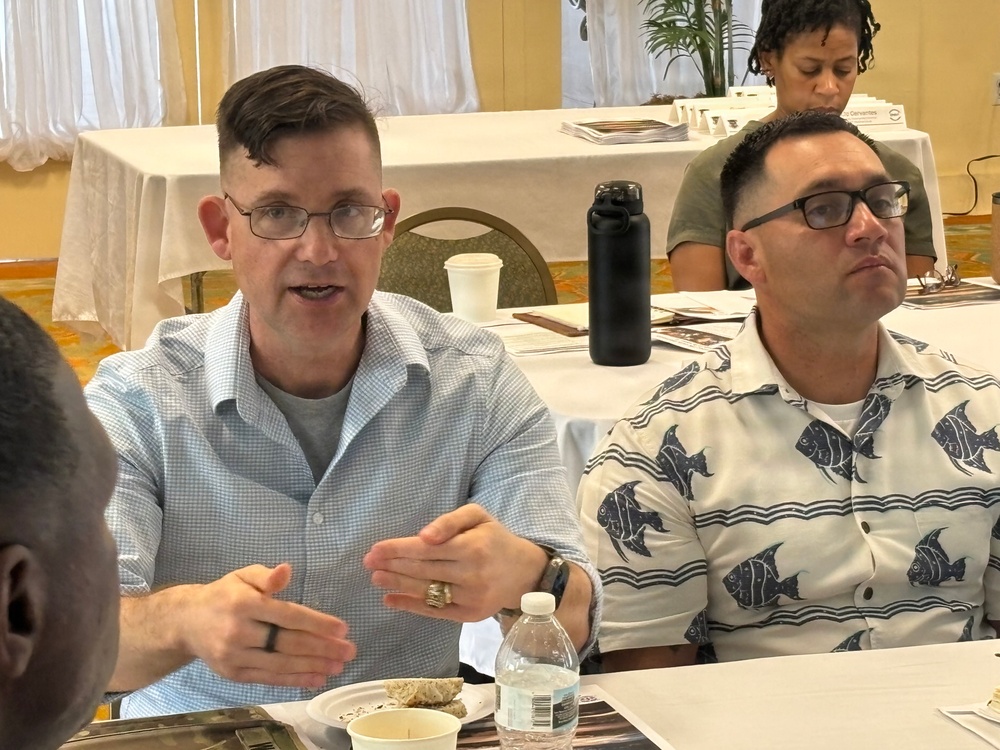
Senior U.S. military medical leaders from across the Indo-Pacific region gathered at historic Ford Island in Pearl Harbor, Hawaii, April 14 to 16 to discuss healthcare and medical readiness efforts and plan for the year ahead. The Spring 2026 Strategic Offsite meeting included more than 100 key staff members from the Defense Health Agency’s Defense Health Network Indo-Pacific, the U.S. Army’s Medical Readiness Command, Pacific, and their subordinate organizations spread from Washington, California and Alaska to Hawaii, Guam, Japan and the Republic of Korea.
“This offsite is about writing the next chapter for this organization over the next 12 months,” said U.S. Army Brig. Gen. Deydre Teyhen, director of DHN-IP and commanding general of MRC, P.
With two major roles, Teyhen directs a medical network of Army, Navy and Air Force Military Treatment Facilities (MTFs) under the Defense Health Agency with 15,000 employees in seven major MTFs and more than 40 supporting medical and dental clinics, which provide medical care for approximately 223,000 TRICARE beneficiaries. In her Army role, she commands more than 4,000 Soldiers and civilians and provides regionally ready, globally responsive medical forces, health service support, and force health protection across the region.
Teyhen’s two responsibilities focus on health care delivery to military TRICARE beneficiaries and medical readiness for the joint force. She assumed her responsibilities in April 2025, and to integrate her two organizations and optimize their effectiveness, she developed a combined mission statement, vision, and values in August 2025, a first for a DHA network and military medical readiness unit. Next, she led her two staffs through development of a combined governance structure during a September 2025 Strategic Offsite in order to create a system of committees, councils and working groups that enable the network and readiness command to identify and solve common issues.
This week’s Strategic Offsite focused in large part on how the governance structure has been implemented since September, while setting priorities for the next year.
“First, we need to revisit our vision: integrated health and force readiness,” Teyhen told the assembled leaders in the opening session.
According to Teyhen, policy decisions led to a separation of medical care and medical readiness. “We are the group of leaders that puts health and readiness back together to reduce the friction for those we lead on the front line of medicine,” said Teyhen.
In order to do so, Teyhen told the group to review their efforts, identify priorities, and decide what to start, what to stop, and what to sustain.
“First, we need to reflect,” said Teyhen. We need to give ourselves a hard look. This is not the time to talk about just about what is going well. We need to talk about challenges so we can solve problems.”
As a motivational leader focused on people, Teyhen seeks to “bring the joy and soul back to medicine,” and she views trust as fundamental for effective units and patient safety. Prior to the Strategic Offsite, Teyhen had participants take a trust survey developed by Stephen M.R. Covey, and on the first morning the results were presented by Michael Sean Covey. According to Covey, the DHN-IP and MRC, P scored 83.57% on the Organization Trust Index, placing them among the top organizations in the world. The top 10% of organizations average 78%, said Covey.
The survey showed that staff members have significant trust in each other and their leaders, and they gave high ratings to each other for competence. Covey said the results also showed humility, as members gave higher competence ratings to others than they gave themselves. Respondents acknowledged Teyhen’s leadership as influencing their high scores. One respondent said, “The recent governance structure has built more trust and transparency,” and other comments provided similar feedback. The survey also showed areas for improvement, although some concerns were due to differences between the military Services and the Defense Health Agency. Those institutional differences are the types of issues the governance structure seeks to address.
Following Covey’s presentation, participants launched into the heart of the Strategic Offsite. Day 1 focused on implementation of the governance structure that was created in September, and each committee had an opportunity to brief the group on accomplishments and ongoing projects, while asking the Board of Directors (BOD) to approve future actions.
The Network Regional Operations Committee (NROC) reported that it created a sprint team to help implement the Army’s overhaul of the Soldier Recovery Unit program in the region and another sprint team to address psychiatry needs in Japan. Ongoing efforts include medical device integration modernization.
“Responsible for addressing multi-factorial, multi-stakeholder, healthcare operation challenges facing our military treatment facilities, the NROC works toward making the health system better for our patients and staff,” said Devin Morrison, NROC chairman and DHN-IP chief of staff.
The Medical Affairs Committee (MAC) established five specialized subcommittees to address critical readiness and healthcare gaps with a focus on quality, safety, and patient-centered care. These governance bodies are currently tackling complex issues such as policy gaps for anti-obesity medications among active-duty Soldiers, improving cancer screening performance, and expanding telehealth capabilities throughout the Indo-Pacific—including the integration of ambient listening technology. During the offsite, the Board of Directors further expanded this framework by approving two additional MAC councils: Dental and Mental Health.
“Through governance, we’ve gained the authority and freedom of maneuver necessary to drive our overarching priority lines of effort,” said Dr. Kevin Nakamura, chief medical officer for DHN-IP and MAC chairman. “The MAC combines the strengths of DHN-IP Medical Affairs and the MRC,P Medical Support Operations to deliver the platform and resources our MTFs and Direct Reporting Units need to overcome their most wicked healthcare delivery challenges.”
The Resource Management Committee (RMC) briefed the expansion of coding efforts to enhance business procedures as well as significant efforts by the Expedited Hiring Working Group to shorten the time needed to hire and onboard civilian employees. Upcoming priorities include examining opportunities for consolidating contracts and services across the Hawaii medical facilities in order to increase efficiency, reduce cost, and lower the administrative demand on medical leaders.
“The RMC has allowed the coordination and collaboration across the services to address resourcing requirements, and we look forward to addressing identified logistics challenges that will increase the readiness of the network to support the joint warfighters,” said U.S. Army Col. Jason Mathre, RMC chairman and resource manager for MRC, P.
The Senior Enlisted Leader Committee (SELC) highlighted progress in helping enlisted service members to operate at the top of their medical credentials while instilling a culture of pride and ownership among enlisted members. This ongoing effort recognizes the incredible skill and professionalism of enlisted Soldiers, Sailors and Airmen and seeks to utilize their full potential. One big win reported by the committee involved working with the Non-Commissioned Officer Academy at Schofield Barracks to enable Soldiers across Oahu, Hawaii, to conduct virtual sick calls, eliminating the need for Soldiers to travel and reducing time away from their units and training.
“That was a positive win for Army brigades across the island,” said Command Sgt. Maj. Mike Contreras from MRC, P.”
The Hawaii Joint Executive Committee (JEC) is the principal advisory body to the DHN-IP director and the Indo-Pacific Board of Directors for healthcare delivery on Oahu. The JEC reported Tri-Service improvements in active-duty access to care in physical therapy, after-hours emergency dental care processes, restructuring of laboratory services, and consolidation of civilian human resources functions, among other achievements. Future efforts include reducing low acuity visits to emergency rooms in order to free up ER staff for those with true health emergencies and centralizing certain duplicative administrative services.
“The cross-service relationships built in and through the JEC between MTF directors and their staff pay huge dividends in healthcare delivery to Hawaii-based Army, Air Force, Navy and Marine beneficiaries,” said Ilona Horton, JEC facilitator and DHN-IP assistant director for alignment and coordination in Hawaii.
Day 1 wrapped up with a Board of Directors meeting–which is composed by senior leaders from DHN-IP and MRC, P– as well as leaders from their subordinate medical facilities and units, each of whom has an equal vote on issues. The BOD voted to approve several initiatives, such as creating a technology advancement/modernization project team, establishing a council to improve access to care, conducting a public health landscape analysis, and creating a centralized budget and consolidating efforts in Hawaii.
“Setting our course for the remainder of fiscal year 26 and beyond, the BOD approved multiple new lines of effort for the committees. Each decision focused on enhancing the healthcare and readiness missions of MRC, P and DHN-IP,” said Morrison.
Day 2 of the Strategic Offsite focused on round-table discussion about multiple topics focused on military medical readiness.
“Today is about solving problems,” said Teyhen.
Discussions included mobilization of the joint force in an emergency or conflict and medical skills sustainment. Another panel addressed differences between the military Services’ policies for medical profiles that affect service members’ duty status and readiness to deploy, and there were panel discussions for installation health services support and medical lessons from the recent Exercise Vital Knight.
“I hope today we learned to understand each other’s languages, Service culture and policies,” said Teyhen at the Day 2 conclusion. “It’s all about culture. As we try to get after the readiness issues, we have to get at the cultural mindset. We are leading cultural change and sharing vision to build medical readiness across the force.”
Day 3 was devoted to each Military Treatment Facility and each Medical and Dental Activity, which provided briefings to the group and shared best practices. U.S. Air Force Col. Jason Telfer, commander of the 15th Medical Group and director of Hickam Clinic at Joint Base Pearl Harbor-Hickam in Hawaii, shared his clinic’s innovation to address a 30% reduction in pharmacy personnel that had increased wait times from 21 to 114 minutes.
According to Telfer, the clinic implemented “a multi-faceted innovation to streamline the prescriptionlifecycle, including elimination of physical drop-off lines through remote activation (Q-Anywhere), automating inventory management, and leveraging Robotic ProcessAutomation (RPA).” This innovation reduced wait times to 20 minutes, increased patient satisfaction to 99%, and it is projected to save $14 million after investing only $200,000.
The innovation also contributed to increased readiness. “Automation allows pharmacy personnel to focus on career field readiness training and complex patient care needs,” said Telfer.
MRC, P’s Dental Health Activity told the group how their dentists not only contributed to dental readiness but also to international partnerships through participation in Pacific Partnership 2025 in Vietnam. According to U.S. Army Col. Charles Lambert, DENTAC sent four dentists and five enlisted dental technicians to Vietnam, where they provided oral screenings, prevention education, and disease control via dental extractions or fluoride varnish on 850 students attending Gio Linh Elementary School; provided more than 800 toothbrushes, toothpaste tubes, and floss along with patient education materials in Vietnamese; and set up four portable dental chairs, one portable dental X-ray unit, and field dental kits.
Lambert said his main takeaway from the exercise was “awareness of the importance of maintaining a ‘ready dental force’ that can work in austere environments with a partner nation.”
At the conclusion of the third day, Command Sgt. Major Contreras judged the offsite a success. “You nailed it,” said Contreras. He also acknowledged how hard the assembled leaders work and encouraged them to take time for their own needs.
“Thank you so much for what you do on a continuous basis. It’s such a difficult job, and you do it in such a professional manner. You’re continuously knocking down problem sets and leveraging the right people to get things done. You’re doing it day in and day out. Please find time to take the opportunity to take care of yourself so when people need you, you are able to be there for them. We’re always making other people the priority, but we have to find time to make ourselves a priority.”
Teyhen reminded the leaders to stay focused on the basics: ready medics, ready forces, healthcare delivery. And she encouraged participants to help our teams enjoy their work while taking care of others.
“What we do is hard work,” said Teyhen. “It takes communication, it takes teamwork, it takes trust, but if we all row together and do it right we can have fun along the way. If we keep pushing happiness over the cognitive horizon it will never happen. Happiness is in the present. Work can be fun. I hope we figure out how to do that.”
news/563153/integrating-healthcare-and-readiness-indo-pacific-military-medical-leaders-convene-hawaii”>Source link
-

-

-

-
-


