A newly derived “q-desic” equation suggests that quantum effects may subtly alter particle trajectories across the universe.
Bringing together quantum physics and gravity is often described as the “Holy Grail” of modern science. Quantum theory explains the behavior of the smallest particles with remarkable precision, while Einstein’s general theory of relativity describes gravity and the large-scale structure of the universe. Yet despite decades of effort, these two foundational frameworks still cannot be fully reconciled.
A variety of proposals attempt to bridge this divide, including string theory, loop quantum gravity, canonical quantum gravity, and asymptotically safe gravity. Each approach offers promising ideas but also faces unresolved problems.
One major obstacle has been the lack of clear experimental predictions. Without measurable quantities to compare against observations, it remains impossible to determine which theory, if any, correctly describes nature. Researchers at TU Wien now report progress that could help move the field closer to that goal.
Cinderella and quantum gravity
“It’s a bit like the Cinderella fairy tale,” says Benjamin Koch from the Institute for Theoretical Physics at TU Wien. “There are several candidates, but only one of them can be the princess we are looking for. Only when the prince finds the slipper can he identify the real Cinderella. In quantum gravity, we have unfortunately not yet found such a slipper – an observable that clearly tells us which theory is the right one.”
To identify this missing “slipper,” meaning a measurable test that could distinguish between competing theories, the team focused on a central concept in relativity known as a geodesic. “Practically everything we know about general relativity relies on the interpretation of geodesics,” explains Benjamin Koch.

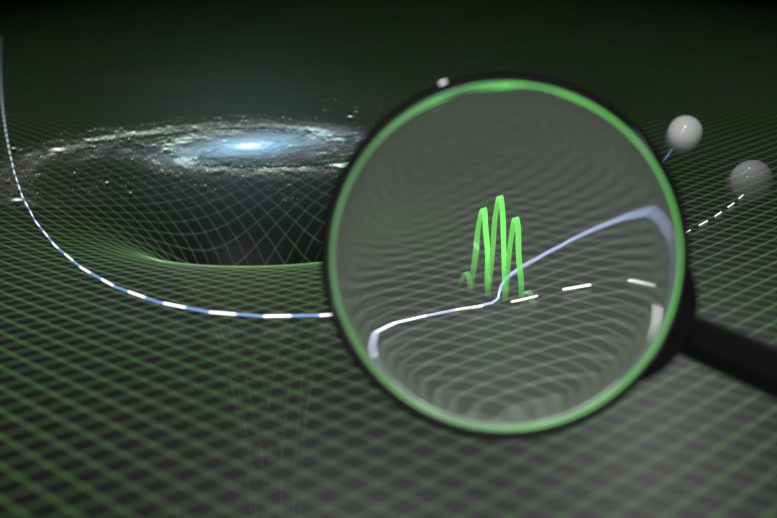
“A geodesic is the shortest connection between two points – on a flat plane, that’s simply a straight line, whereas on curved surfaces things become more complicated.” For example, if you want to move from the North Pole to the South Pole on the surface of a sphere, the shortest path is a semicircle.
In Einstein’s theory, space and time form a unified four-dimensional structure called spacetime. Massive objects such as stars and planets bend this spacetime. According to general relativity, Earth revolves around the Sun because the Sun’s mass curves spacetime, shaping the path Earth follows into an almost circular orbit.
The quantum version of geodesics
The shape of these paths depends on what physicists call the metric, which describes how strongly spacetime is curved. “We can now try to apply the rules of quantum physics to this metric,” says Benjamin Koch. “In quantum physics, particles have neither a precisely defined position nor a precisely defined momentum. Instead, both are described by probability distributions. The more precisely you know one of them, the more fuzzy and uncertain the other becomes.”
In quantum mechanics, quantities such as position and momentum are represented by wave functions rather than exact values. Using a similar strategy, researchers can attempt to treat the spacetime metric itself as a quantum object. In that case, curvature would no longer have a single well-defined value at each point. Instead, it would fluctuate according to quantum rules.
This approach leads to major mathematical challenges.
Working with his PhD student Ali Riahinia and Angel Rincón (Czech Republic), Koch developed a new method for quantizing the metric in a specific but important situation: a spherically symmetric gravitational field that remains constant over time.
This type of gravitational field can describe the Sun’s gravity. “Next, we wanted to calculate how a small object behaves in this gravitational field – but using the quantum version of this metric,” says Koch. “In doing so, we realized that one has to be very careful – for instance, whether one is allowed to replace the metric operator by its expectation value, a kind of quantum average of the spacetime curvature. We were able to answer this question mathematically.”
Their work led to a new equation, which the researchers call the q-desic equation, referring to the classical idea of geodesics. “This equation shows that in a quantum spacetime, particles do not always move exactly along the shortest path between two points, as the classical geodesic equation would predict.” In principle, precise observations of freely moving objects in spacetime, such as an apple falling toward Earth in outer space, could reveal information about the quantum nature of spacetime itself.
Shoe size 10-35 or rather 10+21?
How different is a q-desic from an ordinary geodesic? When considering gravity alone, which is the weakest of the known fundamental forces, the difference is extraordinarily small. “In this case, we end up with deviations of only about 10-35 meters (about 1 × 10-33 inches) – far too small to ever be observed in any experiment,” says Benjamin Koch.
However, general relativity also includes the cosmological constant, often associated with “dark energy.” This quantity drives the accelerating expansion of the universe on the largest scales. When the team incorporated the cosmological constant into the q-desic equation, the outcome changed dramatically.
“And when we did that, we were in for a surprise,” reports Benjamin Koch. “The q-desics now differ significantly from the geodesics one would obtain in the usual way without quantum physics.”
The deviations appear at both extremely small and extremely large distances. Although the tiny-scale differences are unlikely to be measurable, the situation is different at vast cosmic scales. At distances of around 1021 meters (about 6.2 × 10²⁰ miles), the predicted paths can diverge substantially. “In between, for example when it comes to the Earth’s orbit around the Sun, there is practically no difference. But on very large cosmological scales – precisely where major puzzles of general relativity remain unsolved – there is a clear difference between the particle trajectories predicted by the q-desic equation and those obtained from unquantized general relativity,” says Benjamin Koch.
A new perspective on observational data
The findings, published in the journal Physical Review D, introduce more than a new mathematical framework for connecting quantum theory and gravity. They also suggest a possible path toward testing quantum gravity using astronomical observations.
“At first, I would not have expected quantum corrections on large scales to produce such dramatic changes,” says Benjamin Koch. “We now need to analyze this in more detail, of course, but it gives us hope that by further developing this approach we can gain a new, and observationally well testable, insight into important cosmic phenomena – such as the still unsolved puzzle of the rotation speeds of spiral galaxies.”
Returning to the Cinderella analogy, researchers may finally have identified a potential observable that can separate promising quantum gravity theories from those that fall short. A slipper has been found – now we have to find out which theory it truly fits.
Reference: “Geodesics in quantum gravity” by Benjamin Koch, Ali Riahinia and Angel Rincon, 22 October 2025, Physical Review D.
DOI: 10.1103/w1sd-v69d
Never miss a breakthrough: Join the SciTechDaily newsletter.
Follow us on Google and Google News.
Source link