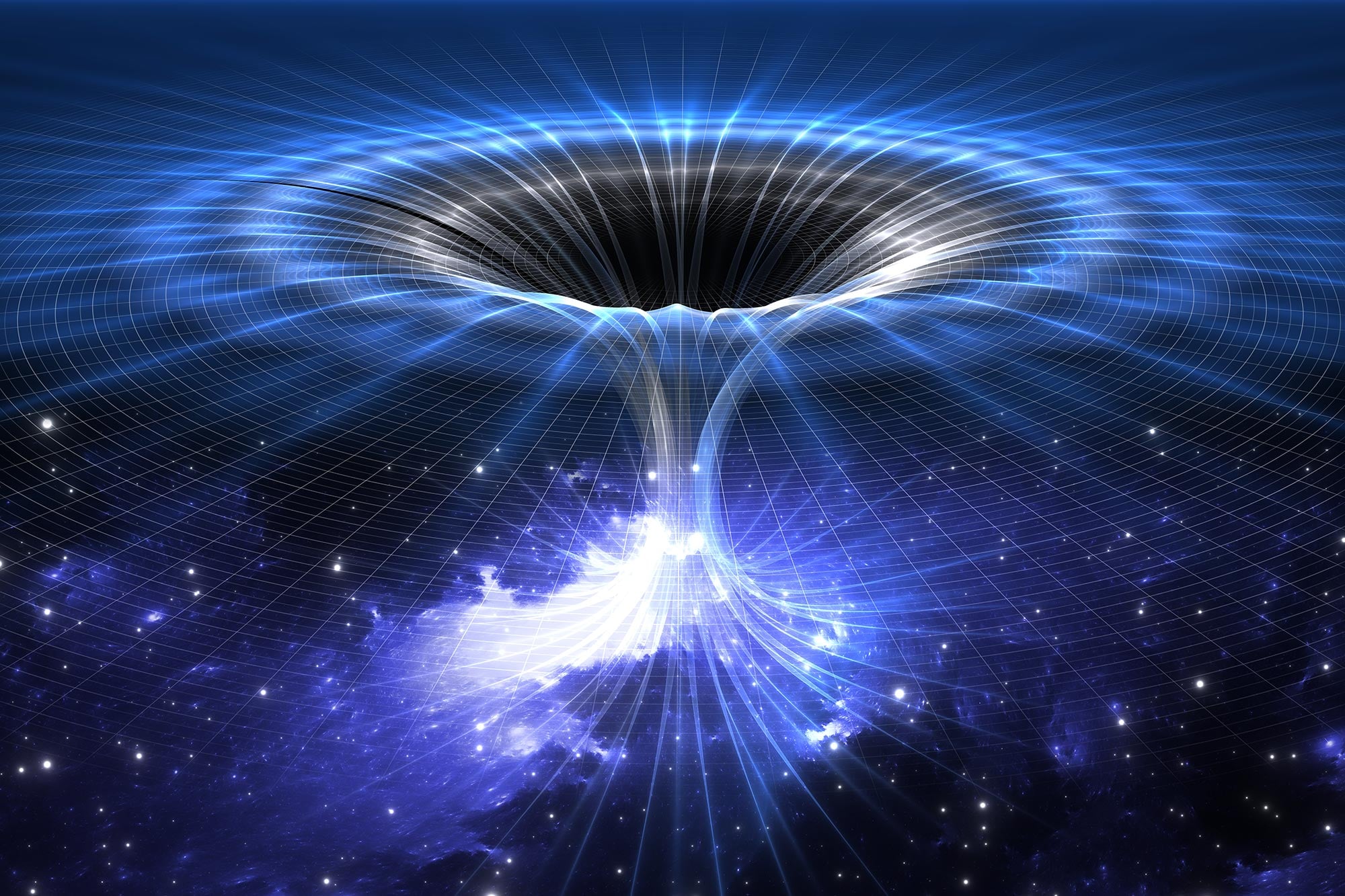
Einstein–Rosen bridges may reflect a two-directional structure of time that preserves information and hints at a pre–Big Bang universe.
Wormholes are commonly portrayed as cosmic passageways that connect distant parts of space or even different moments in time. However, that popular image stems from a misunderstanding of earlier work by physicists Albert Einstein and Nathan Rosen.
In 1935, Einstein and Rosen were not trying to describe interstellar shortcuts. They were examining how particles behave under extreme gravitational conditions when they proposed what they called a “bridge.” This concept describes a mathematical connection between two identical, mirrorlike versions of spacetime.
Its purpose was to preserve consistency between general relativity and emerging ideas in quantum physics, not to create a route for travel. The association between Einstein–Rosen bridges and wormholes developed later, even though it diverged from the original intent.
In our recent research, my colleagues and I revisit this idea and argue that the Einstein–Rosen bridge suggests something much more fundamental than a hypothetical tunnel through space.
The puzzle Einstein and Rosen were addressing was never about space travel, but about how quantum fields behave in curved spacetime. Interpreted this way, the Einstein–Rosen bridge acts as a mirror in spacetime: a connection between two microscopic arrows of time.
Quantum mechanics governs nature at the smallest scales such as particles, while Einstein’s theory of general relativity applies to gravity and spacetime. Reconciling the two remains one of physics’ deepest challenges. And excitingly, our reinterpretation may offer a path to doing this.
A misunderstood legacy
The “wormhole” interpretation emerged decades after Einstein and Rosen’s work, when physicists speculated about crossing from one side of spacetime to the other, most notably in the late-1980s research.
But those same analyses also made clear how speculative the idea was: within general relativity, such a journey is forbidden. The bridge pinches off faster than light could traverse it, rendering it non-traversable. Einstein–Rosen bridges are therefore unstable and unobservable — mathematical structures, not portals.
Nevertheless, the wormhole metaphor flourished in popular culture and speculative theoretical physics. The idea that black holes might connect distant regions of the cosmos — or even act as time machines — inspired countless papers, books, and films.
Yet there is no observational evidence for macroscopic wormholes, nor any compelling theoretical reason to expect them within Einstein’s theory. While speculative extensions of physics — such as exotic forms of matter or modifications of general relativity — have been proposed to support such structures, they remain untested and highly conjectural.
Two arrows of time
Our recent work revisits the Einstein–Rosen bridge puzzle using a modern quantum interpretation of time, building on ideas developed by Sravan Kumar and João Marto.
Most fundamental laws of physics do not distinguish between past and future, or between left and right. If time or space is reversed in their equations, the laws remain valid. Taking these symmetries seriously leads to a different interpretation of the Einstein–Rosen bridge.
Rather than a tunnel through space, it can be understood as two complementary components of a quantum state. In one, time flows forward; in the other, it flows backward from its mirror-reflected position.
This symmetry is not a philosophical preference. Once infinities are excluded, quantum evolution must remain complete and reversible at the microscopic level — even in the presence of gravity.
The “bridge” expresses the fact that both time components are needed to describe a complete physical system. In ordinary situations, physicists ignore the time-reversed component by choosing a single arrow of time.
But near black holes, or in expanding and collapsing universes, both directions must be included for a consistent quantum description. It is here that Einstein–Rosen bridges naturally arise.
Solving the information paradox
At the microscopic level, the bridge allows information to pass across what appears to us as an event horizon – a point of no return. Information does not vanish; it continues evolving, but along the opposite, mirror temporal direction.
This framework offers a natural resolution to the famous black hole information paradox. In 1974, Stephen Hawking showed that black holes radiate heat and can eventually evaporate, apparently erasing all information about what fell into them — contradicting the quantum principle that evolution must preserve information.
The paradox arises only if we insist on describing horizons using a single, one-sided arrow of time extrapolated to infinity — an assumption quantum mechanics itself does not require.
If the full quantum description includes both time directions, nothing is truly lost. Information leaves our time direction and re-emerges along the reversed one. Completeness and causality are preserved, without invoking exotic new physics.
These ideas are difficult to grasp because we are macroscopic beings who experience only one direction of time. On everyday scales, disorder — or entropy — tends to increase. A highly ordered state naturally evolves into a disordered one, never the reverse. This gives us an arrow of time.
But quantum mechanics allows more subtle behaviour. Intriguingly, evidence for this hidden structure may already exist. The cosmic microwave background — the afterglow of the Big Bang — shows a small but persistent asymmetry: a preference for one spatial orientation over its mirror image.
This anomaly has puzzled cosmologists for two decades. Standard models assign it an extremely low probability — unless mirror quantum components are included.
Echoes of a prior universe?
This picture connects naturally to a deeper possibility. What we call the “Big Bang” may not have been the absolute beginning, but a bounce — a quantum transition between two time-reversed phases of cosmic evolution.
In such a scenario, black holes could act as bridges not just between time directions, but between different cosmological epochs. Our universe might be the interior of a black hole formed in another, parent cosmos. This could have formed as a closed region of spacetime collapsed, bounced back and began expanding as the universe we observe today.
If this picture is correct, it also offers a way for observations to decide. Relics from the pre-bounce phase — such as smaller black holes — could survive the transition and reappear in our expanding universe. Some of the unseen matter we attribute to dark matter could, in fact, be made of such relics.
In this view, the Big Bang evolved from conditions in a preceding contraction. Wormholes aren’t necessary: the bridge is temporal, not spatial — and the Big Bang becomes a gateway, not a beginning.
This reinterpretation of Einstein–Rosen bridges offers no shortcuts across galaxies, no time travel and no science-fiction wormholes or hyperspace. What it offers is far deeper. It offers a consistent quantum picture of gravity in which spacetime embodies a balance between opposite directions of time — and where our universe may have had a history before the Big Bang.
It does not overthrow Einstein’s relativity or quantum physics — it completes them. The next revolution in physics may not take us faster than light — but it could reveal that time, deep down in the microscopic world and in a bouncing universe, flows both ways.
Reference: “A new understanding of Einstein–Rosen bridges” by Enrique Gaztañaga, K Sravan Kumar and João Marto, 8 January 2026, Classical and Quantum Gravity.
DOI: 10.1088/1361-6382/ae3044
EG acknowledges grants from Spain Plan Nacional (PGC2018-102021-B-100) and Maria de Maeztu (CEX2020-001058-M). This research was funded by Fundação para a Cienciaê a Tecnologia grant number UIDB/MAT/00212/2020 and COST action 23130.
Adapted from an article originally published in The Conversation.

Never miss a breakthrough: Join the SciTechDaily newsletter.
Follow us on Google and Google News.
Source link
-

-

-

-

-