
When world leaders meet at the 2026 Munich Security Conference starting Friday, interconnected topics of trans-Atlantic security policy and EU defense will be high on the agenda.
Over the past year, the European Union has pushed toward its goal of establishing a more self-reliant defense strategy and creating a stronger, more independent EU defense industry. The conduct of the Trump administration in geopolitical affairs ranging from ceasefire negotiations between Russia and Ukraine to tensions over Greenland has repeatedly reinforced the urgency of that goal.
European leaders have not said as much officially, but a more independent EU implies one that is less dependent on the United States.
DW analyzed arms trade data collected by the Stockholm International Peace Research Institute. Since 1950, SIPRI has tracked military expenditures and the trade of what it calls “major conventional arms” such as aircraft, air-defense systems, armored vehicles, artillery, ships, satellites and sensors.
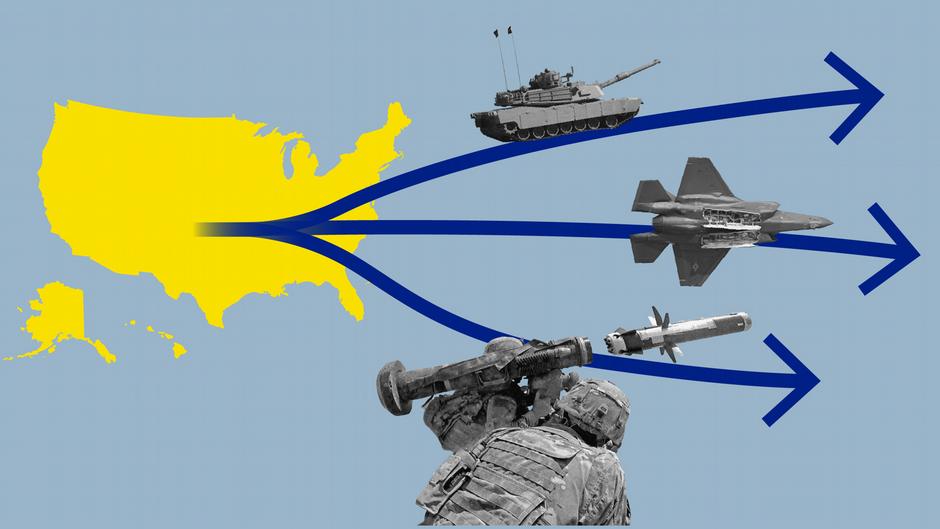
DW’s analysis demonstrates the extent to which the United States dominates the defense market — within Europe and around the world.
Five countries account for majority of global weapons exports
The United States has been the biggest weapons exporter in the world for over two decades, accounting for 35% of global arms sales. The US is followed by Russia (21%), France (8%), Germany (7%) and China (5%). Combined, these five countries supplied 74% of all weapons traded from 2000 through 2024.
Switching focus onto weapons importers reveals the dominance of the five biggest suppliers in each region — although import data only captures a portion of a country’s reliance on suppliers for defense.
For example, the import data does not shed light on how much a country spends on defense systems overall, and how much of that goes into weapons imports from abroad. This would allow for insight into how much a country is actually dependent on foreign weapons supply. Data to do that reliably and flawlessly does currently not exist at an international level.
Analysts at the Bruegel think tank and the Center for Strategic and International Studies (CSIS) also point out that defense products made within Europe through joint ventures with US manufacturers would not be represented in export-import data. The defense industry covers more than physical goods such as weapons and also includes shared intelligence, surveillance and staffing of control-and-command structures in multilateral organizations. In addition to hardware, defense products include software and upgrades that make governments reliant on manufacturers for years after the initial purchase.
If anything, the arms trade data likely underestimates how deeply interdependent the defense sectors of different nations are. Still, data on the weapons trade does offer insight into the relationship between importers and exporters.
Beyond Europe: Which regions import most weapons from the United States?
Though countries in Oceania import the highest share of weapons from the United States, their overall import volume is comparatively low. European and Asian countries, on the other hand, have quite high import volumes and source high shares of their arms imports from the United States. From 2000 through 2024, 46% of weapons imported into Europe came from the US. In the same time frame, Asian countries sourced 35% of their imported weapons from the United States. From 2020 through 2024, these shares were even higher, demonstrating how the United States has become an even more important weapons trade partner for these countries.
“There is no way to change the dependence on the US in the short term,” said Aylin Matle, a political scientist and senior research fellow with the Center for Security and Defense at the German Council on Foreign Relations. “One example is the decision by many European countries to purchase F35 fighter jets from the US: This means that they are tied to the system for at least a decade and are dependent on spare parts deliveries from the manufacturer’s country.”
Within each region, trade patterns vary widely. Import shares from the United States range from as high as 96% (Netherlands) to as low as 17% (Hungary) among European countries.
Nineteen of the 50 countries responsible for the most weapons imports from 2020 to 2024 sourced more than half of their weapons imports from the United States. These trade relations run deep: For almost all of them, this is either a continuation of a strong weapons-import relationship with the US, or even an increase in 2020-24 compared with other five-year-periods since 2000.
Matle pointed to Japan, South Korea and the Philippines as Asian countries with an especially high dependence on the United States. “These countries are paying close attention to the current American stance toward Europe, with its demand for greater burden sharing,” Matle said. “The first Trump administration as well as the Biden administration have also called on countries in the Indo-Pacific to spend more on defense — but not as drastically as in Europe.”
Decrease dependence on US — by forging new alliances
Matle said these governments grew increasingly nervous with Trump’s return to office — “not only because of dependence on the defense industry, but also because of the promise of protection should a confrontation with China arise.”
Her research focuses on how selected European and Indo-Pacific countries view their respective threat situations, what connections and similarities exist, and whether this leads to cooperation. She found that, since the return of Trump, governments have forged new alliances, including recently setting up more cooperation agreements with European countries. “I strongly suspect that this will continue to increase against the backdrop of current security policy developments,” Matle said, “even if in the future there would be an American administration that is more sympathetic to the Europeans.”
Time to diversify trade partners?
There are also countries that show a contrary pattern to being heavily dependent on a single supplier, such as the United States, diversifying imports from several countries. Greece, Qatar and India buy the same systems from multiple suppliers, which results in what Pieter Wezeman, a senior researcher with SIPRI’s Arms Transfers Programme called “nightmare” logistics on the ground when running the systems together.
“Those are classic examples where there are political reasons to diversify, but where it’s also very clear that major questions can be asked about the logistical efficiency,” Wezeman said.
Brazil, on the other hand, may import from different countries, but then purchases different weapon types from each. “They will buy French submarines and that’s it,” Wezeman said. “They don’t buy some German ones on top of that.”
What does a resilient defense strategy look like?
Matle, Wezeman and other analysts say self-reliance is key to resilience. “In a scenario involving a conflict in the Indo-Pacific, it is only logical that the US defense industry would supply its military first, rather than fulfilling contracts with the Europeans. If in that scenario at the same time there is a confrontation with Russia on NATO’s eastern flank, then European industry should also be in a position to supply its military,” Matle said.
The European Union appears to have embraced this strategy with its Readiness 2030 plan, which would strengthen the EU’s industrial base by offering funding plans to incentivize member states to invest in defense products made within the bloc.
Wezeman said the EU defense industry would already be in a position to quickly arm European militaries: It would only be a matter of priorities. On the one hand, “there is a significant capacity in Europe, which is not necessarily used for Europe itself,” Wezeman said. “There’s very significant export from Europe to other parts in the world.” However, Wezeman added, “within Europe there has been a strong push to sustain significant arms exports, and I think that we could also expect that from a future arms industry in Europe.”
If the EU defense industry wants to scale up to supply European militaries and, at the same time, keep maintaining or even expanding its export relations, it will inevitably have to face another challenge. Rare earth minerals are crucial to building defense products, and there is currently only one main supplier: China. “In the short term, there are no real alternatives,” Matle said. “There are no other countries where rare earths can be produced this quickly and at this scale.”
So, in becoming more independent from the US defense industry, the EU defense industry might become more dependent on another big player — one that has also shown it does not shy away from using its power as leverage.
Rosie Birchard contributed to this report.
Edited by: Milan Gagnon
Data, code and methodological choices behind this story can be found in this github repository. More data-driven stories by DW can be found here.
Source link
-

-

-

-

-


