
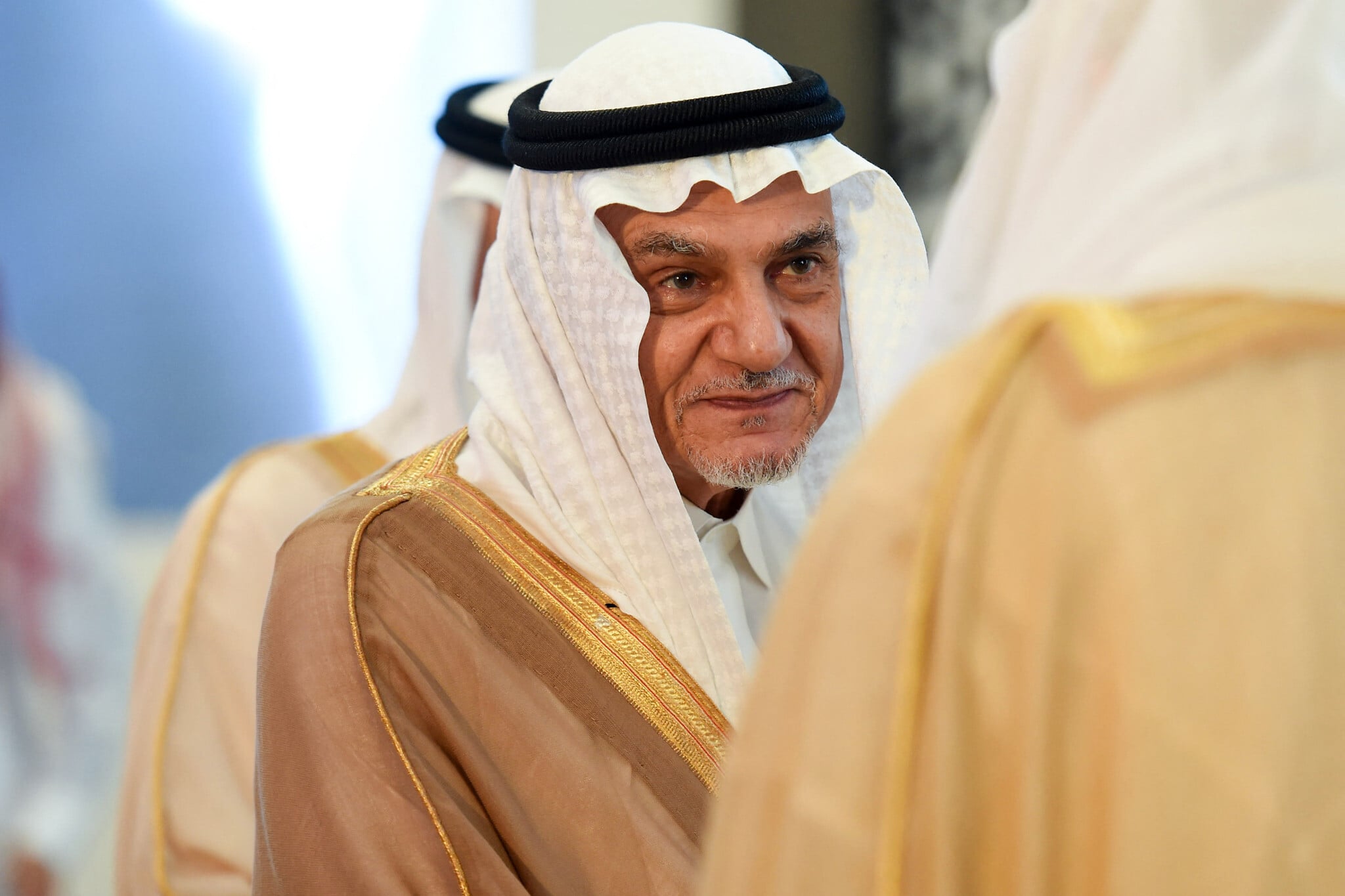
Saudi Arabia’s former intelligence chief, Prince Turki al-Faisal, told The Times of Israel on Sunday that Riyadh is currently not even entertaining the idea of normalizing relations with Israel and will only do so if Jerusalem begins acting like a “normal country.”
“Saudi Arabia is not considering a normalization deal with Israel. Should Israel become a normal country with normal acceptance of international law, then Saudi Arabia will consider normalization,” he said in an interview.
While Prince Turki made the comments in a highly rare engagement with Israeli media, the content of his remarks was another demonstration of just how far the world’s leading Arab and Muslim nation appears to be from forging ties with Israel, despite Washington’s strong desire to see it happen.
Prince Turki is known for adopting a harsher tone against Israel than that of his government in recent years, but his positions have been reflective of Riyadh’s official stance on potential ties with the Jewish state.
He served as director general of Saudi Arabia’s General Intelligence Directorate from 1979 to 2001 before shorter stints as the Gulf kingdom’s ambassador to the UK and the US. He has continued weighing in on international affairs since his retirement from public life, and he currently serves as the chairman of the King Faisal Foundation’s Center for Research and Islamic Studies.
Although Saudi officials generally hold a no-contact policy with Israeli media, Prince Turki agreed to answer a series of questions regarding the prospects of a potential normalization agreement between Riyadh and Jerusalem.
Defining a ‘pathway’ to statehood
Asked to clarify Riyadh’s specific conditions for establishing ties with Israel, given that some Saudi officials have spoken of the need for a Palestinian state to be established while others have insisted upon only a “pathway” to a two-state solution, Prince Turki said there’s “no discrepancy.”
“Realizing the two-state solution requires a serious and trusted pathway that leads to the end goal, which is a viable Palestinian state as envisioned by the Arab Peace Initiative of 2002 and the vision of peace presented for a final settlement of this protracted conflict in that initiative,” he said, referencing the Saudi-backed proposal for a two-state solution based on the pre-1967 borders along with a “just and agreed” solution to the Palestinian refugee issue — terms successive Israeli governments have rejected.
“Normalizing ties with Israel was conditioned by reaching that final and fair solution to the Palestinian cause. Therefore, Saudi statements on a ‘pathway’ mean the need for a reliable peaceful process that leads to [that] final solution, with the understanding that such a process requires involvement of many international and regional countries, including Saudi Arabia, to engage in such a process,” he continued.
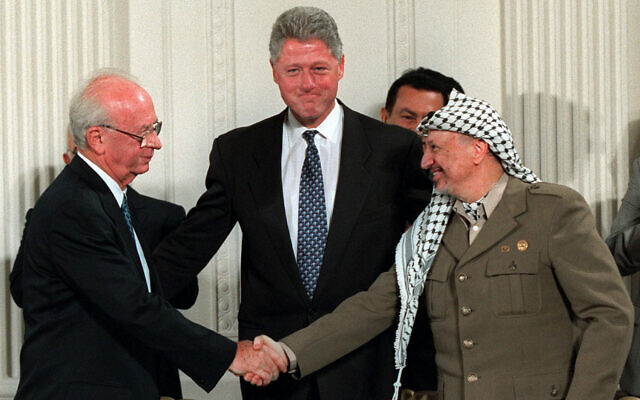
“That was the case after the Madrid Middle East Peace Conference of 1991, when Saudi Arabia, with other Arab countries, engaged in that process. Alas, all went in vain. Israel was not ready to pay the price of peace. The man of peace in Israel at the time was assassinated and his partner from the Palestinian side was poisoned,” Prince Turki said, referring to former Israeli prime minister Yitzhak Rabin and former Palestine Liberation Organization chairman Yasser Arafat, who Israel alleges orchestrated the Second Intifada.
While the Palestinians have long accused Israel of poisoning Arafat, Jerusalem has flatly denied the claims; and none of the independent investigations conducted by Swiss, French and Russian forensics teams definitively concluded that the PLO founder’s 2004 death at the age of 75 was the result of poisoning.
The Trump administration is looking to move past these historical grievances and is hoping Saudi Arabia will join the Abraham Accords in the near future. The initial Abraham Accords were a series of normalization agreements brokered by the Trump administration in 2020 between Israel and several Arab nations.

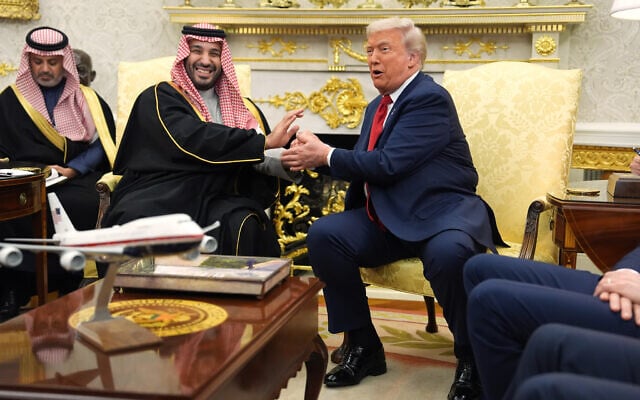
But Saudi Arabia’s de facto leader, Crown Prince Mohammed bin Salman, poured cold water on the idea during his White House meeting with US President Donald Trump last month.
“We want to be part of the Abraham Accords, but we want also to be sure that [we] secure a clear path [toward a] two-state solution,” the crown prince said.
Saudi officials have periodically added additional qualifiers to the “pathway” to Palestinian statehood that they seek, such as “time-bound” or “irreversible.”
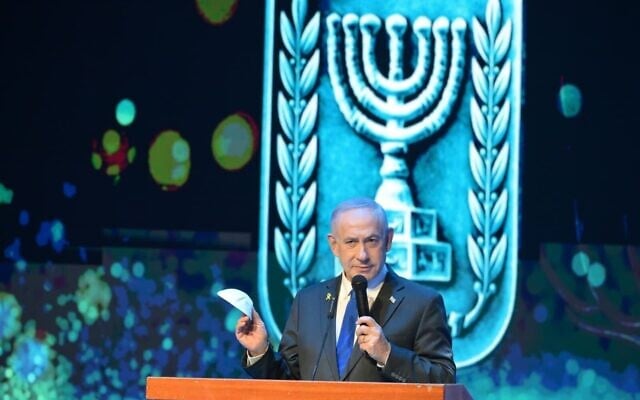
“Unfortunately, with the ruling mentality in Israel nowadays, every step toward peace is reversible and not ‘time-bound,’” Prince Turki said of the government led by Prime Minister Benjamin Netanyahu, which has worked to thwart the possibility of a Palestinian state being established, arguing that it would pose a security threat.
“Israeli aggressive behavior in the region — in Gaza and the West Bank, in Syria, in Lebanon — reversing on the commitments to the ceasefire during Gaza war and reversing its verbal commitment to the Abraham Accords about not changing the status on the ground, and the statements on Biblical Greater Israel do not call for trust in Israel,” said the former Saudi intelligence chief.
Israel has defended its strikes in Gaza after a ceasefire was reached in October, arguing that they have largely been in response to Hamas violations. Its troops have established buffer zones inside Syria and Lebanon that Jerusalem says are needed to secure Israel’s northern border. Netanyahu agreed to shelve plans to annex large parts of the West Bank in exchange for the Abraham Accords normalization deal with the United Arab Emirates, but critics argue that Israel has taken significant steps since to tighten its grip beyond the Green Line that amount to de facto annexation.
“Gaining trust requires Israel to conduct itself according to rules and norms of international law and the resolutions of the UN Security Council and abide by them,” Prince Turki said.
Won’t be pressured by Trump
Asked whether Riyadh risks upsetting Trump and harming its ties with the US by refusing to normalize relations with Israel, Prince Turki responded that the Gulf kingdom “bases its foreign policy on its own national interests, not according to the wishes and pressures of others.”
“Prince Mohammed bin Salman publicly stated the Saudi view in the White House in the presence of Mr. Trump, and Mr. Trump did not say that he was upset by Prince Mohammed’s words,” the former intel chief claimed.
Channel 12 reported that the US president was left “disappointed and angry” after a “tense” exchange with Prince Mohammed on the matter during the private portion of their White House meeting.
Prince Turki also flatly rejected the notion that Riyadh was close to normalizing ties with Israel before Hamas’s October 7, 2023, onslaught that sparked the two-plus-year Gaza war.
“All the speculation about normalization before Oct. 7 was out of wishful thinking on the part of mostly Israeli or American pro-Israeli sources,” he argued.
“However, Saudi Arabia is always ready to talk about peace in the Middle East and its requirements. Saudi Arabia’s position is no normalization without a peaceful resolution to the Palestinian issue that entails the two-state solution,” Prince Turki reiterated.
Prince Mohammed, however, said weeks before October 7 that “every day we get closer” to Saudi Arabia normalizing ties with Israel, while clarifying that the Palestinian issue is still a “very important” component of the process.
The Times of Israel also revealed this month that the US and Saudi Arabia had reached understandings on the eve of Hamas’s October 7, 2023, attack regarding the concessions Israel would have to make vis-à-vis the Palestinians for Riyadh to normalize relations with Jerusalem.
The PA isn’t the problem
Asked if Riyadh still sees strategic benefit to relations with Israel against the backdrop of the weakening of Iran and its regional proxies, Prince Turki responded: “There is no strategic benefit for Saudi Arabia’s normalization with Israel that is not yet a normal country that is peaceful and lives with its neighbors according to rules and norms of natural relationships between countries.”
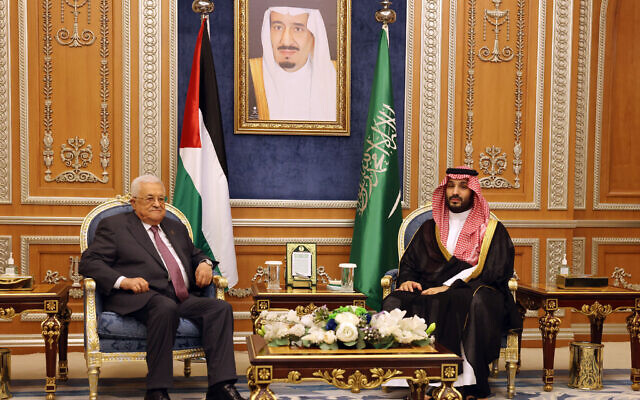
He also rejected the notion that the Palestinian Authority, led by President Mahmoud Abbas — who has long faced allegations of corruption — poses an obstacle to a peace deal with Israel.
“I believe Israel is responsible for the failure of the PA, since Israel is in control of all aspects of life in the Palestinian territories. Therefore, the failure of the PA is not a justification to avoid the real issues of peace. Israel must reform by abandoning its expansionist ambitions and seeking peace, not domination,” Prince Turki said, echoing comments made by a Saudi minister earlier this month.
“The irony is that while the Arab world has shifted its stance from not recognizing Israel, Israel has shifted its stance from accepting the two-state solution,” the former intel chief reflected.
Israelis are largely seen to have moved politically further to the right following the devastating Hamas assault of October 7, and while Opposition Leader Yair Lapid says he still supports a two-state solution, the best-positioned candidate to unseat Netanyahu, former prime minister Naftali Bennett, opposes the framework.
Pressed whether he sees any of the alternatives to Netanyahu as a potential partner for peace with Saudi Arabia, Prince Turki responded, “Whoever succeeds Netanyahu should accept the two-state solution. That is for the Israeli people to decide.”
-

-

-

-

-


