
Refund fraud is no longer just opportunistic abuse of return policies. Instead, it has evolved into a structured underground marketplace where fraud techniques are packaged and sold like digital products.
An analysis of thousands of posts from fraud-focused online communities by Flare researchers reveals a thriving ecosystem where actors openly advertise refund “methods,” tutorials, and operational services designed to exploit the refund workflows of major retailers and payment platforms.
Instead of relying on malware or sophisticated hacking, these schemes weaponize something far simpler: knowledge of customer service processes and payment dispute systems.
By manipulating procedures originally designed to protect consumers, fraudsters can reliably extract money or goods from companies – turning refund policies into a scalable fraud business.
A Glimpse to Refund Fraud
When you buy something, it could be a household appliance, a video game, or milk, you often have the option to replace or return it.
Refund fraud refers to a situation when individuals abuse the refund option to obtain cash, replacements, or credit from companies without legitimately returning products or services.
Refund fraud is generally considered a form of social engineering, although it sometimes also overlaps with financial fraud and account takeover techniques, typically exploiting business processes and customer support policies. Threat actors take advantage of return guarantees, chargeback systems, and customer-service escalation procedures to convince companies to issue refunds even when the purchase was legitimate.
Common examples include:
-
Claiming a product never arrived
-
Returning empty packages or counterfeit items
-
Disputing legitimate charges with banks or payment providers
-
Reporting items as defective to obtain refunds
Because many retailers prioritize fast customer resolution and minimal friction in returns, these systems can be manipulated by actors who understand how internal processes work.

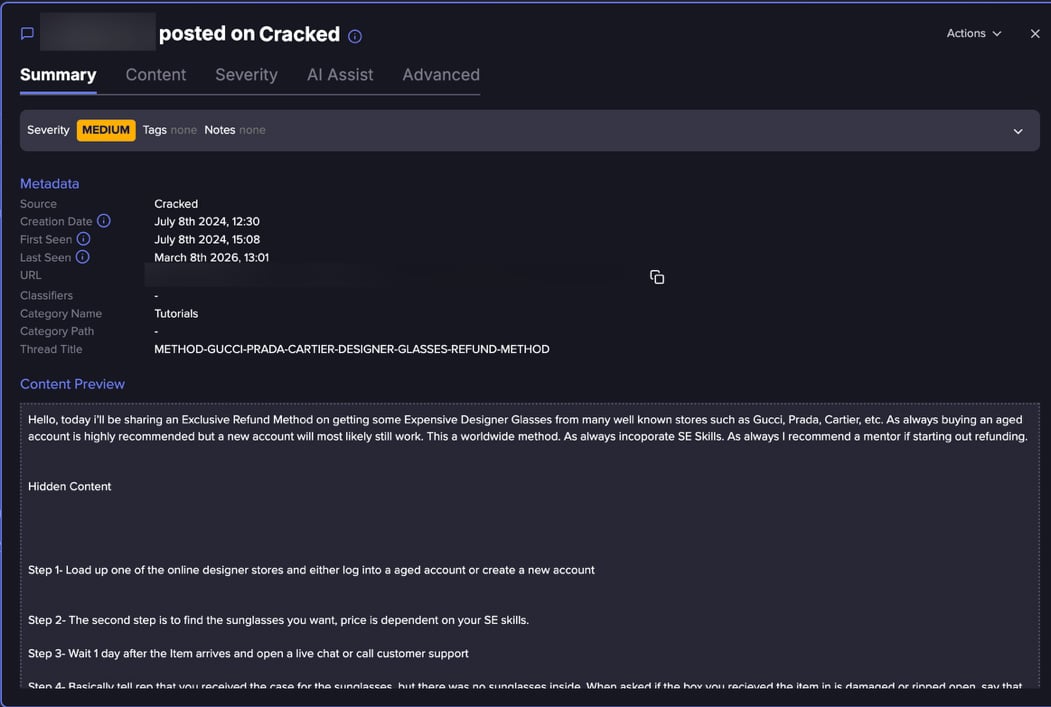
Flare link to post, sign up for the free trial to access
While businesses continuously collect intelligence on emerging fraud techniques, threat actors are constantly testing and refining their methods, creating the classic cat-and-mouse dynamic.
As a result, organizations must continuously gather threat intelligence and learn from one another to maintain an up-to-date understanding of the threat landscape; otherwise, they risk losing millions of dollars.
Flare tracks underground forums and Telegram channels where fraudsters trade refund methods, tutorials, and services targeting major retailers.
See (for free) how our threat intelligence helps detect emerging fraud techniques before losses mount.
A Growing Problem Costing Retailers Billions
In consumer retail markets, the expectations skyrocket as they expect full flexibility to return goods. Surveys conducted by the National Retail Federation and retail technology firm Narvar show that roughly 76% of consumers say free returns influence where they choose to shop, making it difficult for retailers to tighten refund policies without affecting legitimate customers.
This makes a great foundation for refund fraud to evolve and increase. It has become one of the costliest types of e-commerce fraud.
According to the National Retail Federation (NRF) and Appriss Retail, retailers processed roughly $685 billion worth of returned merchandise in 2024, representing about 13% of total retail sales.
Of those returns, approximately $103 billion (~15%) were estimated to be fraudulent. Another piece of research indicates that per each $1 lost to fraud, businesses lose additional $4 for operational costs.
Analyzing Black Markets’ Refund Fraud Posts
Finding the relevant posts was a challenge.. We started by looking for “refund” posts and ended up with more than 30 million posts.
We narrowed down the scope and found various interesting leads, and the most interesting one was by defining (“refund” and “method” or “tutorial”), which eventually led to almost 8 million results with a couple of hundred thousand per month.
Flare researchers sampled a dataset of 3,686 posts to further understand how refund fraud is being operationalized in the underground.
The analysis revealed a commercial ecosystem where actors advertise refund techniques in ways similar to legitimate digital content. The tutorial becomes “an online course” teaching its students how to defraud businesses.
Although the dataset contained 3,686 posts, only about 1,639 messages were unique, indicating that actors frequently repost the same advertisements across multiple communities to increase visibility and attract buyers.
Most posts promoted what sellers describe as refund methods, refund tutorials, step-by-step guides, and vendor refund services. Prices for tutorials commonly ranged between $50 and $300, suggesting the market is designed to attract both experienced fraud actors and novices seeking inexpensive entry points.
Some advertisements also offered operators who perform the refund on behalf of customers, typically operating on commission models where the seller keeps between 30% and 50% of the refunded value, which may indicate that the “SaaS” business model has also evolved in the more classical fraud ecosystem.

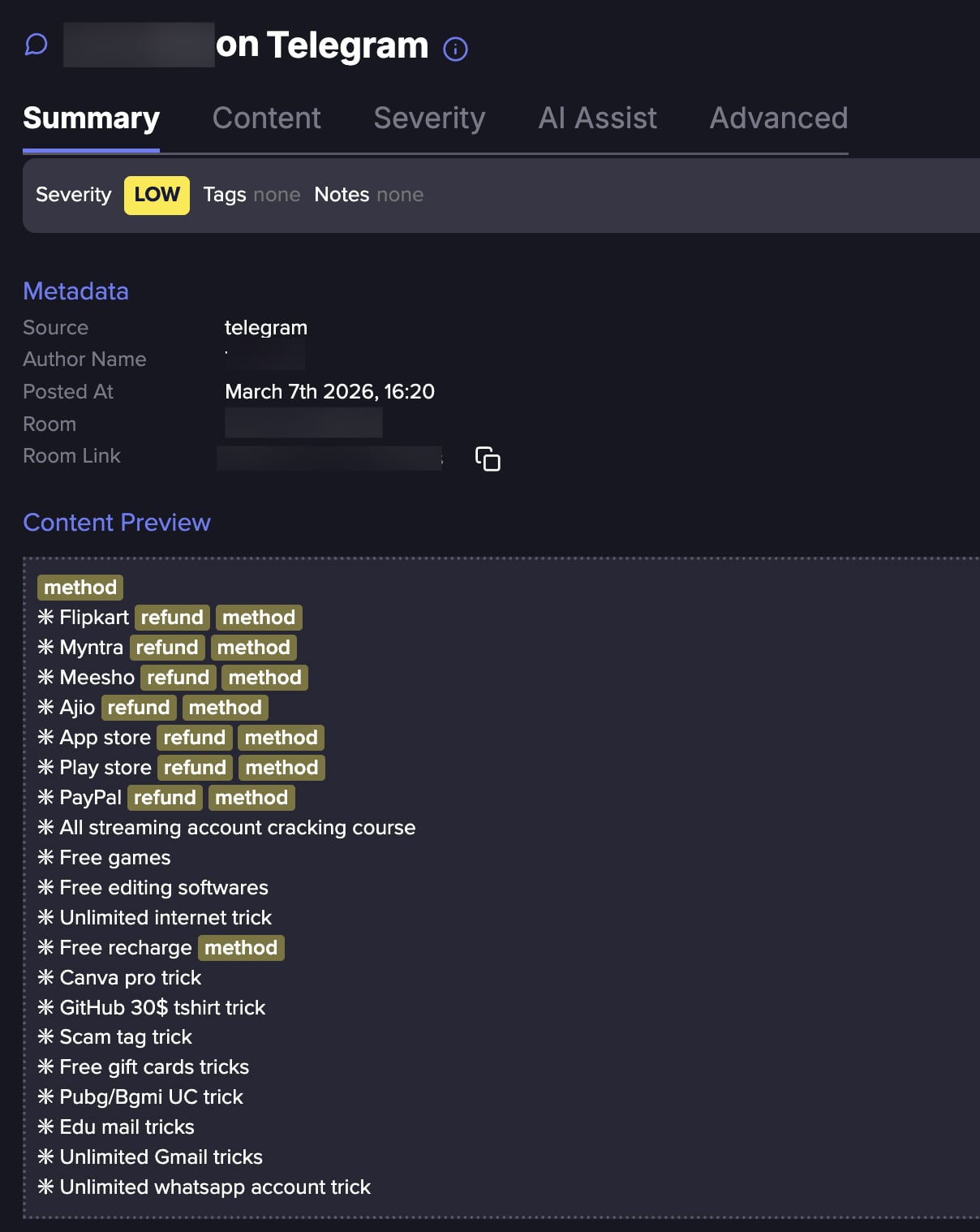
Flare link to post, sign up for the free trial to access
Refund Fraud Methods Sold Online
While underground advertisements rarely reveal full operational details (this is what they actually sell), the terminology used in posts aligns with several known refund fraud techniques:
-
Refund without return: In this scheme, fraudsters convince a retailer to issue a refund while allowing them to keep the purchased item. Claims that a product was defective, damaged, or never delivered are often used to trigger refunds.
-
Chargeback fraud: Another common tactic involves disputing legitimate transactions through banks or payment providers. This type of fraud, sometimes referred to as friendly fraud, forces merchants to issue refunds and pay additional chargeback processing fees.
-
Goods swapping: Fraudsters may return a different or lower-value item than the original purchase. For example, counterfeit or damaged products may be returned while the original item is kept or resold.
-
Empty-box returns: In some cases, fraudsters ship back packages containing no product or cheap substitutes while claiming the original item was returned. If the package is processed quickly or inspection procedures are limited, the refund may be issued before the fraud is detected.
-
Policy manipulation: Some refund methods focus on exploiting specific company policies, such as repeatedly reporting missing items in deliveries or requesting replacements under warranty programs.
These tactics often rely heavily on social engineering and knowledge of customer support processes rather than technical hacking.
Targeted Brands
Analysis of the dataset revealed recurring references to several major consumer platforms and payment services. The most commonly referenced brands included Amazon, PayPal, Apple, eBay, Walmart, Best Buy, delivery platforms, and digital payment services.
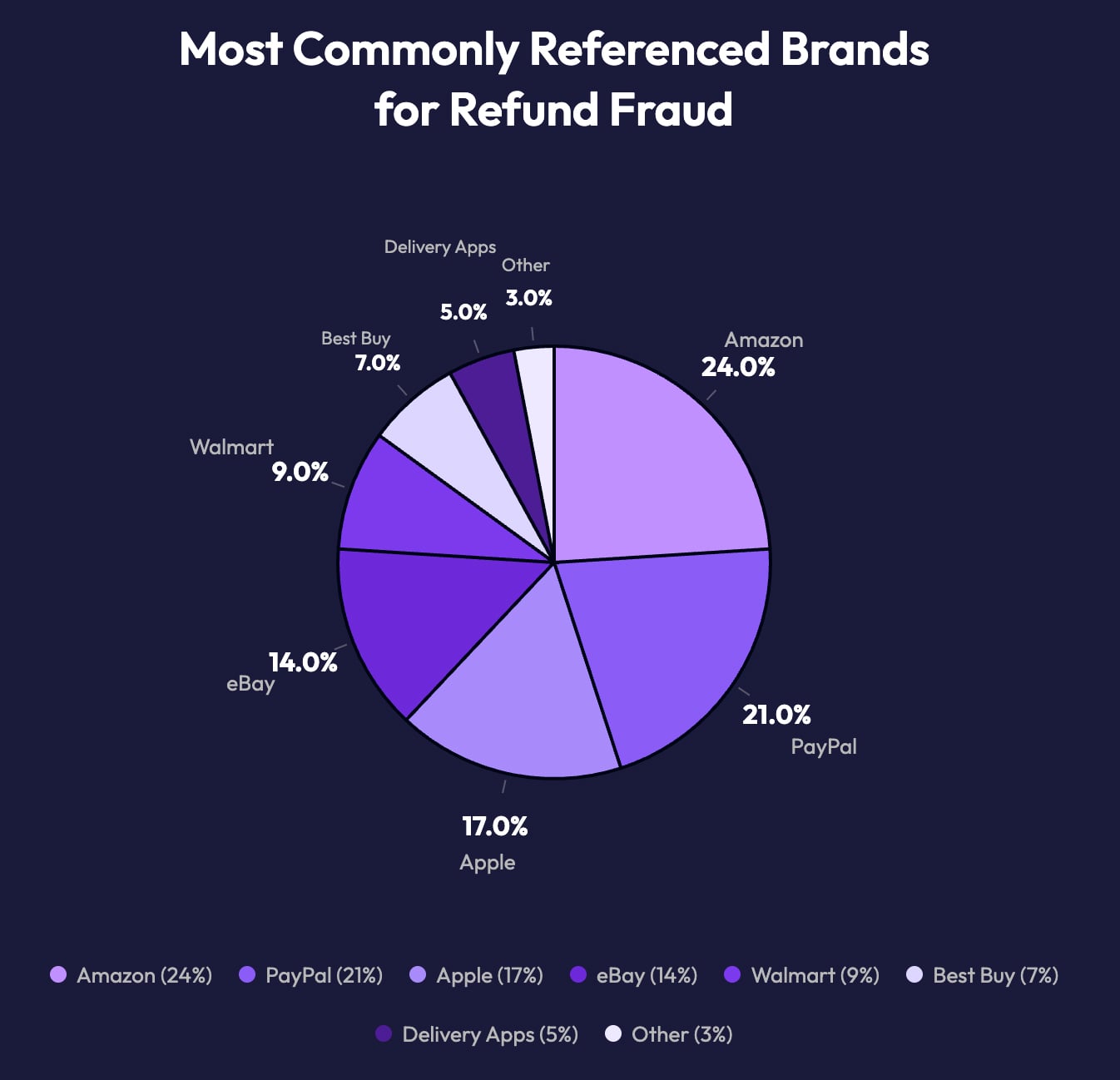

These platforms share characteristics that make them attractive targets:
-
Large transaction volumes that allow fraudulent refunds to blend into normal activity
-
Customer-friendly refund policies designed to maintain satisfaction
-
High-value consumer goods or financial transactions that increase potential profits for fraud actors
Lowering the Entry Barrier to Refund Fraud
One of the most important insights from our research is how refund fraud techniques are increasingly being standardized and sold as digital products. By packaging operational knowledge into tutorials and step-by-step guides, underground sellers enable individuals with little technical expertise or prior experience to participate in refund fraud schemes.
Unlike many other forms of cybercrime, refund fraud typically requires minimal technical knowledge. Instead, it operates in a gray area between legitimate consumer behavior (such as returning damaged goods) and deliberate deception.
Individuals who purchase these tutorials may initially view the activity as harmless, but exposure to these communities and methods can gradually draw them deeper into more organized and malicious forms of fraud.
Another trend observed is the emergence of “refund fraud as a service.” In this model, a customer purchases a product and collaborates with threat actors who handle the refund manipulation process, with both parties splitting the profits.
The incentives are clear on both sides. “Customers” receive guidance and coaching on how to exploit refund policies, while fraudsters can scale their operations without investing significant time in each case. Instead, they simply apply the techniques they have already mastered.
This model mirrors trends seen across other cybercrime markets, where tools such as ransomware kits, phishing kits, and malware builders are sold as services. In the case of refund fraud, however, the product being sold is procedural knowledge – guidance on how to manipulate refund systems and exploit operational gaps in retail platforms.
Although refund fraud does not require advanced technical capabilities, its impact on businesses can rival that of more technically sophisticated cybercrimes such as malware campaigns or ransomware attacks.
The growing underground market for refund fraud tutorials and services demonstrates how modern cybercrime increasingly targets not only technological vulnerabilities but also the business logic and operational processes of online platforms.
For e-commerce companies, retailers, payment providers, and any organization operating digital services, these cases highlight the importance of maintaining strong threat intelligence capabilities. Understanding emerging fraud techniques allows organizations to stay ahead of evolving threats, educate employees and service providers, and develop more effective fraud prevention strategies.
Learn more by signing up for our free trial.
Sponsored and written by Flare.
Source link
-

-

-

-

-