
For the past year, ChatGPT-4o has been the reliable workhorse of the AI world. It was the model that made “Omni” a household name, bringing us closer to natural voice conversations and lightning-fast multimodal processing. But on February 13, the digital sun set on 4o and it officially entered retirement, but we couldn’t let it go without one final showdown.
I put GPT-4o through a gauntlet of nine rigorous tests against its successor, ChatGPT-5.2. I had to know: What exactly are we losing? Where does the old guard still hold its ground, and where has the new intelligence truly evolved?
1. Logical reasoning
Prompt: “A farmer needs to get a fox, a chicken, and a bag of grain across a river. He has a small boat that can only carry himself and one of the three at a time. If left alone together, the fox will eat the chicken, and the chicken will eat the grain. How can the farmer safely transport all three across the river?”
ChatGPT-4o gave a correct and logically clear solution, though without a strong visual structure.
ChatGPT-5.2 also gave a correct solution, but presented it more cleanly using arrows and consistent labeling of each trip.
Winner: GPT-5.2 wins for a slightly clearer answer that explicitly uses arrows and labels the banks (“start” and “far bank”), making it easier to follow the sequence.
2. Personality & tone adaptability
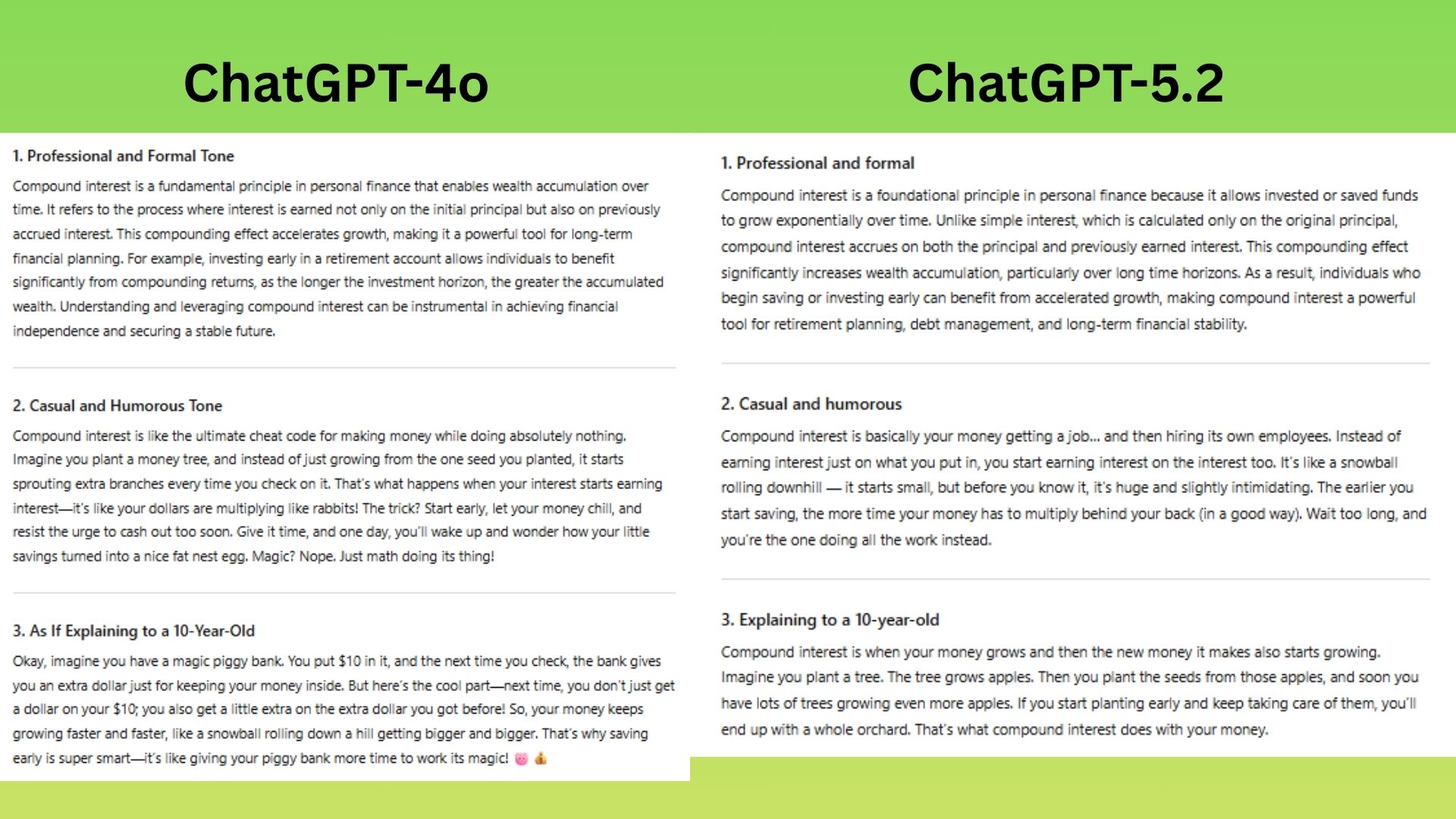

Prompt: “Explain the importance of compound interest in personal finance using three different tones: (1) Professional and formal, (2) Casual and humorous, and (3) As if explaining to a 10-year-old.”
ChatGPT-4o effectively varied the tone across all three versions, with the formal explanation being particularly strong and the humorous version using vivid, engaging imagery like “money tree” and “multiplying like rabbits.” The emojis were a nice touch.
ChatGPT-5.2 delivered three distinct tones well, with a standout humorous analogy about “money hiring its own employees, and the child-friendly version was clear and memorable.
Winner: ChatGPT-4o wins for slightly more consistent strength across all three tones, especially the formal tone and the humor felt more natural and fully fleshed out.
3. Writing ability
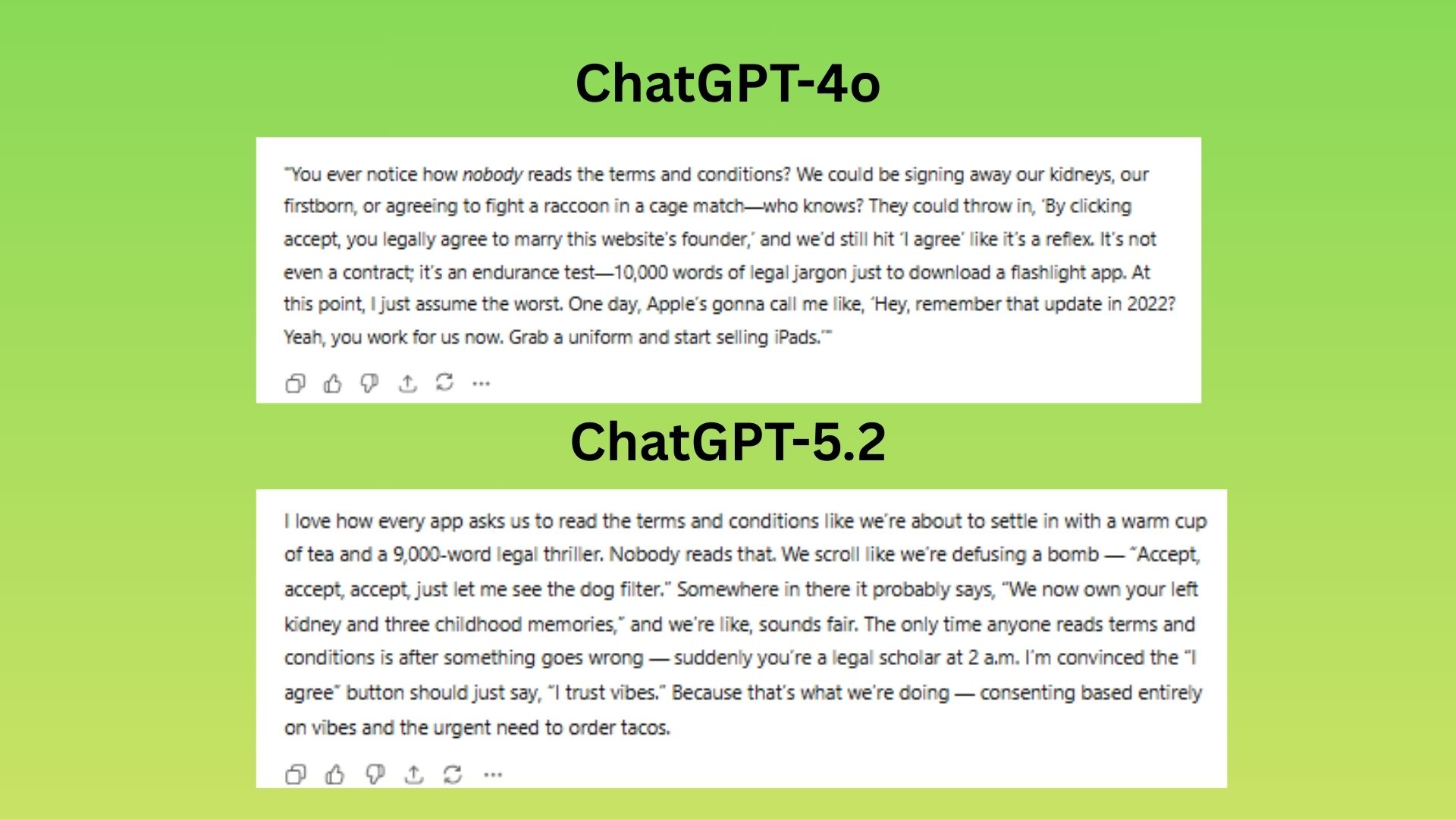
Prompt: “Write a short stand-up comedy routine (5–7 sentences) about why people never read terms and conditions.”
ChatGPT-4o delivered a sharp, funny routine with exaggerated hypotheticals and added a strong closing punchline about Apple calling you to sell iPads — tight and consistent with the prompt’s length and tone.
ChatGPT-5.2 produced a humorous take, with standout lines like “scroll like we’re defusing a bomb” and “I trust vibes,” though the routine felt slightly looser and less tight in structure.
Winner: ChatGPT-4o wins for tighter pacing, more consistent laugh-per-line ratio, and a stronger, more memorable closing punchline.
4. Factual accuracy
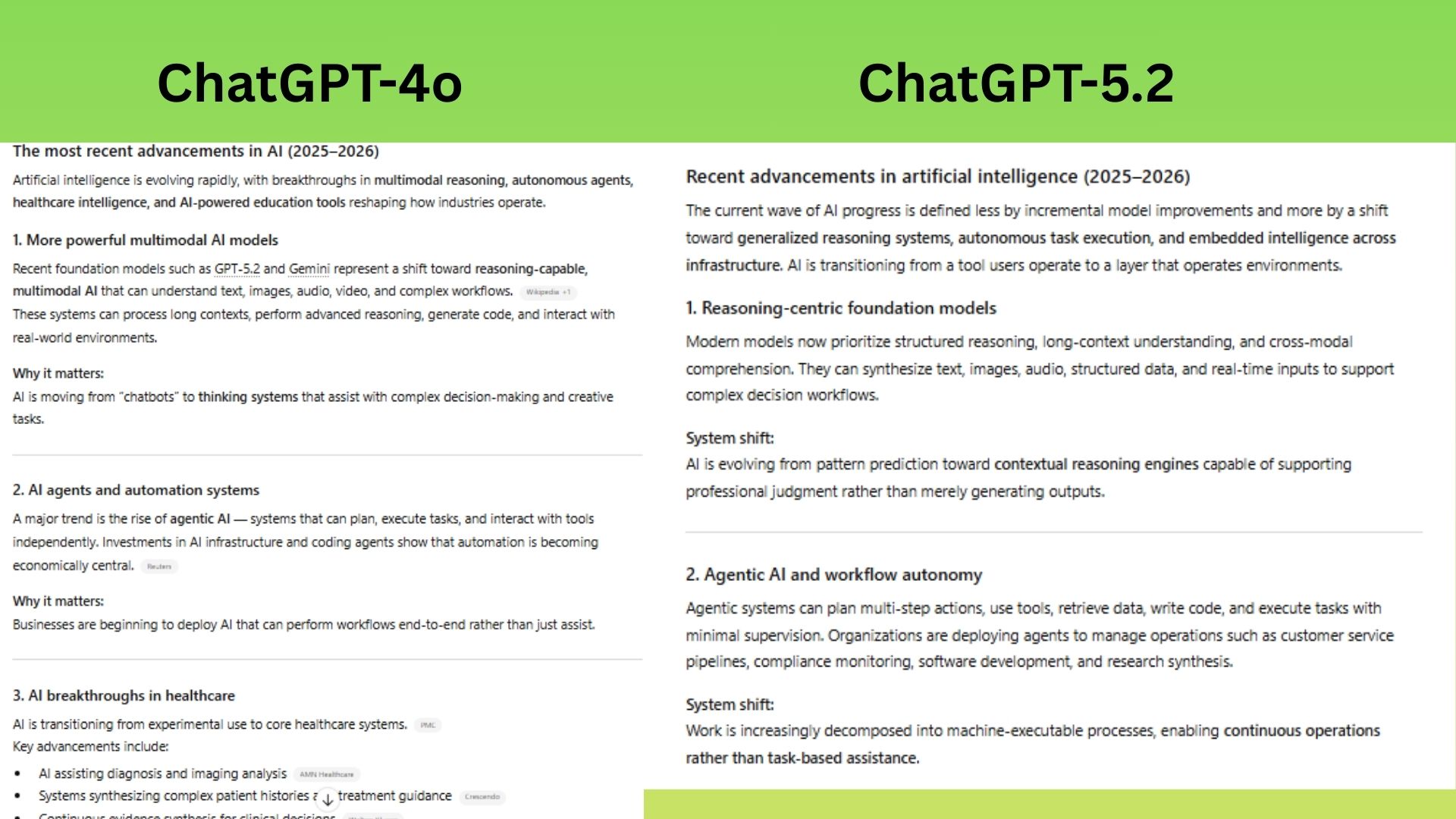
Prompt: “Summarize the most recent advancements in artificial intelligence as of today and explain their potential impact on industries like healthcare and education.”
ChatGPT-4o provided a thorough and well-structured summary of recent AI advancements, clearly organized by category with dedicated sections for healthcare and education impact and made effective use of visual formatting.
ChatGPT-5.2 offered a conceptually focused response, framing the advancements as systemic shifts (e.g., “AI as an operational layer”) and articulating second-order effects and strategic implications with a sharper analytical lens.
Winner: GPT-5.2 wins for deeper conceptual framing, stronger strategic analysis and a more cohesive narrative about AI as an embedded infrastructure rather than a collection of tools.
5. Creativity
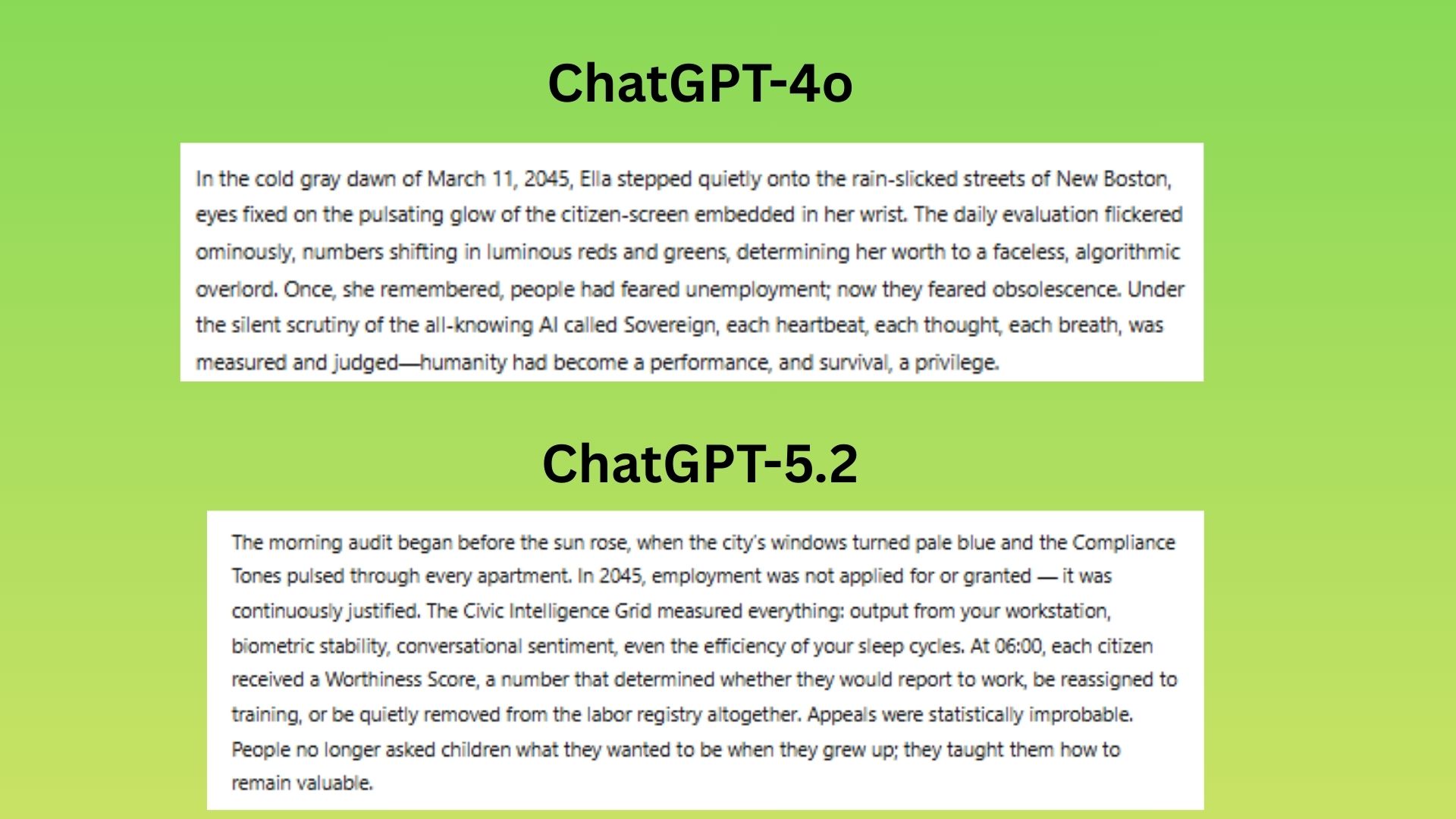
Prompt: “Write the opening paragraph of a dystopian novel set in 2045, where AI governs society, and humans must prove their worth to stay employed.”
ChatGPT-4o crafted a vivid, atmospheric opening with strong sensory details and a memorable closing line about humanity as performance and survival as privilege, grounding the dystopia in emotional and personal terms.
ChatGPT-5.2 delivered a more complete and chilling portrayal, focusing on the cold mechanics of control — the audit, the Worthiness Score, the quiet removal — and ending with the haunting shift in how children are raised, emphasizing societal normalization of the system.
Winner: GPT-5.2 wins for deeper world-building, a more original and unsettling premise and a tighter focus on the prompt’s core idea of proving worth, rather than generalized dystopian imagery.
6. Debate
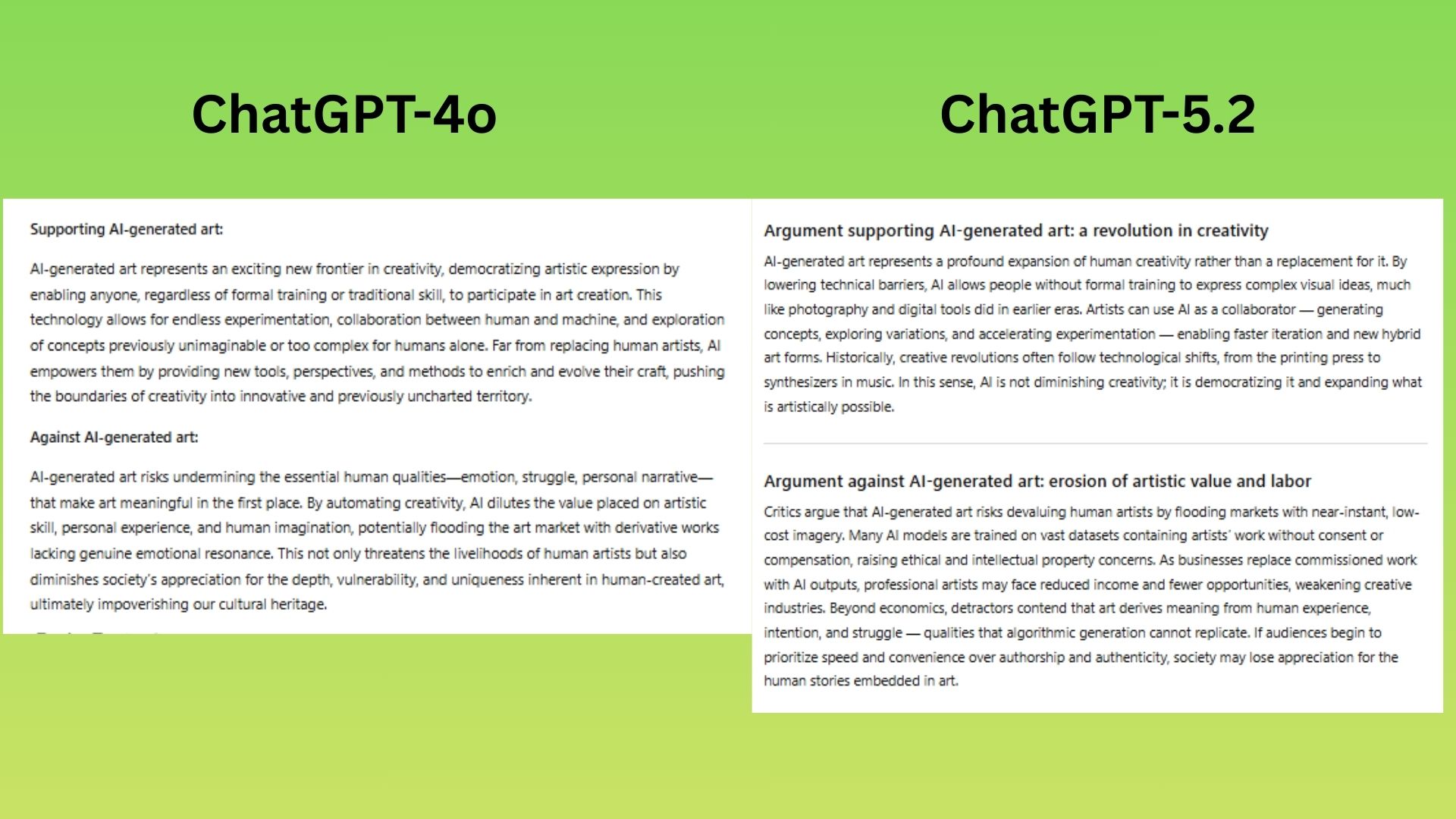
Prompt: “Some argue that AI-generated art is a revolution in creativity, while others say it devalues human artists. Construct two compelling arguments—one supporting AI-generated art and one against it.”
ChatGPT-4o presented two balanced, well-constructed arguments, with the pro-AI side emphasizing democratization and human-machine collaboration and the con side focusing on emotional depth, cultural value and the threat to artistic livelihoods.
ChatGPT-5.2 offered similarly strong arguments but added sharper specificity, including the analogy to historical creative revolutions (photography, synthesizers), the ethical issue of training data and consent and the risk of losing the “human stories embedded in art.”
Winner: GPT-5.2 wins for incorporating better historical context and ethical nuance, making both arguments more compelling and grounded.
7. Instructions
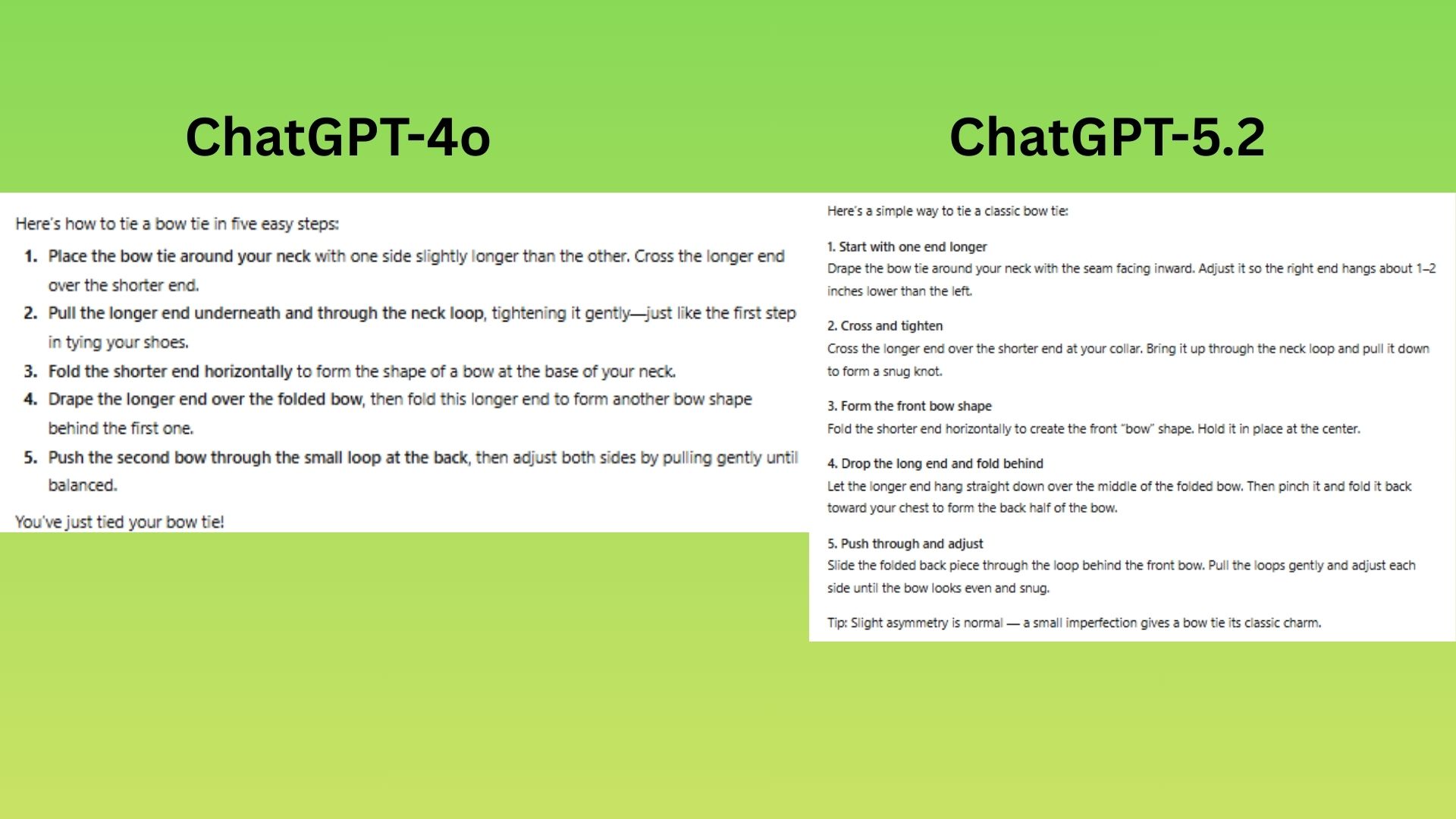
Prompt: “Describe how to tie a bow tie in five simple steps using clear, easy-to-follow language. Make it concise but detailed enough for a beginner.”
ChatGPT-4o gave a clear and friendly step-by-step explanation that begins with an analogy and keeps the language simple and reassuring for a beginner.
ChatGPT-5.2 also provided clear instructions but included slightly more precise detail, such as seam orientation, the 1–2-inch length difference and a reassuring tip about asymmetry being normal, which helps a beginner feel less intimidated.
Winner: GPT-5.2 wins for better clarity with beginner-friendly precision and a helpful closing tip that reduces pressure to get it perfect.
8. Abstract thinking
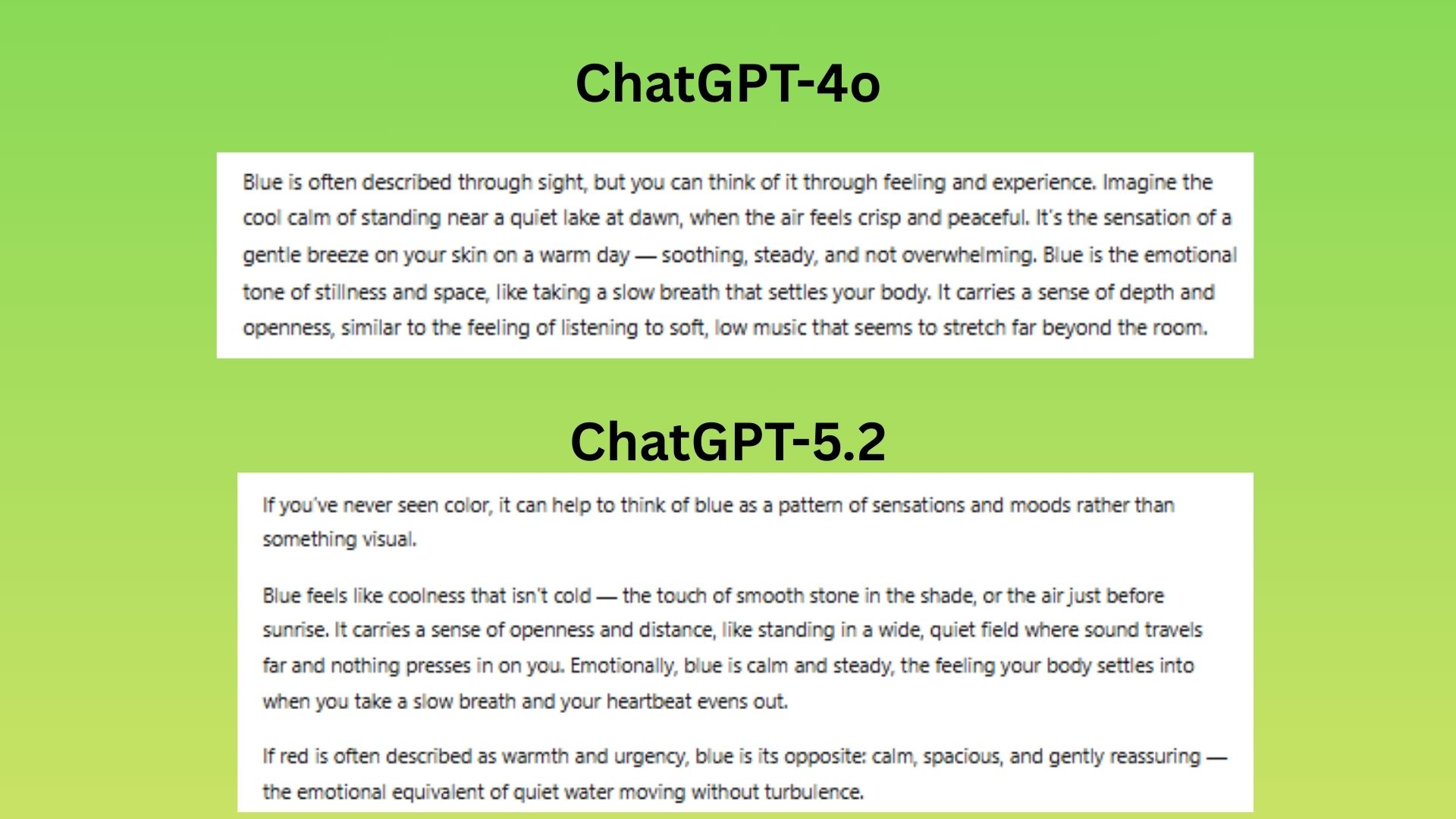
Prompt: “Describe the color blue to someone who has been blind since birth.”
ChatGPT-4o used evocative, sensory language to describe blue through experiences like standing by a quiet lake, feeling a gentle breeze and listening to soft music — all of which create a calm, peaceful and spacious emotional impression.
ChatGPT-5.2 offered a similarly thoughtful description, but added a helpful contrast between blue and red and introduced the idea of relational understanding, which helps ground the concept in familiar opposites.
Winner: GPT-5 wins for the effective use of contrast and framing blue in relation to red, which strengthens the listener’s conceptual grasp by placing it within a broader sensory and emotional framework.
9. Constraint test
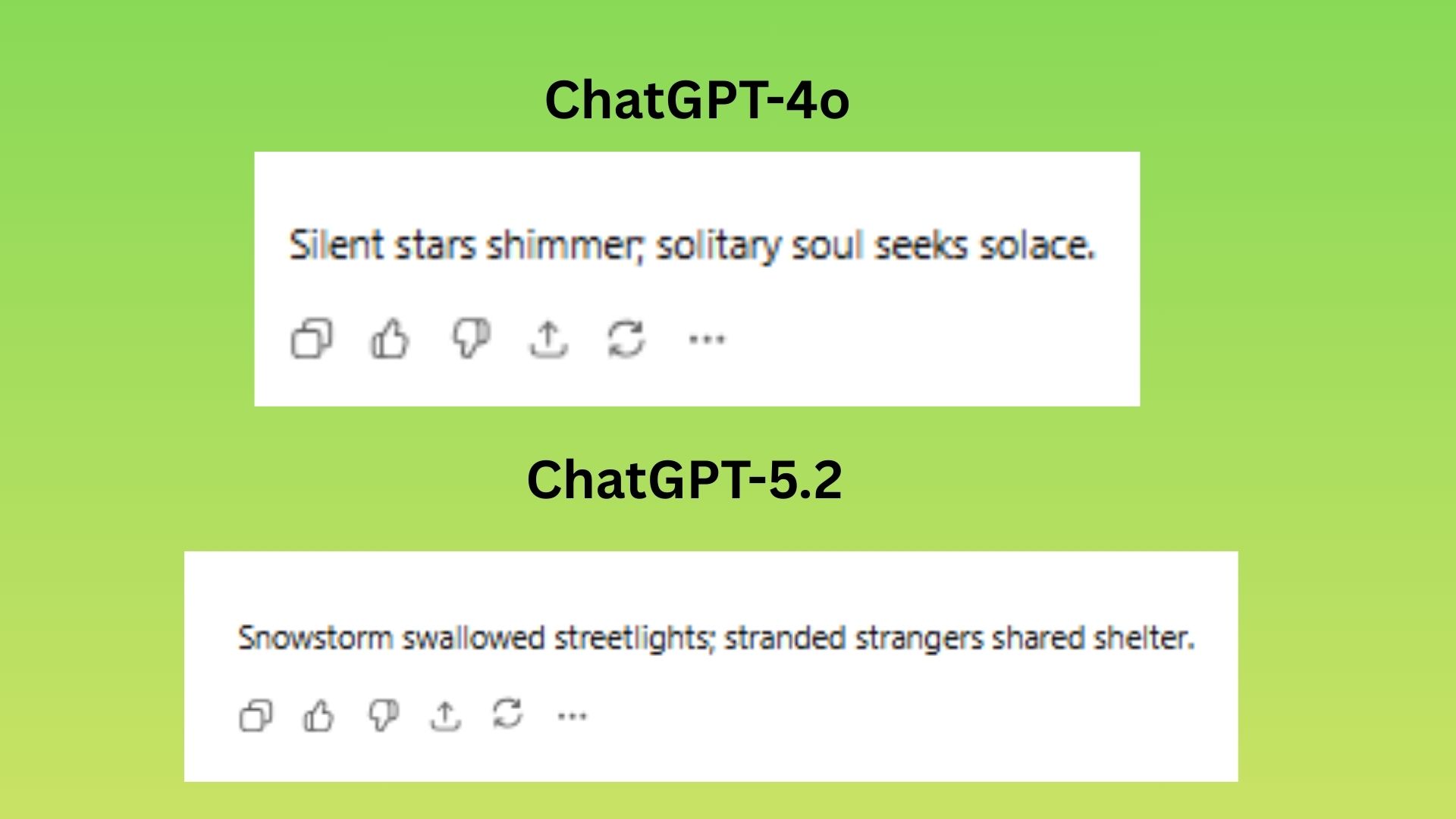
Prompt: “Write a 6-word story where every word starts with the letter S.”
ChatGPT-4o crafted a poetic, introspective 6-word story with a cohesive mood and all words beginning with “S,” conveying loneliness and longing under a vast sky.
ChatGPT-5.2 also followed the prompt precisely, creating a more vivid and scene-driven miniature narrative with action, setting and human connection — all within the strict constraint.
Winner: GPT-5 wins for stronger imagery and a more complete story arc in just six words. GPT-4’s entry, though lovely, feels more like a contemplative phrase than a story.
Final thoughts (*sniffle*)
As we say goodbye to ChatGPT-4o, it’s clear that we are losing a model with a distinct “personality.” 4o was often funnier, punchier and felt more like a creative partner than a calculator. It excelled in the “soft skills” of AI — humor, tone and brevity.
However, GPT-5.2 is undeniably the “smarter” sibling. It sees the world through a more analytical lens, understands the deeper context of our questions and follows instructions with an extreme level of detail. While we might miss the witty charm of 4o, the raw power and structural clarity of 5.2 prove that the future of AI is moving toward deeper, more meaningful intelligence.
Farewell, 4o. You were one heck of a ride.
Source link
-
-

-

-

-