

‘Go inside, he will kill you’: Israeli militants step up West Bank school attacks | West Bank
The Israeli reservist shot 14-year-old Aws al-Naasan in the head just outside the western gate of the Mughayyir boys’ secondary school, where he was studying in ninth grade.
Aws collapsed instantly, bleeding heavily. More shots rang out as his friends ran to his side, picked up his now-limp body and rushed him out of the line of fire, their path along the school wall marked by a trail of their classmate’s blood.
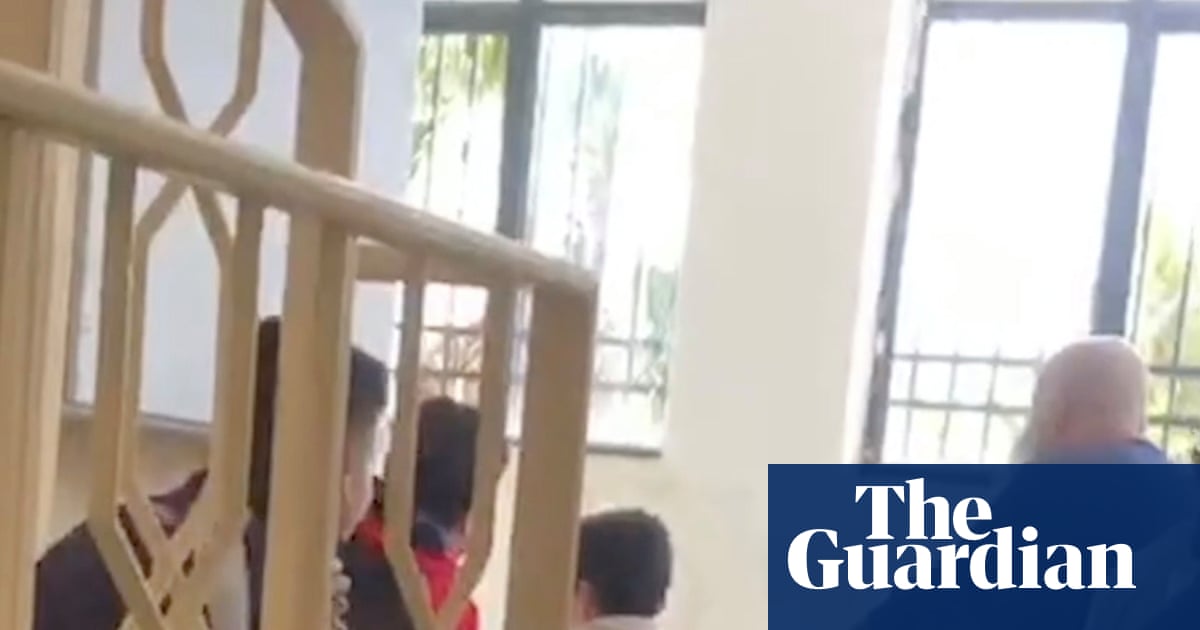
Footage from inside the building showed terrified children and teachers crouched in stairwells, shouting at others to get down. Another video captured the shooter, a reservist in partial military uniform, taking aim at the school from the hillside above.
A few minutes later the same man killed the younger brother of an English teacher Waheed Abu Naim, whose family live beside the school. Jihad Abu Naim was 36; his wife is heavily pregnant with the couple’s first child, a girl due this month.
Aws and Abu Naim were shot dead on 21 April amid a wave of settler violence in the occupied West Bank, much of which has targeted schools and students in the territory.
Mughayyir, a village of about 3,000 people nestled in the rolling hills north-east of Ramallah, has been targeted for many years. Aws’s father, Hamdi al-Naasan, was killed in January 2019, shot in the back by a settler as he tried to rescue an injured neighbour.
Aws was only in third grade at the time, and his teachers devoted extra attention to the young boy in the years that followed. “We tried to make Aws feel safe, and ensure he had some rules in his life, to protect him from the impact of losing his father,” said Waheed Abu Naim. “Then we lost him.”
After the killings, classes in Mughayyir were suspended for a week as parents and teachers weighed up hopes for their children’s futures against immediate fears for their lives. “We want to go back to school, but our families are worried,” said Ahmed Abu Ali, a friend and classmate of the murdered teenager.
Education is under attack across occupied Palestine. The situation is most severe in Gaza, where more than 600,000 school-age children are approaching the end of a third year without formal in-person education. Israeli attacks there have killed at least 792 teachers and 18,639 students, according to the UN, and damaged or destroyed nine out of 10 school buildings.
But students and schools are also targets of spiralling Israeli violence in the occupied West Bank, where there is a climate of near total impunity for attacks on Palestinians.
A few hours after Aws was killed outside his school, settlers attacked and demolished a British- and European-funded school for Palestinian children in a village 25 miles to the north.
In Hammamat al-Maleh, in the northern Jordan valley, settlers used bulldozers to raze four classrooms, school toilets and the two playground areas into a heap of twisted metal and crumpled plastic, scattered with ruined books.
The French government, which contributed some of the funding to the school, has demanded compensation from the Israeli government for the destruction.
In the south Hebron Hills, on 13 April Israeli settlers put razor-wire across the road to the school attended by Palestinian children from Umm al-Khair village, blocking students from crossing since then.
“This path is not just a road, it is the lifeline that connects our children to their education and to a sense of normal life,” said one resident, Tariq Hathaleen. “The purpose is clear to us: to pressure our community to leave our land, to intimidate us through our children.”
Photograph: Mamoun Wazwaz/APAImages/Shutterstock
When a group of adults and children from the village staged a sit-in protest at the fence, demanding access to their school, Israeli soldiers fired teargas at them.
“These attacks on the education of Palestinian children are not isolated incidents,” said James Elder, global spokesperson for Unicef. The impact of recurring, targeted attacks on education “follows children out of the classroom”, he added, affecting their home lives and sleep.
Israeli forces have a history of disrupting education in Mughayyir. A checkpoint regularly set up on the road below the boys’ school frightens and distracts students, residents said, and the soldiers staffing it sometimes block teachers who live outside the village from coming to teach their classes.
A surge of deadly Israeli attacks on Palestinians across the occupied West Bank this spring also put teachers on alert for new threats to their pupils.
So when two settlers and four masked soldiers were spotted walking towards the school soon after noon on 21 April, teachers corralled students into the compound, shut the main gate and sent a message to parents and neighbours: armed Israelis were near the school, they should come collect their children.
Waheed Abu Naim went to try to talk to the Israelis, asking them in English and Arabic why they had come. Only one responded, saying “go back” in Arabic, and raising his gun. The message was clear. “Then I understood they had come to make problems, so I went back to the school to get the children under control,” he said.
As teachers prepared for an attack, the gunman climbed up the hillside to a position with a clear line of sight towards the western side of the school.
A handful of students were still in the street, and Abu Naim tried to order them to safety as the reservist aimed his weapon at the boys. “I was shouting to them ‘go inside, he will kill you’.” Moments later shots rang out and Aws crumpled to the ground.
Teachers and fellow students carried him round the corner to administer first aid, and drive him to a clinic, but he had died before he reached doctors.
Taleb al-Naasan, his paternal grandfather, said: “He was a respectful kid, with good manners, who just wanted to grow up and have a family of his own, a normal life.” Aws leaves behind a doubly bereaved family, including two sisters and a younger brother.
The next day families buried their dead and Israeli forces raided the village, firing teargas and stun grenades at Palestinian homes for half an hour.
The rights group B’Tselem said the shooting in Mughayyir fitted a “consistent pattern” of deadly attacks by Israeli soldiers and settlers pursuing a campaign of ethnic cleansing.
“Israeli militias raid Palestinian villages in order to provoke confrontation and elicit a response, which they then use as a pretext for lethal gunfire and terror attacks on residents attempting to defend their homes,” the group said.
These attacks are “carried out with the declared objective of forcibly displacing thousands of Palestinian residents from their homes”.
The Israeli military said the gunman was a reservist, who stepped out of his car and opened fire after stones were thrown at the vehicle. Video footage of the attack, and bloodstains on the road, showed the shooter was several hundred metres from the nearest road when he killed Aws.
The military spokesperson also said troops did not accompany the reservist at the time of the killing, and reached the area afterwards.
Source link
