

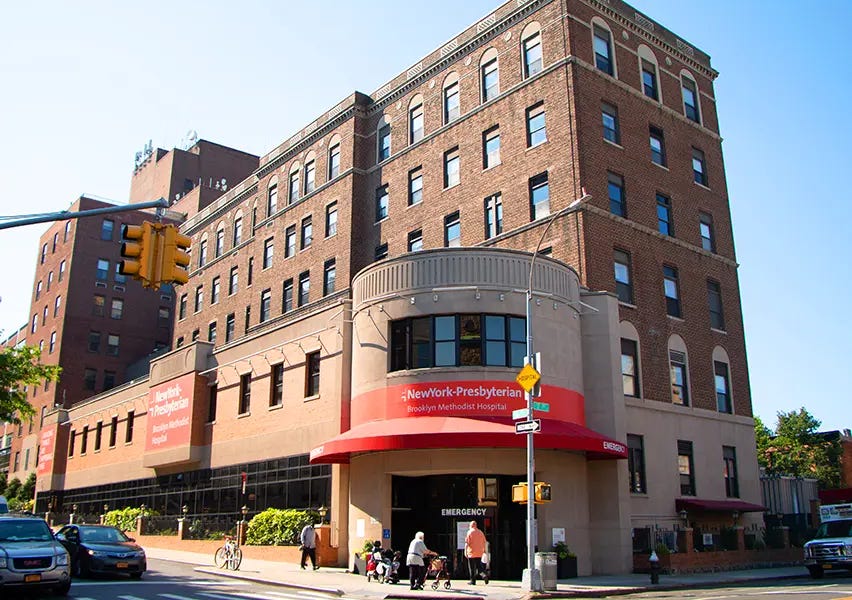
Over the holiday break my wife and I experienced one of those ordeals that all parents dread: a young child in the ER, hooked up to an IV, for an adverse response to medication to treat an illness. Though we are fully past it, the sense of near-disaster underscored for me the centrality of great emergency care for all Americans—and the need for universal policies that aid proper rest and recovery.
In our case our son—who is recovering quite well—first came down with a high fever the Friday after Christmas. His symptoms were alarming enough to prompt me to take him to the ER at New York-Presbyterian Brooklyn Methodist Hospital the next morning, where, after a chest X-ray, the doctors and nurses discovered he had developed bacterial pneumonia, presumably brought on by influenza A. The attending physician then prescribed the antibiotic Clindamycin to treat him, and he was released. 36 hours later we were back in the ER due to my son vomiting and complaining of extreme stomach pain. By sunrise Monday he was receiving his antibiotics and vital fluids through an IV and sipping juices and milk with the aid of anti-nausea medication. To our immense relief, his condition dramatically improved, and he was discharged Tuesday evening, and he and his sister are resuming their cozy start to the New Year.
Staying overnight in the hospital with a sick child conjures up the most awful images. A loneliness that few authors have captured laps you amid the ambience of electronic beeps and heating vents. Even when your gut and your mind tell you “the worst” isn’t happening and things will soon improve, you recognize doctors are disinclined to explicitly assuage you until, well, your loved one is doing better.
In those interim hours a host of fleeting, sometimes strange and lucid observations can occur. As familiar as I am with an inner voice that comes with being a writer, I found myself keyed into another voice, the voice that emerges when you come to accept you are in the midst of an emergency. It begins by admonishing you to remember how tenuous your control over your own life actually is.
Medical emergencies are a severe test—of faith you might not want to admit and much else. However temporary, they usually force a reckoning with one’s priorities and discontents—even if one sincerely feels they are, on most days, living a fulfilling life. For most people adulthood is marked by the long struggle to choose well, maintain good health, and build some modicum of financial security without living a life void of color and pleasure. If you are a social democrat like me, you hope politics will bend toward your general philosophy of life and that progressive leaders will do their utmost to safeguard against life’s gravest hazards. Social insurance and public investment can’t eliminate heartbreak and tragedy, trials inherent to the human condition, but such policies can foster the conditions that reduce injury to health and prevent financial ruin from accompanying life’s difficult passages. By legitimating social rights and identifying common obligations and standards, social democracy is meant to give citizens a little more peace of mind in an unpredictable world.
During our admission I reflected now and then on the ways in which social democracy has, by most metrics, receded in my lifetime and what this decline has meant for social trust. Few institutions seem equipped to repair it, and health care workers are now one of the last pillars of public confidence in our system and its professions. That’s not surprising. Although doctors, nurses, and other hospital staff are hardly infallible, I’m not sure society would function at all if their jobs became any harder. It must be extraordinarily taxing to tend to the sick and injured and preserve an identity separate from the adrenaline and drama that punctuates such responsibilities. Together as a country we could do better by them and their patients.
I can nevertheless see why so many outside the medical field regard it with ambivalence. Hospital stays tend to quickly warp your sense of place and agency. As much as I expected we would be discharged within a few days, I was unnerved by how quickly I was absorbed into the rhythms of hospital life and how they affected my mind. When my wife and I swapped places so that I could rest, I pondered how time seemed to move faster in the hospital room than at home, despite having very little to do there but wait, hug, and observe. Desperate for some levity, I repeatedly remarked to my wife that the food remained laughably inedible, seemingly unchanged since our daughter’s birth in 2019 (and possibly since the 1980s). My mind kept returning, though, to the idea of the hospital as a symbol of advance and decline—as a bridge between eras and generations, as a locus of the life cycle, but also as a testament, or record, of a society’s priorities.
I thought, in particular, about how a hospital doubles as a museum of technology and a frontier of innovation and skills-building. It is a place where relatively simple tools and old, occasionally temperamental devices are employed alongside cutting-edge equipment and medicine. It is also a place where lay visitors must yield to the judgment of experts but never hesitate to ask questions or lose vigilance if something appears to be compromised or inadequate. Communication, after all, remains the basis of successful treatment.
I thought, too, about the hospital as an institution that functions like a ministate; admission is akin to entering a new complex reality, a society of patients, doctors, nurses, and staff who seem more of that world than the outside one. It is a place where babies are born and lives are saved but also one where disease and impending loss are managed in installments and shift changes. The collective effort can represent the best of humanity and leave you in awe of the courage, stamina, and fortitude it takes to provide medical care. Yet the process can also feel terribly impersonal and bureaucratic. Hospitals are a marvel of technological and civilizational progress, but they are also among the last places most people ever want to be.
Composure is a pathetic yet necessary thing to hold onto in such circumstances. Your subconscious knows that moments of calm, even outright dullness, can be an illusion punctured by devastating lab results. If you consider yourself a person who is particular about how things are done—and I am one, most of the time—you don’t like being at the mercy of an opaque schedule. You also resent your utter, sudden dependency on others whose names you barely hear. Without anyone making you feel bad or answering annoyedly, you are somehow embarrassed to ask for assistance if it isn’t “urgent.” Meanwhile, as you watch your sick loved one doze off, you “catch” yourself filling your mind with frivolous thoughts or scrolling through gossipy stories you wouldn’t normally read. The need to mentally escape grows even as you are reticent to momentarily leave the room for a cup of ice.
By trying to “turn off the worry,” you become alert to your rising impatience and boredom. That stirs guilt, and then you start lamenting the times you were curt with your spouse or a scold to your kids. You pray you’ll get the time back and make up for every shortcoming. A moment later you recriminate yourself for glancing through an after-Christmas sale instead of wading through more medical articles that might help you ask the “right questions.” As humans it is hard to admit our need for basic comforts and pacifying distractions when our hearts are racing and we are forced to surrender to someone else’s expertise. Every hour you wonder if engaging the inner voice does you any good. The peculiar combination of inertia and feelings of peril is very draining. If you could eliminate every sensation or emotion except the relief you are desperately waiting for, you would. This is not just because you are afraid but because you feel stupefied by how dark everything could get and may already have.
As you summon the will to stop googling every possible complication, you begin to question your own mental reliability. You repeatedly recount the sequence of events that led you to go to the ER—because you are asked to by different nurses and doctors but also because you are determined to prove you have every reason to be there. You struggle to be meticulous and focused so that the number of more terrifying scenarios can be either ruled out or headed off efficiently. At the same time, you can hear the panic in your voice, fearful the care team will judge you for not acting sooner. Kids are resilient, the saying goes. Yet they are so little and vulnerable. The self-reproach is hard to avoid. You feel on trial despite the kind and sympathetic voices echoing in your ear. Your heart pleads, “Just let us go home.”
Until I got my son to giggle riotously on Tuesday morning, the one moment that made me think maybe everything would turn out alright was how strong he felt when I first helped the nurses restrain him during his venipuncture. It was a reassuring strength—unscientific, sure, but still equal in weight to when one of the doctors later said he was “aerating nicely.” I suppose I didn’t ever doubt our stay would be fairly brief—as long as the blood work turned out fine and the fever went away. Still, in those 48 hours the fear never really subsided until my wife was asked Tuesday evening if we’d like to be discharged. Naturally, I was overcome with gratitude, though some sadness lingered. How many distressed parents didn’t get to hear those words before the New Year?
It might sound a bit maudlin, but upon my son’s return home, I made a New Year’s resolution to not let my petty agonies as a writer get the better of me so often. I was humbled by the professionalism of my son’s entire hospital team, whose diligent, vital labor makes sick kids well and families like mine whole again. Like anyone else with a grueling job, nurses and doctors might want to hide in a closet and scream at the end of every shift, but they didn’t show it in front of us. Their resolve to help countless strangers week after week provided some timely perspective about the modest but meaningful privileges I enjoy. It impressed upon me that there is nothing weak about being grateful for what you have and what you can share.
Inevitably, though, I found myself once again lamenting the toxicity of our national politics, especially the hubris and malfeasance of what the columnist Michelle Goldberg aptly called “Trump’s kakistocracy.” Our country faces serious challenges, mocked in word and deed by its own so-called leaders. This routine degradation amplifies a sense of paralysis and disbelief in democracy. It blinds us as well to the quotidian yet extraordinary things that do fill up the good side of the ledger—to the actions and sacrifices that inspire others to do more than fixate on their own personal ambition. It is no exaggeration that the best health care workers personify the other America that is possible, and yet it is one that feels more distant than ever.
Of course, our health system is riddled with many unnecessary problems, exacerbated by the reckless and cowardly can-kicking of our political class. The cost burden is becoming astronomical—irrationally so. A lot of hard-working families are having their income siphoned off by escalating insurance premiums for substandard coverage. Onerous medical debt and surprise billing still plague millions of households. No matter what economists say about the bigger picture, these trends will be a drag on growth and development unless comprehensive reforms are introduced that bring us in line with France or the Nordic countries. And it will delay efforts to orient the system more toward preventative care and breakthrough treatments—initiatives that would help “unclog” the system, free up urgently needed resources for emergencies, and attract and retain care personnel at all career levels.
I suspect these sorts of advances would boost the morale of health care workers and strengthen public confidence in the overall health system. A society full of people wary of seeking medical care due to cost is one that will suffer a further erosion in social trust. It will also mean public health will deteriorate and compound the harmful effects of the “K-shaped” economy. We need investments that convince workers entering the medical field that their contributions will be truly indispensable and that they will be able to devote more of their time to healing people rather than just managing endless chronic illnesses. Working families likewise should be able to expect their care won’t be compromised by budget cuts or staff burnout. They need to believe that when they are in a medical crisis or are experiencing unsettling health issues, the professionals attending to them really do have the presence of mind, stamina, and resources to efficiently provide the best, most scrupulous care possible.
Nothing about my son’s experience at Methodist left me to fundamentally doubt the quality of the care we received. The nurses were attentive and gentle, and the doctors, though understandably circumspect, did enough to alleviate my greatest anxieties. Long after the general memory fades, I will still remember the older black man who provided our wheelchair transport at five in the morning and the touching look he gave me when he asked, “How are you doing, Dad?” All the same, I can’t help but meditate on how quickly a few mistakes could have made the situation far more frightening for my wife and me. Indeed, if we hadn’t firmly requested chest imaging at the get-go, and if we hadn’t rushed back to the ER based on new and worsening symptoms, we might be stuck in some room with more machines, desperate to communicate with our son.
Difficult as that is to write, it proves we weren’t simply very lucky. In an era shadowed by the rise of AI and its effects on human learning and psychology, it was the old-fashioned gut response that guided us to act wisely. That’s a life lesson I’m not sure any amount of formal training or machine learning can impart on its own.
If there is another lesson to draw here, it is, ultimately, about the importance of family life and the need for holistic policies to support recovery after a medical emergency. My wife and I are both freelancers and in some ways enjoy more time at home and professional autonomy than the average American family. But as with millions of other working parents who have participated in the great sectoral-structural shift away from Fordism and fixed salaries, there are no guarantees that we can postpone work without consequence or turn down multiple jobs to care for sick dependents. Of course, it is that much harder for the moms and dads who are on the clock at a warehouse, big box store, or restaurant, with little to no job security to speak of.
In this respect, something beyond the insurance system needs to change. American workers, the self-employed, and small businesses deserve a safety net that removes the bitterest trade-offs between taking time to treat an illness or care for convalescing loved ones and keeping up with the bills. As progressives hammer home the need to overhaul and improve the “care economy”—to make it the envy of the world and proof that in America the dignity of work is still honored—this imperative to secure the common benefit of paid sick leave should be at the forefront of their demands. For all of life’s uncertainties and unavoidable tragedies, it is one clear step toward a healthier, more optimistic society.
Source link
