

Iceland to hold referendum on EU accession talks in next few months, PM says – as it happened | Europe
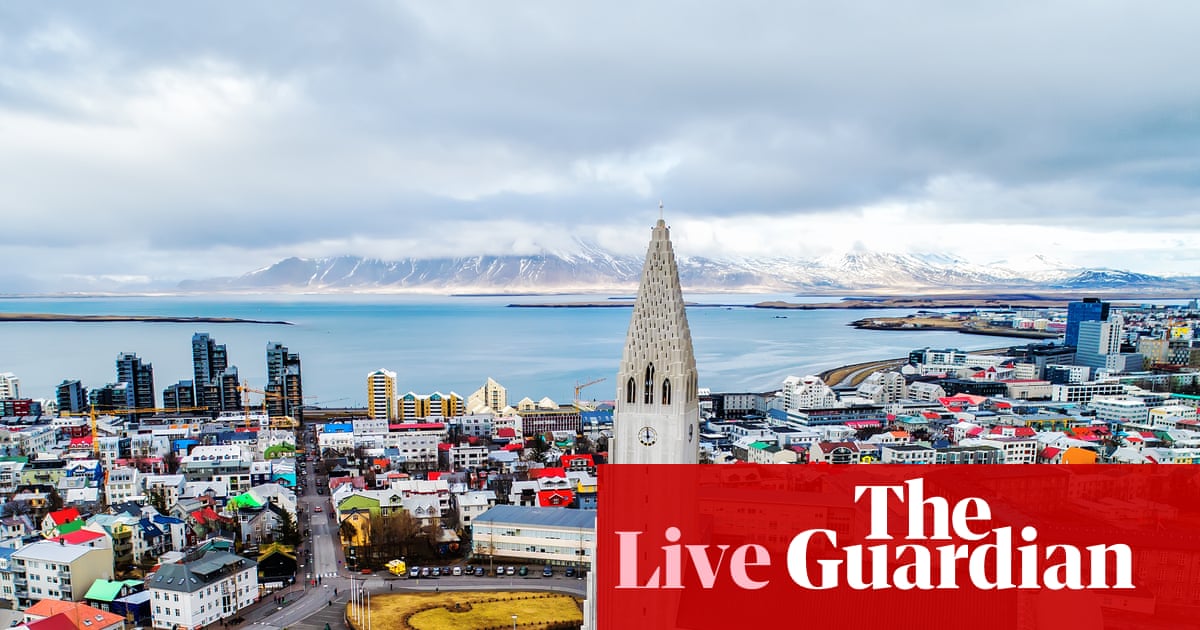
Iceland to hold referendum on opening EU accession talks in ‘next few months,’ PM says
Jakub Krupa
Iceland is to hold a referendum on opening accession talks to join the European Union in “the next few months,” the country’s prime minister Kristrún Frostadóttir said at a press conference in Warsaw.

Speaking alongside the Polish prime minister, Donald Tusk, she said that the government “has not decided finally on the date” yet, but it is going to be “in the coming months.”
“We are going forward now in the next few months – possibly, as we haven’t decided finally on the date, but in the coming months … – to have a referendum on opening up the accession negotiations for Iceland for possibly joining the EU,” she said.
She added that during her bilateral talks with Tusk, the pair “talked extensively about the importance of understanding that this is about opening an opportunity” and integrating Iceland more with the EU, while preserving “the respect for Icelandic identity within Europe.”
She said it would be important for Iceland to see that its distinct Arctic identity is “taken into consideration,” as well as its own “way of life or the way we use our resources.”
Tusk said he would be “more than happy” to see Iceland join the bloc, drawing on Poland’s experience as a “success story” in the European integration.
He also agreed with Frostadóttir on the importance of making sure the EU “show respect” to all countries and “treat bigger and smaller countries equally.”
“I would be more than happy if Iceland [joined] part of our community, even if [the EU] needed to change a little bit for that, be more flexible, and I would be ready to work with Kristrún on this [as] it is in our common interest,” he said.
Tusk also drew on his personal experience of Britain’s withdrawal from the European Union, pointing to the shifting attitudes in the British society ten years on from the Brexit referendum as the evidence of belated appreciation of the value of the EU membership.
“Maybe the best evidence that it makes sense to discuss integration is the situation in the UK. If you ask people … about Brexit … the latest polls are absolutely clear that 65% of the Brits would vote for the EU today; more than 80% of young people in the UK are in favour of a possible membership of the EU. [So,] if you have this very experience of Brexit, maybe you know much better than others that the membership of the EU is something really valuable,” he said.
Responding, Frostadóttir diplomatically said that her government would “listen to whatever the Icelandic population wants to do,” but thanked him for his comments acknowledging Iceland’s own identity.
Some 30,000 Poles live in Iceland, making them by far the largest foreign born community in the country, with Frostadóttir somewhat touchingly paying tribute to their contribution and singling out her daughter’s “favourite teacher in the kindergarten” named Małgorzata.
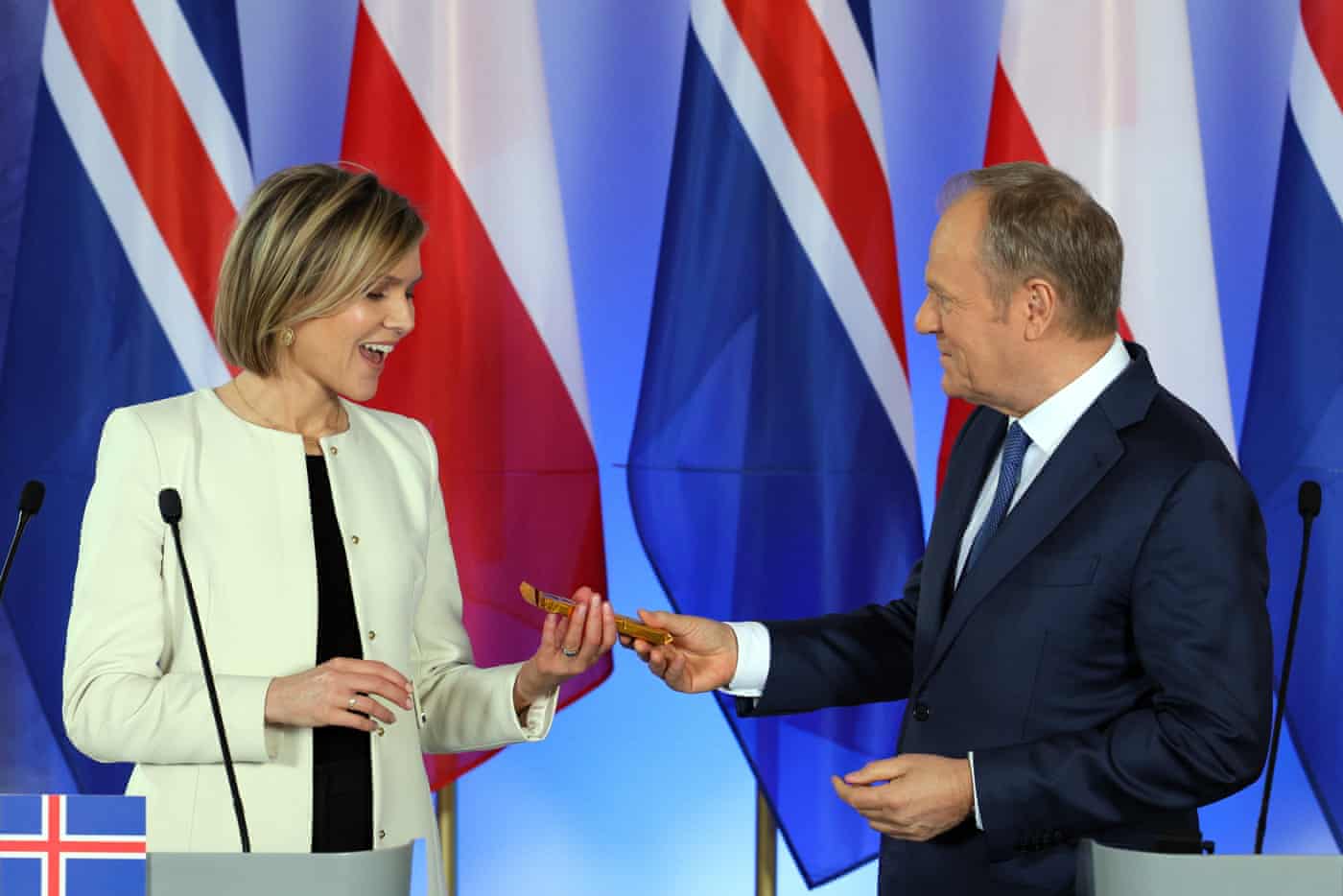
As a gift, Frostadóttir was also given a Polish chocolate wafer bar Prince Polo, which is very popular in Iceland – and apparently is her dad’s favourite sweet snack.
Key events
-
Closing summary
-
Iceland to hold referendum on opening EU accession talks in ‘next few months,’ PM says
-
Germany ‘appalled by Hungary’s behaviour’
-
First Ukrainian drone plant in UK begins operations
-
Former Polish intelligence chiefs face charges over Pegasus spyware
-
Orbán doubles down on attacks on Ukraine, EU, Hungarian opposition ahead of key elections
-
Switzerland and EU to finalise package of deals next week
-
EU exporters could face months of uncertainty on trade with US
-
Ukraine officials showed evidence of Russian damage to Druzhba pipeline, Poland’s Sikorski says
-
Repair works on Druzhba pipeline ongoing but in ‘very difficult circumstances’ amid Russian attacks, Ukraine tells EU
-
Orbán alleges Ukraine could seek to disrupt Hungary’s energy system
-
Repairing Druzhba pipeline ‘not that fast,’ Zelenskyy says
-
76th Italian song festival Sanremo gets under way
-
Germany’s Merz looks for opportunities with China, despite differences
-
Macron names new Louvre head to get it out of crisis after last year’s jewel heist
-
EU-UK post-Brexit reset needs to be ‘decisively accelerated,’ senior MEP says
-
Ukraine-US talks in Geneva on Thursday part of preparation for trilateral meeting with Russia, Zelenskyy says
-
‘Working very hard’ on Ukraine and pointed praise for Nato’s defence spending ramp up in Trump’s speech
-
Ukrainian negotiators to meet with US representatives on Thursday, Zelenskyy says
-
Morning opening
Closing summary

Jakub Krupa
… and on that note, it’s a wrap for today!
-
Iceland is to hold a referendum on opening accession talks to join the European Union in “the next few months,” the country’s prime minister Kristrún Frostadóttir said (17:18).
-
Her comments appear to suggest the government will bring forward plans to organise the vote, previously rumoured to be planned for early 2027 (17:37).
In other news,
-
Hungarian prime minister Viktor Orbán appeared to escalate his rhetoric towards Ukraine (14:32) as he made unsubstantiated claims alleging that Ukraine could be looking to disrupt its energy grid, and ordered soldiers to protect key energy facilities (12:54), just weeks before a closely contested parliamentary election in Hungary.
-
The two countries remain at odds over their views on what is blocking the use of the Druzhba oil pipeline, which continues to be affected by recent Russian strikes (12:54, 13:06, 13:12).
Separately,
-
German chancellor Friedrich Merz for deepening ties with China, while pushing for fairer trade rules between the two countries and seeking Chinese help on Ukraine as he continues his visit to the country (9:51, 11:56).
-
Switzerland and the European Union will next week sign a package of agreements aimed at simplifying and harmonising their ties, Berne and Brussels said (13:50).
-
The 76th Sanremo Italian song festival got under way last night at the iconic Ariston Theatre (12:37).
And that’s all from me, Jakub Krupa, for today.
If you have any tips, comments or suggestions, email me at jakub.krupa@theguardian.com.
I am also on Bluesky at @jakubkrupa.bsky.social and on X at @jakubkrupa.
The Icelandic referendum had previously been tipped for early 2027, so today’s comments from Frostadóttir appear to confirm some media reporting that the government will try to bring it forward.
The formal proposal – expected to be drafted early spring, according to local media – needs to be approved by the parliament first, after which there is a nine-month window for organising the actual vote.
The Icelandic National Broadcasting Service said in January that two opinion polls appeared to indicate a narrow preference for joining the bloc, but with the margins so thin that it could go either way.
“Two opinion poll surveys in 2025 suggested slim majorities for those who favour EU membership. In one by Prósent, 45% of respondents said they supported Iceland’s accession to the European Union, while 35% said they did not. A Gallup survey from the same year suggested similar results, with 44% of respondents saying they favoured Iceland joining the European Union, and 36% saying they were opposed.”
Iceland to hold referendum on opening EU accession talks in ‘next few months,’ PM says
Jakub Krupa
Iceland is to hold a referendum on opening accession talks to join the European Union in “the next few months,” the country’s prime minister Kristrún Frostadóttir said at a press conference in Warsaw.
Speaking alongside the Polish prime minister, Donald Tusk, she said that the government “has not decided finally on the date” yet, but it is going to be “in the coming months.”
“We are going forward now in the next few months – possibly, as we haven’t decided finally on the date, but in the coming months … – to have a referendum on opening up the accession negotiations for Iceland for possibly joining the EU,” she said.
She added that during her bilateral talks with Tusk, the pair “talked extensively about the importance of understanding that this is about opening an opportunity” and integrating Iceland more with the EU, while preserving “the respect for Icelandic identity within Europe.”
She said it would be important for Iceland to see that its distinct Arctic identity is “taken into consideration,” as well as its own “way of life or the way we use our resources.”
Tusk said he would be “more than happy” to see Iceland join the bloc, drawing on Poland’s experience as a “success story” in the European integration.
He also agreed with Frostadóttir on the importance of making sure the EU “show respect” to all countries and “treat bigger and smaller countries equally.”
“I would be more than happy if Iceland [joined] part of our community, even if [the EU] needed to change a little bit for that, be more flexible, and I would be ready to work with Kristrún on this [as] it is in our common interest,” he said.
Tusk also drew on his personal experience of Britain’s withdrawal from the European Union, pointing to the shifting attitudes in the British society ten years on from the Brexit referendum as the evidence of belated appreciation of the value of the EU membership.
“Maybe the best evidence that it makes sense to discuss integration is the situation in the UK. If you ask people … about Brexit … the latest polls are absolutely clear that 65% of the Brits would vote for the EU today; more than 80% of young people in the UK are in favour of a possible membership of the EU. [So,] if you have this very experience of Brexit, maybe you know much better than others that the membership of the EU is something really valuable,” he said.
Responding, Frostadóttir diplomatically said that her government would “listen to whatever the Icelandic population wants to do,” but thanked him for his comments acknowledging Iceland’s own identity.
Some 30,000 Poles live in Iceland, making them by far the largest foreign born community in the country, with Frostadóttir somewhat touchingly paying tribute to their contribution and singling out her daughter’s “favourite teacher in the kindergarten” named Małgorzata.
As a gift, Frostadóttir was also given a Polish chocolate wafer bar Prince Polo, which is very popular in Iceland – and apparently is her dad’s favourite sweet snack.
Germany ‘appalled by Hungary’s behaviour’
Hungary’s Viktor Orbán is no stranger to criticism and the foreign ministers of Germany and Belgium have been laying it on thick.
“All I can say is that I remain appalled by Hungary’s behaviour,” said Germany’s Johann Wadephul, after Orbán blocked a major EU loan to Ukraine. He added that Hungary’s decision to veto the latest round of EU sanctions against Russia “betrays its own struggle for freedom”.
Belgian foreign minister Maxime Prevot also warned that “Hungary must understand” that for other EU countries “the patience is wearing thin very quickly”.
First Ukrainian drone plant in UK begins operations
Some news closer to home – the first Ukrainian drone production plant in the UK has begun its operations today.
Valerii Zaluzhnyi, Ukraine’s ambassador to the UK and former commander of the Ukrainian armed forces, made the announcement on social media, saying launching production in the UK “has a deep strategic logic”.
He said:
This is not a shift in the centre of gravity from Ukraine. This is an expansion of our joint capabilities and the creation of a second resilience contour that guarantees the continuity of production.
We are leaving the engineering expertise centre in Ukraine and integrating production into the British defence space. We are creating a new quality of partnership, where allies not only support each other, but also form a common industrial security base.
The drones manufactured by Ukrainian company Ukrspecsystems “have long proven their effectiveness in hi-tech warfare”, Zaluzhnyi added.
He does not say where the plant is based, but Ukrspecsystems said in September that it would establish a production and training hub in Suffolk.
Both Ukraine and Russia have utilised drones on an unprecedented scale in the now four-year war, filling a gap left by a shortage of artillery and precision weapons.
Former Polish intelligence chiefs face charges over Pegasus spyware
Former chiefs of Poland’s civil and military intelligence services face charges of misconduct in public office as part of a wider investigation into the previous government’s use of the controversial spyware Pegasus.
Pegasus is a powerful tool designed by Israeli company NSO Group. It is capable of taking control of a target’s mobile phone, accessing data from secure messaging apps and even turning the device into a recorder.
The two men, who led Poland’s Internal Security Agency and Military Counterintelligence Service, were charged on Wednesday, Poland’s prosecutor general said in a statement.
The prosecutors allege, among others, that they allowed for the spyware’s deployment despite not securing the high-level clearances required for intelligence operations. They could face up to three years in jail, the statement said.
For more on the domestic political controversies about the use of Pegasus, see Shaun Walker’s story from 2024:
Orbán doubles down on attacks on Ukraine, EU, Hungarian opposition ahead of key elections
Meanwhile, Hungary’s Viktor Orbán has doubled down on his rhethoric against Ukraine and the EU, claiming in a highly-confrontational social media post that “the Brusselian leaders” – his derisive term for top EU officials – “reached an agreement with president Zelenskyy to continue the war.”
“This is bad news for Europe. A war is being prolonged that clearly has no solution on the battlefield, yet causes immense destruction,” he said, stressing the high death toll of the conflict.
“This is what Brussels is supporting,” he claimed.
The pro-Russian leader, believed to be at risk of losing power after 16 years in the upcoming parliamentary election, claimed that Ukraine and Europe were losing the war, and unnecessarily provoking Russia into a nuclear confrontation – essentially repeating some of the most recent Kremlin lines (Europe Live, Tuesday).
He further made further allegations – without any evidence – that during the recent Munich Security Conference the leader of the Hungarian opposition Tisza party, Péter Magyar, concluded “a secret deal” with the EU, “under German patronage” and offered his support for the war.
“Hungary must stay out of this. The Hungarian government must safeguard the country’s security,” he said.
His comments need to be seen through the lens of the upcoming election in April, with polls suggesting Orbán is trailing behind Magyar’s Tisza by 10 percentage points, as he is seeking to ramp up his anti-Ukrainian rhetoric in a bid to make electoral gains.
Switzerland and EU to finalise package of deals next week
Meanwhile, Switzerland and the European Union will next week sign a package of agreements aimed at simplifying and harmonising their ties, Berne and Brussels said, as reported by AFP.
The Swiss government said in a statement that it had been informed Wednesday that Swiss president Guy Parmelin and European Commission chief Ursula von der Leyen “would sign the Switzerland-EU package of agreements (Bilaterals III) in Brussels on Monday.”
EU-Swiss ties are currently governed by a patchwork of agreements, and the two have for years been striving to nail down a broader cooperation agreement. Switzerland suddenly walked away from more than a decade of negotiations in May 2021, but the two sides picked up talks again three years later, AFP explained.
“Switzerland and the EU will now sign the remaining agreements and protocols on 2 March, together with a joint declaration establishing a high-level dialogue,” Berne said.
The deal will still have to be voted on by the parliament and approved in a referendum, though.
EU exporters could face months of uncertainty on trade with US

Lisa O’Carroll
in Brussels
Exporters from the EU may face months of uncertainty selling products to the US with some manufacturers now facing higher tariffs than they did under the deal sealed last August with Donald Trump.
European trade commissioner Maroš Šefčovič said on Tuesday the EU said it was facing “transitional period” of a few months in relations with the US with commitments from trade representative Jamieson Greer and commerce secretary Howard Lutnick that they stood by last year’s agreement.
Šefčovič yesterday said the transition period could last 150 days, up to 24 July, when Trump’s latest 10% tariffs apply.
The EU’s trade spokesperson Olof Gill said today that Brussels was waiting to hear how that would transition would play out after the agreement involving tariffs of 15% on most exports was shot down by the US supreme court.
“If the US has given commitment that it will honour its agreements, that it will honour the 15%, we are waiting for them to explain in peer operational detail how that will work.
As regards the legal basis [of the current and future deal], that’s what the Americans have to explain to us. So we have this transitional phase … We are engaging with the US to ensure that in that transitional phase the commitments made by the US or the joint statements are honoured.
We will continue on our commitments, and in the meantime, there’s this deadline within which the US has to explain what comes next.”
The EU also confirmed that some goods that were tariffed at more than 5% before the deal would now face tariffs of more than 15%.
Ukraine officials showed evidence of Russian damage to Druzhba pipeline, Poland’s Sikorski says
For what it’s worth, Poland’s foreign minister Radosław Sikorski said that during his visit to Kyiv on Tuesday, “the head of Ukraine’s Naftohaz showed me pictures of Russian damage to the Brody pumping station on the Druzhba oil pipeline,” siding with the Ukrainian explanation of the situation.
Repair works on Druzhba pipeline ongoing but in ‘very difficult circumstances’ amid Russian attacks, Ukraine tells EU
Lisa O’Carroll
Meanwhile, the European Commission said it was told by Ukraine that its efforts to repair the Druzhba oil pipeline connecting Siberian oilfields with central Europe were being hampered by heavy bombardment from Russia.
The commission’s president, Ursula von der Leyen, asked Ukraine to “accelerate” the works during her visit to Kyiv earlier this week.
But Ukraine told the European Commission that “emergency preparatory work is ongoing, but in very difficult circumstances,” an EU spokesperson said.
“We understand the point of view of President Zelenskyy, who says that the Ukrainian people are constantly repairing what Russia is systematically destroying, and some citizens are even losing their lives, [while] repairing critical energy infrastructure,” she said.
“We condemn in the strongest terms Russian attacks on Ukraine’s energy infrastructure,” she added.
Orbán alleges Ukraine could seek to disrupt Hungary’s energy system
And in the last few minutes, Hungary’s Viktor Orbán has escalated this conflict with Ukraine even further, claiming that Kyiv could be looking to “disrupt” the operation of Hungary’s energy system.
He offered no evidence to support the claim, but said that Hungary would deploy soldiers and equipment to protect key energy facilities.
The move comes as Orbán seeks to make his fiercly anti-Ukrainian stance one of the key points ahead of the key parliamentary election in April, which could see him ousted after 16 years in power.
Source link
