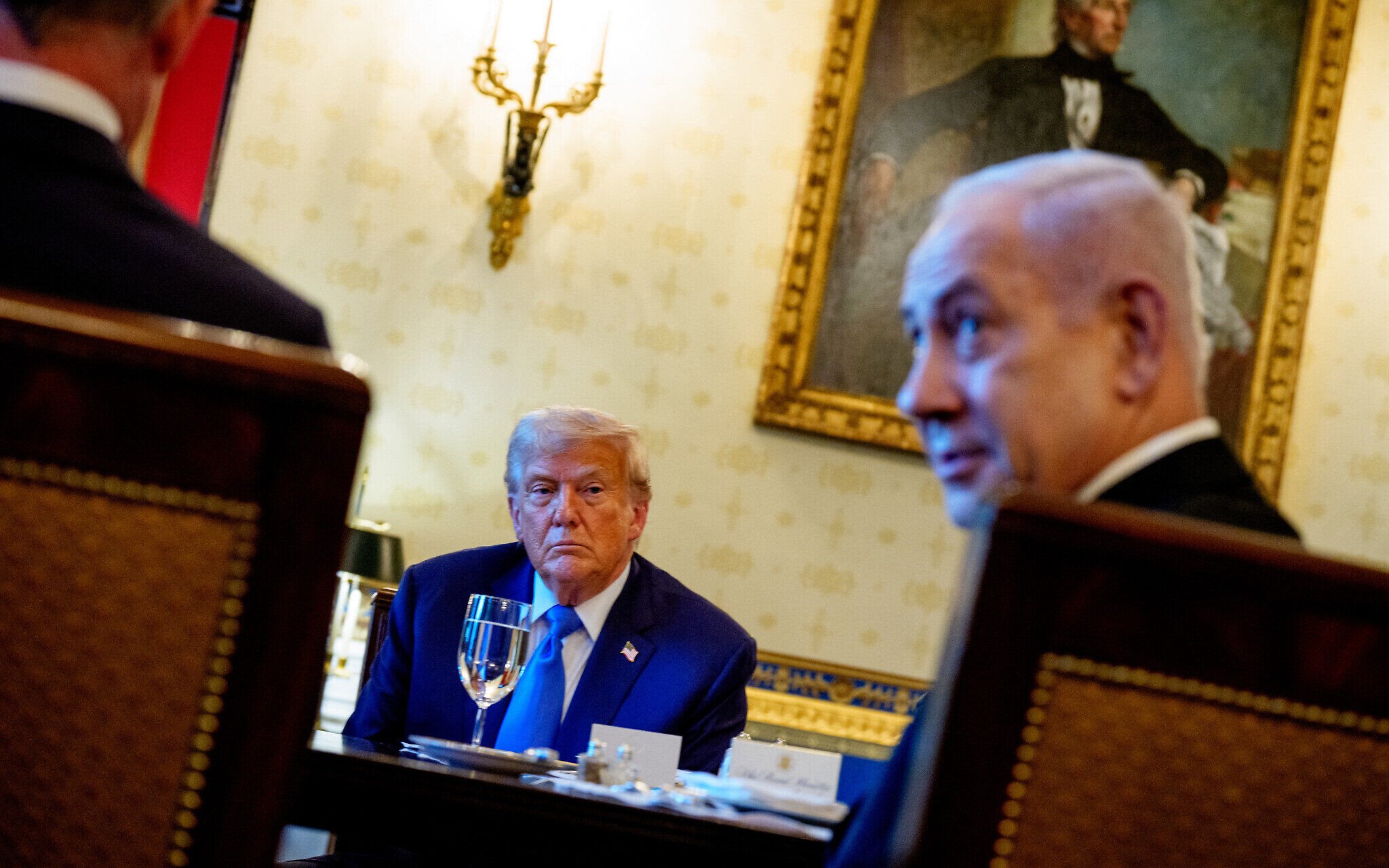
All five of Prime Minister Benjamin Netanyahu’s meetings this year with US President Donald Trump were important landmarks for Israel’s security and standing in the world. Yet the sixth, slated for Monday at Trump’s Mar-a-Lago resort, comes at an especially critical point, where difficult decisions must be made on the way forward in Gaza, Lebanon and Iran.
The first phase of Trump’s 20-point vision for Gaza, announced in September following the leaders’ fourth meeting in Washington and celebrated in October during their most recent meeting in the Knesset, is reaching its endpoint. Though such a feat was difficult to imagine on that “big, big day,” when the leaders announced the plan in the White House, all the living hostages have since returned to Israel, and the body of only one slain hostage remains in Gaza. Food and aid are flowing into most of the Strip.
This hardly came easily. Even the first phase of the plan, ostensibly more straightforward than the second, required close American oversight in the form of the Civil-Military Coordination Center in Kiryat Gat and a steady stream of visiting senior officials to maintain the ceasefire. Deadly Hamas attacks on IDF troops and escalating Israeli strikes in response strained the truce. The Rafah crossing between Israel and Egypt is supposed to open in both directions, but remains shut, as Egypt refuses to open it at all as long as Israel insists that Gazans only be allowed out and no one in.
Moreover, Hamas was supposed to hand over all the slain hostages in the first 72 hours after the ceasefire took effect, but handed over none. Instead, they were returned in small batches, with Israel accusing the terror group of intentionally slowing down the process to buy time.
Trump and his advisers believe that the key to the deal’s success is maintaining momentum. As long as things keep moving forward, an alternative to Hamas will gradually emerge, and the terror group will weaken over time.
Israel, on the other hand, recognizes that Hamas has no intention of disarming, and Israeli leaders are not afraid of saying as much publicly.
It appears that the International Stabilization Force that the US is trying to pull together will not be anything that Hamas would fear. No nation wants to send troops if they would need to engage in combat. And were powerful, hostile countries like Turkey and Pakistan to contribute, they would represent a shield behind which the Palestinian terror group could rebuild its army, based on lessons learned in the latest round of fighting with Israel.
In this context, Israel wants a deadline from Trump for Hamas to disarm, with the threat of a no-holds-barred IDF operation hovering just beyond.
Moment of truth
Netanyahu intends to present the current juncture as one that will determine the legacies of Trump’s top envoys, especially Steve Witkoff and Jared Kushner, an Israeli source told The Times of Israel. They could either be remembered for rescuing the hostages and engineering Hamas’s demise, he will tell them, or for being outfoxed by Hamas while setting the stage for future conflict and bloodshed in Gaza.
There is no guarantee that Netanyahu’s stark — and arguably patronizing — message will land, especially without his right-hand man, former strategic affairs minister Ron Dermer, beside him anymore.
Dermer had proven adept at reading Trump over the past year, predicting that the president would join in the June strike in Iran, when the IDF brass, overly confident in its understanding of US politics, was sure that Israel would be bombing the country’s nuclear sites alone.
Now, many of Dermer’s past files fall on Israel’s ambassador to Washington, Yechiel Leiter, who is acting in his first diplomatic role and is far less ideologically aligned with Netanyahu than Dermer. Leiter is firmly in sync with the religious settler right, a bloc with which Netanyahu partners, but is not a part of.


Moreover, if recent reports are to be believed, there is some measure of Netanyahu fatigue among Trump’s top advisers. According to Axios, they believe that the prime minister is sabotaging the ceasefire deal and peace process.
Netanyahu also has his work cut out for him on other dangerous fronts.
Israel battered Iran’s Hezbollah proxy in late 2024, and the Lebanese government that emerged in the wake of Israel’s victory does not hide its desire to end the terror group’s existence as an independent army.
However, the Lebanese Armed Forces is no match for Hezbollah if it ever comes to blows, and the Shiite militia is sure to wield the threat of a potential return to civil war in Lebanon if the government pushes it too hard.
On that front, Netanyahu should have an easier path to walk this week. The US deadline for Hezbollah’s disarmament will end with the calendar year, and top US officials are warning on the record that Israel will escalate its attacks if the terror group continues to cling to its guns and rockets.
Moreover, even as the IDF has killed almost 400 Hezbollah operatives since the 2024 ceasefire, the Trump administration has continued to give Israel a green light to violently impose its will on the Iran-backed group.


Giving, in order to receive
Despite being helpless in the face of Israeli strikes throughout the 12-day war in June, the Iranian regime is actively exploring ways to recover and eventually hit back. Its rule remains secure, and it sees some success in its ballistic missile project after dozens of missiles snuck through Israeli defenses, hitting important bases and killing Israeli civilians. As opposed to its nuclear program, no treaty keeps Tehran from building as many ballistic missiles as it can.
Netanyahu, as he did in the first half of the year, will try to align Trump’s approach as closely as possible with Israel’s on the timing and operational details of another potential attack on the Islamic Republic. One should keep in mind that Trump eagerly went along with a deception campaign in the weeks and days leading up to the Israeli strikes, which included leaks about ostensible disagreements between Jerusalem and Washington.
A repeat of such coordination against Iran remains a possibility, but as Trump sees much of his foreign policy through a transactional lens, Netanyahu will have to give to receive.
Changing Israel’s approach to Syria’s new regime is a relatively easy place to start. Dependent as he is on the West’s belief that he is a pragmatist who has left his jihadist ways behind, Ahmed Al-Sharaa and his government have absolutely no incentive to threaten or attack Israel. Moreover, Syria is currently firmly on Israel’s side in the fight against Hezbollah and Iran, and is the player best situated to block the terror group’s rearmament on the ground.
A slow but steady withdrawal of IDF forces from the buffer zone inside Syria is a relatively modest price to pay for more enthusiastic Trump support against the Iranian axis.
Still, two domestic factors further complicate Netanyahu’s mission.


He faces elections within the next year, and as the sitting prime minister on October 7, 2023, and the leader who oversaw a grueling war that left Hamas in power, Netanyahu is not in an especially strong position. The two scandals in his own circle — Qatargate and the leak of classified intelligence to the Bild newspaper — gained new momentum over the past week, and could weaken him further.
Netanyahu must therefore balance his need to project effective wartime leadership with avoiding a crisis with Washington that would undermine his claim that he is best equipped to capitalize on Trump’s second term.
At the same time, he is attempting to persuade a Trump who deeply supports the partnership with Israel, but who has close advisers and family members who favor a cooler bilateral relationship.
You get in a ceasefire what you won on the battlefield, and while Netanyahu spokeswoman Shosh Bedrosian claimed two months ago that Israel achieved all of its war aims with the Trump plan, its implementation shows how wishful that statement was.
It may well be that Israel must return to the battlefield in Gaza — and potentially in Lebanon and Iran — to craft the peace that will enable the realization of Trump’s vision for a stable, prosperous Middle East. But Trump would prefer that outcome to be ushered in through his unique, and occasionally effective, brand of diplomacy.
If a new Middle East is to have a chance, Trump and Netanyahu will need to reach a shared understanding this week on how to get there.
-

-

-
-
-