

Is China’s military as strong as it looks?
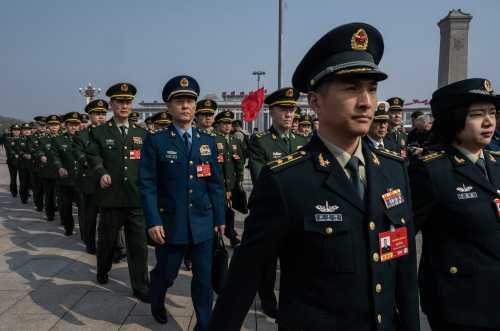
Ryan Hass speaks with Jon Czin and John Culver, a top expert on China’s military, about how sweeping leadership purges and rapid military modernization are reshaping the People’s Liberation Army. What do these competing forces mean for the risk of conflict with the United States? And what lessons are China’s military leaders learning from the U.S. war with Iran?
CULVER: If you start to behave as if you think China’s already decided to go to war, then I think war becomes inevitable. We will fall into a very deep deterrence trap. And it will be a highly lethal engagement for both sides, probably without a clear winner.
[music]HASS: Hello, you’re listening to The Beijing Brief from the John L. Thornton China Center at Brookings, part of the Brookings Podcast Network. I’m Ryan Hass, director of the China Center. And the Beijing Brief is a biweekly podcast focused on unpacking the forces shaping U.S.-China relations and China’s political, economic, and technological ambitions.
With me today to discuss China’s military is my friend and co-host Jon Czin, as well as our nonresident senior fellow John Culver. Jon, you’re on the hot seat this time around, no longer serving as host, but, instead the source of interrogation. John Culver, it’s really wonderful to have you on the show with us today. I consider you a national treasure. You’ve been studying China roughly as long as I’ve been alive.
CULVER: Gee, thanks Ryan.
CZIN: Only 25 years. Amazing!
[0:59]HASS: But you’ve also briefed presidents, prime ministers, and so many other leaders over the course of your career. So it’s really wonderful to be able to allow the public to enjoy the pearls of wisdom that previously were only reserved for top leaders.
My goal for our conversation today is to extract as much insight from two Johns who both used to work at the CIA and are experts on the Chinese military. On one hand, China’s military is undergoing a massive buildup. Xi Jinping has stated that China must become world class by its centennial in 2027 with expanding nuclear, maritime, cyber, and space capabilities. And at the same time, the Chinese military has been rocked by purges. I often joke that one of the most dangerous jobs in the world today is to be a Chinese general, because many of them end up in jail or worse.
And so really what I want to try to tease out of both of you is how to reconcile these two competing forces: China’s rapid military buildup and the operatic level purges that exist at the same time. What does this tension tell us about China’s capacity to pursue its ambitions?
But before we get into that, let me just ask both of you how did you get interested in China’s military? What is your origin story here?
[2:12]CULVER: Yeah, I have the well-worn path I think most experts in our field have of having no background on China other than my grandparents meeting in Beijing in the 1920s. And then in 1984, I answered an ad in the Washington Post for the CIA. And of course it’s a rapid process. Merely two years later or a year-and-a-half later, they invited me to join.
And after the successful interview, I said, what am I doing? Because that wasn’t made clear at all during the interview. Oh, you’re going to be doing China. In fact, you’re going to be the only analyst covering Chinese ground forces, which was at that point, the largest service in the world. It was like 3.5 million troops. I said, well, I better get cracking because I had very just general knowledge of China at that time.
So, luckily it was 1985 and the ‘80s were incredibly formative period for China with reform and opening under previous leader Deng Xiaoping. Of course, the Tiananmen Square crisis in 1989 and then the aftermath. So I was very lucky, you know, to be plunged into this and to have to kind of follow it from the inside as an analyst with access to great information at that time.
Really stood me in good stead. And I just kept getting energized by the content and the people I got to work for and the mission. So I just never had any reason to want to do anything else. I felt like I would’ve paid them to do that job. It was so fun.
[3:42]HASS: That’s awesome. Jon Czin, how about you?
[3:44]CZIN: So also similar kind of story. I had known that I had wanted to be an analyst for some time. You know, for background, I grew up in New Jersey and 9/11 happened a week into my freshman year of college. But I was at a small college founded by Quakers. I was a skinny kid. And I realized the contribution I was going to make to my country was probably not to become a sniper for the Marines or to become a Special Forces. Right? Like, that wasn’t going to work out for well for anyone.
But what happened was, you know, as I became more engaged in the world of foreign policy, international relations, I saw an ad in Foreign Affairs, kind of like John seeing the ad in the Washington Post, to become an analyst. I was like, oh, nerd for hire. That is something I am well positioned to do.
So I went to grad school and as I went on in my studies, I realized what I was really interested in was not the Middle East, but really China and about great power politics. I was into great power competition before it was cool, I think. Right? This is in the early 2000s.
And then, I had applied for a job at the Agency, went through the process, walked in the door. I knew I would be covering China. I had no idea what I would actually be doing until I got sworn in at, like, 6:30 in the morning. And then my new manager came in and and grabbed me and told me I’d be covering China’s leadership.
Now, what’s remarkable about that in retrospect is that Xi Jinping had just become vice president two weeks earlier, and heir apparent. Right? So my time covering Chinese politics has almost totally coincided with his own career and rise to the top.
And the reason I ended up following these issues related to the military was, number one, just because, you know, John and our military analysts were kinda the cool kids at the time and doing amazing work. But it was a really interesting moment. I started in 2008 and in that period there was this really interesting split screen in U.S.-China relations.
You know, my friends and family who knew I was interested in China were all asking me about the Beijing Olympics. There were very positive vibes in the relationship. President Bush was going to attend the Olympics. But I walked into an office that was very high strung and very worried about the possibility of a real contingency in the Taiwan Strait.
And John was deeply involved in that effort at the time and has written about it subsequently in Foreign Affairs. And that split screen, you know, the kind of amity on the outside but real sense of danger on the inside, I mean, that was a very formative experience for me as a China hand.
[5:50]HASS: Well, I want us to get to a conversation around Taiwan and how close we are to the possibility of conflict today. But before we do so, John Culver, can you level set for us what is the People’s Liberation Army? What makes it unique? What should our audience know about it?
[6:05]CULVER: I think the first thing people should know about the People’s Liberation Army is that it is not the military force of the Chinese state. It is the armed wing of the Communist Party. And that gets very relevant when you look at what Xi’s done to the high command over the last two years.
They’re a force that traditionally was the largest in the world, very backward in terms of equipment, and then moved after 1999 to really change that. It became much more modern and have more capabilities.
So today, 26 years on, you see a highly lethal force, you know, most capable missile forces in the world. And I say that with a pretty good knowledge of what U.S. capabilities are. A force that can present many problems that the U.S. military hasn’t had to deal with since World War II.
Tremendous scale. It’s no longer the largest by a large margin. It’s probably on par numerically. A budget that’s grown exponentially since the 1990s to be second in the world only after the United States, with some interesting accounting to examine. So it’s a force that obviously the Pentagon has to take seriously into PACOM and the policy set.
But then the other side is, I don’t think that war is the plan for Xi Jinping. And, he decides how the PLA is going to be employed because he’s the head of the Party, the chairman of the Central Military Commission. And it pretty much comes down to him — since he fired almost all the other members of the Central Military Commission — when and how it’ll be employed.
And so I think that’s the central tension you see in the Chinese military today, is that he wants options. He wants a military that can really do things if called upon, and he doesn’t have to worry that they’re wholly corrupt or that the military is going to look after and put its own interests above those of Xi Jinping and the Communist Party.
[7:59]HASS: Jon Czin, John just talked about purges at the top of the Chinese military. Why should my mother living in Orcas Island, Washington, care about the purges? What is their significance?
[8:11]CZIN: So the significance of the purges is, number one, I think just in terms of understanding what’s going on in China, I think. John and I have looked at this closely, the scope and scale of what’s going on, you really have to reach back to either the period after Tiananmen or really back to the Mao era. Right? Like, this is very tumultuous what’s going on in the military.
And I think what’s impelling it is not that XI is distracted from preparing for some kind of contingency involving Taiwan and, you know, by implication of the United States. It’s because he’s serious about it. He’s willing to make very deep incisions, even to his own political network, to ensure that he has a military that’s capable with fighting the United States. And I think that is the real concern.
So this is not a today or tomorrow problem necessarily. Almost by definition, Xi has a lot of work to do to kind of renovate the high command. But it shows how serious he is. There was this whole debate about is this Xi just being paranoid in a way that’s more kind of clinical than useful in the system. It’s a possibility. But I think what’s really going on here is that it just shows Xi’s sangfroid.
And I think what it means for the long term, you know, less maybe for your mother and more for more for our kids, unfortunately, is that we’re going to be dealing with a military that’s formidable. Right? And that poses the kind of challenges, as John was saying, to the United States military that we’ve not really had to deal with in a long time.
I mean, I think we’ve seen, just in the last few weeks, we’ve had remarkable successes dealing with Iran, but we’ve also been bedeviled by relatively cheap kit, drones and other things. And that is not the PLA. Right? If dealing with Iraq and an insurgency and dealing with Iran is going to be nettlesome for us, I mean, dealing with the PLA is something really we have not dealt with in a long, long time.
[9:53]HASS: Right. John, do you share that diagnosis of the causes for the purges? Because there’s a lot of speculation in Washington and elsewhere that it relates to corruption or Xi’s desire for control or the possibility of a coup. There’s all kinds of stuff out there. So how do you explain why Xi Jinping is being so aggressive in sort of rooting out his top generals?
[10:17]CULVER: I’d offer some humility. I’ve been retired from government for six years. I pay attention to developments, but I’m also humbled by the fact that I don’t know from first level sourcing exactly what’s going on.
But, I think for Xi Jinping, he’s really reverting almost to Mao Zedong thought, which is power grows from the barrel of a gun. And the relevant power there isn’t warfare with the United States primarily. It’s keeping the Communist Party in power, and ensuring that the Communist Party doesn’t rot from within.
And I think the more he looked at the problem of corruption in the PLA, which, you know, from the time he started after the 18th Party Congress in late 2012, the first thing he did was go after senior military corruption. He arrested and, or had arrested, and imprisoned the two former most senior uniform military members. And it’s a drum beat that he’s now carried on ever since.
Now, the intensification I think we’ve seen in the last year or two shows that he’s now done with letting PLA processes try and manage this problem. And in a way corruption becomes kind of a broad rubric for a deeper set of issues he has, which is, first of all, it’s not really about fighting a war over Taiwan primarily. It’s about the PLA being absolutely subordinate to him and the Communist Party and absolutely responsive to him. And he’s seen examples where other authoritarian regimes, especially in the Middle East during the Arab Spring era, broke with their political leadership, turned on them. Egypt is a particular case, and there were others. And basically the military in those countries put their own interests above those of the political leadership. And he’s determined to make sure that will not happen.
So in a way, it’s useful for corruption to be a plausible reason why he’s now, as of a study done by CSIS published about a month ago, dismissed 53% of his very most senior generals and admirals, you know, of his four star and three star military leadership.
And he hasn’t replaced them. That’s the really amazing thing, is the Central Military Commission, the political organ under the Communist Party that governs the military, went from seven members down to two, which Xi is the leader, and one vice chairman. And he hasn’t replaced the former members. It’s still a two person committee. And that that’s still true, you know, six months later is just very, very interesting.
And so I would, caution anyone trying to make sense of this to, you know, have some humility that we’re in a very unprecedented era. And if anyone thinks they have high confidence about how this is going to play out, you might want to take that with a grain of salt.
[12:59]CZIN: Yeah. And I think it’s worth embellishing that last point, right, about having humility about this, because I’m mindful of this, especially after last fall’s Plenum. It’s not just that we don’t know sitting here in Washington what’s going on. I suspect that many of these officers are also unpleasantly surprised by what’s transpired over the last few years.
I referenced the Plenum where, you know, as our colleague Allie Matthias and I wrote about a large swath of Central Committee members were missing. Right? The top 200 or so members of China’s leadership met. And they represent all different parts of the Party apparatus, not just the military.
But I think it’s easy to forget, this is a heavily stovepiped institution. You have people flying in from Chongqing and Ningxia and further reaches of China who don’t have exposure and, you know, day-to-day dealings with the military. And I think even the military itself is very heavily stovepiped. And these guys show up for a major meeting, the big annual confab, and you look around, it’s like, why is the vice chairman of the Central Military Commission missing? Why are a bunch of general officers not in attendance?
And I think that that’s something that’s important to keep in mind is just how secretive the system is. And people don’t know inside the system truly until these things pop.
The other point I want to embellish that John made on corruption is that, you know, in corruption in many ways is a pretext for getting rid of these people, especially because of the way the PLA was for the first part of the century where everybody had their hand in the till and everybody was corrupt. It’s kind of very useful for Xi and the party leadership because then it gives them a reason to get rid of anyone that they wanted to. Right? They’ve got everybody’s permanent record on file.
[14:24]CULVER: Yeah. It’s more of a rationale than an actual reason.
[14:26]CZIN: Yeah, and I think insofar as it’s an actual reason, it’s not about corruption per se. Right.? And I just wanted to embellish this point about the Arab Spring. It’s not just about the money and the graft and the skimming off the top, you know, the kind of Jersey style graft and corruption. I’m sure Xi is disgusted by that and doesn’t like it. But it’s a sense that you are doing something that violates the party’s discipline that is inherently disloyal. Right? It’s not about corruption versus loyalty. This is a disloyal act. And it means you have your own set of interests independent of the Party. And I think that more than the actual money and the pettiness of it is really what Xi doesn’t like and what really gives him agita about this dynamic.
There’s one other part of this, too, about the political logic of how Xi has pursued these anti-corruption campaign inside the military. Because when it started, as John said, he went after the former top two officers in the PLA, the guys who had run the system and let it fester for so long, for more than a decade. And going after them was a really risky move. Right? This is like going after made men in the mafia and living to tell about, and he did this as a brand new general secretary. Right? It was pretty brazen and breathtaking the fact that he was willing to do it, but there was a political logic to do it.
We always talk in the China world about, you know, “kill the chicken to scare the monkeys.” You’re going to go after the underlings to send a message to the grandees in the Party. This was just the opposite. Right? This is what we we were jokingly called in one of our Foreign Affairs piece, “killing the monkeys.” Right? You know, so that you scare the bejesus out of everybody else further down the food chain.
I think what’s remarkable now that we’re into Xi’s first term is that Xi started his tenure by going after his enemies and rivals. Now he’s going after his friends and people that he has a real personal relationship and people he personally promoted and handpicked.
So for us as analysts on the outside, and I think probably again for these guys too, it raises a whole host of different analytic questions. Right? It’s the same beast, but it’s taken on a new shape.
[16:16]HASS: Right. Well, I think that you guys have done a tremendous job of sort of coloring in the emotional state of senior leaders in the Chinese military —
CULVER: — or at least analysts trying to make sense of it.
CZIN: Yeah. We’re not psychoanalysts, we’re just regular analysts —
[16:30]HASS: — as well as the potential motivations for Xi Jinping to take such aggressive and risky moves within his own military leadership.
I want to flip the script now and look at the other side of this equation, which is Chinese military capabilities. And, John, maybe we can start with you. Where do you see China’s military most capable of threatening U.S. forces? Where do you see the Chinese military as most vulnerable to American military capabilities right now?
[16:57]CULVER: I mean, we’re talking about a military that hasn’t been in a war since 1979 when it invaded northern Vietnam, which didn’t go great for them. I mean, they seized all the northern provincial capitals of Vietnam and destroyed a lot of economic infrastructure. But they lost 35,000 KIA, killed in action, in two weeks of combat. So, that was a kind of a a warning.
So they’ve had to do instead is study how the U.S. does war. So they built a military that really harvests a lot of the lessons of what they’ve seen us do since Desert Storm and every iteration of combat through the Near East and Middle East over the last few decades.
And so they build a force that’s technically sophisticated, highly lethal in terms of its ability to conduct long range precision strikes and roughly comparable to the United States in cyber capabilities, in counter space capabilities. It’s now a major space fairing power with relay satellite constellations and surveillance satellites that are roughly the same as ours.
So they have capability to see anywhere on the planet. We cannot move major naval forces anywhere close to China without us being under constant surveillance. Which is really striking, because as recently as the mid-1990s, when the Chinese were conducting exercises on the Taiwan Strait, the Clinton administration wanted to send a demonstration of deploying carrier strike groups. And I told the secretary of defense at the time, Bill Perry, you’re going to have to go on TV and tell them you’re doing it because they have no means to detect it otherwise unless you’re within visual range of China.
So today they track us globally. They know where U.S. forces are postured. They have an extremely sophisticated surveillance capacity. I don’t know if you’re as tired as I am about hearing about the latest massive Chinese cyber intrusions of critical U.S. networks.
So they have a capacity to not only wage sophisticated 21st-century warfare, but a capacity to hold at risk things well beyond the physical area of the Taiwan Strait should it come to that. Both in the U.S. domestically, in our telecommunications infrastructure, and then also anywhere in the Western Pacific they could reach with hypersonic, supersonic ballistic and cruise missiles. And they’re building massive inventories of those weapons.
One lesson they already have learned that we seem to be learning now again in Iran is that you go through a lot of expensive stuff very quickly in high intensity technological warfare. And so they are, building deep magazines for all the systems they would need for any potential conflict or crisis with us.
[19:40]HASS: And where do you both think that they feel most vulnerable to American military capabilities today?
[19:45]CULVER: I think they’re extremely mindful that they haven’t been to war and going on 50 years, and that everything they think they’ve learned has been from observing us. And it’s not the same thing as doing it yourself.
So, for example, a Taiwan Strait conflict could involve a massive naval blockade. They’ve never done that. It’s harder than it sounds. It’s not as hard as invasion, but it’s pretty darn hard. You have to show an ability to iterate naval and coast guard and ballistic missile fires, to have a very well-engineered surveillance network to be able to spot ships at sea and interdict them or target them as needed.
And then invasion is a whole different scale of problem. Being able to move 150,000 troops in a single wave across a hundred miles at its narrowest of Taiwan Strait, land them, supply them, deal with U.S. Intervention — that’s a huge, multifaceted, command and control problem. Only made kind of more imponderable if you’ve just eviscerated your general officer corps and all the people who were, training and preparing troops for that mission.
[20:49]HASS: And so how do you think that this nets out? They have annihilated the general officer corps, the top leadership of the Chinese military. Does that affect Xi Jinping’s risk calculus when it comes to Taiwan? Will it impact decisions that he makes about applying pressure or potentially more, using force against Taiwan?
[21:07]CULVER: It’s a bit of a paradox how Xi Jinping views military preparation given that he’s eviscerated the general officer corps over the last two years. On the one hand it should reassure people and think, you know, I’m reading the tea leaves of our own government, if they thought that, there was a real risk that China was preparing for conflict in the next year or two, I think we would’ve had second thoughts about committing so much force to Iran. I think they actually looked at what Xi had done to the PLA and understood that he’s not planning to initiate conflict.
And I think for Xi Jinping, Taiwan remains a crisis he needs to avoid rather than an opportunity he wants to seize. Because his real eye is on not seizing the island as soon as he thinks the PLA’s ready. It’s actually building toward his other mid-century goals, which is to have the largest economy in the world, to be highly innovative, dominant manufacturing economy. To have China be basically unreliant on the rest of the world, while the rest of the world is highly reliant on China.
So in that scenario, if he’s not looking to go to war with Taiwan, if that remains a crisis he wants to avoid rather than an opportunity he needs to seize, then I think it makes sense then why he thinks he can do what he did to the general officer corps. He’ll have time to rebuild.
He’s also probably a little happy about what’s going on on the island, which is going through a highly polarizing moment. A divided legislature really set against the current President Lai that’s creating really unprecedented kind of partisan division on the island.
[22:42]HASS: Right. Jon, what do you think?
[22:44]CZIN: It’s a great question and and it’s one I’ve been getting a lot this year. And the way I’ve started to think about it is that, because of the reasons John articulated at the end, the causal vector runs the other way. Right? Rather than how are the purges shaping Xi’s thinking about Taiwan, I think Xi is probably looking at things macroscopically and thinking, what kind of space do I have to renovate my high command given the current geopolitical condition?
So not a key driver of it, but I think he’s probably sees a pretty permissive environment, that he feels safe because of the political situation on the island where you had the KMT chairman, chairwoman, just come and visit him just a couple weeks ago. President Trump doesn’t seem as personally invested in the security of Taiwan as previous administrations. Right? He doesn’t seem as interested in it.
And so I think, you know, if you’re Xi Jinping and you’re thinking about should I take a sledgehammer in effect and begin demolition and renovation of my high command, now seems like a relatively safe moment to do it. Right? Like, maybe this is just on my mind because I’m going through the process of moving and home renovation, but this is not the kind of thing you do at a moment of insecurity. It’s like when you feel like you’ve got a little bit of cushion. Right?
[23:40]HASS: Yeah. I’ve I’ve heard you say that you never renovate your roof when it’s raining.
[23:44]CZIN: Yes, exactly. That’s my, that’s my chengyu 成语. And I think that’s a, big part of what’s going on. It’s not that, again, like I said before, it’s not like he’s distracted from the Taiwan issue set. It’s that he feels like he’s got space. It’s not a today, tomorrow problem. It’s not about the Davidson Window, so-called, and 2027. You know, he’s got time to be patient and see what happens in the next Taiwan election in 2028 and in our own elections. Right? And he’ll also be at the start of his fourth term.
[24:11]HASS: Right. So, Jon, picking up on that, help us situate ourselves in Xi Jinping’s shoes, thinking macroscopically about China’s overall ambitions and the military’s role in them. How do you explain China’s overall ambitions and the role that the military is expected to play?
[24:25]CZIN: I think the military is a crucial facet of it. And I think, you know, his predecessors poured a lot of money and resources and time into cultivating the PLA and to getting this modernization underway. But I think because Xi’s own father was a revolutionary commander himself, right, and had grown up in the PLA, and Xi himself had been a mishu 秘书 in the PLA, I think he understands their political importance and their importance to him personally throughout his tenure. And also understands what they mean for China on the world stage. Right?
So there’s often this debate in Washington that’s almost really theological about, you know, China’s place in the world order. What role does it want? You know, I think they are relatively parochial about these things despite some of their more grandiloquent promises and campaigns, like the various global initiatives. Right?
I mean, what we’re talking about, the germ of PLA modernization is that they recognized they didn’t really have the wherewithal or the resources to deal with the U.S. They couldn’t even see them when we would sail into the Taiwan Strait. So they realized we need a military that’s capable of dealing with the U.S. military in a contingency.
But what I think what’s interesting about that is the natural implication of that then is you’re building a military to deal in every facet with the world’s most capable military. The knock on of that is you are in effect designing the world’s most capable military yourself. Right? And so they watch us very closely and they study us very closely.
And that’s one of the things I worry about right now in this current moment with the Iran war going on, is that there is this school of thought in Washington that this is somehow having a deterrent effect on China. Xi’s already deterred. Right? There’s not something pneumatic going on where he’s just winding up and waiting for the right moment to take Taiwan.
But I think they are watching closely. And what I worry about is that they are seeing just how impressive our capabilities are, and they’re diligently taking notes, and that this is going to have a catalytic effect on the PLA’s modernization the same way that the first Persian Gulf War did, right, now that we’re in act three of this.
[26:17]HASS: John, what lessons do you think the Chinese are taking away from watching us prosecute war in Iran?
[26:22]CULVER: Well, I, I’ve watched them think about what to learn from war since we executed Desert Storm. And that was a real eye-opener because there were whole kinds of technological capabilities that were unknown to them. So they had a steep learning curve. Frankly, the curve isn’t very steep now; they’ve learned a lot of lessons.
So mostly I I think what they’re taking away is that we have reconfirmed some things that they already believed, and it’s telling them that they’ve made mostly the right procurement options and development options, but they need to do more in certain areas. So the area they’re probably going to latch onto hardest is going to be the expanding role of artificial intelligence in platforms for military use, especially drones.
Now, the situation on the Taiwan Strait, you know, like everything in Asia is dominated by the tyranny of time and distance. It’s unlike the war in Ukraine and even what we’ve been doing in the Strait of Hormuz. So the kind of systems that are capable and even transformative in those other battles are largely irrelevant to the Taiwan Strait, because you have to have platforms, whether they’re sea or air or subsurface drones that have serious range, serious ability to fly or sail or scuttle long distances.
And so that’s going to give them a different set of menu options than I think we’ve been confronting. I mean, one of the benefits they have, as Jon noted, was that the war they’re worried about and the enemy they’re worried about is the United States. And their single-minded focus on the preparation for conflict in their front yard, and then extending out maybe 2,000, 1,500 kilometers in the Western Pacific.
The U.S. has to prepare for contingencies globally. So we may spend, you know, eye-popping mounts, $1.5 trillion in the latest administration budget request. But that doesn’t eclipse what they’re able to invest in, you know, a third or half that amount, because they’re preparing for a single conflict really and a single adversary. And it’s all going to be in close proximity, whereas they’re going to have short logistic lines, they have the world’s dominant manufacturing base, and really dominant defense industrial base.
That’s one troubling note that I have as an American when I look at what we have done or not done in the last 20 years is our relative incapacity to quickly build large amounts of relevant things, especially for a war we’d have to fight on the other side of the planet.
[28:51]CZIN: If I may, I just wanted to underscore something there. Because there’s really a paradox here of China being the second superpower, right, that gives them an advantage over us in some ways. Whereas we have, like John said, we have these sprawling global responsibilities. China does not. And what that means is when we think about great power competition, I think they actually have a lot more discipline and focus. Right? They don’t have to worry about a wide range of things. They can get up every morning and think backwards about how to reverse engineer against our own advantages. Right? And we don’t really have that as the superpower.
So it’s kind of a paradox because we are still the preeminent force and the preeminent superpower. But those sprawling global responsibilities, our own kind of aspirations, it distracts us a lot of times. Right? And it makes us harder to sustain that position and remain the incumbent superpower.
[29:36]HASS: So final question for both of you. One of the questions that I receive often when I travel around the United States is are my children going to have to go to war against Chinese military service members? Looking out over the next decade and beyond, because we’ve established that we are in a period of renovation of the Chinese military, on a scale of one to 10, 10 being the most excited or anxious, and 1 being the most relaxed, where do you both fall on the spectrum of likelihood of U.S.-China conflict over the next decade or beyond?
[30:05]CULVER: I’d probably today peg it at about a 3 because neither the Chinese or the U.S. want to fight this war. And so there’s an inherent constraint on the possibility of conflict. Now, I’m mindful that can change. I mean, the reason why it’s not higher than a three even given uncertainties and the highly lethal nature of advanced technology and conflict, is because the U.S. has long had a stable policy that removes a lot of the potential sparks, especially over Taiwan.
Now, where I have caution and where I’d be, you know, thinking about changing my rating to a higher number is if our policy suddenly changes or if China’s policy suddenly changes. If for some reason Taiwan became much more important as Xi Jinping or any leader’s idea of legacy or his ability to wield power, then I think we could be in a whole new era.
Similarly, if the U.S. no longer maintained its One China policy with discipline, if we start to behave as if Taiwan’s just another country and one that merits our defense, then, you know, that can be true on a moral ground, but I think it we’re getting into treacherous territory in terms of war avoidance.
I’m not telling my grandson, you know, please don’t join the military. Right? But I think that it’s worth watching. And the thing is, we’re in a more, everything that lends stability to this situation over the course of my life and career looking at China has all weakened over the last 10 years.
So, I’m hoping the trend can still be our friend, and a lot of that’s going to be with policy continuity. If you start to behave as if you think China’s already decided to go to war, then I think war becomes inevitable. We will fall into a very deep deterrence trap. And it will be a highly lethal engagement for both sides, probably without a clear winner.
[31:57]HASS: Right. Zero to 10, what do you think, Jon?
[31:59]CZIN: I think 3 out of 10 is about right, but I think this is kind of the conundrum for U.S. policymakers, especially, you know, 25 years into a century that has been highly kinetic. This is what I worry about, right, for the defense community and for a lot of policymakers that allows you to defer a lot of those hard decisions about what we need to do to get our act together for an increasingly capable PLA. Right? Because there aren’t things going boom, right, there’s always some kind of crisis in the Middle East or now in Europe or somewhere else that you can and should focus on.
The dynamic that has led throughout throughout my career is a shifting military balance of power that favors China. Right? So what I really worry about is not necessarily about the actual hot war, but just that we wake up one day 10, 15 years from now and find out we’re not the preeminent military superpower because we’ve been so distracted and unfocused for so much of this century. And all of a sudden China really is. And even if there isn’t a conflict, that’s very insidious. Right? And that’s a very dangerous position to find ourselves in down the road. And I think that’s where the trend line is right now.
[32:59]CULVER: Yeah. I kind worry that political trends here could shift us to a growing sense in the public, if not policymakers, that we can’t fight a war over Taiwan. that either it’s not worth defending or it isn’t a vital American interest. Because then I think, you know, the whole kind of architecture starts to shake.
[33:17]CZIN: So one last point, I I mentioned earlier that early in Xi’s term there will be another election on Taiwan. And that that’s a potential inflection point for Xi. I think if Xi is dealing with a fourth term of the Democratic Progressive Party —
HASS: — the incumbent party —
CZIN: — the incumbent party in Taiwan, which Beijing views as anathema, I think Xi potentially starts to get very frustrated. Right? And I think he could, reach for some of those higher end, kinetic operation, short of a full-scale invasion or the million man swim. Right? But something like an offshore island seizure seizing some of Taiwan’s islands that are very close into China, or doing something along those lines just to shake the dynamic up.
Because I think as he gets into his fourth term and he gets later into his seventies, he is going to be thinking more about his legacy. And if he feels like the cross-strait dynamic is stuck and not trending in his favor and that they are just, in his own words, handing this down from generation to generation, that’s going to be increasingly unacceptable for him.
And that could be inherently dangerous if he does start to feel that impetus, especially in his old age.
[34:17]HASS: Well, we’re going to have to leave it there for today. John Culver, Jon Czin, thank you very much for lending your wisdom and your insight into how to read China’s military in its overall strategic plans. The one thing I’ve taken away is that the tumult at the top of the Chinese military is real, but that should not offer any false complacency to anyone who is paying attention to the relationship between the United States and China.
So, for more in-depth analysis from our team, visit the China Center on the Brookings website at Brookings dot edu slash China Center. You can also subscribe to our monthly newsletter at the China Bulletin for the latest updates.
Thank you.
CULVER: Thank you, Ryan.
CZIN: Thanks.
On behalf of the team at the John L. Thornton China Center, thank you for listening to The Beijing Brief. This podcast is produced by the Brookings Podcast Network.
Our thanks to the production team, including supervising producer Ike Blake; senior producer Fred Dews; producer Allie Matthias; audio engineer Gastón Reboredo; and video producers Daniel Morales and Teddy Wansink. Rachel Slattery designed the show’s artwork. Also, thank you to our colleagues in the John L. Thornton China Center, Foreign Policy, and Office of Communications at Brookings for their support.
To learn more about our research, visit us at Brookings dot edu slash ChinaCenter. And to learn more about this podcast, go to Brookings dot edu slash TheBeijingBrief, or wherever you like to get your podcasts..
Source link
