

When a ram tips its head back, curls its upper lip, and takes a deep breath – what is known in the world of animal husbandry as a “flehmen response” – it is often a sign of arousal. Sheep have a small sensory organ located above the roof of the mouth, and the flehmen response helps to flood it with any sex pheromones wafting about.
Usually, rams flehmen when they encounter ewes during the mating period, according to Michael Stücke, a farmer with 30 years of experience raising sheep in Westphalia, Germany. But on Stücke’s farm, the rams flehmen “all the time”.
“They do this all the time, because they find each other attractive,” said Stücke of his 35 male sheep. “They’re cuddling. They’re showing signs of affection. They’re jumping on each other. It’s undeniable that they’re attracted to each other.”
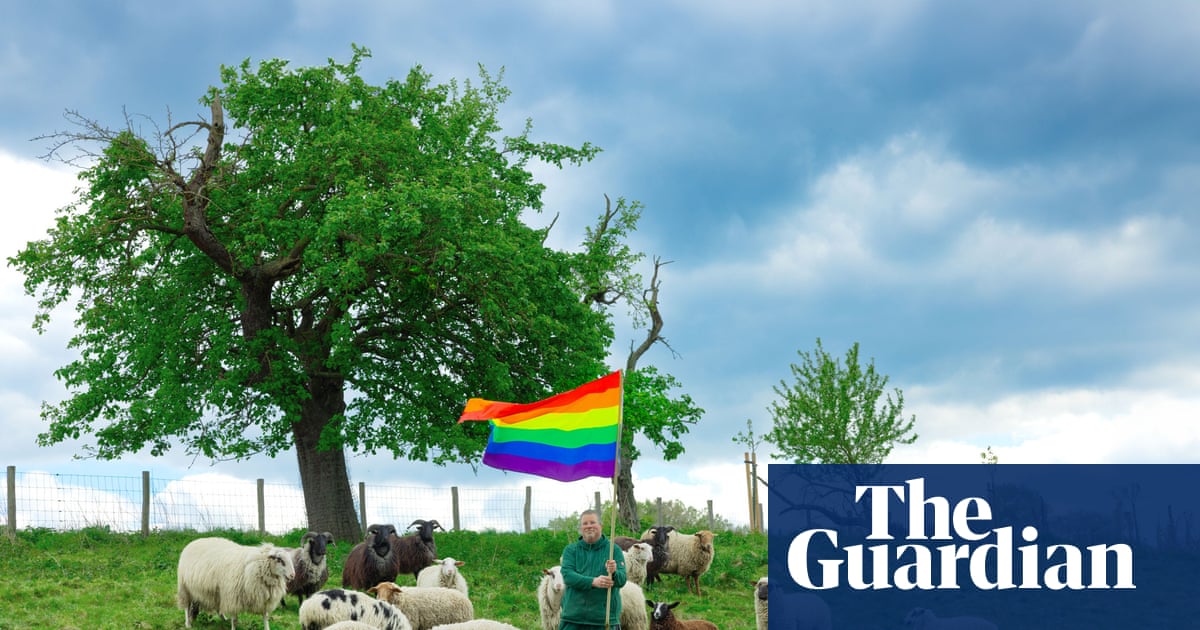
Stücke is the proud shepherd of the world’s first and likely only flock of gay rams. Though researchers have found that as many as 8% of male sheep are “male-oriented”, homosexuality is viewed disfavorably by most farmers, who expect rams to perform a breeding function. Rams who refuse to breed are often slaughtered for meat, and it was during a discussion of this harsh reality with Stücke’s friend and business partner Nadia Leytes that the idea for Rainbow Wool was born: “What can we do to not send all of them to the slaughterhouse?”
“My heart beats for the weak and oppressed in general,” Stücke told the Guardian, with Leytes translating. “I am gay myself and know the prejudices and obstacles that come with being a gay man, especially in the agricultural business.”
Rainbow Wool’s solution has been to buy gay rams directly from breeders, outbidding the price they might receive from a slaughterhouse, and keep them for their wool. The flock now numbers 35, and the farm has a waiting list. Individual sheep can be named and sponsored – they include a Bentheimer landschaf named Wolli Wonka, a Shropshire named Prince Wolliam, and Jean Woll Gaultier – and the wool is processed by a mill in Spain. All profits are donated to LGBTQ+ charities in Germany. “A couple of sheep [have been] saved but also a couple of people,” Leytes said, noting that their donations have supported relocating people living in countries where being gay is illegal.
Correctly identifying a sheep’s sexual orientation can be tricky. “Everybody can just say: ‘Hey I have a gay ram,’” Stücke said, “but what we’re doing is observing their behavior.”
“Some rams basically jump on everything, whether it’s female or male,” he added. “That would not qualify as being a gay ram. That would qualify as being a dominant. But if a ram consistently refuses to mate with a female sheep, this is the sign that you know he prefers other rams.”
Stücke’s flock burst on to the fashion scene last month when they provided the raw material for a knitwear collection designed by Chrome Hearts collaborator Michael Schmidt and sponsored by gay dating app Grindr. Schmidt sent 36 looks down a New York City catwalk, all knit or crocheted from the wool of Stücke’s gay sheep. Each look represented a male archetype, starting with Adam sans Eve and including a pool boy, sailor, pizza delivery boy, plumber and leather daddy.
“I really wanted to lean into the gay,” Schmidt told the New York Times. “I view it as an art project. It’s selling an idea more than a collection of clothing, and the idea it’s selling is that homosexuality is not only part of the human condition, but of the animal world. That puts the lie to this concept that being gay is a choice. It’s part of nature.”
The naturalness of homosexuality as demonstrated by the gayness of sheep has been a subject of media fascination for decades, thanks in large part to Charles Roselli, a professor of biochemistry at Oregon Health and Science University. Roselli’s research into how sex hormones affect brain development is the source of the factoid about one in 12 rams being gay.
In 2007, his work fell victim to what the New York Times called “a textbook example of the distortion and vituperation that can result when science meets the global news cycle” when the Times, People for the Ethical Treatment of Animals (Peta) and some gay rights activists accused Roselli – inaccurately – of seeking to “cure” homosexuality in rams and, ultimately, humans. (Roselli did not respond to an interview request from the Guardian.)
Rainbow Wool has not been targeted with the same degree of vitriol – a snarky Telegraph headline about a supposed “woke test” for New York’s fashion scene notwithstanding – but Stücke has been moving the gay flock from field to field to ensure their safety after receiving online threats. “Nobody knows where they are stationed because there’s a lot of haters,” Leyte said.
Still, the project has faced criticism for whitewashing the realities of animal farming, which demand “brutal, violent heteronormativity”, the scholars Gabriel N Rosenberg and Jan Dutkiewicz wrote in the New Republic. “If anything, the gay wool fashion show should make us think not about the good fortune of the few rescued rams but about how animal farming systematically, routinely, and often violently exploits the reproduction of all the animals it encounters.”
Rosenberg and Dutkiewicz point to a number of problems with ascribing human identities such as “gayness” to animals, including the fact that researchers only classify sexuality based on “topping” behavior, and have no way to register a ram’s preference for “bottoming”. “You can’t ask rams about their identities, and we have no evidence that sheep ascribe any special significance to sex in the way humans often do,” they write. “Calling rams gay risks either imputing human thoughts and feelings to sheep … or distorting what people mean by gay.”
The limits of how far any kind of biological essentialism can get in helping to justify human rights through appeals to naturalism became immediately clear when I asked Stucke whether Rainbow Wool had any plans to provide sanctuary for lesbian sheep.
“I am personally convinced there are lesbian sheep, and I would like to create a new herd out of them, but it’s really hard to determine,” Stucke said. A key problem is that it’s impossible to know female sheep’s sexual preferences. “The act of being jumped on happens without consent in most cases, especially if the female herd is being kept for profit – for lambs or for meat,” he said.
Once a farmer starts taking an animal’s consent into account, is it possible to still be a farmer? What about the sheep who prefer not to be shorn? Or eaten? Every year, approximately 6.5bn male chicks are “shredded alive” soon after they hatch, for the crime of being born male; female chicks get to live – but only for as long as they produce eggs.
Stücke is conscious of the limits of comparisons between farm animals and humans, but he nevertheless finds meaning and purpose in tending to his flock of gay sheep.
“I had some times when it was not easy for me to accept who I was and how I was wired, especially growing up in a very conservative family,” he said. “I needed to find myself, and I found myself, and this is now something that I treat with openness.
“If we can save an animal who is living in a different way, it sends a powerful message. It doesn’t have to be a direct comparison to say animals are just like people. It’s metaphorical.”
Source link
