
Public health, explained: Sign up to receive Healthbeat’s free New York City newsletter here.
The new health commissioner for New York City is a Harvard-educated emergency physician and former White House fellow who has spent the past several years in Boston combining medicine with advocacy work, burnishing a resume that leans more toward health care than public health.
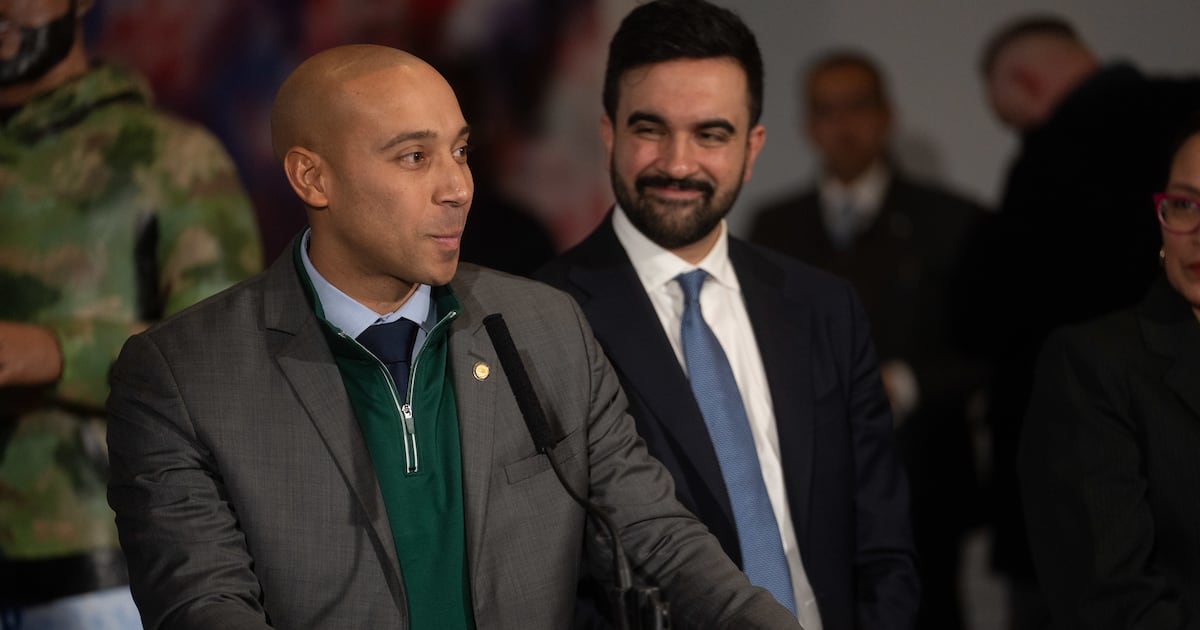
At a news conference Saturday in the Bronx, New York City Mayor Zohran Mamdani named Alister Martin as the new head of the New York City Department of Health and Mental Hygiene following weeks of speculation about who he would pick to run the agency. At 37, Martin will oversee one of the largest health departments in the world, with more than 7,000 employees and an annual budget of $1.6 billion.
“While this is a new chapter for me in the city, it is not the beginning of my story. It’s a continuation of one that began just down there, the street in Queens,” Martin said from the lectern after Mamdani introduced him. “My mother raised me as a single parent in Jackson Heights, just a few blocks from Elmhurst Hospital.”
(Elsewhere, such as in his White House fellow bio and in a Harvard magazine, Martin has said he grew up in New Jersey.)
Martin’s appointment comes at pivotal time for New York City, and he will be tasked with protecting the health of millions of New Yorkers, some of whom stand to lose their health insurance or Medicaid under looming federal cuts, or see their premiums spike under the Affordable Care Act.
Martin will also assume a key role in coordinating efforts around the World Cup matches that are expected to bring more than a million visitors this summer to Greater New York — a responsibility that will take on even greater significance because of the deep cuts to the Centers for Disease Control and Prevention and the U.S. withdrawal from the World Health Organization.
Martin will report to Helen Arteaga Landaverde, the deputy mayor who was recently named to oversee Health and Human Services. She previously led NYC Health + Hospitals/Elmhurst as its CEO.
Health Department spokesman William Fowler said Martin was unavailable for an interview. Martin did not respond to an interview request sent to his email address.
Dr. Michelle Morse will remain chief medical officer
Martin’s appointment came as something of a surprise. There had been high hopes in certain New York City public health circles that Mamdani would keep Dr. Michelle Morse, a longtime health equity advocate who had served in an acting role since October 2024 and expressed her desire to run the department under Mamdani. On the reddit thread r/nycpublicservants, commenters expressed disappointment that Morse was passed over.
In a statement released Monday, Morse welcomed Mamdani’s pick.
“This work was always far larger than any one person: It did not begin with me, and it does not end with me. I look forward to working with Commissioner Martin as he prepares to lead the best health department in the world.”
Fowler said Morse “continues to serve in her role as the agency’s chief medical officer.”
Generally, heads of public health departments are selected after having led smaller departments and moved up through the ranks, said Bruce Y. Lee, a professor at the CUNY Graduate School of Public Health & Health Policy. Martin’s resume reveals little leadership experience.
“This is not a traditional pick,” Lee told Healthbeat.
Martin went from high school expulsion to Harvard graduate
The son of a mother who worked as a biology teacher and a United Nations human rights consultant with Haitian ancestry and a father who served as a diplomat from Belize, Martin grew up in Neptune, New Jersey, and played competitive tennis in high school. During his senior year, he was expelled because of an off-campus fight and earned a GED, he told Teen Vogue in a 2023 interview.
Instability at home was apparently the norm. His father had suddenly left the family, and he and his mother sometimes went without insurance or a primary care doctor, he told the magazine. The experience would later help him connect with patients in the emergency room.
Martin and his father didn’t meet until he was 20 and his father was dying of a late cancer diagnosis, according to a 2021 profile in the Harvard Kennedy Magazine.
“My going to be there for him in his final days was a reflection of my mother’s strength, of all the kindness, love, and compassion she had instilled in me. I came to understand my father, and by doing so, came to understand myself more clearly,” he told the magazine.
Martin went to college at Rutgers, where he continued to play tennis, and then went to Harvard Medical School and the Harvard Kennedy School, earning degrees from both in 2015, according to his LinkedIn profile. He holds a master of public policy degree from the Kennedy School of Government, instead of a master’s of public health degree that is more traditional for someone running a public health department.
Martin brought voter registration to emergency room
Two years after completing his residency, Martin built successful
national campaigns to enlist doctors in the battle against the opioid epidemic, according to the Harvard magazine story, and his advocacy work as a doctor would only deepen.
In 2019, during the presidential race between Donald Trump and Joe Biden, Martin co-founded a startup at Massachusetts General Hospital called Vot-ER, where he had been a chief resident and faculty member. And during the pandemic, he knocked on doors in Boston neighborhoods that saw high numbers of residents sick with Covid-19 and needed vaccinations.
After years of seeing patients struggle with the health consequences of poverty, drug addiction, homelessness, and other issues, he founded Vot-ER to register voters in emergency rooms.
“What if long emergency room wait times, an unfortunate fact of life, could also be a key to increasing voter participation among traditionally underrepresented groups in our electorate?” Martin wrote in a January 2020 opinion piece for The Boston Globe with Cass Sunstein, a prominent Harvard law professor. “The demographic overlap between those who most use the ER for their health care and those who don’t vote presents a potential opportunity.”
The effort provoked debates about the roles that physicians should or shouldn’t play in civic life. It also drew rebuke from conservative groups, including the Republican National Convention, which sent letters to the secretaries of state in six swing states urging officials to monitor Vot-ER ahead of the general election, according to a 2024 article in The Philadelphia Inquirer. Vot-ER was folded into A Healthier Democracy, a nonprofit that has made contributions ranging from $5,500 to $60,000 to community health centers in mostly swing states, according to 2024 tax records.
An executive director of Vot-ER said at the time that Vot-ER does not endorse political parties or candidates, complies with election laws, and has board members from both political parties.
From 2021 to 2022, Martin was a White House Fellow, working as an adviser to Vice President Kamala Harris on voting rights issues. Later, he was part of a U.S. Department of Health and Human Services advisory panel on outreach and education.
In recent years, Martin has focused on running A Healthier Democracy as its CEO and teaching as an assistant professor at Harvard Medical School.
In his remarks at Saturday’s news conference, Martin said he no longer wanted to see health care become such a financial burden to patients.
“We are going to make sure that when a family walks into a health center, they can walk out not just healthier, but more financially stable,” he said. “We’re going to prove that public health is not just about disease. It’s about dignity, about stability, about making sure that no one gets left behind.”
Trenton Daniel is a reporter covering public health in New York for Healthbeat. Contact Trenton at tdaniel@healthbeat.org or on the messaging app Signal at trentondaniel.88.
Source link
-

-

-

-
-


