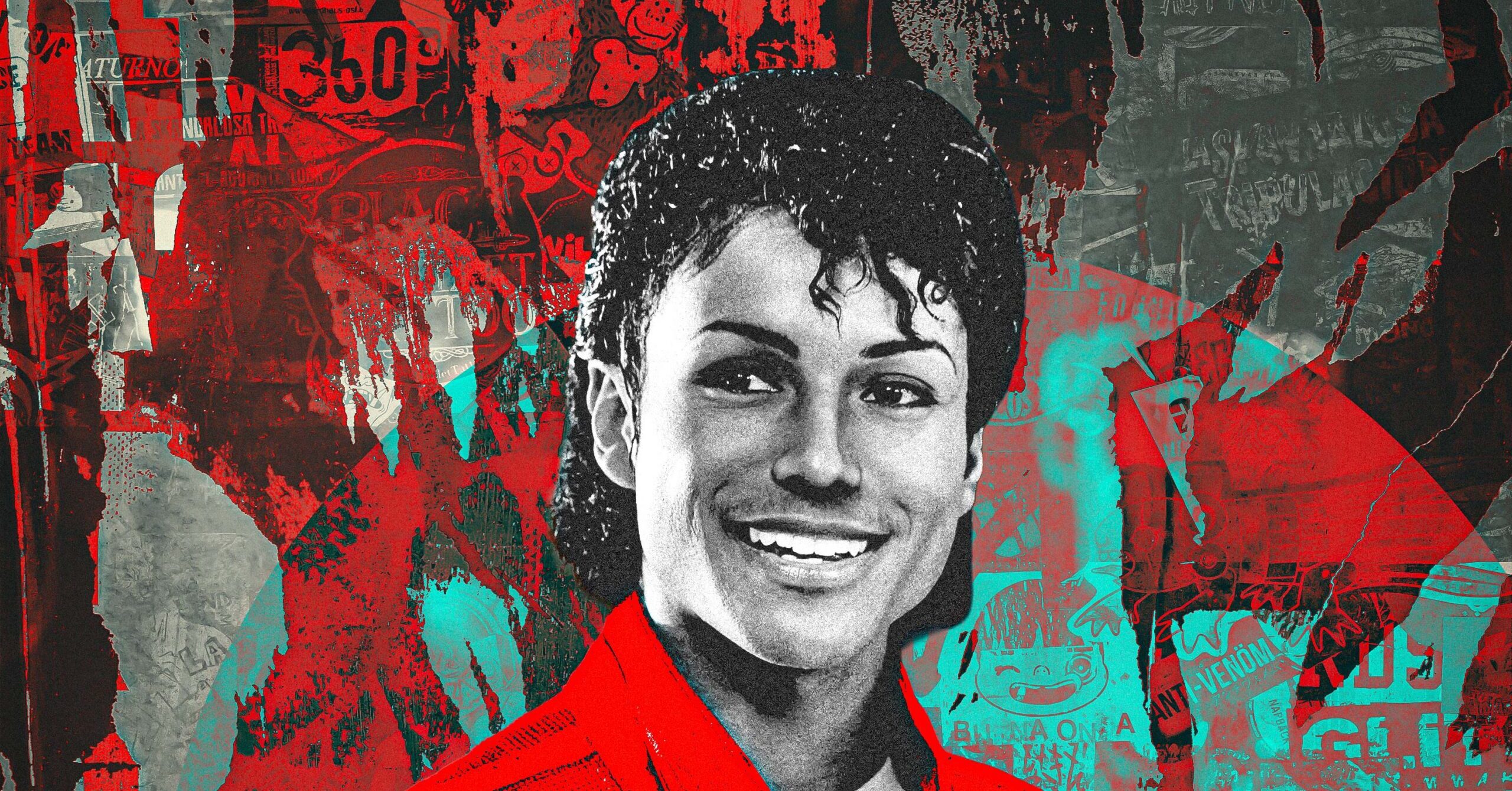
The 32-foot-tall replicas of a defiant, bandolier-clad Michael Jackson commissioned to promote his 1995 double album, HIStory, were thought up by their subject, an imperial edict from an authentically world-conquering hero. The story goes that when Sony executives asked MJ what they could do in support of a purportedly historical double album, he told them to build him a statue. Eager to nab their all-you-can-eat meal ticket, the label not only called Jackson’s bluff but raised it by ponying up for 10 separate exercises in freestanding pop idolatry.
Size matters, but so does tone, especially when it comes to a savior complex. When John Lennon quipped that he and his bandmates were bigger than Jesus, it was an intentional boomerang; he was accepting the media’s crown of thorns with a wink and a smile. But the slate-gray MJ monoliths dotting metropolitan skylines from London to Johannesburg begged to be taken literally—and also deconstructed—on their own stone-faced terms: They were sight gags at Jackson’s expense (as well as Sony’s). The martial atmosphere of HIStory’s promotion was more akin to a military campaign than an album launch; for every heart and mind captured in the process, there was a pair of eyes—or several—rolling back not in reverent awe but in sardonic mockery. Reviewing HIStory and its extravagant multi-platform packaging in the Los Angeles Times, Chris Willman wrote that the album went “beyond the bounds of self-congratulation to become perhaps the most baldly vainglorious self-deification a pop singer has yet deigned to share with his public.”
Writing for NPR in 2019 after the release of the critically acclaimed and stomach-churning HBO documentary Leaving Neverland, in which Wade Robson and James Safechuck say that Jackson sexually abused them, pop critic Ann Powers tried to reckon with the singer’s sordid private life and solid-gold musical legacy. Powers called Jackson “the kind of star whose relics, manifesting as earworms or visual memory flashes, people carry around with them at all times”; she could have mentioned the Jackson statues, which have long since outlasted their inspiration. Some have spawned pop-up theme parks and pilgrimages; Swedish media recently chronicled one piece’s migration from Austria to Angelholm. They’re not only relics but ruins; they’re a testament to the bristling, irreconcilable tension between Jackson’s durability as a pop icon and a yearning for disposability among those disturbed by his behavior. Nobody will forget Michael Jackson anytime soon; the question is how he’ll be remembered. After all: HIStory is written by the winners.
Enter Antoine Fuqua, a reliable Hollywood pro, and the Jackson estate, which has a vested interest in keeping MJ’s legacy both bigger than life and strategically sanitized. Reportedly budgeted at nearly $200 million and starring its namesake’s nephew Jaafar Jackson in the title role—an ideal piece of casting emphasizing an all-in-the-family vibe—Michael is set to dominate the spring box office; prognosticators are already eyeing a record-setting opening weekend. Certainly, the film has been designed for maximum accessibility—the script is written in broad strokes by Oscar-nominated screenwriter John Logan and crammed with as many officially licensed hits as possible, from “Ben” to “Billie Jean” to “Bad.” The story spans from 1966 to 1988, meaning it ends too early to include reproductions of the Jackson statues. It doesn’t need them, though, because Michael is a monument in and of itself: an absurdly burnished slab of showbiz hagiography that takes Jackson’s self-aggrandizement as a baseline for its own nostalgic, IMAX-sized spectacle. It is vainglorious deification merged with fan service under the sign of ancillary revenues. “Sorry media, u don’t get to control the narrative anymore of who Michael Jackson truly was,” said the singer’s nephew Taj in a post on X. “The public gets to watch this movie, they will decide for themselves. And you can’t handle that.”
In this case, the narrative is simplified: Michael is so calculated and conventional as to border on genre self-parody—call it Moonwalk Hard. The other MJ jokes write themselves just as easily: It’s a really (really) bad movie, a game of “Remember the Time” with a selective memory, a biopic so corny and clichéd that it ought to look at itself in the mirror and ask itself to change its ways. Fuqua and his backers are blissfully unconcerned with nuance, or subtlety, or persuading nonbelievers. Instead, they’re counting on the people who carry Jackson with them succumbing to the sheer proliferation of earworms on offer, all sung and danced by Jackson’s flesh and blood with scary aplomb. There’s more of Michael’s charisma and stage presence in Jaafar Jackson’s acting than there was of Freddie Mercury in Rami Malek; consider it a backhanded compliment to say that Michael is about on par, quality-wise, with Bohemian Rhapsody, except that it might ultimately win more Oscars. (Every moment of Colman Domingo’s all-stops-out performance as Joe Jackson should be subtitled “For Your Consideration.”) Is the world ready for a Best Picture contender in which the King of Pop plays a vigorous game of Twister with a CGI chimpanzee in a diaper? Somehow, Better Man—an exponentially better and more inventive pop biopic—didn’t get to that one first.
It’s worth talking about Better Man for a moment here, because Michael Gracey’s film remains—against all odds and common sense—the gold standard for recent pop music biopics, easily outclassing A Complete Unknown, Springsteen: Deliver Me From Nowhere, and, while we’re at it, the last couple of Planet of the Apes movies. The reasons for its excellence have relatively little to do with the music or significance of Robbie Williams and everything to do with the expressiveness of the filmmaking—with how Gracey (a legitimately weird filmmaker who doesn’t have a hip bone in his body) scrambles codes and clichés into crazy configurations in order to simultaneously cater to and subvert audience expectations. The fact that it flopped reinforces that there’s considerably more profit in giving people what they want, straight up (and also maybe that nobody in the U.S. knows who Robbie Williams is).
Hence the shrewd—and increasingly standard-issue—decision by Lionsgate to screen Michael early for social media influencers, who have a professional obligation to be easily impressed. “Yes, Michael is the best musical biopic of all-time,” posted one noted authority on the matter (has he seen Better Man?). Meanwhile, the film critics who’ve panned Michael are being castigated on social media as haters or heretics who’ve legit lost the plot, or as shills engaged in a smear campaign. Jackson conditioned his listeners to see reporters as “tabloid junkies” while accruing the benefits of full-court promotional presses; that’s why, as far as fans are concerned, critics better be dancing in the aisles at Michael, or at least bending the knee.
The reluctance to countenance anything resembling critical thinking is a common denominator among contemporary fan cultures, a behavior equivalent to superhero worship. No wonder, then, that Michael has been staged like a Marvel movie, from the overbright, weirdly slop-coded cinematography (credited to Dion Beebe, who shot Miami Vice) to the shorthand characterizations and info-dump dialogue to the slack yet frenetic pacing, with no scene lasting more than three or four minutes unless it’s a musical number. Fuqua is hardly a franchise-style hack; he’s a solid action director who knows how to stage a set piece (and direct a star performance, as evidenced by Training Day). But he’s too compromised by this assignment to assert himself stylistically, and it shows. In an interview with The New Yorker, Fuqua offered that he specializes in stories about “men under pressure.” Given the myriad legal and logistical contingencies of this particular project, that might be a reference to his own experience or an after-the-fact attempt to complicate purely mercenary motives. Another Fuqua quote from the New Yorker piece, directed at those who have spoken out against Jackson, resonates as well, and not very flatteringly: “Sometimes, people do some nasty things for some money.”
Plenty has already been written about the scrapped framing device that would have introduced Jackson circa 1993, mid–strip search at the Neverland Ranch. “I shot him being stripped naked, treated like an animal, a monster,” Fuqua explained to The New Yorker. That material was ultimately vetoed in accordance with the settlement between the Jackson estate and Jordan Chandler, whose father said Jackson sexually abused the 13-year-old. “Jackson’s estate belatedly realized a settlement [Jackson] had signed with the boy’s family forbade it from using his story for commercial purposes,” writes Ben Fritz in The Wall Street Journal; fortunately for the producers, they had all the money in the world to throw at the problem. Cue roughly three weeks of reshoots, which ballooned the movie’s budget while rounding off its edges; chances are the estate will make up the difference in box office receipts.
There are ghostly traces of the more ambivalent movie Fuqua may have been trying to make. For instance, it’s hard to shake an early shot of 10-year-old Michael flipping through a picture book of Peter Pan and staring intently at Peter’s shadow—a quietly nightmarish image worthy of a better movie, and also more in line with Jackson’s own proclivity to disguise, disfigure, and weaponize his innocence. It’s not a coincidence that one of his first big hits was a perverse love theme from a cheapjack horror movie about a loner training an army of killer rats; you really believed that Michael and Ben understood each other on an instinctual level. The reason “Thriller” is a masterpiece—the video even more than the song—is that it signals the presence of a monster within (“I’m not like other guys”). Jackson’s fascination with all things gothic was a big part of his creative makeup; his dream project was a biopic of Edgar Allan Poe, who (in)famously married his 13-year-old cousin.
The great, beguiling paradox of Jackson’s music was the way it leveraged universal outreach and appeal against the very real eccentricities of its creator, whose strangeness was a matter of public record long before it was considered a liability. The idea that millions of record buyers recognized some aspect of themselves in a man whose relationship to reality was helplessly skewed from childhood onward could be a tricky, trenchant subject for an artist willing to plunge into murky waters. Fuqua is content, though, to bob on the surface. The opening sequences, which hurtle through Michael’s early forays into stardom alongside his similarly talented but less instantly magnetic siblings, are about as compelling and textured as a Wikipedia entry, including their treatment of trauma. We’re shown Joe beating his youngest son in front of the other kids, but somehow, the violence doesn’t resonate beyond its function as exposition; it’s something to be gotten through en route to the fun stuff.
The juxtaposition of domestic violence and the grind of the club circuit is expedient rather than revelatory. There’s no curiosity about why the Jackson Five’s music struck a chord, or what its popularity augured in a changing pop landscape, or the weirdness of a prepubescent kid warbling romantic pop ballads. All that registers—and all that has to—is the idea that Michael was a genius from birth: more gifted than his brothers, his mentors, or really anybody else on earth. We get over-the-top testimonials from Berry Gordy (Larenz Tate) and Quincy Jones (Kendrick Sampson), the latter of whom doesn’t seem to do much more during the recording of Off the Wall than twiddle some knobs. At least Amadeus had Salieri to complicate the conceit of Mozart as a vessel for divine grace; Michael unfolds in thrall to its namesake. The only good, intentional laugh in the whole movie comes when the singer worries that God might bestow some of his best hooks on Prince instead; at that point, I was wishing that I had been watching Purple Rain instead.
Beyond dramatizing (and reinforcing) Jackson’s world-historical vanity, which was commensurate with his world-historical talent, Michael strives to make quasi-religious icons out of people on the right side of various life-rights negotiations and NDAs. Hence the comically inflated portrayal of John Branca (Miles Teller), the entertainment lawyer who helped Jackson purchase the Beatles’ back catalog and who has lately presided over 15 years’ worth of MJ-themed exploitation and ephemera as a coexecutor of the singer’s estate. (Among his achievements: initiating litigation against the makers of Leaving Neverland, which is, as of this writing, unavailable on the major streaming platforms in the U.S.)
In one of several scenes that split the difference between squishy, Oscar-baiting sentimentality and helpless camp, we see Branca smiling warmly as Michael—his head recently scalded to a crisp by that infamous Pepsi commercial shoot gone wrong—lays hands on the young inhabitants of a burn ward, like Mother Teresa in a hospital gown and rhinestone glove. In another, Michael and his label whisperer exhort CBS Records honcho Walter Yetnikoff (Mike Myers) to get the video for “Billie Jean” played on MTV against the objections of programmers scared off by Black artists. “I won’t sit in the back of the bus,” squeaks our hero; that MTV cofounder Les Garland denied the story of this encounter scarcely matters. As for the scene where Michael invites members of the Crips and the Bloods to a dance studio on Skid Row to help choreograph “Beat It,” it’s putatively true but, as played, worthy of the behind-the-music satire of Yacht Rock; sadly, there are no cameos by Eddie Van Halen or Toto.
“HIStory continues …,” claims the title card at the end of Michael; all that’s missing is a Marvel-style stinger depicting the broadcast premiere of The Simpsons, or a meet-cute with Lisa Marie Presley. Suffice it to say that the Jackson brain trust will have a trickier time dancing around the complexities endemic to a sequel set in the ’90s and beyond; the prospect of another movie made in the same mode but set, say, during the shooting of Living With Michael Jackson, or amid the rehearsals for This Is It, is nightmarish—or grimly funny—to contemplate. “There’s a possibility of there being a part two that may deal with other things that happened afterwards,” said Domingo in an interview with Today that had the ring of damage control. “This is about the making of Michael, how he was raised, and how he was trying to find his voice as an artist.”
Domingo’s claim that Michael has no mandate to discuss Jackson’s legal issues because they occurred outside of its timeline not only ignores the matter of film-saving reshoots but, however unintentionally, proves the real meaning of the phrase “controlling the narrative.” Michael’s disingenuously airbrushed style is directly related to the material its makers can’t and likely never will put on-screen; they’ve found their voice and have the resources to amplify it in Dolby Atmos. They’re under no obligation to produce a negative—or honestly nuanced—portrayal, but nor are skeptics or dissenters required to fall in line under the pop-authoritarian pretense of letting people enjoy things.
“A lot of people, I think, will kind of swallow any misgivings they may have and just sort of say, ‘Oh well, it’s a great jukebox movie,’” said Leaving Neverland’s director, Dan Reed, in an interview with The Hollywood Reporter. “I think Jackson was genuinely a very nasty man and hurt a lot of children. And he may have been a great entertainer, but those things don’t cancel each other out.” Great art has been made out of examining tensions like the ones described by Reed. The nature of content is to gloss over them or efface them altogether. In that sense, Michael is a success on the terms it’s set for itself. Once again, Jackson has gotten his jumbo-sized statue, made-to-order and impossible to ignore. The sense of a smooth facade barely masking the depths of denial suggests that Michael has truly been made in his image.
Adam Nayman
Adam Nayman is a film critic, teacher, and author based in Toronto; his book ‘The Coen Brothers: This Book Really Ties the Films Together’ is available now from Abrams.
Source link
-

-

-

-

-