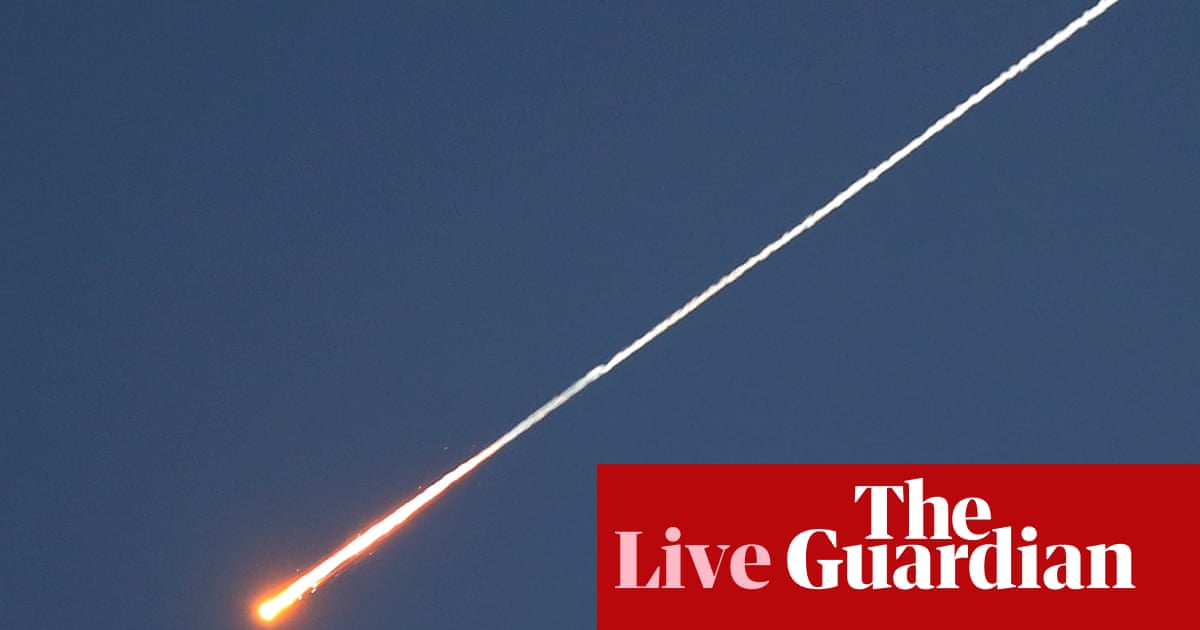
Yemen’s Houthis confirm attack on Israel
Yemen’s Houthis say an attack on Israel on Saturday came after continued targeting of infrastructure in Iran, Lebanon, Iraq and Palestinian territories.
The group said the attack was made with a barrage of missiles, adding that their operations would continue until the “aggression” on all fronts ends.
The entry into the war of the Houthis has called into question whether the rebel group, backed by Tehran, will again target commercial shipping travelling through the Red Sea corridor.
Key events
Pakistan PM and Iran president discuss hostilities in phone call
The Pakistani prime minister, Shehbaz Sharif, said he held a one-hour phone call with the Iranian president, Masoud Pezeshkian, as Islamabad prepares for talks with regional leaders.
In a post on X, Sharif said he expressed Pakistan’s solidarity with Iran and condemnation of Israeli attacks. He said he also thanked Pezeshkian “for his appreciation of Pakistan’s sincere efforts to advance peace and facilitate dialogue in the region”.
The Pakistani foreign ministry announced earlier today that the country’s foreign minister, Ishaq Dar, will meet with his counterparts from Saudi Arabia, Turkey and Egypt in Islamabad to hold “in-depth discussions on a range of issues, including efforts to de-escalate tensions in the region”.
The ministers, who are expected to begin the two-day talks tomorrow, will also meet with Sharif, the foreign ministry said in a statement.
Islamabad has positioned itself as a potential venue for US-Iran negotiations, with officials confirming Pakistan delivered Washington’s 15-point ceasefire proposal to Tehran earlier this week.
Dar posted on X that he was “looking forward to welcoming my brother foreign ministers”.
Iran is said to be reviewing the US proposal, although one official has dismissed it as “one-sided and unfair”. Iranian media reported that Tehran has put forward its own five-point plan, with conditions including an end to the fighting and the assassination of its officials, guarantees that no other war is started against it, reparations for the current conflict, and Iranian control over the strait of Hormuz.
Ukrainian president Volodymyr Zelenskyy said his country and the UAE have agreed to cooperate on defence, as the Gulf nation faces continued attacks from Iran.
Zelenskyy said he met with Emirati president Mohamed bin Zayed Al Nahyan and that the two leaders agreed to “cooperate in the field of security and defence”.
In a post on X, he said:
We discussed the security situation in the Emirates, Iranian strikes, and the blockade of the strait of Hormuz, which directly affects the global oil market. For all normal states, it is important to ensure stability and protect lives amid today’s threats. Ukraine has relevant expertise in this area – our cities, unfortunately, have been under daily attack for four years of full-scale war. Ukrainians have developed an appropriate protection system that delivers a significant interception rate against enemy drones and missiles. This systematic approach and integration of experience is exactly what we are offering to our partners.
The official Abu Dhabi Media Office has provided an update on the missile attack this morning in the UAE capital, saying six people were injured, increasing an earlier casualty toll of five.
Authorities said a missile interception led to debris falling near the Khalifa Economic Zone in Abu Dhabi, close to Khalifa Port.
In a statement, the media office said: “Authorities further confirmed an additional injury as a result of the incident, to a Pakistani national, bringing the total number of injured individuals to six, with injuries ranging from minor to moderate.”
It did not say where the attack was launched from, but the country’s defence ministry said earlier that its forces were intercepting missile and drone attacks from Iran.


Tess McClure
‘It didn’t matter whose child I rescued’: parents of Iran school bombing victims describe their worst day
When Marzieh heard the first bang, an almighty crash that rattled the room, her first thought went to her youngest son, Mohammad. He must have got out on to the balcony and discovered a new game, she thought: using all of his small might to smash its sliding doors closed. Marzieh stood up from where she was working at her sewing machine, and shouted for him to stop.
“Mum, it wasn’t me,” he called back.
Then, the second crash sounded, the force of it making the entire house tremble. Could it be the neighbours, she wondered – construction work, renovations? But even as the thought occurred, she knew it wasn’t right: their nextdoor neighbours had all left for work that morning, and only she and Mohammad were at home.
Just a few minutes earlier, at 11.17am, Marzieh had received an abrupt phone call from Mrs Mohammadian, her eight-year-old daughter Zahra’s teacher. The primary school, a few blocks away, was closing early, she said – could the family pick Zahra up? But Mrs Mohammadian hadn’t said why, swiftly concluding the message to call the next parent on her list. Marzieh rang her husband at work, who sent his brother to pick up the girls – Zahra and her cousin were in the same class.
Now, standing in the house, Marzieh felt a strange, numb feeling settle in. She looked down, and noticed she was shaking. From the street outside she could hear voices, and so Marzieh gathered up Mohammad, rushing to find her chador (veil) to leave the house. As she opened the door, the acrid smell of smoke hit her. People ran back and forth down the road. She stopped someone to ask what was happening. “War has started,” they said.
Hours before the world learned that a US missile had hit Shajareh Tayyebeh school, parents were already searching the rubble for their sons and daughters. In this exclusive report, four families describe the events of 28 February:
A drone attack at Kuwait airport has caused “significant damage” to its radar system, the state-owned Kuwait News Agency (Kuna) reported.
Civil aviation authorities confirmed there were no injuries after the airport was “subjected to several drone attacks”, according to Kuna.
The airport has been targeted several times since the onset of the Iran war, most recently on Wednesday when a drone attack on a fuel depot at the site caused a massive fire. Kuwait has blamed Iran for the attacks.
Israel carried out dawn airstrikes on several towns in southern Lebanon on Saturday, state media reported, while Hezbollah announced attacks on Israeli forces, including in Debel.
Lebanon’s state-run National news agency reported “a series of strikes” at dawn on the town of Majdal Selm, “successive strikes” on the towns of Kafra, Hanniyeh, Touline and Adloun, and several Israeli strikes on Nabatiyeh, hitting “residential and commercial buildings and a fuel station”.
The agency also reported strikes on border towns, particularly Taybeh, with “an attempt by enemy forces to advance toward the Litani area”.
Hezbollah said it had targeted gatherings of Israeli forces in Debel, a predominantly Christian border town where some people are still living.
Pakistan will host talks next week with Saudi Arabia, Egypt and Turkey on the war in the Middle East, a senior foreign ministry official told AFP on Saturday.
“We will host a quadrilateral meeting on Monday,” the official said on condition of anonymity, adding that the exact representation was not yet confirmed. They said delegations were expected to arrive in Pakistan by Sunday night.
Pakistan has emerged as a key facilitator between Iran and the US. Islamabad has longstanding links with Tehran and close contacts in the Gulf, while the prime minister, Shehbaz Sharif and army chief Field Marshal Amin Munir have struck up a personal rapport with US President Donald Trump.
The US and Iraq will “intensify cooperation” to prevent pro-Iran attacks and ensure Iraqi territory is not used to launch assaults against US facilities, Washington’s embassy in Baghdad has said in a statement.
“The Iraqi and US sides decided to intensify cooperation to prevent terrorist attacks and ensure that Iraqi territory is not used as a launching point for any aggression against the Iraqi people, the Iraqi Security Forces, Iraqi strategic facilities and assets, as well as against US personnel, diplomatic missions, and the Global Coalition,” the US embassy in Baghdad said in a statement posted on X on Friday.
Yemen’s Houthis confirm attack on Israel
Yemen’s Houthis say an attack on Israel on Saturday came after continued targeting of infrastructure in Iran, Lebanon, Iraq and Palestinian territories.
The group said the attack was made with a barrage of missiles, adding that their operations would continue until the “aggression” on all fronts ends.
The entry into the war of the Houthis has called into question whether the rebel group, backed by Tehran, will again target commercial shipping travelling through the Red Sea corridor.
Updating our earlier report about an Iranian attack on an airbase in Saudi Arabia, more than two dozen US troops have been wounded in Iranian attacks on the Prince Sultan airbase in the past week, AP sources say.
Iran fired six ballistic missiles and 29 drones at the base in a Friday attack that wounded at least 15 troops, including five seriously, according to the sources who were not authorized to comment publicly. US officials initially reported that at least 10 US troops were injured, including two seriously wounded. The base had come under attack twice earlier this week.
Sirens have been sounding in Bahrain through Saturday morning, with authorities warnings of potential attacks. The country’s interior ministry has urged people to head to the nearest safe location.
Earlier in the day, the ministry said civil defence officials had extinguished a fire at a facility that had been targeted by Iran.
Bahrain has so far seen two deaths since the war began, with the most recent drone strike hitting a residential building in the capital Manama, according to the interior ministry.
A worker has been injured in a drone attack on Oman’s Salalah port while a crane suffered limited damage, Oman’s government said on Saturday.
Oman had served as a mediator between the US and Iran before the current war. But earlier this month, Oman’s foreign minister claimed the US had “lost control of its own foreign policy” and accused Israel of persuading Donald Trump’s administration to go to war with Iran.
You can read more of that background here in an earlier report by our correspondent Hannah Ellis-Petersen in Dubai.
The Guardian’s south Asia correspondent, Hannah Ellis-Petersen, is reporting that Gulf countries are worried about possible attacks by Iran-backed militias and proxy armed groups in the region. Any such attacks would further destabilise Gulf regimes and escalate the war in the Middle East.
Qatar, Kuwait, the United Arab Emirates, Bahrain, Saudi Arabia and Jordan have condemned Iranian attacks on their soil, including attacks carried out through Iranian proxies.
While on Wednesday, Kuwait said it had foiled a plot to kill state leaders, and arrested six suspects believed to be associated with Iran’s most powerful proxy group, Hezbollah.
Source link
-

-

-

-

-