
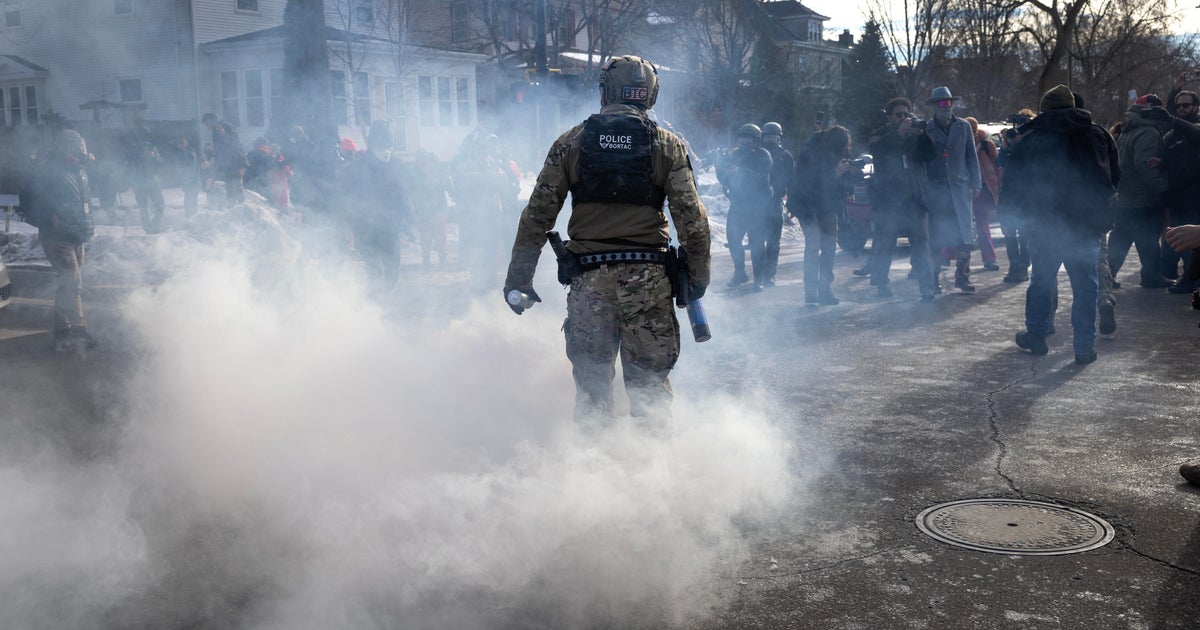
The fatal shooting of 37-year-old Alex Pretti by Border Patrol agents on Saturday has further escalated tensions in Minneapolis, a city now at the center of America’s heated battle over immigration enforcement.
Pretti’s killing occurred less than three weeks after Renee Good, another Minneapolis resident and U.S. citizen, was shot and killed by an Immigration and Customs Enforcement officer.
A total of 3,000 ICE and Customs and Border Protection agents are now operating in the city, a force that is roughly five times the size of the Minneapolis Police Department, which has about 600 officers. A top ICE official said Sunday that federal agents had carried out roughly 3,400 arrests in the area, though he did not say how many arrestees had criminal records.
Here’s a look at how the Trump administration’s crackdown in Minneapolis has unfolded, and the major events that have placed the Midwestern city in the national and global spotlight.
Dec. 1: ICE launches crackdown in Minneapolis area
ICE launched “Operation Metro Surge” in the Minneapolis area in the first week of December, the latest in a string of Trump administration immigration crackdowns targeting Democratic communities. CBS News reported at the time that ICE planned to target, in part, those with deportation orders, including Somali immigrants, a population President Trump has harshly criticized.
Minnesota had drawn nationwide attention due to a litany of fraud schemes that allegedly bilked billions of dollars from the state’s federally funded public assistance programs. Mr. Trump attacked state officials over the fraud scandals — and zeroed in on the fact that most of the dozens charged in the schemes were of Somali descent.
The state has the nation’s largest Somali American population, the vast majority of them U.S. citizens, either by birth or through naturalization, according to census data.
Dec. 26: Viral video alleges fraud in Minnesota day cares
In a now-viral YouTube video posted the day after Christmas, conservative influencer Nick Shirley visited nearly a dozen day care facilities in the Minneapolis area that he alleged were receiving taxpayer money but not providing any services. The video, which has racked up nearly 4 million views on YouTube, was amplified by Vice President JD Vance and Attorney General Pam Bondi.
State investigators later visited several of the day care centers highlighted in his video, and said nine of them were “operating as expected.” Eight of the facilities had children present during the inspection, and a ninth was not yet open for the day, the Minnesota Department of Children, Youth and Families said. One of the centers closed in early January.
Dec. 29: ICE dispatches agents to visit Minneapolis-area businesses
Days after the Shirley video was posted, agents from ICE’s Homeland Security Investigations branch were dispatched to conduct site visits to several dozen Minneapolis businesses. Homeland Security Secretary Kristi Noem said they were overseeing a “massive investigation on childcare and other rampant fraud.”
Jan. 5: Thousands of additional federal agents are deployed
Roughly a week after the Shirley video, CBS News first reported that the Trump administration would be deploying an additional 2,000 federal immigration agents to the Twin Cities. The Department of Homeland Security subsequently called the deployment the largest operation in its history.
Octavio JONES /AFP via Getty Images
The reinforcements included Border Patrol agents, including commander Gregory Bovino, who had previously led sweeping and controversial immigration enforcement operations in Charlotte, Chicago and Los Angeles.
Jan. 7: Renee Good shot and killed by ICE officer
Two days later, an ICE officer in Minneapolis fatally shot 37-year-old Renee Good while she was behind the wheel of her car, sparking outrage and setting off days of protests.
Videos of the incident appear to show Good’s car was approached by multiple ICE officers, one of whom stepped in front of her vehicle. Good backed up, turned her wheel and began to drive her car forward, and the officer in front of the SUV, identified as Jonathan Ross, fired multiple shots.


Mr. Trump and members of his administration accused Good of intentionally hitting and trying to run over the agent, in what Noem described as an “act of domestic terrorism” that left the officer injured. Lawyers representing Good’s family have said Good and her partner were observing ICE operations. Analysis of video from the scene suggested Good may have been trying to steer away from the officers, not towards them.
Hours later, Mayor Jacob Frey sharply criticized ICE, telling the agency: “Get the f*** out of Minneapolis.”
Jan. 13: Prosecutors resign as they face pressure over Renee Good investigation
At least six career prosecutors in the Minneapolis U.S. Attorney’s Office resigned, including Assistant U.S. Attorney Joe Thompson, as the office faced pressure to treat the investigation of Renee Good’s shooting as a case of assault on a federal officer as opposed to a civil rights case. At least six Justice Department prosecutors, most of them supervisors in the Civil Rights Division, said they were leaving the department soon after they learned there would not be a civil rights investigation into Good’s shooting.
An FBI supervisor in the Minneapolis field office’s public corruption squad later resigned, too, partly over pressure to “discontinue” the investigation of Good’s shooting, a source told CBS News.
Separately, the Minnesota Bureau of Criminal Apprehension withdrew from a probe into the shooting, saying the Justice Department had blocked state investigators from accessing evidence.
Jan. 15: ICE officer shoots man in leg during alleged shovel attack
Exactly a week after the killing of Good, DHS said another ICE officer shot a Venezuelan migrant he was trying to arrest in Minneapolis. The department said the migrant and two other Venezuelan men attacked the ICE officer with a snow shovel and broom handle. The officer, DHS said, shot the original target of the operation in the leg following a confrontation.
The Venezuelan man suffered non-life-threatening injuries and was later charged by the Justice Department and accused of assaulting the ICE officer, alongside another migrant involved in the altercation.
Jan. 15: Trump threatens to use Insurrection Act in Minneapolis
As protests over the immigration operations continued to flare, President Trump threatened to invoke the Insurrection Act if state officials didn’t “stop the professional agitators and insurrectionists from attacking the Patriots of I.C.E.”
If the president decides to invoke the law, it could set the stage for the military to be deployed onto the streets of Minneapolis over the objections of state and local officials.
Later that week, some 1,500 active-duty soldiers in Alaska were placed on standby for a possible deployment to Minnesota, a defense official told CBS News.
Meanwhile, the Justice Department has weighed working with the Pentagon on a smaller scale in Minnesota, calling for military lawyers and forensic accountants to assist with fraud investigations in the state.
Jan. 16: Judge blocks agents from arresting or using pepper spray on peaceful protesters
A federal judge blocked DHS agents from arresting or using pepper spray and nonlethal munitions on peaceful protesters in Minnesota, after a lawsuit alleged federal agents “violently subdued” demonstrations against immigration enforcement.
Scott Olson / Getty Images 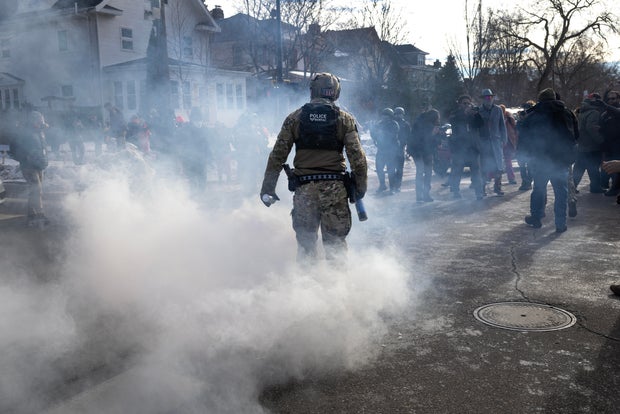

The government has denied using excessively heavy-handed tactics, with Assistant Secretary of Homeland Security Tricia McLaughlin saying the agency “is taking appropriate and constitutional measures to uphold the rule of law and protect our officers and the public from dangerous rioters.”
An appellate court paused the order less than a week later.
Jan. 16: Justice Department probes Frey, Walz and other Minnesota officials over alleged obstruction of immigration agents
On Jan. 16, CBS News disclosed a Justice Department investigation into allegations that Minnesota Gov. Tim Walz, Minneapolis Mayor Jacob Frey and other local officials had conspired to impede federal immigration agents.
Walz and Frey denounced the probe, calling it political intimidation.
A week later, the Justice Department subpoenaed the offices of Walz, Frey and other top state and local officials, including Minnesota Attorney General Keith Ellison.
Jan. 18: Anti-ICE protesters disrupt church service, triggering Justice Department crackdown
A group of protesters angry over ICE’s presence in Minnesota entered a church in St. Paul on Jan. 18, disrupting a Sunday service. The protesters said they focused on Cities Church because a man listed as pastor at the church also appeared to work for ICE.
The protest, which prompted families with children and other congregants to leave the church, was widely condemned by conservatives and the Trump administration, which quickly vowed to launch a criminal investigation. The Justice Department also said it would bring charges against former CNN anchor Don Lemon, who was present in the church at the time. Lemon said he was reporting on the protest.
Three people were arrested on federal charges several days after the protest, but a federal magistrate judge refused to sign arrest warrants for five other people, including Lemon, sources told CBS News. Federal prosecutors asked an appeals court to order the lower court to issue the remaining arrest warrants, but a panel of appellate judges declined that request.
Jan. 18: U.S. citizen detained by ICE at gunpoint
Immigration agents forced their way into a house in St. Paul, Minnesota, and detained ChongLy “Scott” Thao — a Hmong American and U.S. citizen — at gunpoint without a warrant, The Associated Press reported.
Images of 56-year-old Thao being led out of his home in handcuffs, wearing only underwear, Crocs and a blanket draped over his shoulders in the snow, provoked anger toward ICE and renewed questions about the agency’s tactics. Thao was later released.
Reuters 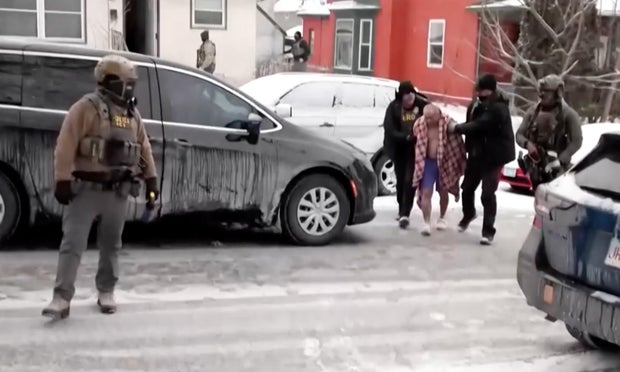

DHS described the incident at Thao’s home as a “targeted operation” seeking two convicted sex offenders who it said lived at the same address, and alleged Thao matched the description of the suspect. Thao’s family has strongly disputed the claim that the suspects lived there.
A day later, two whistleblowers revealed ICE had quietly issued a memo in May 2025 authorizing its officers to forcibly enter people’s homes, without a judicial warrant, during operations targeting those with deportation orders. The directive marked a seismic shift from longstanding rules meant to comply with the Fourth Amendment, which has long been interpreted to mean law enforcement can’t enter private property without a judge’s warrant.
Jan. 20: ICE takes 5-year-old boy into custody with his father
On Jan. 20, a team of ICE officers in Minneapolis took into custody a man from Ecuador and his 5-year-old son, Liam Conejo Ramos. Videos and photos of the incident — depicting Liam wearing a blue bunny hat and his school backpack — garnered national attention, triggering questions about who the Trump administration was targeting in its mass deportation effort.
Ali Daniels / AP 

Dueling narratives of the incident quickly materialized. Federal officials said ICE targeted the man’s father — not Liam — and accused him of being in the U.S. illegally. According to their version of events, Liam’s father tried to flee ICE and abandoned Liam in a car in the process. After arresting the father, the agency said ICE officers attempted to get Liam’s mother to take him but she refused to do so.
People who have spoken to the mother said she was scared to open the door to ICE, fearing she too would get arrested. Advocates and school officials accused ICE of trying to use Liam as bait — a claim ICE has denied.
Liam and his father are currently being held at a family detention center overseen by ICE in Texas. CBS News reported they have pending immigration cases and can’t be legally deported for now.
Jan. 24: Alex Pretti fatally shot by Border Patrol agents
Just weeks after Renee Good’s shooting, a second person was shot and killed by immigration agents: Alex Pretti, a 37-year-old U.S. citizen who worked as an ICU nurse.
Videos of the incident show Pretti standing in the middle of a Minneapolis street holding up his phone toward immigration agents. After he and several others were pushed back, he was wrestled to the ground by a group of agents and appeared to struggle as they tried to bring his arms behind his back. He was then shot multiple times.
VIDEO OBTAINED BY REUTERS 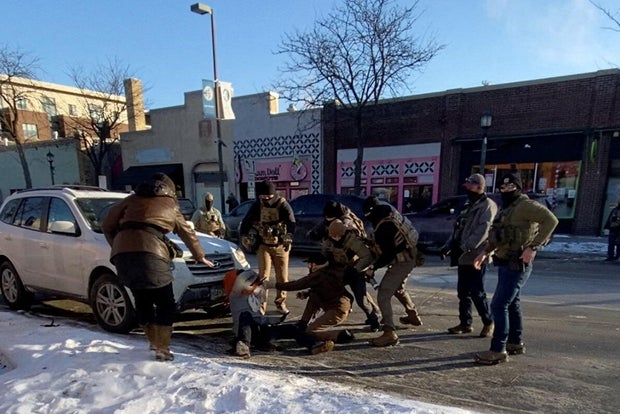
Noem alleged that Pretti “approached” officers with a handgun and “reacted violently” when officers tried to disarm him, forcing the agent to fire “defensive shots.” Videos reviewed by CBS News do not show Pretti with a gun in his hand before the shooting, and one video from immediately beforehand, when officers were struggling with Pretti, appears to show an agent reaching into the scrum empty-handed and emerging with a gun. Local police officials have said Pretti was a lawful gun owner with a permit to carry.
The Trump administration has defended the officer, with Bovino accusing Pretti, without citing evidence, of trying to “massacre law enforcement” during an operation to pursue a man who was in the country illegally and wanted for domestic assault. Local politicians have condemned the shooting, with Walz calling it “sickening.”
“These tactics are very obviously not safe, and it is generating a lot of outrage and fear in the community,” Minneapolis Police Chief Brian O’Hara told “Face the Nation with Margaret Brennan,” adding that even if an investigation ultimately finds the shooting was lawful, it may not matter “because there is so much outrage and concern around what is happening in the city.”
Alex Kormann/The Minnesota Star Tribune via Getty Images 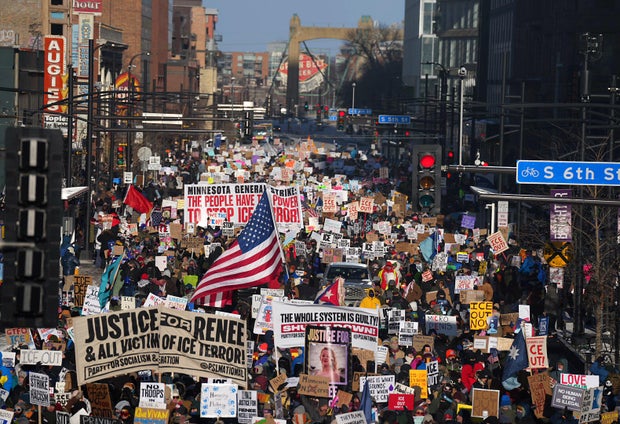

Jan. 24: Bondi makes three demands to “bring back law and order”
In a three-page letter, Bondi pressed Walz to let the federal government review Minnesota’s voter rolls and welfare data, and to give ICE greater access to jails in the state.
“I am confident that these simple steps will help bring back law and order to Minnesota and improve the lives of Americans,” Bondi wrote in her letter to the governor Saturday, which accused state officials of “anti-law enforcement rhetoric” and “putting federal agents in danger.”
Minnesota Secretary of State Steve Simon rejected the request, calling it “an outrageous attempt to coerce Minnesota into giving the federal government private data on millions of U.S. Citizens in violation of state and federal law.”
The Trump administration has long pushed authorities in Minnesota to cooperate more extensively with ICE’s requests to detain people and to let federal agents go into detention facilities. State corrections officials say they already cooperate with ICE, but cooperation varies at the county level.
In a Truth Social post a day later, Mr. Trump also called on local law enforcement to assist ICE, urging Walz, Frey and Democratic officials nationwide to “formally cooperate with the Trump Administration to enforce our Nation’s Laws, rather than resist and stoke the flames of Division, Chaos, and Violence.”
Jan. 25: Minneapolis police chief says, “This is not sustainable”
Minneapolis Police Chief Brian O’Hara said “people have had enough” and urged leaders to “come together and figure this out.”
“This is the third shooting now in less than three weeks,” he said in an interview on “Face the Nation with Margaret Brennan.” “The Minneapolis Police Department went the entire year last year, recovering about 900 guns from the street, arresting hundreds and hundreds of violent offenders, and we didn’t shoot anyone. And now this is the second American citizen that’s been killed, it’s the third shooting within three weeks.”
“This is not sustainable” for the city’s 600 officers, O’Hara said. “This is taking an enormous toll trying to manage all of this chaos on top of having to be the police department for a major city. It’s too much.”
Source link
-

-

-

-

-



