
World Health Organization. Depressive disorder (depression). WHO Fact Sheets. https://www.who.int/news-room/fact-sheets/detail/depression (2024).
Bockting, C. L., Hollon, S. D., Jarrett, R. B., Kuyken, W. & Dobson, K. A lifetime approach to major depressive disorder: the contributions of psychological interventions in preventing relapse and recurrence. Clin. Psychol. Rev. 41, 16–26 (2015).
Google Scholar
Monroe, S. M. & Harkness, K. L. Major depression and its recurrences: life course matters. Annu. Rev. Clin. Psychol. 18, 329–357 (2022).
Google Scholar
Buckman, J. et al. Risk factors for relapse and recurrence of depression in adults and how they operate: a four-phase systematic review and meta-synthesis. Clin. Psychol. Rev. 64, 13–38 (2018).
Google Scholar
Jaeger, J., Berns, S., Uzelac, S. & Davis-Conway, S. Neurocognitive deficits and disability in major depressive disorder. Psychiatry Res. 145, 39–48 (2006).
Google Scholar
Nanni, V., Uher, R. & Danese, A. Childhood maltreatment predicts unfavorable course of illness and treatment outcome in depression: a meta-analysis. Am. J. Psychiatry 169, 141–151 (2011).
Google Scholar
Technow, J. R., Hazel, N. A., Abela, J. R. Z. & Hankin, B. L. Stress sensitivity interacts with depression history to predict depressive symptoms among youth: prospective changes following first depression onset. J. Abnorm. Child Psychol. 43, 489–501 (2014).
Google Scholar
Gariépy, G., Honkaniemi, H. & Quesnel-Vallée, A. Social support and protection from depression: systematic review of current findings in Western countries. Br. J. Psychiatry 209, 284–293 (2016).
Google Scholar
Anmella, G. et al. Exploring digital biomarkers of illness activity in mood episodes: hypotheses generating and model development study. JMIR Mhealth Uhealth 11, e45405 (2023).
Google Scholar
Wright, A. G. & Woods, W. C. Personalized models of psychopathology. Annu. Rev. Clin. Psychol. 16, 49–74 (2020).
Google Scholar
Nahum-Shani, I. et al. Just-in-time adaptive interventions (JITAIs) in mobile health: key components and design principles for ongoing health behavior support. Ann. Behav. Med. 52, 446–462 (2016).
Google Scholar
Teepe, G. W. et al. Just-in-time adaptive mechanisms of popular mobile apps for individuals with depression: systematic app search and literature review. J. Med. Internet Res. 23, e29412 (2021).
Google Scholar
Van Genugten, C. R. et al. Beyond the current state of just-in-time adaptive interventions in mental health: a qualitative systematic review. Front. Digit. Health https://doi.org/10.3389/fdgth.2025.1460167 (2025).
Amin, R. et al. A systematic review of mobile sensing data for longitudinal monitoring and prediction of depression severity. J. Med. Internet Res. 27, e57418 (2025).
Google Scholar
Bufano, P., Laurino, M., Said, S., Tognetti, A. & Menicucci, D. Digital phenotyping for monitoring mental disorders: systematic review. J. Med. Internet Res. 25, e46778 (2023).
Google Scholar
Hickey, B. A. et al. Smart devices and wearable technologies to detect and monitor mental health conditions and stress: a systematic review. Sensors 21, 3461 (2021).
Google Scholar
Sano, A. et al. Identifying objective physiological markers and modifiable behaviors for self-reported stress and mental health status using wearable sensors and mobile phones: observational study. J. Med. Internet Res. 20, e210 (2018).
Google Scholar
Snippe, E., Smit, A. C., Kuppens, P., Burger, H. & Ceulemans, E. Recurrence of depression can be foreseen by monitoring mental states with statistical process control. J. Psychopathol. Clin. Sci. 132, 145–155 (2023).
Google Scholar
Wichers, M., Smit, A. C. & Snippe, E. Early warning signals based on momentary affect dynamics can expose nearby transitions in depression: a confirmatory single-subject time-series study. J. Pers. Oriented Res. 6, 1–15 (2020).
Google Scholar
Coutts, L. V., Plans, D., Brown, A. W. & Collomosse, J. Deep learning with wearable based heart rate variability for prediction of mental and general health. J. Biomed. Inform. 112, 103610 (2020).
Google Scholar
Matcham, F. et al. The relationship between wearable-derived sleep features and relapse in major depressive disorder. J. Affect. Disord. 363, 90–98 (2024).
Google Scholar
Sarchiapone, M. et al. The association between electrodermal activity (EDA), depression and suicidal behaviour: a systematic review and narrative synthesis. BMC Psychiatry https://doi.org/10.1186/s12888-017-1551-4 (2018).
Bowen, R., Wang, Y., Balbuena, L., Houmphan, A. & Baetz, M. The relationship between mood instability and depression: implications for studying and treating depression. Med. Hypotheses 81, 459–462 (2013).
Google Scholar
Hammen, C. L. Stress and depression: old questions, new approaches. Curr. Opin. Psychol. 4, 80–85 (2015).
Google Scholar
Mehu, M. & Scherer, K. R. The appraisal bias model of cognitive vulnerability to depression. Emot. Rev. 7, 272–279 (2015).
Google Scholar
Langholm, C. et al. Classifying and clustering mood disorder patients using smartphone data from a feasibility study. npj Digit. Med. https://doi.org/10.1038/s41746-023-00977-7 (2023).
Birmaher, B. et al. Mood lability among offspring of parents with bipolar disorder and community controls. Bipolar Disord. 15, 253–263 (2013).
Google Scholar
Kessing, L. V. et al. Mood instability in patients with unipolar depression measured using smartphones and the association with measures of wellbeing, recovery and functioning. Nord. J. Psychiatry 78, 518–524 (2024).
Google Scholar
Marwaha, S., Balbuena, L., Winsper, C. & Bowen, R. Mood instability as a precursor to depressive illness: a prospective and mediational analysis. Aust. N. Z. J. Psychiatry 49, 557–565 (2015).
Google Scholar
Naim, R. et al. Real-time assessment of positive and negative affective fluctuations and mood lability in a transdiagnostic sample of youth. Depress. Anxiety 39, 870–880 (2022).
Google Scholar
De Raedt, R. & Koster, E. H. W. Understanding vulnerability for depression from a cognitive neuroscience perspective: a reappraisal of attentional factors and a new conceptual framework. Cogn. Affect. Behav. Neurosci. 10, 50–70 (2010).
Google Scholar
Hammen, C. Stress and depression. Annu. Rev. Clin. Psychol. 1, 293–319 (2005).
Google Scholar
Li, W. et al. A meta-analysis and systematic review of the association between cortisol and the beginning of depression symptoms in adolescents and young adults. Folia Neuropathol. 62, 335–347 (2024).
Google Scholar
Vaessen, T. et al. The association between self-reported stress and cardiovascular measures in daily life: a systematic review. PLoS ONE 16, e0259557 (2021).
Google Scholar
Smets, E. et al. Large-scale wearable data reveal digital phenotypes for daily-life stress detection. npj Digit. Med. https://doi.org/10.1038/s41746-018-0074-9 (2018).
Kappen, M. et al. Acoustic speech features in social comparison: how stress impacts the way you sound. Sci. Rep. https://doi.org/10.1038/s41598-022-26375-9 (2022).
Nolen-Hoeksema, S., Wisco, B. E. & Lyubomirsky, S. Rethinking rumination. Perspect. Psychol. Sci. 3, 400–424 (2008).
Google Scholar
Wenze, S. J., Gunthert, K. C. & German, R. E. Biases in affective forecasting and recall in individuals with depression and anxiety symptoms. Pers. Soc. Psychol. Bull. 38, 895–906 (2012).
Google Scholar
Fang, H., Tu, S., Sheng, J. & Shao, A. Depression in sleep disturbance: a review on a bidirectional relationship, mechanisms and treatment. J. Cell. Mol. Med. 23, 2324–2332 (2019).
Google Scholar
Baglioni, C. et al. Insomnia as a predictor of depression: a meta-analytic evaluation of longitudinal epidemiological studies. J. Affect. Disord. 135, 10–19 (2011).
Google Scholar
Tsuno, N., Besset, A. & Ritchie, K. Sleep and depression. J. Clin. Psychiatry 66, 1254–1269 (2005).
Google Scholar
Lim, D. et al. Accurately predicting mood episodes in mood disorder patients using wearable sleep and circadian rhythm features. npj Digit. Med. https://doi.org/10.1038/s41746-024-01333-z (2024).
Ulrichsen, A. et al. Do sleep variables predict mood in bipolar disorder: a systematic review. J. Affect. Disord. https://doi.org/10.1016/j.jad.2024.12.098 (2024).
Stojchevska, M. et al. Assessing the added value of context during stress detection from wearable data. BMC Med. Inform. Decis. Mak. https://doi.org/10.1186/s12911-022-02010-5 (2022).
Lyall, L. M. et al. Subjective and objective sleep and circadian parameters as predictors of depression-related outcomes: a machine learning approach in UK Biobank. J. Affect. Disord. 335, 83–94 (2023).
Google Scholar
O’Callaghan, V. S. et al. A meta-analysis of the relationship between subjective sleep and depressive symptoms in adolescence. Sleep Med. 79, 134–144 (2021).
Google Scholar
Ernst, G. Heart-rate variability—more than heart beats? Front. Public Health https://doi.org/10.3389/fpubh.2017.00240 (2017).
Kim, H., Cheon, E., Bai, D., Lee, Y. H. & Koo, B. Stress and heart rate variability: a meta-analysis and review of the literature. Psychiatry Investig. 15, 235–245 (2018).
Google Scholar
Koch, C., Wilhelm, M., Salzmann, S., Rief, W. & Euteneuer, F. A meta-analysis of heart rate variability in major depression. Psychol. Med. 49, 1948–1957 (2019).
Google Scholar
Galin, S. & Keren, H. The predictive potential of heart rate variability for depression. Neuroscience 546, 88–103 (2024).
Google Scholar
Achten, J. & Jeukendrup, A. E. Heart rate monitoring. Sports Med. 33, 517–538 (2003).
Google Scholar
Ishikawa, Y. et al. Electrodermal activity and skin temperature characteristics related to stress and depression: a 4-week observational study of office workers. J. Affect. Disord. Rep. https://doi.org/10.1016/j.jadr.2025.100877 (2025).
Posada-Quintero, H. F. & Chon, K. H. Innovations in electrodermal activity data collection and signal processing: a systematic review. Sensors 20, 479 (2020).
Google Scholar
Klimek, A., Mannheim, I., Schouten, G., Wouters, E. J. M. & Peeters, M. W. H. Wearables measuring electrodermal activity to assess perceived stress in care: a scoping review. Acta Neuropsychiatr. https://doi.org/10.1017/neu.2023.19 (2023).
Buyukdura, J. S., McClintock, S. M. & Croarkin, P. E. Psychomotor retardation in depression: biological underpinnings, measurement, and treatment. Prog. Neuropsychopharmacol. Biol. Psychiatry 35, 395–409 (2010).
Google Scholar
Wanjau, M. N. et al. Physical activity and depression and anxiety disorders: a systematic review of reviews and assessment of causality. AJPM Focus 2, 100074 (2023).
Google Scholar
Mahindru, A., Patil, P. & Agrawal, V. Role of physical activity on mental health and well-being: a review. Cureus 15, e33475 (2023).
Google Scholar
Aleem, S. et al. Machine learning algorithms for depression: diagnosis, insights, and research directions. Electronics 11, 1111 (2022).
Google Scholar
Lee, T., Lee, H., Lee, J. & Kim, J. Ensemble approach to combining episode prediction models using sequential circadian rhythm sensor data from mental health patients. Sensors 23, 8544 (2023).
Google Scholar
Van Mijnsbrugge, D., Ongenae, F. & Van Hoecke, S. Context-aware deep learning with dynamically assembled weight matrices. Inf. Fusion 100, 101908 (2023).
Google Scholar
Palmius, N. et al. Group-personalized regression models for predicting mental health scores from objective mobile phone data streams: observational study. J. Med. Internet Res. 20, e10194 (2018).
Google Scholar
DeMasi, O., Feygin, S., Dembo, A., Aguilera, A. & Recht, B. Well-being tracking via smartphone-measured activity and sleep: cohort study. JMIR Mhealth Uhealth 5, e137 (2017).
Google Scholar
Cho, C. et al. Mood prediction of patients with mood disorders by machine learning using passive digital phenotypes based on the circadian rhythm: prospective observational cohort study. J. Med. Internet Res. 21, e11029 (2019).
Google Scholar
Holstein, V. et al. Remote monitoring of depression severity: a machine learning approach. Preprint at medRxiv https://doi.org/10.1101/2023.08.22.23294431 (2023).
Schneider, S., Junghaenel, D. U., Smyth, J. M., Wen, C. K. F. & Stone, A. A. Just-in-time adaptive ecological momentary assessment (JITA-EMA). Behav. Res. Methods 56, 765–783 (2023).
Google Scholar
Pavlacic, J. M., Young, J., Hahn, C. K., Ruggiero, K. J. & Rheingold, A. A. Just-in-time adaptive ecological momentary assessment and ecological momentary interventions for posttraumatic psychopathology in the modern age of technology. Psychol. Trauma 17, S168–S175 (2025).
Google Scholar
Busk, J. et al. Daily estimates of clinical severity of symptoms in bipolar disorder from smartphone-based self-assessments. Transl. Psychiatry https://doi.org/10.1038/s41398-020-00867-6 (2020).
Haslbeck, J. M. B. et al. Comparing Likert and visual analogue scales in ecological momentary assessment. Behav. Res. 57, 217 (2025).
Google Scholar
Chikersal, P. et al. Detecting depression and predicting its onset using longitudinal symptoms captured by passive sensing. ACM Trans. Comput. Hum. Interact. 28, 1–41 (2021).
Google Scholar
Ware, S. et al. Automatic depression screening using social interaction data on smartphones. Smart Health 26, 100356 (2022).
Google Scholar
Wang, J. et al. Acoustic differences between healthy and depressed people: a cross-situation study. BMC Psychiatry https://doi.org/10.1186/s12888-019-2300-7 (2019).
Seifpanahi, M., Ghaemi, T., Ghaleiha, A., Sobhani-Rad, D. & Zarabian, M. The association between depression severity, prosody, and voice acoustic features in women with depression. Sci. World J. 2023, 9928446 (2023).
Google Scholar
Cummins, N. et al. A review of depression and suicide risk assessment using speech analysis. Speech Commun. 71, 10–49 (2015).
Google Scholar
Balliu, B. et al. Personalized mood prediction from patterns of behavior collected with smartphones. npj Digit. Med. https://doi.org/10.1038/s41746-024-01035-6 (2024).
Choi, J., Lee, S., Kim, S., Kim, D. & Kim, H. Depressed mood prediction of elderly people with a wearable band. Sensors 22, 4174 (2022).
Google Scholar
Vairavan, S. et al. Personalized relapse prediction in patients with major depressive disorder using digital biomarkers. Sci. Rep. https://doi.org/10.1038/s41598-023-44592-8 (2023).
Müller, S. R., Chen, X., Peters, H., Chaintreau, A. & Matz, S. C. Depression predictions from GPS-based mobility do not generalize well to large demographically heterogeneous samples. Sci. Rep. https://doi.org/10.1038/s41598-021-93087-x (2021).
Coenen, T. et al. Requirements and concerns of individuals remitted from depression for an early relapse detection mHealth app: focus group study. JMIR Mhealth Uhealth 13, e67141 (2025).
Google Scholar
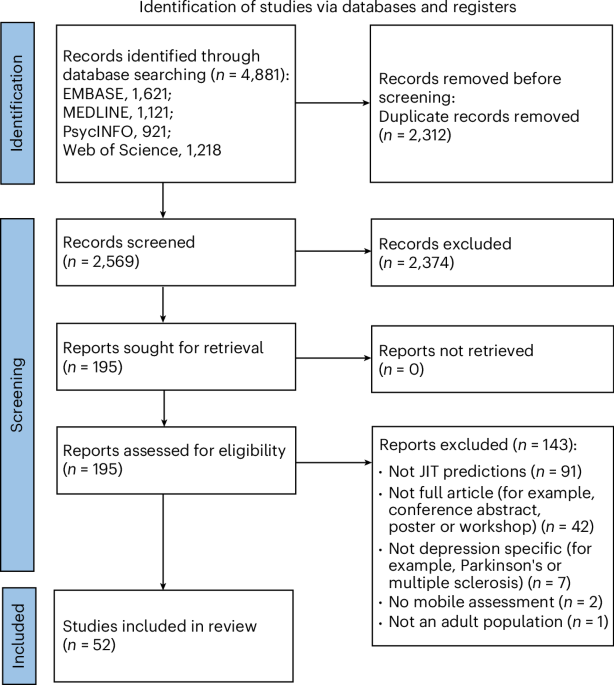
Tricco, A. C. et al. PRISMA Extension for Scoping Reviews (PRISMA-SCR): checklist and explanation. Ann. Intern. Med. 169, 467–473 (2018).
Google Scholar
Covidence systematic review software (Veritas Health Innovation, 2025); www.covidence.org
Viswanathan, M. et al. Recommendations for assessing the risk of bias in systematic reviews of health-care interventions. J. Clin. Epidemiol. 97, 26–34 (2018).
Google Scholar
Auerbach, R. P., Srinivasan, A., Kirshenbaum, J. S., Mann, J. J. & Shankman, S. A. Geolocation features differentiate healthy from remitted depressed adults. J. Psychopathol. Clin. Sci. 131, 341–349 (2022).
Google Scholar
Cohen, A. et al. Digital phenotyping data and anomaly detection methods to assess changes in mood and anxiety symptoms across a transdiagnostic clinical sample. Acta Psychiatr. Scand. 151, 388–400 (2024).
Google Scholar
Currey, D. & Torous, J. Digital phenotyping correlations in larger mental health samples: analysis and replication. BJPsych Open https://doi.org/10.1192/bjo.2022.507 (2022).
Demasi, N., Aguilera, N. & Recht, N. Detecting change in depressive symptoms from daily wellbeing questions, personality, and activity. In IEEE Wireless Health (WH) 1–8 (IEEE, 2016); https://doi.org/10.1109/wh.2016.7764552
Difrancesco, S. et al. The day-to-day bidirectional longitudinal association between objective and self-reported sleep and affect: an ambulatory assessment study. J. Affect. Disord. 283, 165–171 (2021).
Google Scholar
Horwitz, A. et al. Utilizing daily mood diaries and wearable sensor data to predict depression and suicidal ideation among medical interns. J. Affect. Disord. 313, 1–7 (2022).
Google Scholar
Ikäheimonen A. et al. Predicting and monitoring symptoms in patients diagnosed with depression using smartphone data: observational study. J. Med. Internet Res. 26, e56874 (2024).
Kumagai, N. et al. Assessing recurrence of depression using a zero-inflated negative binomial model: a secondary analysis of lifelog data. Psychiatry Res. 300, 113919 (2021).
Google Scholar
Lee, H. et al. Prediction of impending mood episode recurrence using real-time digital phenotypes in major depression and bipolar disorders in South Korea: a prospective nationwide cohort study. Psychol. Med. 53, 5636–5644 (2022).
Google Scholar
Liu, T. et al. The relationship between text message sentiment and self-reported depression. J. Affect. Disord. 302, 7–14 (2021).
Google Scholar
McIntyre, R. S. et al. Ecological momentary assessment of depressive symptoms using the mind.me application: convergence with the Patient Health Questionnaire-9 (PHQ-9). J. Psychiatr. Res. 135, 311–317 (2021).
Google Scholar
Moshe, I. et al. Predicting symptoms of depression and anxiety using smartphone and wearable data. Front. Psychiatry https://doi.org/10.3389/fpsyt.2021.625247 (2021).
Niemeijer, K., Mestdagh, M. & Kuppens, P. Tracking subjective sleep quality and mood with mobile sensing: multiverse study. J. Med. Internet Res. 24, e25643 (2021).
Google Scholar
Opoku Asare, K. et al. Predicting depression from smartphone behavioral markers using machine learning methods, hyperparameter optimization, and feature importance analysis: exploratory study. JMIR Mhealth Uhealth 9, e26540 (2021).
Google Scholar
Pedrelli, P. et al. Monitoring changes in depression severity using wearable and mobile sensors. Front. Psychiatry. https://doi.org/10.3389/fpsyt.2020.584711 (2020).
Pellegrini, A. M. et al. Estimating longitudinal depressive symptoms from smartphone data in a transdiagnostic cohort. Brain Behav. https://doi.org/10.1002/brb3.2077 (2022).
Place, S. et al. Behavioral indicators on a mobile sensing platform predict clinically validated psychiatric symptoms of mood and anxiety disorders. J. Med. Internet Res. 19, e75 (2017).
Google Scholar
Shah, R. V. et al. Personalized machine learning of depressed mood using wearables. Transl. Psychiatry https://doi.org/10.1038/s41398-021-01445-0 (2021).
Shende, C. et al. Predicting symptom improvement during depression treatment using sleep sensory data. Proc. ACM Interact. Mob. Wearable Ubiquitous Technol. 7, 1–21 (2023).
Google Scholar
Song, S., Seo, Y., Hwang, S., Kim, H. & Kim, J. Digital phenotyping of geriatric depression using a community based digital mental health monitoring platform for socially vulnerable older adults and their community caregivers: a 6-week living lab single arm pilot study. JMIR Mhealth Uhealth 12, e55842 (2024).
Google Scholar
Stamatis, C. A. et al. Prospective associations of text-message-based sentiment with symptoms of depression, generalized anxiety, and social anxiety. Depress. Anxiety 39, 794–804 (2022).
Google Scholar
Stamatis, C. A. et al. Differential temporal utility of passively sensed smartphone features for depression and anxiety symptom prediction: a longitudinal cohort study. npj Ment. Health Res. https://doi.org/10.1038/s44184-023-00041-y (2024).
Stange, J. P. et al. Let your fingers do the talking: passive typing instability predicts future mood outcomes. Bipolar Disord. 20, 285–288 (2018).
Google Scholar
Tazawa, Y. et al. Evaluating depression with multimodal wristband-type wearable device: screening and assessing patient severity utilizing machine-learning. Heliyon 6, e03274 (2020).
Google Scholar
Thati, R. P., Dhadwal, A. S., Kumar, P. & P, S. A novel multi-modal depression detection approach based on mobile crowd sensing and task-based mechanisms. Multimed. Tools Appl. 82, 4787–4820 (2022).
Google Scholar
Tønning, M. L., Faurholt-Jepsen, M., Frost, M., Bardram, J. E. & Kessing, L. V. Mood and activity measured using smartphones in unipolar depressive disorder. Front. Psychiatry https://doi.org/10.3389/fpsyt.2021.701360 (2021).
Ware, S. et al. Predicting depressive symptoms using smartphone data. Smart Health 15, 100093 (2020).
Google Scholar
Watanabe, K. & Tsutsumi, A. The passive monitoring of depression and anxiety among workers using digital biomarkers based on their physical activity and working conditions: 2-week longitudinal study. JMIR Form. Res. 6, e40339 (2022).
Google Scholar
Wu, C. et al. Automatic bipolar disorder assessment using machine learning with smartphone-based digital phenotyping. IEEE Access 11, 121845–121858 (2023).
Google Scholar
Yue, C. et al. Automatic depression prediction using Internet traffic characteristics on smartphones. Smart Health 18, 100137 (2020).
Google Scholar
Zhang, Y. et al. Predicting depressive symptom severity through individuals’ nearby bluetooth device count data collected by mobile phones: preliminary longitudinal study. JMIR Mhealth Uhealth 9, e29840 (2021).
Google Scholar
Zulueta, J. et al. Predicting mood disturbance severity with mobile phone keystroke metadata: a biaffect digital phenotyping study. J. Med. Internet Res. 20, e241 (2018).
Google Scholar
Hsu, J. et al. Digital phenotyping-based bipolar disorder assessment using multiple correlation data imputation and Lasso-MLP. IEEE Trans. Affect. Comput. 15, 885–897 (2023).
Google Scholar
Kaczmarek-Majer, K. et al. Acoustic features from speech as markers of depressive and manic symptoms in bipolar disorder: a prospective study. Acta Psychiatr. Scand. 151, 358–374 (2024).
Google Scholar
Lee, T. et al. Dynamic bidirectional associations between GPS mobility and ecological momentary assessment of mood symptoms in mood disorders. J. Med. Internet Res. 26, e55635 (2024).
Google Scholar
Sokół-Szawłowska, M., Kamińska, O. & Sochacka, M. MoodMon: novel optimization of bipolar disorder monitoring through patient-driven voice parameter submission and AI technology.Postęp. Psychiatr. Neurol. 33, 230–240 (2024).
Google Scholar
Ortiz, A. et al. Day-to-day variability in sleep and activity predict the onset of a hypomanic episode in patients with bipolar disorder. J. Affect. Disord. 374, 75–83 (2025).
Google Scholar
Source link
-

-

-
-

-


