

Monster Storms on Jupiter Unleash Lightning Beyond Anything on Earth
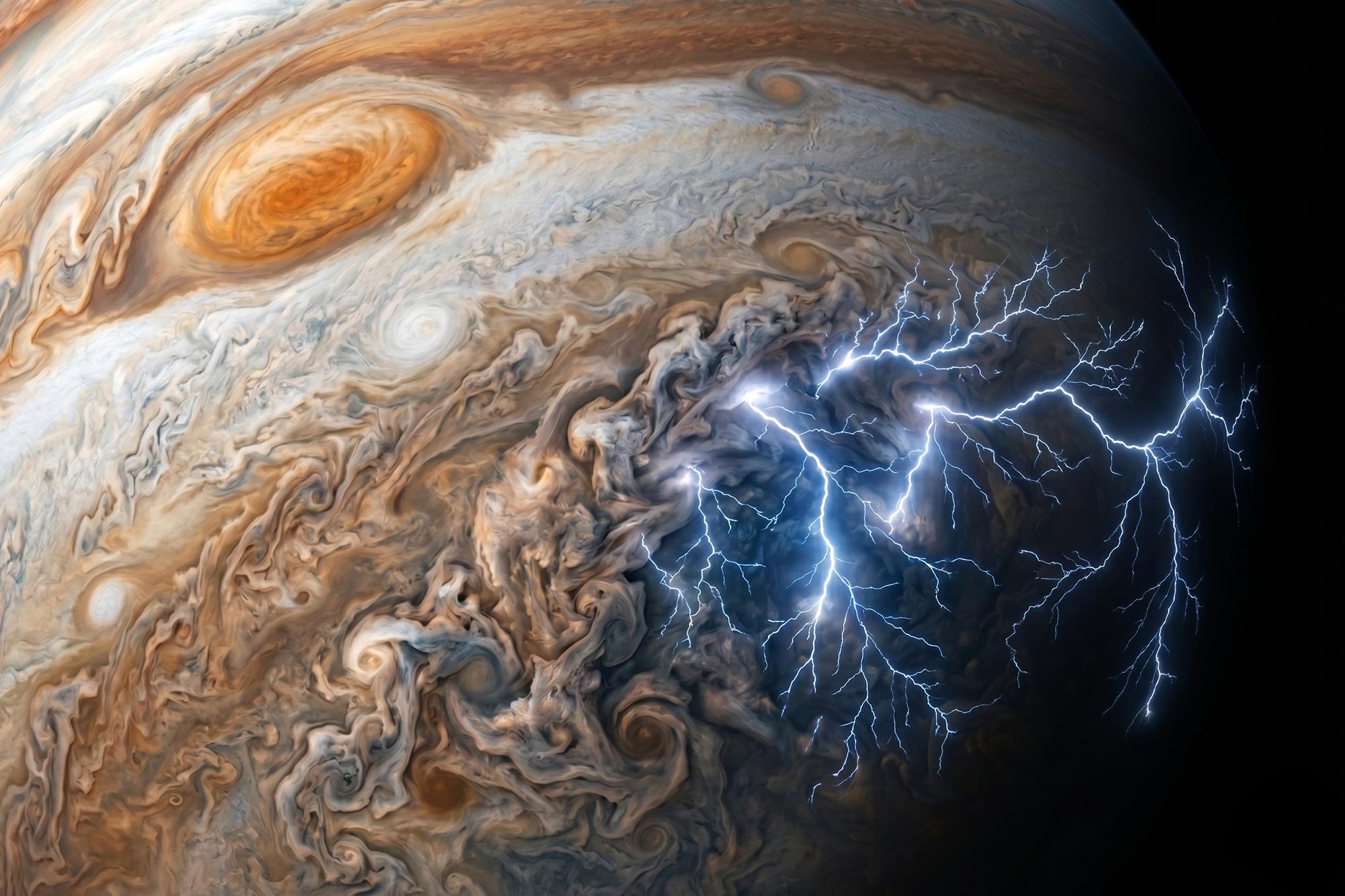
New observations of Jupiter’s lightning reveal unexpectedly complex and powerful storms.
Jupiter, the largest planet in our solar system, is home to massive, long-lived storms, some lasting for centuries. A new study from scientists at the University of California, Berkeley reports that these storms can produce extremely powerful lightning. Some flashes may be up to 100 times stronger than lightning on Earth — and possibly even more intense.
The findings are based on data from NASA’s Juno spacecraft, which has orbited Jupiter since 2016. Juno studies the planet’s atmosphere using a microwave radiometer that detects radio signals produced by lightning, similar to the interference lightning creates on Earth. Microwaves sit at the high-frequency end of the radio spectrum.
Why Study Lightning Beyond Earth?
Examining storms on other planets helps researchers better understand weather on Earth, which still holds many unknowns. Lead author Michael Wong, a planetary scientist at UC Berkeley’s Space Sciences Laboratory, highlighted this point. His study was published in the journal AGU Advances.
“There’s so much we don’t know about lightning on Earth,” he said, pointing out that scientists have identified several new types of “transient luminous events” linked to thunderstorms over the past decade. These TLEs — millisecond electrical phenomena in the troposphere above big storms — include sprites, jets, halos and a phenomenon dubbed ELVEs.
On Jupiter, lightning offers clues about convection, the process that moves heat through the atmosphere. “Convection operates a little bit differently on Earth and Jupiter because Jupiter has a hydrogen-dominated atmosphere, so moist air is heavier and harder to bring upward,” Wong said.
On Earth, air is mostly nitrogen, which is heavier than water. This makes moist air more buoyant and easier to lift. On Jupiter, moist air is heavier than the surrounding atmosphere, so storms need far more energy to rise. When they reach higher altitudes, they release that energy more violently, producing strong winds and intense cloud-to-cloud lightning.
Nearly every spacecraft that has flown past Jupiter has observed lightning, largely because flashes stand out clearly on the planet’s dark side. Earlier missions detected only the brightest flashes, leading to the idea that Jupiter’s lightning was far more powerful than Earth’s.
That view changed when Juno’s highly sensitive star-tracking camera identified many weaker flashes similar to those on Earth. Observations on the night side can be misleading, however, since thick clouds may hide some of the light and make flashes appear weaker than they are, Wong explained.
Juno’s microwave radiometer offers a more reliable measurement because its signals can pass through clouds. Although the instrument was not designed specifically for lightning studies, it can detect microwave emissions from nearby storms.
A major challenge is that multiple storms often occur at the same time across Jupiter’s wide atmospheric bands. This makes it difficult to match a lightning signal to a specific storm. Without knowing the exact source, scientists cannot accurately calculate the strength of each flash. Wong compared this to hearing popping sounds at a Chinese New Year’s parade without knowing whether they come from nearby popcorn or distant firecrackers.
Stealth superstorms
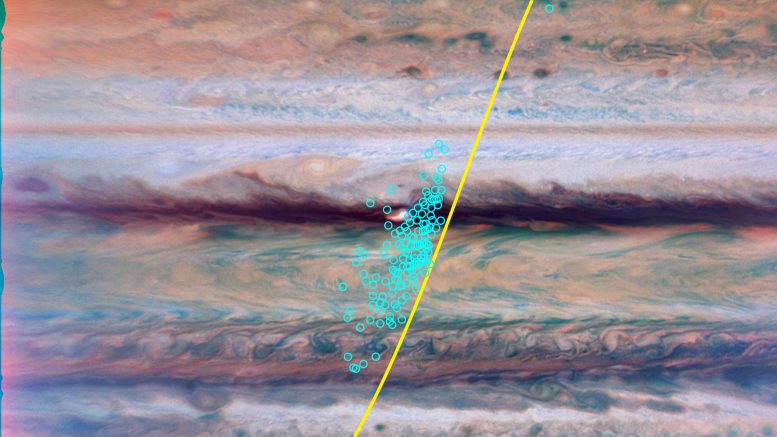
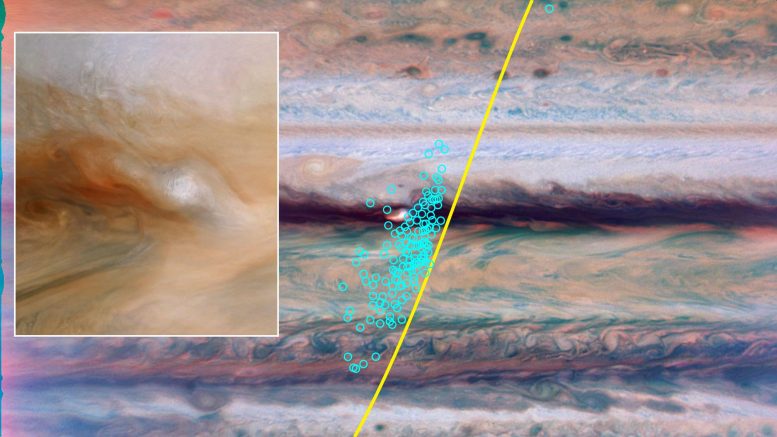
Fortunately, in 2021 and 2022, storm activity in Jupiter’s North Equatorial Belt temporarily decreased. This allowed Wong and his team to isolate individual storms and track them more precisely using data from the Hubble Space Telescope, Juno’s camera, and amateur astronomers. He called these events “stealth” superstorms.
These storms lasted for months and reshaped surrounding cloud patterns, much like larger superstorms. However, their cloud tops did not rise as high.
“Because we had a precise location, we were able to just say, ‘OK, we know where it is. We’re directly measuring the power,’” he said.
During this period, Juno made 12 passes over isolated storms and came close enough in four cases to detect microwave signals from lightning. The spacecraft recorded an average of three flashes per second. In one pass, it detected 206 separate pulses. Out of 613 total pulses, Wong estimated that lightning strength ranged from similar to Earth’s to more than 100 times stronger.
He noted some uncertainty in these comparisons because the measurements were taken at different radio wavelengths. One study suggests Jupiter’s lightning could be up to a million times more powerful than lightning on Earth.
Understanding Lightning Energy
Converting microwave signals into total lightning energy is complex, said co-author Ivana Kolmašová, a space physicist at Charles University in Prague, Czechia, and a member of the Czech Academy of Sciences. Lightning produces energy in many forms, including radio, light, heat, sound, and chemical reactions.
On Earth, a single lightning bolt releases about 1 gigaJoule (1 billion joules), enough to power 200 average homes for an hour. Wong estimates that a lightning bolt on Jupiter could release between 500 and as much as 10,000 times more energy.
The process behind Jupiter’s lightning is likely similar to Earth’s. Rising water vapor condenses into droplets and ice crystals that become electrically charged, creating large voltage differences. On Earth, this often leads to hail. On Jupiter, the ice particles include both water and ammonia. One idea is that they combine to form “mushballs” that fall like slushy hail.
Ongoing Mysteries
Even with these findings, many questions remain. Stronger lightning suggests higher voltages, but the exact processes on Jupiter are still unclear.
“This is where the details start to get exciting, where you can ask, ‘Could the key difference be hydrogen versus nitrogen atmospheres, or could it be that the storms are taller on Jupiter and so there’s greater distances involved?’” he said. Jupiter’s storms are more than 100 kilometers tall, compared to 10 kilometers on Earth.
“Or could it be that greater energy is available because with moist convection on Jupiter, you have a bigger buildup of heat needed before you can generate the storm to create lightning?” he added. “It’s an active area of research.”
Reference: “Radio Pulse Power Distribution of Lightning in Jupiter’s 2021–2022 Stealth Superstorms” by Michael H. Wong, Ivana Kolmašová, Fabiano A. Oyafuso, Masafumi Imai, Shinji Mizumoto, Steven M. Levin, Ramanakumar G. Sankar, Amy A. Simon, Shawn Brueshaber, Glenn S. Orton, Sushil K. Atreya, Cheng Li and Scott J. Bolton, 20 March 2026, AGU Advances.
DOI: 10.1029/2025AV002083
The research was supported by NASA (80NSSC19K1265, 80NSSC25K0362).
Never miss a breakthrough: Join the SciTechDaily newsletter.
Follow us on Google and Google News.
Source link