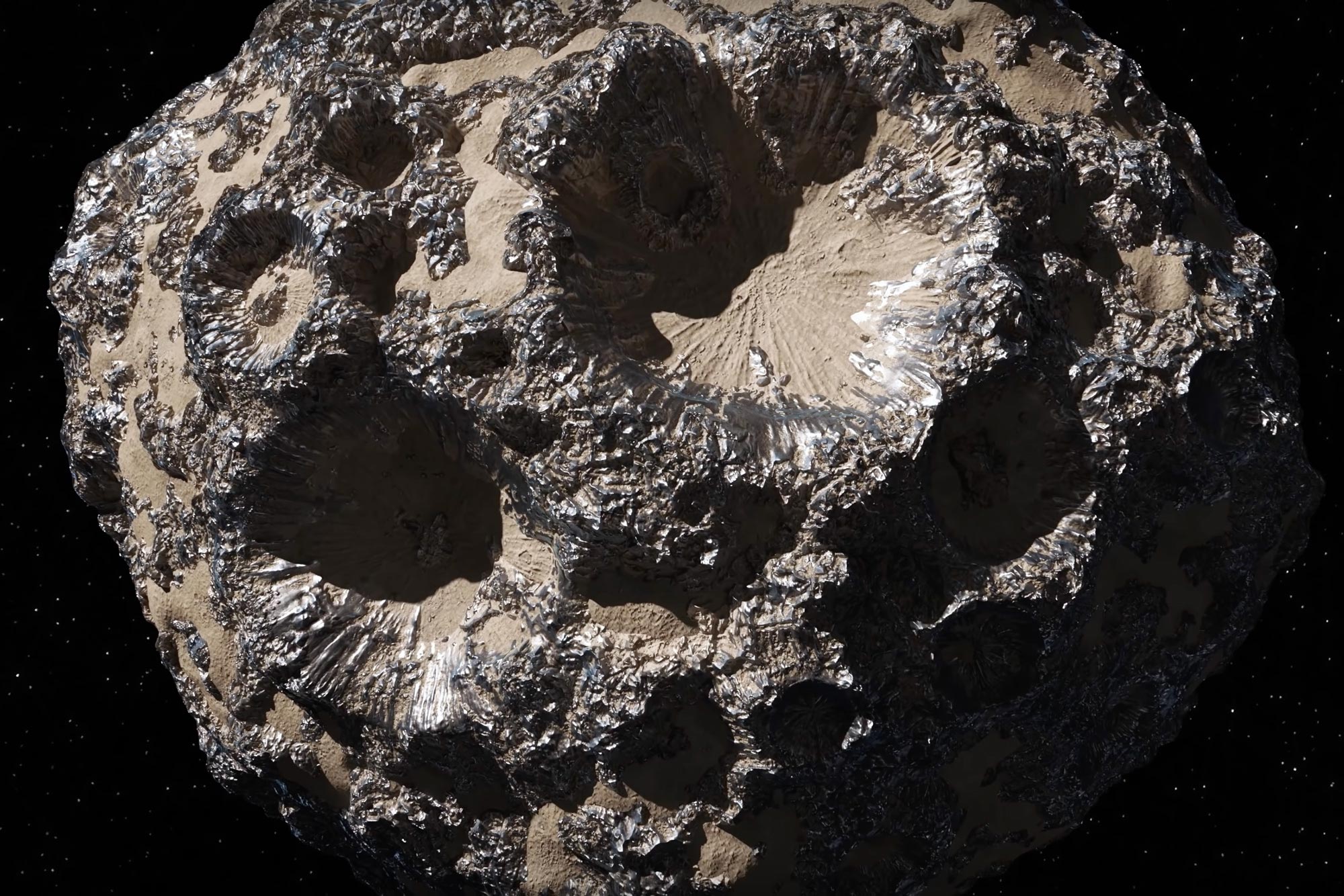
A massive crater on asteroid Psyche may hold the key to whether it’s a lost planet’s core or something more complex. New simulations suggest NASA’s upcoming mission could finally solve the mystery.
More than 200 years after asteroid 16 Psyche was first identified, scientists are still trying to understand how it formed.
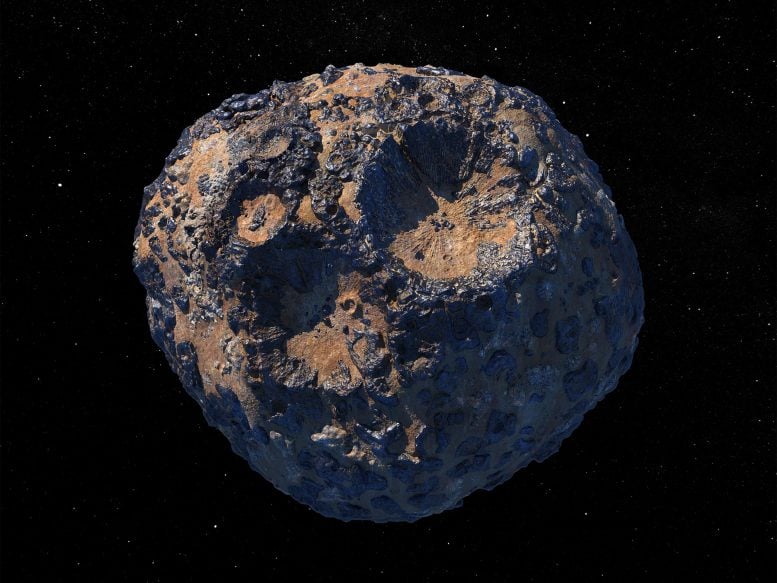
Psyche is the 10th-most massive object in the main asteroid belt between Mars and Jupiter and the largest known metal-rich asteroid, measuring about 140 miles across. NASA’s Psyche mission is set to arrive in 2029 to investigate its origin. Researchers think it could be a remnant of an early planet that was torn apart by massive impacts, or a fragment of a once-layered body that lost its rocky outer layer.
Other theories suggest Psyche may have started out rich in metal, or became a mixture of rock and metal after repeated collisions with other asteroids. Each possibility points to a different explanation for how planets formed in the early Solar System.

Crater Simulations Offer Clues to Psyche’s Interior
To explore these ideas, scientists at the University of Arizona’s Lunar and Planetary Laboratory ran simulations to study how a large crater near Psyche’s north pole may have formed under different scenarios. Their study, published in JGR Planets, provides predictions that will help researchers interpret data from NASA’s Psyche mission once it arrives. When combined with spacecraft observations, these results could finally reveal what Psyche is made of.
“Large impact basins or craters excavate deep into the asteroid, which gives clues about what its interior is made of,” said Namya Baijal, a doctoral candidate at the LPL and first author of the paper. “By simulating the formation of one of its largest craters, we were able to make testable predictions for Psyche’s overall composition when the spacecraft arrives.”
Less than 10% of asteroids in the main belt are metal-rich, and Psyche is the largest of them. Still, scientists will need direct measurements from the spacecraft to determine how that metal is arranged inside.

Porosity Plays a Key Role in Impact Craters
“One of our main findings was that the porosity – the amount of empty space inside the asteroid – plays a significant role in how these craters form,” said Baijal. “Porosity is often ignored because it’s difficult to include in models, but our simulations show it can strongly affect the impact process and shape of craters left behind.”
If an asteroid contains a lot of empty space, it can compress more easily during an impact. This allows it to absorb energy more efficiently, producing deeper and steeper craters with less debris spread across the surface. By comparing these simulated features with real observations, scientists can test whether Psyche has a layered structure of metal and rock or a more mixed composition.
Psyche and the Origins of Planets
The team compares their method to investigating an abandoned pizza shop. Psyche and other main belt asteroids are thought to be leftover pieces from planet formation. “The cooks have long left, but you can look at what’s left behind – the ovens, scraps of dough, the toppings – and make inferences about how the pizzas were made,” said Erik Asphaug, a professor in LPL and co-author of the study. “We can’t get to the cores of Earth or Mars or Venus, but maybe we can get to the core of an early asteroid.”
If Psyche turns out to be an exposed planetary core, stripped of most of its outer layers, it could provide a rare look at a violent phase of planet formation that scientists cannot directly observe.
“We tested two main interior structures for Psyche,” said Baijal. “One is a layered structure with a metallic core and a thin, rocky mantle, which likely formed if a violent collision stripped away the outer layers. The other is a uniform mixture of metal and silicate, created by a more catastrophic impact that mixed everything together, like some metal-rich meteorites found on Earth.”

Modeling a Giant Impact on Psyche
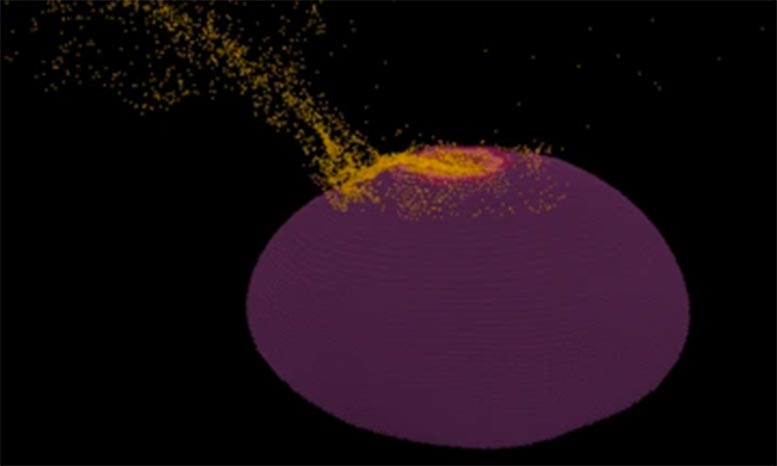
Using detailed shape models based on telescope data, the researchers built a 3D version of Psyche and recreated the formation of a large crater about 30 miles wide and three miles deep. In the simulations, the asteroid was struck at typical asteroid belt speeds of about three miles per second. The team tested different impactor sizes and compared two possible internal structures (metallic core and mixed rock-and-metal) to see which best matched the observed crater.
“We found that an impactor about three miles across would create a crater of the right dimensions,” Baijal said. “The crater’s formation is consistent with both scenarios of Psyche’s makeup.”
Unlike planets, many asteroids are not solid rock. They often contain fractured material and empty spaces from past collisions. By including porosity in their models, the researchers showed that it strongly influences both crater shape and how material is ejected during impacts.
“By rigorously treating Psyche’s shape, porosity, and composition, this work represents a true watershed moment for our capacity to realistically simulate impacts into unique types of asteroids,” said Adeene Denton, a postdoctoral researcher and another co-author of the study.
NASA’s Psyche Mission and What It Will Reveal
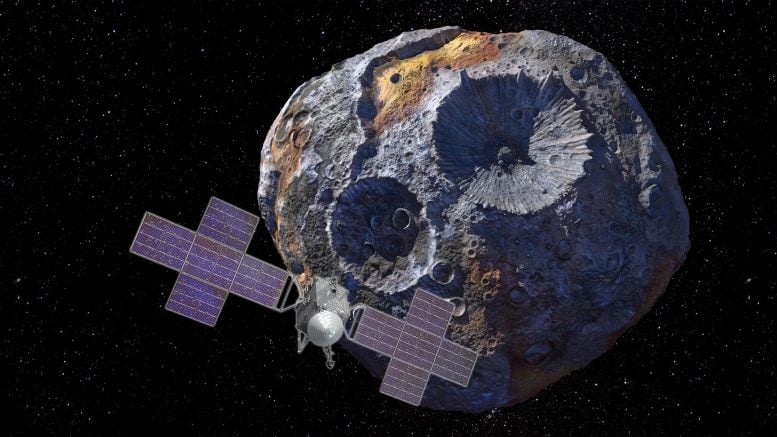
The Psyche spacecraft is equipped to study the asteroid’s surface, gravity, magnetic field, and composition. Along with crater shapes, the simulations predict other features scientists can look for, such as changes in density caused by impacts compressing the interior and the distribution of metal-rich debris across the surface.
“When the spacecraft arrives at Psyche in a few years, the geochemists, geologists and modelers on the team will all be looking at the same object and trying to interpret what we see,” said Asphaug. “This work gives us a head start.”
Reference: “Exploring the Interior Structure of (16) Psyche Through Basin-Scale Collisions” by Namya Baijal, Erik Asphaug, C. Adeene Denton, Martin Jutzi, Sabina Raducan, Saverio Cambioni, Linda T. Elkins-Tanton and Amanda Alexander, 13 March 2026, Journal of Geophysical Research: Planets.
DOI: 10.1029/2025JE009231
The Psyche mission is led by Arizona State University, with Lindy Elkins-Tanton of the University of California, Berkeley, serving as principal investigator. NASA’s Jet Propulsion Laboratory, a division of Caltech in Pasadena, oversees mission management, system engineering, integration and testing, and operations. Maxar Technologies (now Intuitive Machines) in Palo Alto, California, built the spacecraft’s solar electric propulsion chassis.
Psyche is the 14th mission selected for NASA’s Discovery Program, managed by the agency’s Marshall Space Flight Center in Huntsville, Alabama. NASA’s Launch Services Program at Kennedy handled the launch.
Never miss a breakthrough: Join the SciTechDaily newsletter.
Follow us on Google and Google News.
Source link