
AI analysis of Reddit posts uncovered potential side effects of GLP-1 drugs that may be underreported, demonstrating the value of social media in early drug safety insights.
Researchers at the University of Pennsylvania used artificial intelligence to examine more than 400,000 Reddit posts and identify symptoms reported by patients taking GLP-1 drugs, including semaglutide and tirzepatide. These medications are widely used for weight loss and diabetes, but some of the effects described online may not be fully documented in clinical trials or official reports.
The study, published in Nature Health, analyzed over five years of discussions from nearly 70,000 Reddit users. It points to two groups of symptoms that deserve closer attention: reproductive issues such as irregular menstrual cycles and temperature-related effects like chills and hot flashes.
“Some of the side effects we found, like nausea, are well known, and that shows that the method is picking up a real signal,” says Sharath Chandra Guntuku, Research Associate Professor in Computer and Information Science (CIS) at Penn Engineering and the study’s senior author. “The underreported symptoms are leads that came from patients themselves, unprompted, and clinicians could potentially pay attention to them.”


“Clinical trials generally identify the most dangerous side effects of drugs,” adds Lyle Ungar, Professor in CIS and a co-author on the study. “But they can fail to find what symptoms patients are most concerned about; even though social media is not necessarily representative, a large collection of posts may reflect additional concerns.”
Limits of Clinical Trials and Value of Patient Voices
The researchers emphasize that their findings do not prove cause and effect. “We can’t say that GLP-1s are actually causing these symptoms,” notes Neil Sehgal, the study’s first author and a doctoral student in CIS advised by Guntuku and Ungar. “But nearly 4% of the Reddit users in our sample reported menstrual irregularities, which would be even higher in a female-only sample. We think that’s a signal worth investigating.”
Ungar has studied online health discussions for years, including early efforts in 2011 to extract information about drug side effects from user-generated content. He compares these platforms to informal networks where people share experiences in real time.


“Online patient communities work a lot like a neighborhood grapevine,” says Ungar. “People who are living with these medications are swapping notes with each other in real time, sharing experiences that rarely make it into a doctor’s office visit or an official report.”
As social media use has expanded, it has become a more valuable source of health-related data, even as access to that data has grown more restricted. Researchers note that traditional clinical trials remain essential, but they can take years to complete. (Guntuku has also conducted research on methods for adjusting to shifts in platform access.)
Computational Social Listening and Scaling Challenges
“Clinical trials are the gold standard, but by design, they are slow,” says Guntuku. “This is not a replacement for trials, but it can move much faster, and that speed matters when a drug goes from niche to mainstream almost overnight.”
A major challenge in this process, which Guntuku calls “computational social listening,” has been scale. People describe symptoms in many ways, making it difficult to match their language to standardized medical terms used in systems like the Medical Dictionary for Regulatory Activities (MedDRA).

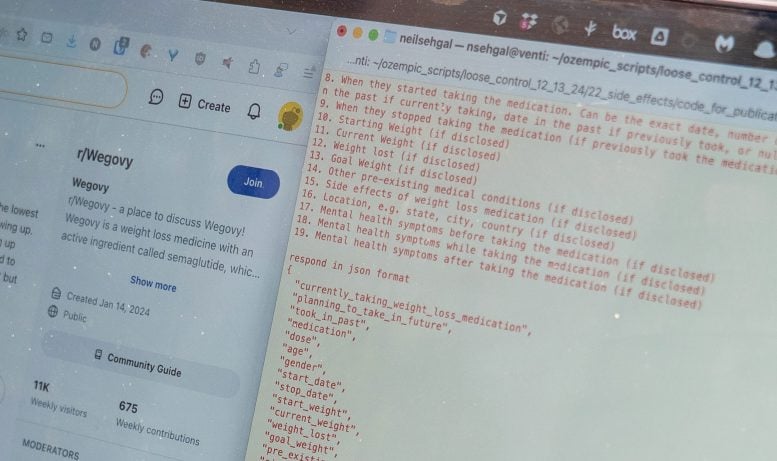
Recent advances in large language models such as GPT and Gemini have made it possible to process and organize these posts more efficiently. “Large language models have made it possible to do this kind of analysis much faster with a level of standardization that could be difficult to achieve before,” says Sehgal.
Key Findings: Reproductive and Temperature Symptoms
Although Reddit users are not representative of the general population, the reported symptoms largely align with known side effects of these medications. About 44% of users mentioned at least one issue, most often gastrointestinal problems.
However, some patterns stood out. Nearly 4% of users who described side effects reported reproductive issues, including irregular cycles, heavy bleeding, and bleeding between periods. Others mentioned temperature-related symptoms such as chills, feeling unusually cold, hot flashes, and fever-like sensations.
Fatigue was also frequently reported, ranking as the second most common complaint, even though it appears less often in clinical trial data.
Biological Explanations and Clinical Implications
“These drugs are thought to work by engaging part of the brain called the hypothalamus, which helps regulate a wide variety of hormones,” says Jena Shaw Tronieri, Senior Research Investigator at Penn’s Center for Weight and Eating Disorders and a co-author of the study. “That doesn’t mean the medications are necessarily causing these symptoms, but it could suggest that reports of menstrual changes and body temperature fluctuations are worth studying more systematically.”

In the short term, the team hopes their findings will prompt healthcare providers and researchers to pay closer attention to patient discussions online. “They’re clearly on patients’ minds, and that’s worth paying attention to,” says Sehgal.
Future research will expand beyond Reddit and include non-English communities to determine whether similar trends appear in other populations. “We don’t really know yet whether what we’re seeing on Reddit reflects the experience of GLP-1 users globally, or whether it’s particular to the kind of person who posts on Reddit in the United States,” Ungar says.
Future of AI in Drug Safety Monitoring
The researchers believe this type of AI-driven analysis could become an important tool for identifying early signals related to new medications and health trends. This approach may be especially useful for substances that gain rapid popularity online, including products sold in less regulated markets such as injectable peptides.
“The whole point of this kind of approach is that it can move quickly, and that’s exactly when it’s most valuable,” says Guntuku.
Reference: “Self-reported side effects of semaglutide and tirzepatide in online communities” by Neil K. R. Sehgal, Jena Shaw Tronieri, Lyle Ungar and Sharath Chandra Guntuku, 10 April 2026, Nature Health.
DOI: 10.1038/s44360-026-00108-y
The authors report no outside funding. Tronieri reports receiving an investigator-initiated grant, on behalf of the University of Pennsylvania, from Novo Nordisk and receiving consulting fees from Currax Pharmaceuticals, LLC. The other authors report no conflicts of interest.
Never miss a breakthrough: Join the SciTechDaily newsletter.
Follow us on Google and Google News.
Source link
-

-

-
-

-