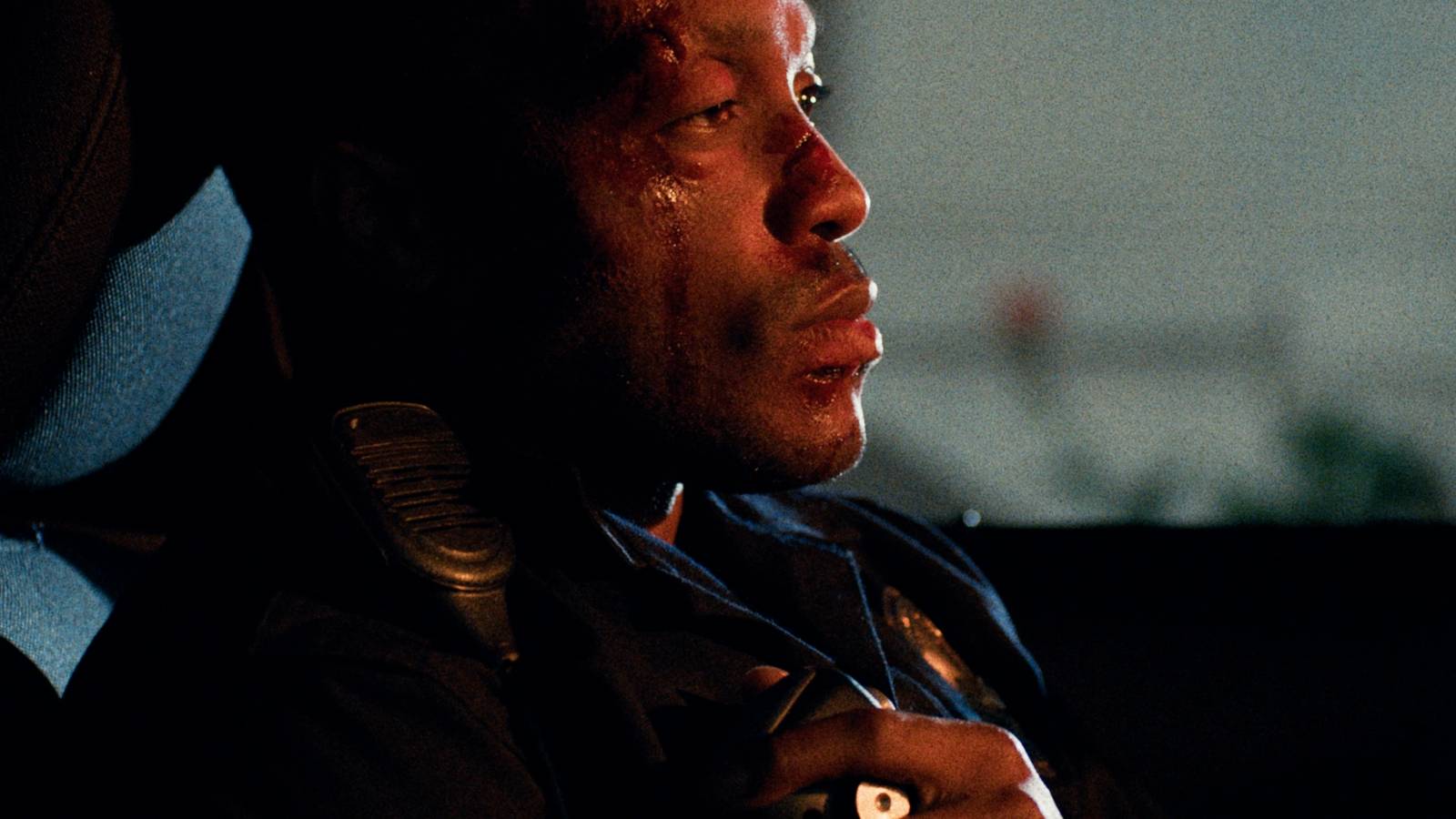
Night Patrol is a funny movie, but comedy isn’t its primary focus. It’s also an extremely bloody horror story, the kind that has more than one central character running around absolutely drenched in gore by the end. And underneath the layers of tongue-in-cheek humor and bloody mayhem, it’s an angry movie as well, a story about police corruption, unchecked violence, and institutional white supremacy that occasionally feels a little too raw, and a little too resonant with the footage we’re currently seeing online every day, as ICE agents assault or kill protesters while abducting people off the streets.
Any resemblance to current events is strictly intentional. Night Patrol co-writer and director Ryan Prows previously earned acclaim for his 2017 directorial debut Lowlife, a black-comedy thriller about an ex-con and a disgraced luchador facing off against a crime lord and a corrupt ICE agent harvesting organs from immigrants in a run-down Los Angeles neighborhood. (Reviews widely compared it to Quentin Tarantino’s early work; Tarantino himself reportedly told Prows the movie was “a real stroke of genius.”) Night Patrol is a more supernatural, fantastical take on some of the same concerns.
Justin Long and Jermaine Fowler star as Los Angeles cops trying to infiltrate the notoriously secretive, powerful LAPD unit known as “Night Patrol.” R.J. Cyler co-stars as a neighborhood ne’er-do-well who escapes one of Night Patrol’s executions and winds up on the run, with his family connections to gangs and the LAPD pulling him in different directions. Then he learns something that’s given away in the film’s trailer — but if you haven’t been spoiled, you should stop reading here, because it’s a lot more fun as a surprise while watching the movie.
Spoiler: Night Patrol’s members are vampires. More than that, they’re white-supremacist cop vampires who see preying on LA’s Black and Brown citizens as a God-given right, and they have a plan in place to harvest Cyler’s entire neighborhood. Night Patrol is in part a cathartic, over-the-top fight-the-power thriller about the forces pushing back against these institutionally backed monsters, and in part a blood-soaked creature-feature action movie, where heavily armed gang members face off against fast-healing bloodsuckers. Polygon sat down with writer-director Ryan Prows after Night Patrol’s world premiere at the 2025 Fantastic Fest to talk about making genre movies about institutional racism, the inevitable comparisons with Ryan Coogler’s Sinners, and bringing in Dermot Mulroney, of all people, as a swaggering vampire lord.
This interview has been edited for concision and clarity.
Polygon: You made a movie in 2017 about a corrupt ICE agent, and about racial inequity and standing up to white supremacy. Now your latest movie is about—
Ryan Prows: Kittens and puppies. [Laughs]
Sure, but also white people in power not just preying on people of color, but literally rounding them up and packing them into cages. Some scenes in this movie look like current news footage. Does it feel like you’re anticipating our current political moment?
It definitely feels like I’m anticipating. I keep being like, When will I get to anticipate kittens and puppies instead? Because yeah, when we were working on Lowlife, we saw just how awful the idea of ICE was, how scary it was, what it could turn into. We were like, “Is anyone even going to know what ICE is?” when we were making that film.
Now I don’t know if the writing’s on the wall, but as we were building this, it naturally built itself — and the movie kind of takes off and has a mind of its own.
Watching this so soon after Sinners, it feels like vampires as a metaphor for racial inequity, for people with institutional power murdering people they see as weaker, lesser, or less protected, is a particularly resonant idea in horror right now. But are you concerned about comparisons to Sinners?
I’m not worried about comparisons — I definitely think it’ll be a boost. To me, it is cool just to be part of that moment, or help contribute to that conversation. It felt like the same thing as Lowlife — people kept comparing it to early Tarantino films, and I was like, “That’s not a bad place to be.”
“Terror,” your segment in V/H/S/94, also deals with white supremacy and vampires.
Sure. I see a theme emerging. [Laughs]
Are there ways in which this movie is exploring things you either tested out in “Terror” or that you wanted to get to, but couldn’t within the run of a short?
Yeah, I think playing with vampire lore and where we could push it — with this one, we obviously have a little more runway to build in the backstory of everything and what truly is being weaponized against [the heroes]. “Terror” was just more of a fun concept: If vampires exploded in sunlight and became human bombs, that would be a fun way to just push that idea more.
The vampires in Night Patrol don’t necessarily work the way they did in “Terror,” but there are still lots of explosions and gore and blood. When we started out, we were like, “How do we make the bloodiest vampire movie?” And I feel confident that we’ve pretty much succeeded. [Blade writer] David S. Goyer was one of our producers, so we were always going to compete and collaborate with him on how bloody we could get a vampire movie.
Why are white supremacy and vampires such resonant concepts for you?
It’s just the idea of people preying on obvious social inequality. The way our country and our society are set up feels like an opportunity for genre stories that have fun and lean into the blood-and-guts thrill-ride aspect of cinema while still commenting on what’s going on out there.


This movie ends on a dramatic mid-action moment. Do you want to return to this character, this story?
Yeah, I would love to. All the filmmakers, writers, producers, everybody, we had a lot of fun building the lore and the backstory. We were always pitching like, “Oh, this character could be this at this time,” or whatever. So when this is a runaway smash hit, be looking for 2 Night 2 Patrol.
You’re in a weird position with this movie in terms of figuring out how to market it to the humor-horror-political-thriller audience that’s most likely to love it without giving away aspects of the film that play best as a surprise. What’s your ideal experience for viewers, in terms of how much they know upfront?
I think you can come in fully knowing what this movie is, or not. I think what’s fun about it is, even if you know what the movie’s real premise is, I guarantee you do not know where it’s going, or how it’s going to get there. So I think it’ll be fun either way. I’m curious to see what plays better for people.
How did you come to work with Dermot Mulroney?
One of the producers connected us. I had an initial phone call with him before he signed on, and it was so cool — he’d obviously read the script and got it right away, got what we were pushing for. He just sort of outlined: These are cops, and I’m playing a cop and I’m sort of also a vampire king, and he was just ready to roll from there. He snapped in and knew what it was immediately, and we were so pumped when he signed on. Our production name for the film as we were putting it together was Pals, as a Young Guns reference, so we were ready for Dermot to come in and just break it up.


It can be a lot of fun to play an over-the-top villain, but it’s also a weird time for a white actor to embrace a role as a racist, a predator planning to casually murder an entire neighborhood full of mostly Black people. How did you navigate the film’s racial elements?
As one of the writers and the director, I had to step away so that I wasn’t leading [the Black actors] too much. We wanted this to feel grounded and real, like everything is authentic and we’re with real people that are in this situation, so when the supernatural stuff pops off, it also feels grounded and real, in a weird way. I didn’t want to blink about charging right into what the movie is saying and doing. The movie is very loud about what it’s saying, but I didn’t want it to just be preachy, just the same message over and over again.
What’s the ideal takeaway for your viewers? You’ve made it clear you want them to have fun in the moment — this is a fairly comedic movie at times — but how do you want them to respond to the more charged political messages?
It’s just starting a conversation, continuing a conversation, in this moment with Sinners and other films that are kind of swirling around genre and politically charged stories. I just want people to keep that going, and to be loud about it. Being provocative enough to continue that conversation is a really big part of it for me.
Night Patrol is in theaters now.
Source link
-

-

-

-
-