

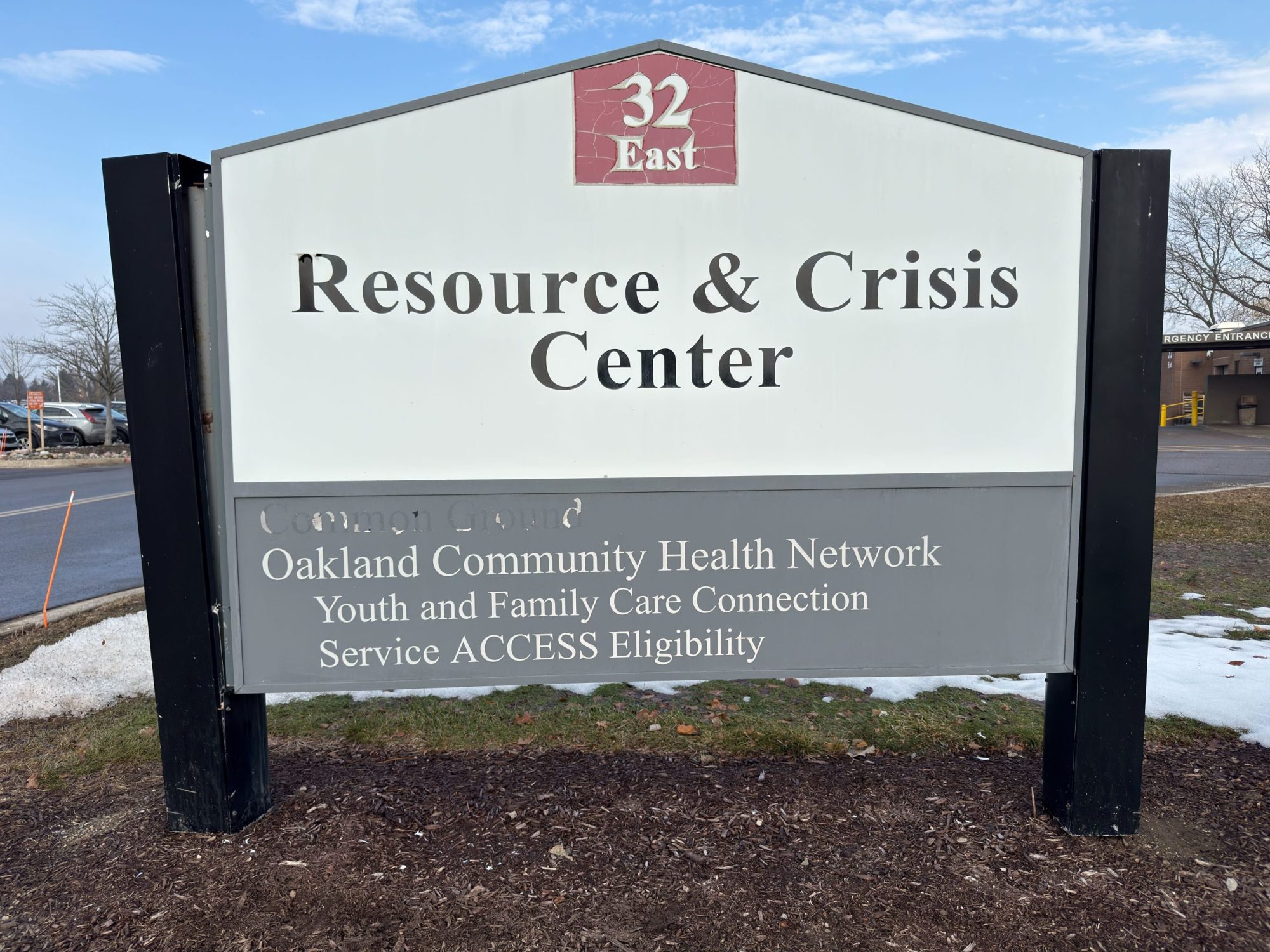
- Law enforcement is Oakland County is being asked to divert individuals in severe psychological crisis to hospitals rather than a designated facility in Pontiac
- Critics say the practice burdens both emergency departments and police officers, who lack specialized training and resources
- The Michigan Mental Health Association says the action is having a “chilling effect” on network providers
TROY – Mental health advocates are worried that a transition in crisis care in Oakland County is causing major service disruptions for adults in psychological emergencies.
Oakland Community Health Network (OCHN), which manages a behavioral health provider network that serves about 30,000 county residents, notified local law enforcement last month to request “individuals in crisis be diverted to the local Emergency Departments” rather than be admitted to the county’s Resource and Crisis Center in Pontiac.
Using the ER to care for mental health patients in crisis is a controversial practice sometimes called “psychiatric boarding.”
The decision pushes out Oakland County’s timeline to fully absorb adult mental health services as it pivots away from contracting out some of that work. Until recently, a nonprofit provider, Common Ground, operated a 24/7 residential crisis center in Pontiac that serves all of Oakland County.
Oakland Community Health Network assumed responsibility for the Pontiac Resource and Crisis Center in late January following the acrimonious end of the county’s relationship with Common Ground.
Related:
Some operations are temporarily paused at the center, leaving Oakland County unable to take in severe mental health cases brought in by police for crisis stabilization, as well as run the center’s short-term, voluntary crisis residential program that serves as an alternative to inpatient psychiatric hospitalization.
Officials say nine individuals receiving care at the center were discharged on Jan. 29, when OCHN assumed responsibility for all adult crisis center crisis services.
“We don’t have the full staffing needed to operate that unit safely,” Trisha Zizumbo, chief operating officer for OCHN, told Bridge Michigan.
Executives at the public agency estimate they have about 50 positions left to fill before normal operations can resume, having brought on about 100 employees, many from Common Ground, during the transition.
Dana Lasenby, OCHN’s chief executive officer, said the agency is awaiting a state license to operate its residential crisis program, and that there are “contingencies in place that are working” that allow the site to continue providing 24/7 walk-in crisis services and other types of support.
Pontiac General Hospital and other local emergency departments are being used as a resource, Lasenby said. Pontiac General is facing a precarious future itself, after it declared bankruptcy in 2024 and was removed from Medicare.

She estimates the Pontiac Resource and Crisis Center will have “everything up and running” by April 1.
“It was not our ideal to cease those services by the previous vendor in the way in which it happened or in the timeframe in which it happened,” Lasenby told Bridge.
Common Ground, which has provided behavioral health services in Oakland County for more than 50 years, ceased adult crisis services at the Pontiac center last month citing a contract dispute.
While leadership at OCHN say the nonprofit was overpaid for its work, Common Ground CEO Heather Rae said the public agency failed to make hundreds of thousands of dollars in payments, causing her organization to run an “unsustainable financial deficit.”
The split occurred over several months as OCHN broadcast its intent to absorb more crisis services amid a shifting mental health care landscape in Michigan.
“It’s definitely problematic,” Rae told Bridge. “It was the only comprehensive crisis center in the state for a very long time.”
Common Ground served 1,300 individuals who were dropped off by police at the Pontiac Resource and Crisis Center in 2025, according to Rae, with about 8,000 visiting the location annually.
The Oakland County Sheriff’s Office did not respond to Bridge’s request for comment.
An ‘unfair and impractical’ decision
Mental health advocates say they are concerned about the “problematic transition” occurring in Oakland County and the “unnecessary confusion” it will cause the community, law enforcement and hospitals.
“Unlike hospital emergency departments, crisis centers are specifically designed and staffed with experienced professionals to aid people in crisis,” said Marianne Huff, president and CEO of the Mental Health Association in Michigan, in a statement.
“To expect hospital emergency departments to be ready to assume responsibility for an unknown number of additional individuals that are brought to hospitals by law enforcement is unfair and impractical.”
Huff told members of the OCHN board Tuesday that the agency’s actions are having a “chilling effect” on the statewide network of service providers who are navigating changing dynamics with their community mental health agencies.
Crisis care advocates maintain that designated facilities with a specialized workforce who can assist in mental health emergencies are more cost-effective than diverting those responsibilities to others, while keeping individuals close to their support systems.

MIchigan hospital leaders say they are “hopeful” that community mental health agencies like OCHN will quickly bring services back online quickly.
“The community mental health system is designed to support crisis response for patients with behavioral health needs,” said Lauren LaPine-Ray, vice president of policy and rural health with the Michigan Health and Hospital Association, in an email. “When these services are taken offline and emergency departments are used for mental health patients, capacity for medical emergencies is limited.”
‘Troubling’ changes for police
The pause of crisis care services returns Oakland County to a baseline experienced by many in Michigan.
Most counties do not have a crisis care facility for law enforcement to use, according to James Tignanelli, president of the Police Officers Association of Michigan.
That lack of resources can be “troubling” for law enforcement personnel, Tignanelli said, as officers have to spend hours escorting individuals in a mental health crisis while they wait for treatment, which takes them away from their primary duties and personal life. He said departments often have to issue mandatory overtime to cover staffing shortages caused by the increased time spent in hospitals.
“It’s a real draw on manpower, and it’s not a setting that is easily secured,” Tignanelli told Bridge. “Ultimately, it’s our job, but it’s not one that we’re really trained for.”
Daniel Pfannes, deputy director of the Michigan Sheriffs’ Association, said a “staggering” number of incarcerated individuals are on psychotropic medication. He said “pre-arrest diversion resources” such as mental health facilities can help keep them away from the criminal justice system.
“If the law enforcement doesn’t have those options available to them, then that individual is going to go to jail,” Pfannes said. “We warehouse too many people that are mental health consumers in the jail systems right now.”
Related

