
AI tools have rapidly become part of everyday life, powering everything from content creation and software development to research and business workflows.
Platforms such as ChatGPT, Claude, Microsoft Copilot, Perplexity and many others are now widely used by individuals and organizations alike, often assisting with tasks that involve internal documents, research material, software code, or other potentially sensitive information.
In many organizations, these tools are already embedded into daily workflows, making them not only convenient but also operationally critical.
As reliance on these services continues to grow, so does their value, but not only for legitimate users, but also within the cybercrime ecosystem. Access to advanced AI models can significantly reduce effort, improve output quality, and accelerate tasks that previously required expertise or time.
An analysis conducted by Flare analysts of hundreds of posts collected from fraud-oriented online communities reveals a growing underground market centered on premium AI platform access. pass
Rather than isolated cases of account misuse, the data points to a recurring pattern in which access to AI platforms is repeatedly advertised and redistributed through resale-style listings. Many of these listings promote discounted subscriptions, bundled access to multiple AI tools, or usage models that claim to remove typical platform limitations.
This may suggest a broader trend in underground markets, where access to digital services can be bundled, repackaged, and resold across a wider buyer base.
How Do Threat Actors Obtain AI Accounts?
While the dataset analyzed by Flare’s researchers does not directly document acquisition methods, patterns in the data may suggest several pathways:
-
Exposed keys and secrets: In recent research conducted by Flare, researchers showed how exposed keys can be found in Docker Hub.
-
Credential theft and account takeover: Listings that include aged Gmail or Outlook accounts may indicate that compromised credentials are being reused to access AI platforms.
-
Bulk account creation and verification bypass: References to virtual phone numbers may suggest that actors create accounts at scale while attempting to bypass verification controls.
-
Abuse of trials and promotional programs: Mentions of gift codes or trial access may indicate that onboarding incentives are being exploited.
-
Shared or resold subscriptions: Some listings and buyer discussions may suggest that access is distributed across multiple users rather than tied to a single owner.
-
Potential API key or developer access resale: Mentions of API keys may indicate that backend or programmatic access is also being marketed.
Taken together, these methods may indicate a combination of account compromise, large-scale provisioning, and policy abuse.
You can monitor underground markets and Telegram channels where threat actors buy and sell stolen AI platform access—before attackers use it against your organization.
Why does underground AI access attract buyers?
-
Cost: Official subscriptions for many premium AI services typically start around $20 per month and can increase significantly depending on usage or enterprise features. In contrast, underground listings frequently emphasize cheaper access or bundled offerings. While exact pricing is not always clearly stated, the consistent focus on affordability suggests a meaningful price gap.
-
Scale: Buyers who require multiple accounts for automation, testing, or evasion purposes may find it easier to purchase ready-made access rather than create accounts individually, particularly where verification and payment requirements introduce friction.
-
Sanctions Bypass: In some countries like Russia, Iran or North Korea, access and payment with local credit cards to ChatGPT, Claude etc., may be restricted. Underground markets offer ready-to-use accounts that remove onboarding steps or know your client and provide immediate access.
-
Model restrictions: Some posts promote “fewer restrictions,” appealing to users looking to bypass safeguards or usage limits. While these claims often read like exaggerated advertising and may seem impractical, they reflect a common reality in underground markets – where accounts or API keys are resold with the promise of reduced controls or oversight.

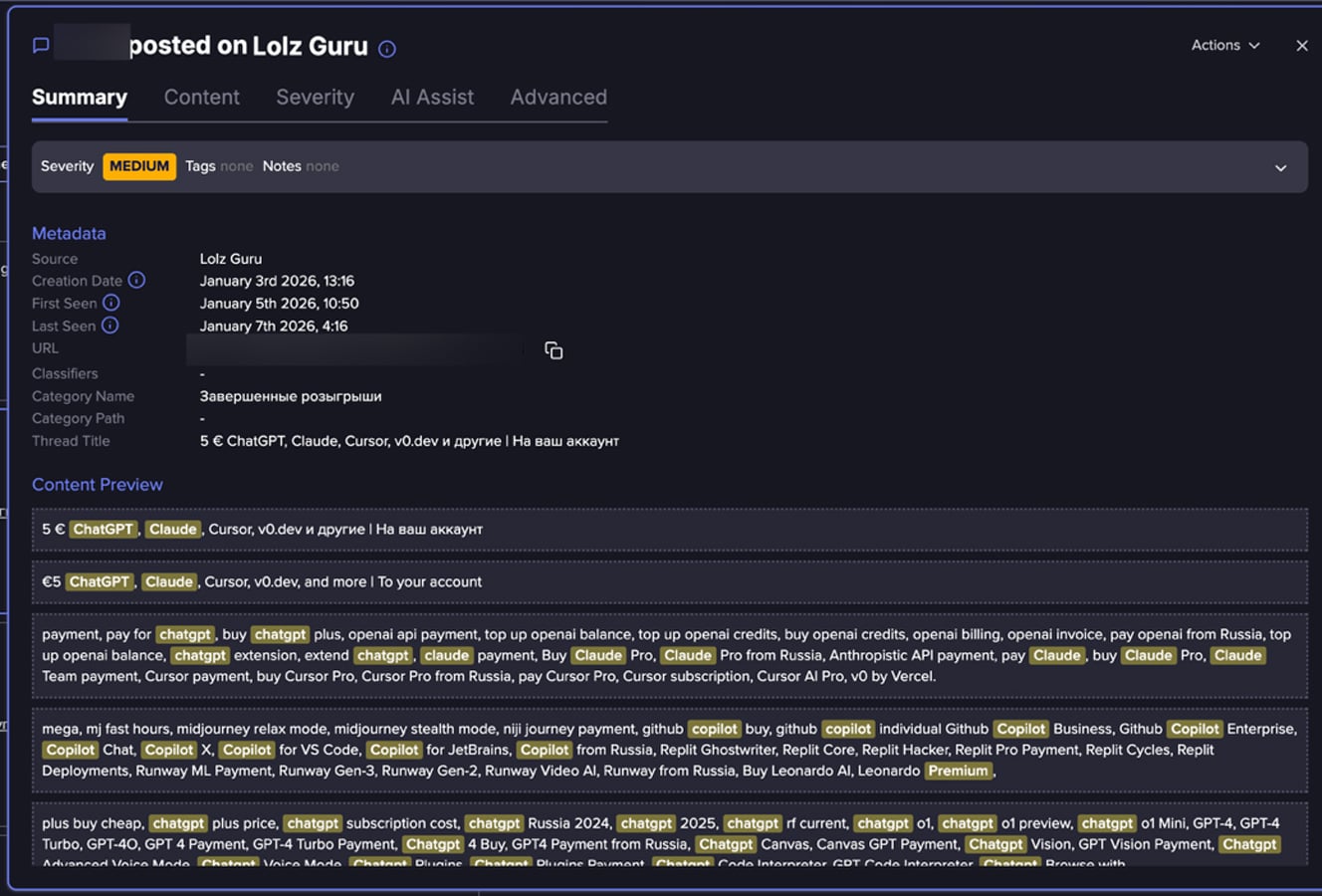
Flare link to post, sign up for the free trial to access if you aren’t already a customer.
How Threat Actors are Using AI platforms
Access to AI platforms may enable a range of activities, some of which extend beyond simple misuse of the services themselves.
In fraud-related scenarios, generative AI tools may be used to produce phishing messages, scam scripts, and multilingual social engineering content at scale. AI-generated text can improve the realism and effectiveness of fraudulent communications.
For example, Europol’s 2025 threat assessment warns that criminal groups are increasingly using generative AI to automate phishing and fraud operations at scale, noting that these tools enable attackers to produce convincing content with greater speed and sophistication than previously possible.
Similarly, Palo Alto Networks’ Unit 42 reported that attackers are leveraging AI to craft highly personalized social engineering campaigns, allowing malicious messages to be tailored more precisely to individual targets and contexts.
Anthropic released in August 2025 a report covering misuse of AI, and in November 2025 another report, orchestrated cyber espionage campaign, illustrating how attackers can misuse AI.
AI tools may also support automation, coding, and content generation tasks, allowing actors to operate more efficiently. Even individuals without strong technical backgrounds can leverage these tools to perform complex tasks.
Some platforms also include image, audio, or video generation capabilities, which may be used to create synthetic content for impersonation or deception.
The Emerging Underground Market for AI Accounts
Flare researchers’ findings suggest that threat actors and underground sellers are perceiving AI accounts as a valuable black market commodity, and AI accounts are integrated into the existing ecosystem that trades access, identity, and digital services. These offerings often appear alongside email accounts, developer tools, and verification infrastructure.
The analysis shows multiple types of AI-related offerings, ranging from direct resale of premium subscriptions to claims of unrestricted or extended access. These offers are often presented in simple, product-like language, making them accessible even to buyers without technical expertise.
Flare’s data contains offers such:
-
ChatGPT Plus and Pro subscriptions
-
Claude Pro access
-
Microsoft Copilot bundled with Office 365 accounts
-
Perplexity AI Pro
-
and API-related offerings
In some cases, multiple services are advertised together as a single bundle.
Some posts use promotional language such as “premium access,” “no limits,” or “full API access.” While these claims cannot always be verified, they may indicate attempts to attract buyers seeking fewer restrictions or greater flexibility than official plans provide.

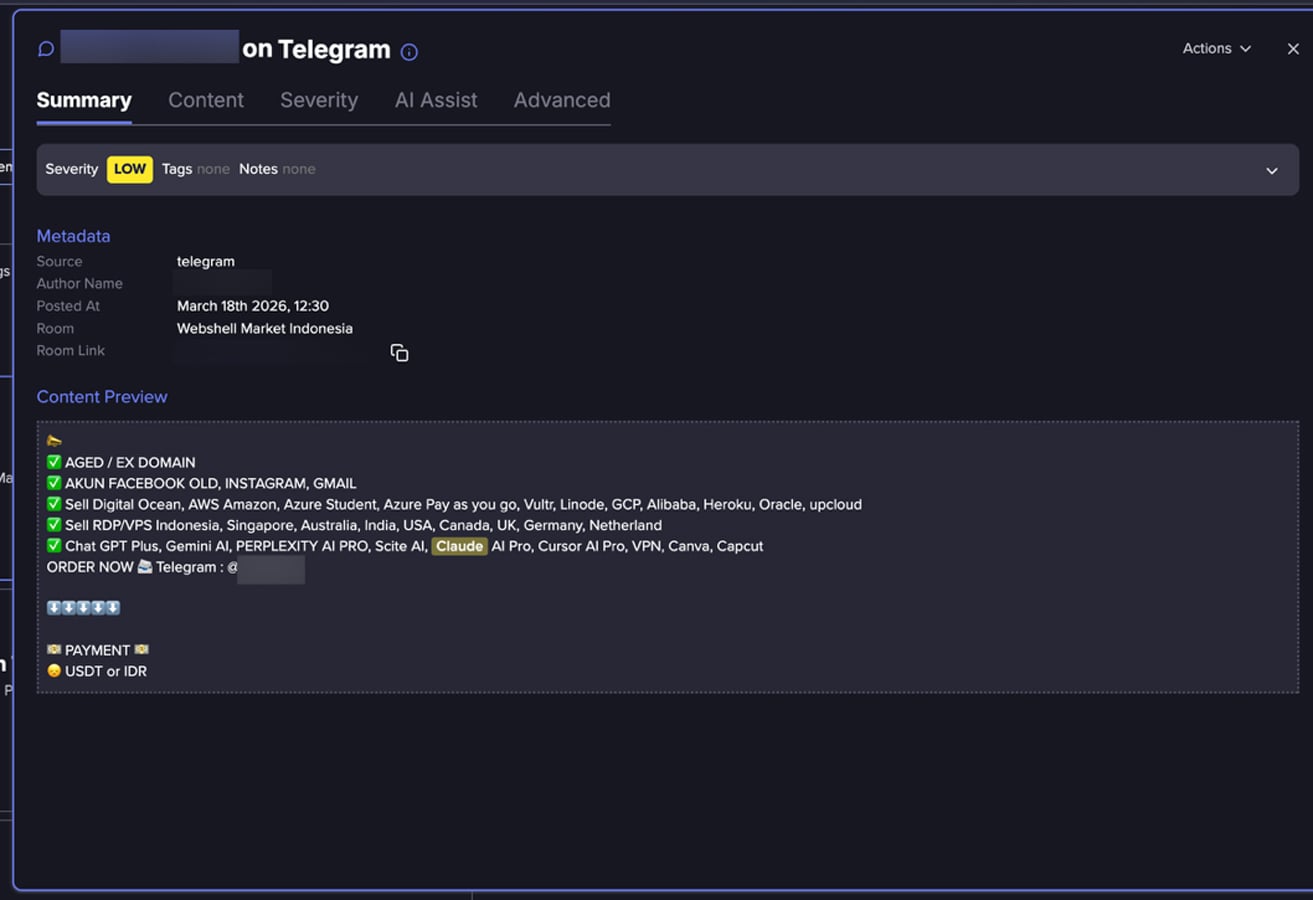
Flare link to post, sign up for the free trial to access if you aren’t already a customer.
This trend may lower the barrier to entry and expand misuse across a broader range of actors. As AI services continue to evolve and gain adoption, their value within underground markets may also increase.
Addressing this shift will likely require stronger account protections, improved monitoring for suspicious activity, and greater awareness of how these services are being incorporated into broader fraud ecosystems.
How organizations can mitigate the risk
-
Enable multi-factor authentication (MFA) on all AI accounts
-
Avoid sharing sensitive data unless using approved enterprise environments
-
Monitor login behavior and usage anomalies
-
Use enterprise-grade accounts with better controls
-
Rotate and secure API keys regularly
-
Monitor underground activity to identify exposed accounts, keys and secrets
-
Educating employees about risks of shared or purchased accounts
-
Implement governance policies for AI tool usage
Learn more by signing up for our free trial.
Sponsored and written by Flare.
Source link
-

-

-

-

-


