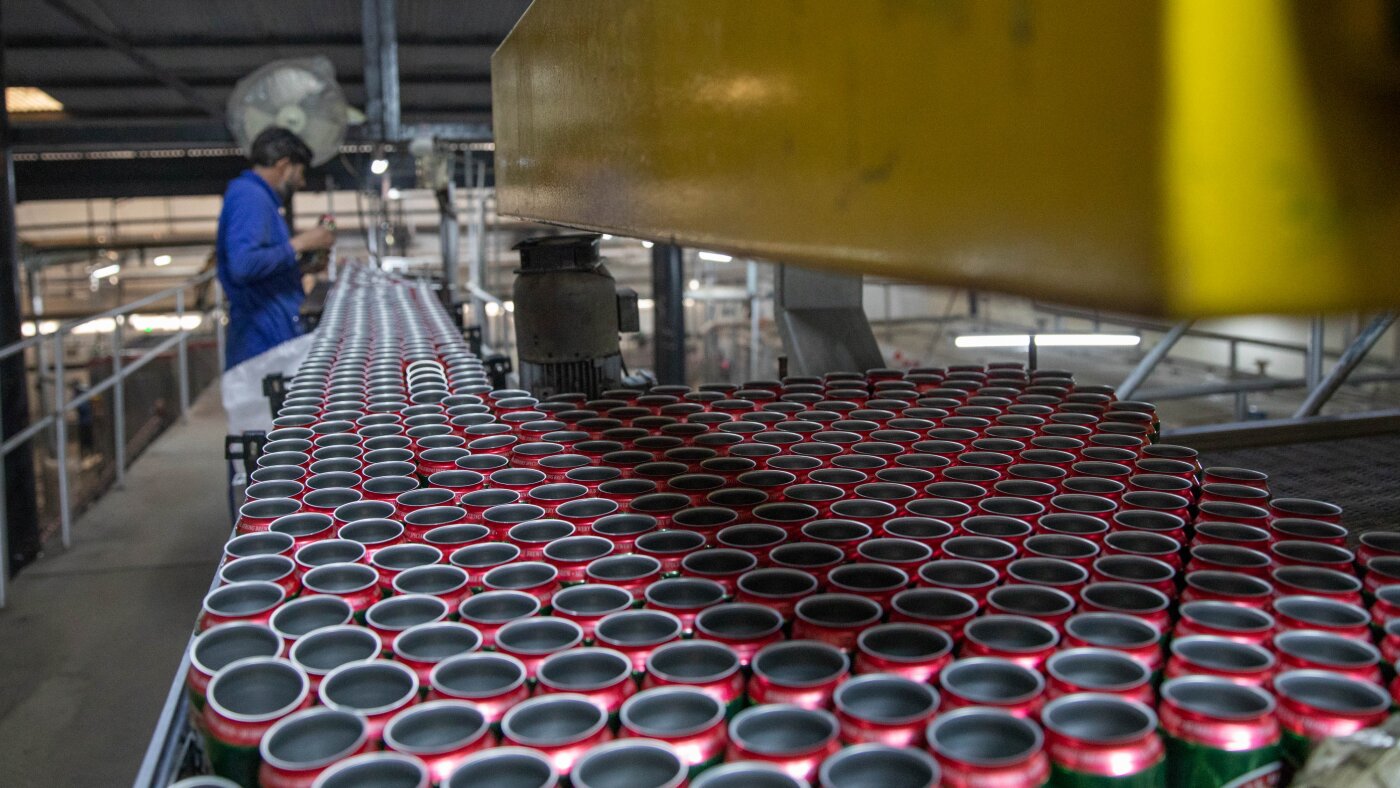
A worker stands stands in the factory where beer is produced at Murree Brewery on Nov. 29, 2025 in Rawalpindi, Pakistan.
Betsy Joles for NPR
hide caption
toggle caption
Betsy Joles for NPR
RAWALPINDI, Pakistan — Inside Murree Brewery’s factory, green-and-red cans move down a conveyor belt to get filled with frothy golden beer. Every month, more than 1 million cans are produced in the company’s industrial brick buildings in this city near Pakistan’s capital Islamabad, and are prepared for distribution around the country.
Alcohol is banned for Pakistan’s Muslim majority, but is still consumed. Murree Brewery has operated within this paradox for decades. It’s the oldest and best-known brewery in the country — founded in the 19th century by the British during their colonial rule of India and acquired by a family in Pakistan in 1947, the year the new country was created through India’s partition. Now, after a nearly 50-year export ban, Murree is shipping beer overseas again.
Though little-known outside South Asia, the company is a household name in Pakistan, says Ali Akbar Khan, author of Rawul Pindee: The Raj Years, which chronicles the brewery’s history. “It’s a landmark,” he says.


Cans of beer move down a production line at the Murree Brewery factory on Nov. 29, 2025, in Rawalpindi, Pakistan. The brewery is owned by a Parsi family that acquired it after Pakistan’s creation in 1947.
Betsy Joles for NPR
hide caption
toggle caption
Betsy Joles for NPR
The brewery survived a prohibition imposed in 1977 by then-Prime Minister Zulfikar Ali Bhutto and tightened by the military dictator who overthrew him, Gen. Muhammad Zia-ul-Haq, who imposed lashing as punishment for drinking alcohol. There were exceptions for sales to non-Muslims and foreigners, and Murree Brewery was allowed to continue operating in Pakistan — but not to resume exporting alcoholic products as it had before the 1977 ban.
“The theory behind the export ban was that an Islamic country should not be seen as exporting a vice,” says Murree Brewery’s CEO Isphanyar Bhandara, whose grandfather acquired the brewery in 1947.
His family is part of the country’s tiny Parsi minority, the descendants of Persian Zoroastrians — a significant factor in their ability to operate a successful brewery in an Islamic republic for three generations.

Isphanyar Bhandara, the Murree Brewery’s CEO and member of the National Assembly of Pakistan, took over the family-owned business in 2008.
FAROOQ NAEEM/AFP via Getty Images
hide caption
toggle caption
FAROOQ NAEEM/AFP via Getty Images
The country’s minority groups — including Hindus and Christians — are allowed to purchase limited amounts of alcohol with official permits. Alcoholic beverages also find their way to Muslims who acquire them through countrywide bootlegging networks and informal liquor shops in the southern province of Sindh.

A sign for Murree Brewery with the year of its founding during the British colonial era is outside the factory where beer and other beverages are produced in Rawalpindi, Pakistan.
Betsy Joles for NPR
hide caption
toggle caption
Betsy Joles for NPR
Bhandara’s father, Minocher Bhandara, who held a seat in Pakistan’s parliament and served as minority affairs adviser to Zia, lobbied the government for years for permission for Murree Brewery to export. Isphanyar Bhandara did the same when he took over the business after his father’s death in 2008. (He too serves as a member of parliament). The brewery, for a short time in the early 2000s, entered partnerships with breweries that produced Murree-branded beer in Austria and the Czech Republic, and discussed a similar setup with a brewery in India around the same time, but that deal didn’t materialize.
Before the export ban, Murree Brewery shipped its alcohol to countries including India, the United States and even Afghanistan. But it wasn’t until last year that the company again got the green light to directly send products abroad, after a 2022 change to Pakistan’s export policy allowing alcohol exports to countries that are not part of the Organisation of Islamic Cooperation, a bloc of 57 nations with significant Muslim populations.

Cans of beer move on a production line at the Murree Brewery. Alcohol is banned for Pakistan’s Muslim majority, but is consumed by non-Muslims and foreigners.
Betsy Joles for NPR
hide caption
toggle caption
Betsy Joles for NPR
The long-awaited string of government approvals that followed were met with cautious optimism at Murree Brewery.
“Initially, we were not confident that all of the things will go smooth,” says Ramiz Shah, the company’s export manager.
But so far, so good. The brewery sent its first shipment of beer — to the United Kingdom — last spring to test out the export process, and then made exports to Portugal and Japan. It is now looking to expand its international sales to other markets, including the United States and Canada.

A worker with boxes in Murree Brewery’s beer production facility in Rawalpindi, Pakistan. Every month, more than 1 million cans are packaged in the company’s industrial brick buildings in Rawalpindi and prepared for distribution around the country.
Betsy Joles for NPR
hide caption
toggle caption
Betsy Joles for NPR
Bhandara credits the government’s change of heart on exports to economics: Pakistan can collect much-needed revenue from these overseas deals. “The government benefits if we export,” Bhandara explains.
There are only around 9 million non-Muslims in Pakistan — less than 4% of a population of some 250 million — creating serious domestic market limitations for a producer of alcohol.

Workers in the Murree Brewery factory where alcoholic beverages are produced in Rawalpindi, Pakistan.
Betsy Joles for NPR
hide caption
toggle caption
Betsy Joles for NPR
Murree Brewery expanded its offerings over the years to include non-alcoholic drinks, including juices, bottled water and fruit-flavored malt drinks — some of which are exported. Shah, the export manager, says the first distributors in the U.K. and Japan to buy Murree’s beer were already importing some of the company’s non-alcoholic options. Since 2020, Murree Brewery has exported alcohol-free products to more than a dozen countries around the world. Shah says relationships with these distributors open a window for possible beer sales, too: “They are easy to target because they know us.”

A worker stands in the factory where beer is produced at Murree Brewery on Nov. 29, 2025 in Rawalpindi, Pakistan.
Betsy Joles for NPR
hide caption
toggle caption
Betsy Joles for NPR
Murree Brewery now has some competition locally from the Chinese-run Hui Coastal Brewery and distillery, which started production in Pakistan’s Balochistan province in 2021. But Murree still managed its best year on record in 2025, surpassing $100 million in annual revenue.
Khan, the author, credits this success to the strategy and foresight of the Bhandara family over the years. “They’re very shrewd businessmen and I think it was a business deal of a lifetime,” he says of their acquisition of the brewery after India’s partition.
For now, the brewery doesn’t have to crank up production to fulfill export demands. Bhandara is hoping that might change, though he remains keenly aware of his context.
“We were always brought up with this concept: not to expand the brewery, not to increase the capacity. Keep your head down. There is an Islamic country,” he says. “We don’t want to be seen as flexing our muscles while producing liquor… That is something we don’t do.”
Source link
-

-
-

-

-