


At the 152nd Inter-Parliamentary Union (IPU) Assembly in Istanbul, Türkiye (15–19 April 2026), PMNCH delivered a clear and urgent message to global parliamentary leaders: protecting the health and well-being of women, children and adolescents (WCAH), who are the bed rock of society and also the most vulnerable, is fundamental to peace, justice and sustainable development. Without urgent action to uphold the rule of law, humanitarian principles and global solidarity, women, children and adolescents will continue to bear the greatest cost in these times of compounding crises.
Convened under the theme “Nurturing hope, securing peace and ensuring justice for future generations,” the Assembly brought together over 1,500 delegates, including more than 720 parliamentarians from 126 countries, alongside 65 Speakers and 46 Deputy Speakers of Parliament.
Through key resolutions, the Assembly called for urgent parliamentary action and partnerships to:
-
Sustain ceasefires and advance peacebuilding efforts in the Middle East and beyond, alongside clear condemnation of breaches of international humanitarian law.
-
Ensure post-conflict recovery is anchored in nationally led peacebuilding and reconciliation processes, with a particular focus on safeguarding the rights and needs of women, young people and displaced populations.
The Assembly concluded with the adoption of the Istanbul Declaration which reinforces a shared commitment to peace, human rights and the principles of the United Nations, while addressing pressing global challenges.
Parliamentary Network to campion health financing for WCAH, with a spotlight on investing in adolescent well-being issues
A central moment of PMNCH’s engagement was the organization of the High-Level Symposium of the Parliamentary Network for Women’s, Children’s and Adolescents’ Health (“Parliamentary Network”), which is convened by Honourable Speaker Thokozile Didiza, Speaker of the National Assembly of South Africa and supported by PMNCH and IPU. This network is currently comprised of 6 Leaders of Parliament including Speakers of Parliaments from South Africa, Botswana, Kenya, Liberia, Senegal, and Deputy Speaker of Namibia.
Attendees of the symposium, included parliamentarians and senior officials from Iran, Jordan, Kenya, Malawi, Namibia, Senegal, Tanzania and Uzbekistan as well as IPU’s Secretary General and WHO’s Representative in Türkiye.
Participants at the High-Level Symposium of the Parliamentary Network for Women’s, Children’s and Adolescents’ Health
“The parliamentary network has a broad appeal… it will attract more parliamentarians who are interested in the issues of maternal, child and adolescent health, which is very critical in a number of our countries across the globe. The symposium gave us an opportunity where different countries were able to affirm the need for such a parliamentary network and the importance for strong collaboration between the parliamentary network and the health committees at home, but also the IPU’s Health Committee and WHO, which was very important because this collaboration will make us have benefits of experience from a number of these areas…” — Honourable Thokozile Didiza, Speaker of the National Assembly of South Africa
The symposium focused on the actions that parliamentarians must take to hold the line for WCAH issues in these challenging times. Dr. Sezin Eda Karsli, a frontline health care worker, and Executive Committee Member, World Association of Trainees in Obstetrics & Gynecology, Türkiye highlighted the stark reality that even in the midst of crises, pregnancies and child birth continue unabated, and that women, children and adolescents are pushed to the margins losing access to essential services when they need them most, and that these services are often the last to be restored.
She underscored the importance of developing resilient healthcare systems supported by adequate finances that can provide continuous and timely care to avert preventable deaths in crises as well as the importance of supporting the health and well-being (including mental health) needs of health care professionals in times of crises.
The attendees agreed that the Parliamentary Network should drive change for WCAH by focusing on the following two priorities:
-
Scaling up domestic resource mobilization to support resilient health systems capable of delivering essential health services for women, children, and adolescents—including displaced populations—with continued access to sexual and reproductive health services, even in crisis settings
-
Investing in the health and well-being of adolescent because their well-being today defines our collective future
There was a strong consensus that:
- Parliamentarians are central to the execution of country-led solutions in the face of global instability
- The Parliamentary Network for WCAH is a critical space for dialogue, peer exchange, collaboration, and advancing accountability
To further strengthen the network, a focused workplan will be developed, and its membership will meet at the 153rd IPU Assembly to share country experiences on domestic resource mobilization.
Historic election of the first woman Secretary General of the IPU
PMNCH congratulated Ambassador Anda Filip on her election as the 9th Secretary General of the IPU, and it’s first woman secretary general. PMNCH reaffirmed its commitment to deepening our collaboration with the IPU, under the leadership of Ambassador Filip, to enhance parliamentary leadership, foster dialogue and action on WCAH priorities
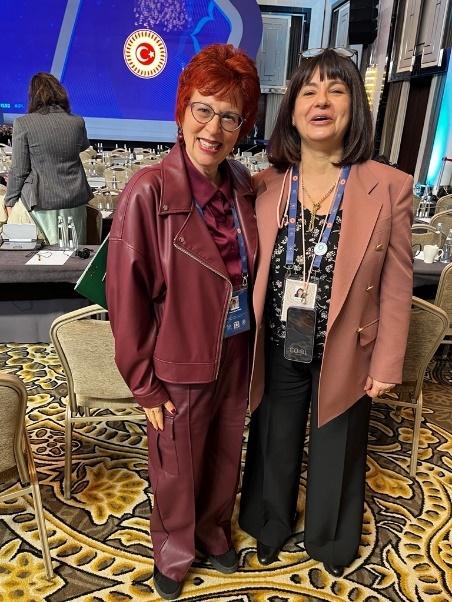
Dr. Flavia Bustreo, Co-Chair, PMNCH Working Group on WCAH in conflicts and climate contexts with Ambassador Anda Filip, IPU Secretary General Elect
Placing WCAH as integral to peace, prosperity and sustainable development for all
Throughout the Assembly, PMNCH advocated to ensure that WCAH was not treated as a sectoral issue but, rather, recognized as key to peacebuilding, social and economic resilience as well as sustainable development.
Through interventions including at the General Debate and Forum of Young Parliamentarians PMNCH called on parliamentarians to:
-
Reprioritize and protect sustainable financing for WCAH as a peace and stability investment and recognize WCAH not as a cost—but as a strategic investment in peace, resilience and human security – resulting in fewer maternal deaths, more girls in school, and overall, more resilient communities.
-
Strengthen inclusive accountability by ensuring that policies reflect lived realities by engaging communities, civil society and young people, and by tracking results across generations.
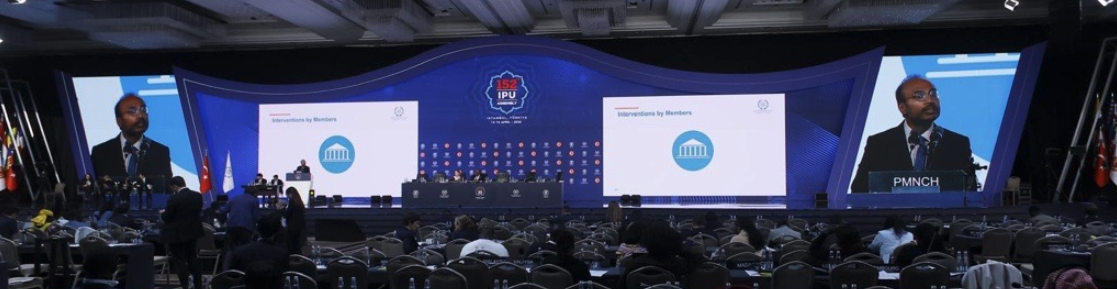
PMNCH at the General Debate
PMNCH also galvanized parliamentary support for country-level action through bilateral engagements with parliamentarians from key Collaborative Advocacy Action Plan (CAAP) countries. These engagements enabled PMNCH to better understand national priorities related to WCAH issues and to identify how best to support parliamentary efforts to advance them. This included exploring practical approaches to sustain parliamentary leadership on WCAH across electoral cycles, particularly by strengthening knowledge transfer and continuity for incoming parliamentarians. These discussions will continue in collaboration with CAAP coordinating partners in key countries.
Domestic resource mobilization through health taxes
PMNCH took the floor during a session on health financing to highlight the potential of health taxes to expand national fiscal space for WCAH priorities. It underscored the critical role of strong, broad-based coalitions in advancing such taxes, particularly in the face of organized opposition from commercial interests. PMNCH emphasizes the importance of investing in WCAH issues especially adolescent health, through taxes on sugary drinks, tobacco, and alcohol. This approach can help galvanize diverse stakeholders, given the associated long-term health benefits of taxing these items and the linkages between early consumption and subsequent addictive behaviors among adolescents.
The path forward: sustaining momentum and delivering results
The 152nd IPU Assembly marked a significant milestone in mobilizing parliamentary leadership to drive collective action on WCAH issues towards ensuring long-term societal prosperity
Momentum will continue toward the 153rd IPU Assembly in Arusha, where the Parliamentary Network for WCAH has been invited to convene to share country experiences and progress on the topic of domestic resource mobilization for WCAH issues, including through the use of health taxes.
As crises deepen and resources tighten, parliamentary leadership will be decisive in protecting progress on WCAH. There can be no peace, justice or sustainable development without investing in the WCAH issues.
As WHO’s Representative in Türkiye, Dr. Tasnim Atatrah said at the symposium of the Parliamentary Network, ”There can be no peace without health, and no health without peace.”
news-and-events/news/item/27-04-2026-mobilizing-parliamentary-leadership-to-protect-women-s-children-s-and-adolescents-health-in-times-of-crisis-pmnch-at-the-152nd-ipu-assembly”>Source link
