WASHINGTON — Today, the U.S. Department of the Treasury’s Office of Foreign Assets Control (OFAC) sanctioned the Cartel de Santa Rosa de Lima (CSRL), which derives the vast majority of its illicit revenue from fuel and oil theft in the Mexican state of Guanajuato. The violent conflict between CSRL and the notorious Mexican terrorist Cartel Jalisco Nuevo Generacion (CJNG) for control of fuel and oil in Guanajuato has made the state one of the deadliest in Mexico. CSRL’s activities also help enable a cross-border energy black market, undermine legitimate U.S. oil and natural gas companies, and deprive the Mexican government of critical revenue. OFAC today also sanctioned Jose Antonio Yepez Ortiz, the leader of CSRL.
“President Trump made a promise to pursue the total elimination of drug cartels to protect the American people,” said Secretary of the Treasury Scott Bessent. “At my direction, the Treasury Department is aggressively cutting these criminals off from the U.S. financial system. No matter where or how the cartels are making and laundering money, we will find it and we will stop it.”
FROM PIPELINES TO POCKETS: MEXICAN CARTELS’ FUEL AND OIL THEFT
Fuel theft, including crude oil smuggling, colloquially referred to in Mexico as huachicol, is currently the most significant non-drug revenue source for Mexican cartels. Thieves in Mexico, known as huachicoleros, use various means to steal fuel and crude oil from Mexico’s state-owned energy company, Petroleos Mexicanos (Pemex), primarily by bribing corrupt Pemex employees. Other methods include illegally drilling taps into pipelines, stealing from refineries, hijacking tanker trucks, and threatening Pemex employees.
Stolen fuel is sold on the black market around Mexico, the United States, and Central America. Stolen crude oil is smuggled into the United States through complicit Mexican brokers and often mislabeled as “waste oil” or other hazardous material to avoid scrutiny and evade taxes and regulations. The stolen crude oil is then delivered to complicit U.S. importers in the oil and natural gas industry operating near the U.S. southwest border, who sell it at a steep discount on the U.S. and global energy markets before repatriating the significant illicit profits back to the cartels in Mexico.
Through these schemes, Mexican cartels steal billions of dollars from Pemex, fuel rampant violence and corruption across Mexico, and undercut legitimate oil and natural gas companies in the United States. In recent years, as Mexican cartels have become more involved in fuel theft-related activities, the Mexican government has reported billions of dollars in lost revenue due to huachicol.
EXPOSING CARTEL DE SANTA ROSA DE LIMA
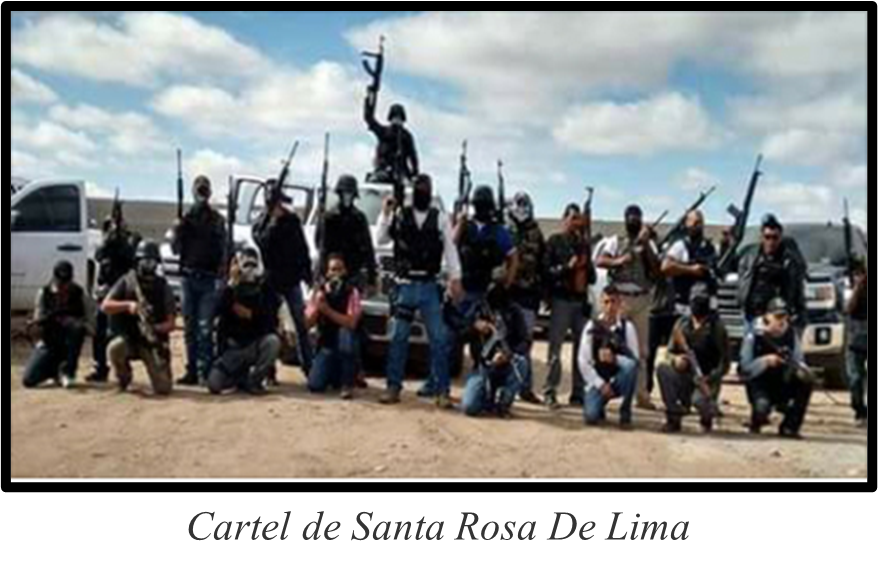
Today, OFAC is sanctioning the Mexican transnational criminal organization known as the Cartel de Santa Rosa de Lima (CSRL). With origins dating back to 2014, CSRL is named after the community where its original members are from: Santa Rosa de Lima in Guanajuato. CSRL is primarily involved in fuel and oil theft, going as far as declaring war with CJNG in October 2017 for control over fuel and oil theft in the so-called “Bermuda Triangle,” a collection of municipalities in Guanajuato wherein a Pemex refinery and many Pemex pipelines are located. As recently as August 2025, Mexican authorities have detained members of CSRL and seized 164,000 liters of stolen hydrocarbons in addition to tanks, tanker trucks, and a clandestine pipeline tap device.

In addition to fuel theft and violence, CSRL has also been involved in narcotics trafficking, including trafficking heroin into the United States.
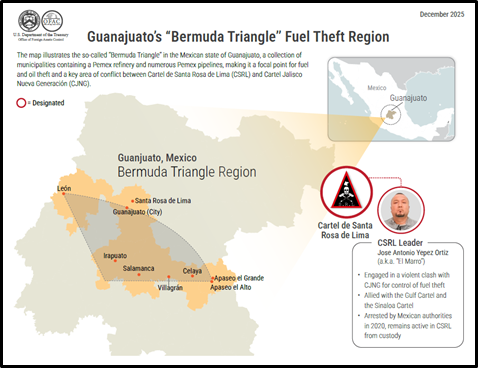

OFAC is also designating the notorious huachicolero and leader of CSRL, Jose Antonio Yepez Ortiz (a.k.a. “El Marro,” meaning the sledgehammer). Prior to his arrest in 2020, he was one of Mexico’s most wanted criminals due to CSRL’s industrial-scale theft of petroleum. In 2022, he was sentenced to 60 years in prison after being found guilty of kidnapping. He still faces accusations of organized crime, money laundering, illegal fuel extraction, attempted homicide, and more. Despite having been arrested, El Marro continues to be active in CSRL from within prison, sending instructions and orders to his collaborators through his lawyers and family members. He helped establish CSRL’s alliance with the Gulf Cartel from within prison.
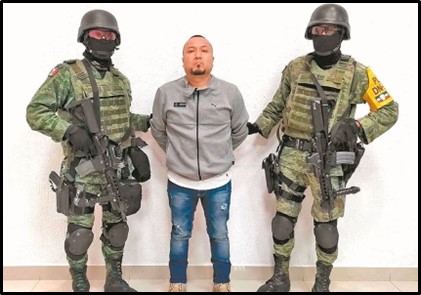

Jose Antonio Yepez Ortiz after Apprehension by Mexican Authorities
CSRL is being designated pursuant to Executive Order (E.O.) 13851, as amended, for being a foreign person that constitutes a significant transnational criminal organization. El Marro is being designated pursuant to E.O. 13581, as amended, for being owned or controlled by, or having acted or purported to act for or on behalf of, directly or indirectly, CSRL.
THE TRUMP ADMINSTRATION’S CONTINUED EFFORTS AGAINST HUACHICOL
On February 20, 2025, the U.S. Department of State designated CJNG as a Foreign Terrorist Organization (FTO) and a Specially Designated Global Terrorist (SDGT).
On May 1, 2025, OFAC sanctioned three Mexican nationals and two Mexico-based entities involved in a drug trafficking and fuel theft network linked to CJNG. CJNG cell leader Cesar Morfin Morfin (a.k.a. Primito) was among those designated. Concurrently, Treasury’s Financial Crimes Enforcement Network (FinCEN) issued an Alert that provides financial typologies and red flags indicative of crude oil smuggling schemes on the U.S. southwest border associated with CJNG and other Mexico-based transnational criminal organizations. In the four-month period following this Alert, FinCEN received Suspicious Activity Reports (SARs), and filers reported over $827 million in suspicious transactions, sent primarily between the United States and Mexico. Based on FinCEN’s analysis with outliers removed, the average oil smuggling transaction amount is $5 million, and the median amount is $1.3 million. The most common U.S. states involved in the SARs are Texas and Florida. In Texas, the subjects were mostly located in cities and towns near the U.S.-Mexico border, including Brownsville, Mission, Eagle Pass, and McAllen.
SANCTIONS IMPLICATIONS
As a result of today’s action, all property and interests in property of the designated or blocked persons described above that are in the United States or in the possession or control of U.S. persons are blocked and must be reported to OFAC. In addition, any entities that are owned, directly or indirectly, individually or in the aggregate, 50 percent or more by one or more blocked persons are also blocked. Unless authorized by a general or specific license issued by OFAC, or exempt, OFAC’s regulations generally prohibit all transactions by U.S. persons or within (or transiting) the United States that involve any property or interests in property of blocked persons.
Violations of U.S. sanctions may result in the imposition of civil or criminal penalties on U.S. and foreign persons. OFAC may impose civil penalties for sanctions violations on a strict liability basis. OFAC’s Economic Sanctions Enforcement Guidelines provide more information regarding OFAC’s enforcement of U.S. economic sanctions. In addition, financial institutions and other persons may risk exposure to sanctions for engaging in certain transactions or activities involving designated or otherwise blocked persons. The prohibitions include the making of any contribution or provision of funds, goods, or services by, to, or for the benefit of any designated or blocked person, or the receipt of any contribution or provision of funds, goods, or services from any such person.
The power and integrity of OFAC sanctions derive not only from OFAC’s ability to designate and add persons to the Specially Designated Nationals and Blocked Persons List (SDN List), but also from its willingness to remove persons from the SDN List consistent with the law. The ultimate goal of sanctions is not to punish, but to bring about a positive change in behavior. For information concerning the process for seeking removal from an OFAC list, including the SDN List, or to submit a request, please refer to OFAC’s guidance on Filing a Petition for Removal from an OFAC List.
Click here to view the chart on the persons designated today.
Click here for more information on the persons designated today.
###
Source link
-
-

-
-

-