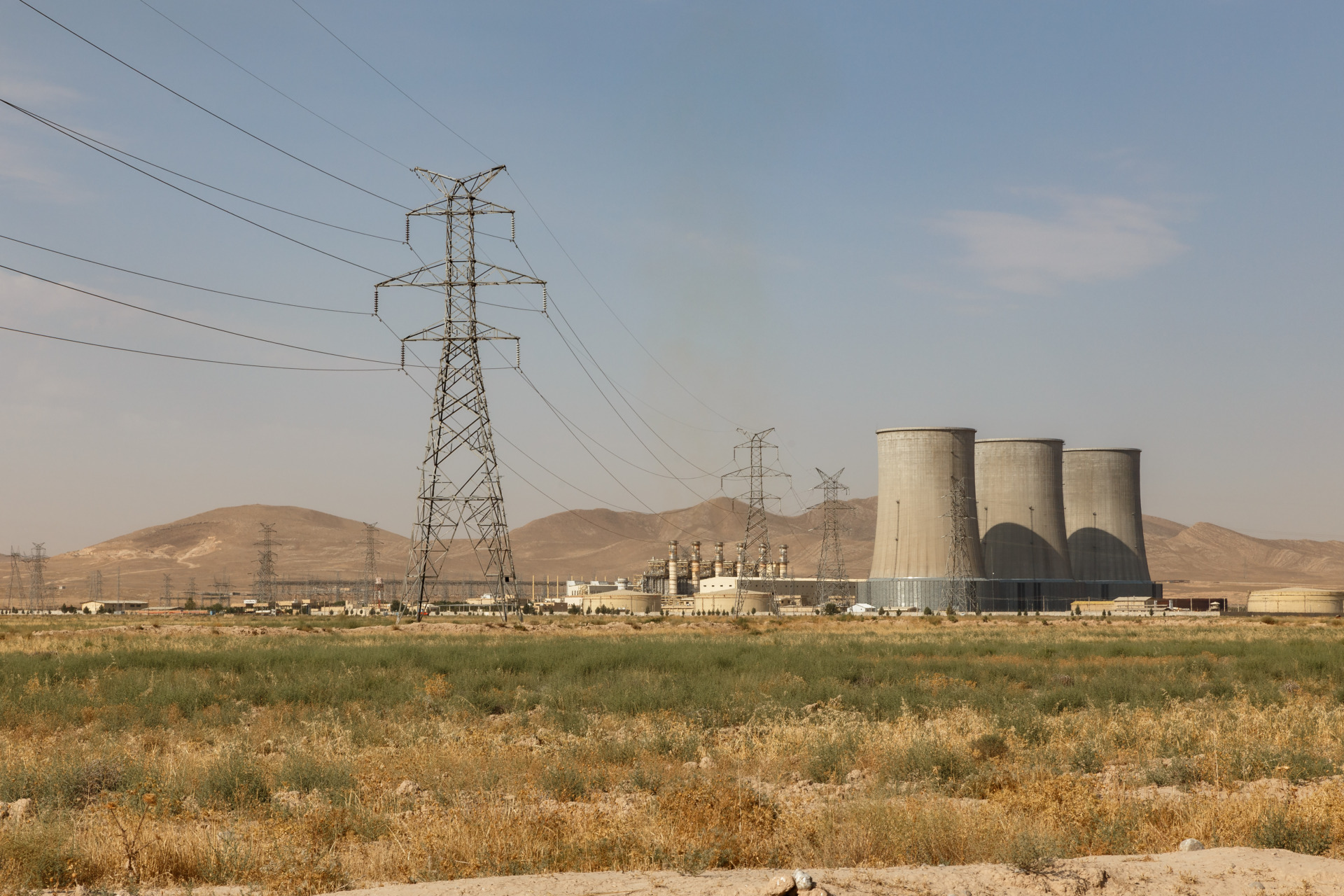
“Tuesday will be Power Plant Day, and Bridge Day, all wrapped up in one, in Iran. There will be nothing like it!!!” posted President Donald Trump on Easter Sunday. In case one thought that was an impulsive utterance, it’s notable that the president in apparently prepared remarks a few days earlier said, “If there is no deal, we are going to hit each and every one of their electric generating plants very hard and probably simultaneously.”
Such rhetorical statements – if followed through – would amount to the most serious war crimes – and thus the president’s statements place servicemembers in a profoundly challenging situation. As former uniformed military lawyers who advised targeting operations, we know the presidents’ words run counter to decades of legal training of military personnel and risk placing our warfighters on a path of no return.
Iranian power plants and other critical civilian infrastructure are protected from attacks by the law of war the United States helped craft after World War II. Such an object can lose its protection only if it is used for military purposes by the enemy and its destruction “offers a definite military advantage.” Even then, such an object can be attacked only if, after a case-by-case rigorous analysis, the “concrete and direct military advantage anticipated” outweighs the civilian suffering that is expected to result. (Geneva Convention Additional Protocol I art. 52, art. 57; DOD Law of War Manual, § 5.6, § 5.12).
Despite those well-settled legal parameters, President Trump has repeatedly threatened to obliterate such infrastructure without regard to the law’s high demands. His comments are blatant expressions that he is willing to turn the United States into a rogue State like Iran and Russia, one that rejects the fundamental legal restraints that protect innocent non-combatants like children, and the Iranian civilian population itself.
Effects on Servicemembers
While our Commander-in-Chief threatens to “obliterate” “each and every one of their electric generating plants,” U.S. military commanders have been approving strike packages, wrestling with how to transform Trump’s dangerous bombast into lawful targets.
Asking our military professionals—lawyers and commanders alike—to grapple with the president’s erratic behavior is enormously consequential. U.S. military commanders have sworn to obey the Constitution and only those orders from their superiors that are lawful. Threats to bomb Iran “back to the Stone Ages” and to show “no quarter, no mercy” are plainly illegal. Trump’s outrageous statements gravely threaten our military professionals’ bedrock moral and legal principles, ones enshrined in the law of war that they’ve been trained to follow their entire careers.
We write to highlight that the Commander-in-Chief’s dangerous rhetoric places our service members in an intolerable position in several respects.
- First, such threats undermine U.S. legitimacy and global standing, as they demonstrate a rejection of binding international agreements and core commitments to the laws of war. Indeed, the U.S. military doubled down on its commitment to the law of war following Vietnam War-era atrocities, requiring our Armed Forces to follow the law regardless how any conflict is characterized. An operation that followed through on Trump’s rhetoric would be one of infamy in the history of modern warfare.
- Second, they pose a significant risk of moral and psychic injury for servicemembers. National soul-searching regarding how Americans fight followed the long U.S. wars in Afghanistan and Iraq, in which both civilian casualties and detainee abuse undermined strategic objectives and weighed heavily on soldiers’ consciences long after the fighting stopped. This reflection led to initiatives such as the Pentagon’s civilian harm mitigation program and new laws regarding detention and interrogation practices, strengthening U.S. commitment to fighting honorably and effectively through adherence to the law.
- Finally, the public record of intent to commit war crimes puts soldiers at risk of later liability. In any future war crimes or U.C.M.J. investigation—for which there may be no statute of limitations—their actions will be judged based on the reasonably available information at the time of the strikes. See, e.g., Executive Summary of the Investigation of the Alleged Civilian Casualty Incident in the al Jadidah District, Mosul, May 8, 2017. Long after the Secretary of Defense receives his anticipated pardon from the president, it is not unlikely that both his and Trump’s expressly stated intent to commit acts that amount to clear war crimes and to dispense with “stupid rules of engagement” may be considered evidence of notice and scienter on the part of servicemembers’ during any future congressional or criminal investigations.
The U.S. military trains to fight with precision and lethality according to the law of war – precision meaning attacking only lawful military objectives while doing our utmost to protect innocent civilians caught up in the fight. The legal hurdle to convert a civilian object such as a power plant into a lawful military objective is a high one because the United States and its allies vigorously rejected “total war” after the massive suffering endured by millions during World War II. What President Trump threatens is exactly that, from a civilian targeting perspective – total war against Iran, a complete rejection of the legal limits the United States has incorporated into the law governing U.S. military operations for both pragmatic and moral reasons.
The Heart of Targeting
U.S. military commanders translating Trump’s orders face a daunting legal and operational task, one that focuses on impact on the Iranian civilian population. Given the scope of his rhetoric, it appears difficult to steer clear of war crimes. To be sure, civilian structures like power plants, roads, bridges, and even water desalination plants can be targeted under particular circumstances. For example, bridges are frequently engaged during ground operations as a means of denying the enemy access to key terrain or supply routes, and a water treatment plant being used as a fighting position is easily targetable in self-defense. But this is only true when the impact on civilians has been carefully considered and expected not to be excessive compared to the concrete and direct military advantage anticipated from the strike.
Indeed, the harm induced by striking a power plant is specifically envisioned by the Department of Defense Law of War Manual. See, e.g., DOD LOWM, Section 5.12.1.3, Foreseeable Harms Versus Remote Harms (“For example, if the destruction of a power plant would be expected to cause the loss of civilian life or injury to civilians very soon after the attack due to the loss of power at a connected hospital, then such harm should be considered in assessing whether an attack is expected to cause excessive harm.”). And as a case in point, the International Criminal Court is investigating Russia for war crimes regarding their intentional targeting of the Ukrainian civilian electrical grid during wintertime that plunged thousands of Ukrainians into life-threatening cold conditions, thereby causing unnecessary civilian suffering that was not outweighed by claims of military advantage. The United States also made sure to “condemn, in the strongest possible terms” the Russian operations against Ukraine’s energy infrastructure. And the State Department’s 2022 formal determination that Russia had committed war crimes included attacks on “critical infrastructure.” (See also, United Nations Independent International Commission on Inquiry on Ukraine para. 109 (“The Commission has also found that the Russian armed forces’ waves of attacks, starting 10 October 2022, on Ukraine’s energy-related infrastructure and the use of torture by Russian authorities may amount to crimes against humanity.”))
Indeed, the United States has traditionally served as a leader in this sphere, developing an entire methodology for determining the collateral effects of munitions on various types of targets (“Collateral Damage Estimation” or “CDE”); a process in which we have both advised in real-time. See Chairman of the Joint Chiefs of Staff Instruction (“CJCSI”) 3160.01D, “No-Strike and the Collateral Damage Estimation Methodology,” last published May 2021 (2012 public version). The United States maintains a database of facilities on a “No Strike List,” or “NSL,” which divides civilian structures in two protected categories. Notably, nuclear power plants appear on the higher of those categories on the NSL, while nearly all other civilian structures—including electric-generating power plants—are recognized to hold standard no-strike protections. The methodology also calculates a noncombatant civilian casualty cut-off value (“NCV”), which serves as a guide to proportionality for certain effects which might yield civilian casualties. Cold and clinical as it may sound, employing CDE methodology and considering NCVs are a perfect example of how the United States has operationalized the concept of proportionality and distinction directly into its conduct of war.
In other words, American military targeting processes have institutionalized and operationalized principles such as distinction and proportionality – to ensure a target qualifies as a lawful military objective in the first place – and precautions in an attack, which forces targeteers to ask whether we can temporarily disable a power plant, for example, versus destroying it.
Diminishing Civilian Morale Is Not A Military Advantage
In light of the president’s comments, it is important to highlight that the DOD Law of War Manual’s note on targeting civilian infrastructure states: “Diminishing the morale of the civilian population and their support for the war effort does not provide a definite military advantage. However, attacks that are otherwise lawful are not rendered unlawful if they happen to result in diminished civilian morale.” DOD Law of War Manual, § 5.6. Such “morale bombing” has been rejected for many decades; it had gained support during World War II only to be roundly rejected by Additional Protocol I to the Geneva Conventions and customary international law. The idea of using civilian pain in order to effectuate political goals would rightly stoke criticisms that the United States’s use of military force against civilian targets equates to acts of sheer terrorism. (See Additional Protocol I art. 51(2) (“Acts or threats of violence the primary purpose of which is to spread terror among the civilian population are prohibited.”) (emphasis added); DOD Law of War Manual, § 5.2.2 (“Measures of intimidation or terrorism against the civilian population are prohibited, including acts or threats of violence, the primary purpose of which is to spread terror among the civilian population.”) (emphasis added).
By all accounts then, the law of war prohibits “acts or threats of violence the primary purpose of which is to spread terror among the civilian population.” It is difficult to read President Trump’s egregious threats of great destruction as anything but intending to spread terror, making it even more incumbent on U.S. military professionals to ensure strikes are limited in their impact on the Iranian people.To be sure, as stated above, individual components of Iranian civilian infrastructure may indeed constitute lawful military targets under specific circumstances in which they contribute to the enemy’s military action and their destruction would provide a definite military advantage. That said, the damning public rhetoric surrounding these planned strikes against all power plants in an undifferentiated manner casts the legitimacy and legality of such an operation in serious doubt, to say the least. We urge military decisionmakers within the chain of command to think long-term, trust their training, and remember their oaths. American military professionals must remind their chain of command that the United States is not like Iran or Russia: our country is great because it adheres to the law of war and emerges victorious because of such adherence, not in spite of it. That might be said of all sorts of operations. Surely, here, the mass devastation on a civilian population makes where to draw the line excruciatingly clear.
FEATURED IMAGE: Shirvan Combine Cycle Power Plant. The power station is located in North Khorasan Province, near the city of Shirvan. (Via Getty Images)
Source link
-

-
-

-

-