

“Stars like the Sun don’t just stop shining,” but this one did
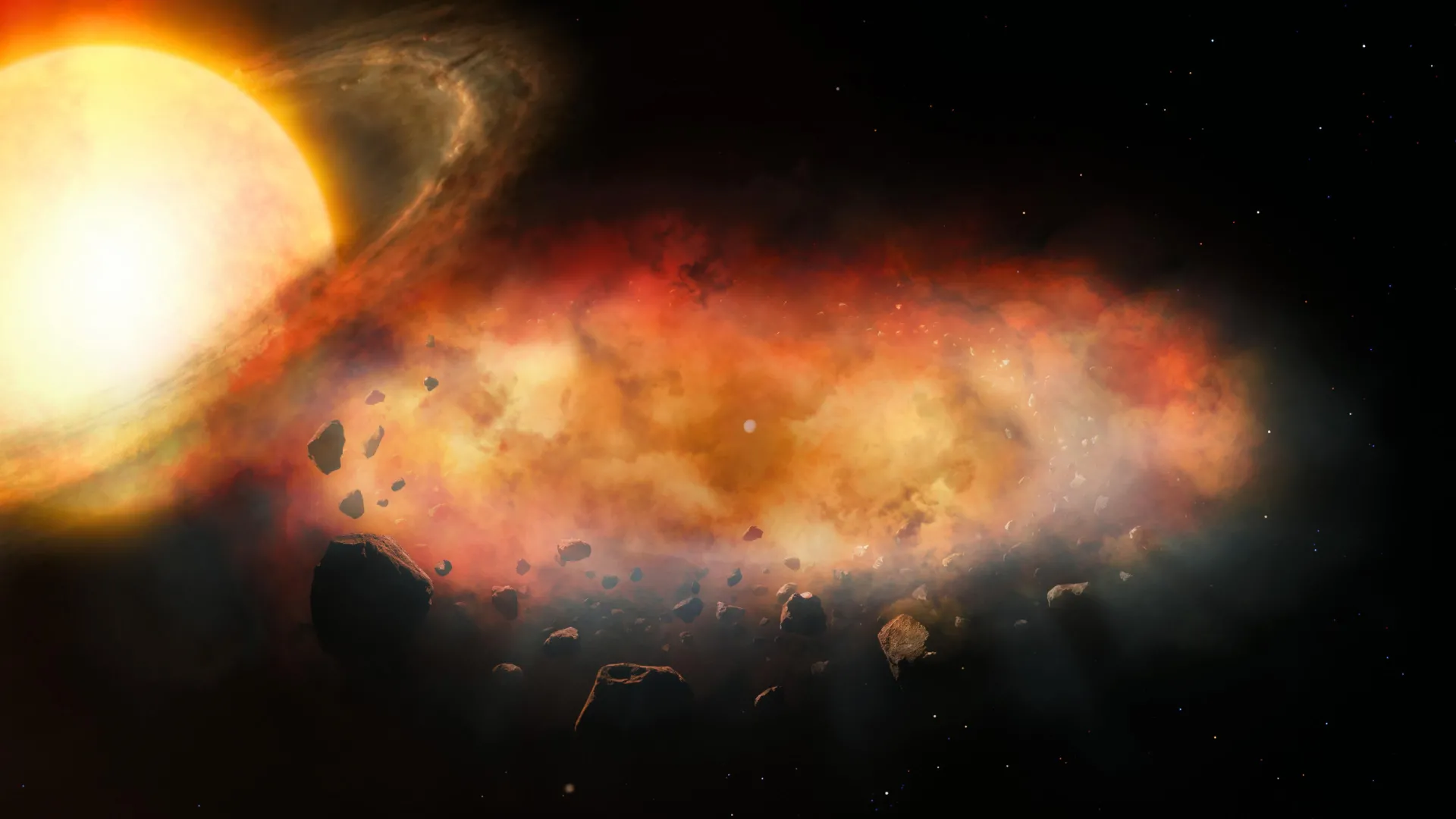
Astronomers have identified powerful winds of vaporized metals inside a vast cloud that blocked the light of a distant star for almost nine months. The finding was made using the Gemini South telescope in Chile, one half of the International Gemini Observatory, which is partly funded by the U.S. National Science Foundation and operated by NSF NOIRLab. The observation offers a rare look at energetic and chaotic activity that can continue shaping planetary systems long after they form.
In September 2024, a star located about 3000 light-years from Earth abruptly dimmed to just one-fortieth of its normal brightness. That dramatic drop persisted until May 2025. The star, known as J0705+0612, closely resembles our Sun, which made the event especially striking to astronomers.
“Stars like the Sun don’t just stop shining for no reason,” says Nadia Zakamska, a professor of astrophysics at Johns Hopkins University. “So dramatic dimming events like this are very rare.”
Months of Observations Capture a Rare Event
Realizing that this unusual dimming could reveal something important, Zakamska and her colleagues began an extended observing campaign. They used the Gemini South telescope on Cerro Pachón in Chile, along with the Apache Point Observatory 3.5-meter telescope and the 6.5 meter Magellan Telescopes. Their results are described in a paper published in The Astronomical Journal.
By combining new observations with archival data on J0705+0612,[1] the researchers concluded that the star was briefly hidden behind an enormous, slowly drifting cloud of gas and dust. The team estimates that the cloud sits about two billion kilometers (1.2 billion miles) from the star and spans roughly 200 million kilometers (120 million miles) across.
A Massive Companion Holds the Cloud Together
The data suggest that the cloud is not free-floating. Instead, it appears to be gravitationally bound to a second object that orbits the star far from its center. Although the exact nature of this companion remains uncertain, it must be massive enough to keep the cloud intact.
Observations indicate that the object has at least several times the mass of Jupiter, and possibly much more. It could be a giant planet, a brown dwarf, or an extremely low-mass star.
If the object turns out to be a star, the cloud would be considered a circumsecondary disk, meaning a debris disk orbiting the smaller member of a two-star system. If it is a planet, the structure would be classified as a circumplanetary disk. In either scenario, seeing a star temporarily blocked by a disk surrounding a secondary object is extremely uncommon, with only a few known cases.
Probing the Cloud With a Powerful New Instrument
To learn what the cloud is made of, the team turned to Gemini South’s newest instrument, the Gemini High-resolution Optical SpecTrograph (GHOST). In March 2025, GHOST observed the dimming event for just over two hours, splitting the starlight into a detailed spectrum that reveals the elements within the cloud.
“When I started observing the occultation with spectroscopy, I was hoping to unveil something about the chemical composition of the cloud, as no such measurements had been done before. But the result exceeded all my expectations,” says Zakamska.
The spectra revealed multiple metals — elements heavier than helium — mixed into the gas. Even more striking, the precision of the data allowed the team to track how the gas was moving in three dimensions. This marked the first time scientists have directly measured internal gas motions within a disk orbiting a secondary object such as a planet or a low-mass star.
The measurements show an active and turbulent environment, with winds of gaseous metals including iron and calcium flowing through the cloud.
“The sensitivity of GHOST allowed us to not only detect the gas in this cloud, but to actually measure how it is moving,” Zakamska says. “That’s something we’ve never been able to do before in a system like this.”
“This study illustrates the considerable power of Gemini’s newest facility instrument, GHOST,” notes Chris Davis, NSF Program Director for NOIRLab, “and further highlights one of Gemini’s great strengths — rapidly responding to transient events like this occultation.”
Evidence Points to a Disk in the Outer System
The detailed wind measurements show that the cloud is moving independently of the star itself. Combined with the long duration of the dimming, this confirms that the object blocking the star is a disk surrounding a secondary companion, orbiting in the outer regions of the system.
The star also shows an excess of infrared radiation, which is often linked to disks of material around young stars. However, J0705+0612 is more than two billion years old, making it unlikely that the disk is leftover material from the system’s original formation.
A Possible Planetary Collision
So where did the disk come from? Zakamska suggests that it may have formed after a major collision between two planets in the outer part of the system. Such an impact could have blasted out enormous amounts of dust, rock, and gas, creating the massive cloud now seen drifting in front of the star.
Why This Discovery Matters
The findings demonstrate how new instruments are opening fresh ways to study hidden and short-lived phenomena in distant planetary systems. GHOST, in particular, is allowing astronomers to examine structures that were previously impossible to probe in detail.
“This event shows us that even in mature planetary systems, dramatic, large-scale collisions can still occur,” says Zakamska. “It’s a vivid reminder that the Universe is far from static — it’s an ongoing story of creation, destruction, and transformation.”
Notes
- A study using archival data from Harvard found that J0705+0612 underwent two other similar dimming events in 1937 and 1981, establishing a 44-year period.
The team is composed of Nadia L. Zakamska (Johns Hopkins University, Institute for Advanced Study), Gautham A. Pallathadka (Johns Hopkins University), Dmitry Bizyaev (New Mexico State University, Moscow State University), Jaroslav Merc (Charles University, Institute of Astrophysics of the Canary Islands), James E. Owen (Imperial College London), Henrique Reggiani (Gemini Observatory/NSF NOIRLab), Kevin C. Schlaufman (Johns Hopkins University), Karolina Bąkowska (Nicolaus Copernicus University in Toruń), Sławomir Bednarz (Silesian University of Technology), Krzysztof Bernacki (Silesian University of Technology), Agnieszka Gurgul (Nicolaus Copernicus University in Toruń), Kirsten R. Hall (Center for Astrophysics | Harvard & Smithsonian), Franz-Josef Hambsch (Association for Astronomy, Meteorology, Geophysics and Related Sciences, German Association for Variable Stars), Barbara Joachimczyk (Nicolaus Copernicus University in Toruń), Krzysztof Kotysz (University of Warsaw, University of Wrocław), Sebastian Kurowski (Jagiellonian University), Alexios Liakos (National Observatory of Athens), Przemysław J. Mikołajczyk (University of Warsaw, National Centre for Nuclear Research, University of Wrocław), Erika Pakštienė (Vilnius University), Grzegorz Pojmański (University of Warsaw), Adam Popowicz (Silesian University of Technology), Daniel E. Reichart (University of North Carolina at Chapel Hill), Łukasz Wyrzykowski (University of Warsaw, National Centre for Nuclear Research), Justas Zdanavičius (Vilnius University), Michał Żejmo (University of Zielona Gora), Paweł Zieliński (Nicolaus Copernicus University in Toruń), and Staszek Zola (Jagiellonian University).
NSF NOIRLab, the U.S. National Science Foundation center for ground-based optical-infrared astronomy, operates the International Gemini Observatory (a facility of NSF, NRC-Canada, ANID-Chile, MCTIC-Brazil, MINCyT-Argentina, and KASI-Republic of Korea), NSF Kitt Peak National Observatory (KPNO), NSF Cerro Tololo Inter-American Observatory (CTIO), the Community Science and Data Center (CSDC), and NSF-DOE Vera C. Rubin Observatory (in cooperation with DOE’s SLAC National Accelerator Laboratory). It is managed by the Association of Universities for Research in Astronomy (AURA) under a cooperative agreement with NSF and is headquartered in Tucson, Arizona.
The scientific community is honored to have the opportunity to conduct astronomical research on I’oligam Du’ag (Kitt Peak) in Arizona, on Maunakea in Hawai’i, and on Cerro Tololo and Cerro Pachón in Chile. We recognize and acknowledge the very significant cultural role and reverence of I’oligam Du’ag to the Tohono O’odham Nation, and Maunakea to the Kanaka Maoli (Native Hawaiians) community.
Source link
