PARK CITY, Utah — Sundance is where I get lost. My first trip to Park City I didn’t know anything or anyone, and scored a bunk bed in a room of four women by cold-emailing an acquaintance of an acquaintance and blurting, “I don’t really mind who I sleep next to as long as they don’t mind that my boyfriend says I snore.”
That was 16 years ago and I have visceral memories of circling the town on a 2 a.m. shuttle hoping to recognize my stop. There was also the afternoon I took a shortcut through some trees and got stuck in snow up to my shins. (That’s also when I learned that cheap boots dissolve under duress.) But just as vividly, I remember getting lost in that year’s movies: breakthrough films by the Safdie brothers, Luca Guadanigno and Taika Waititi, plus Jennifer Lawrence’s star-making performance in “Winter’s Bone.”
It took time to master Park City, to learn the theater locations and make friends, one of whom broke his arm and laptop skidding on a patch of ice while another gave me the fuzzy red mittens I’ve been wearing here for a decade. And I’ve spent the last two Sundances readying to let this town go when the festival decamps for Boulder, Colo., in 2027. (At my second screening this year, I even lost the right mitten.) The Egyptian Theatre on Main Street isn’t showing any new movies this year as the festival is already shutting down limb by limb, but it’s where a colleague dragged a dozen of us critics to “Hereditary’s” fourth not-so-full screening insisting we had to see it, and he as much as anyone put Ari Aster on the map. (He’s also now my editor — hi, Josh Rothkopf!)
God, I’m going to miss this place. By God, let’s go with indie provocateur Gregg Araki’s conception of him: Robert Redford, a titan who hatched an independent film festival from his head like he was Zeus and passed away this September.
“How did he ever come up with that concept?” Araki asked onstage at what he tallied was his 11th Sundance premiere. “Thank you, Robert Redford. You are a god to me, you are immortal.” The 20-something fan seated next to me felt the same way about Araki, hooting so much for his favorite filmmaker that he apologized.
Cooper Hoffman and Olivia Wilde in the movie “I Want Your Sex.”
(Lacey Terrell / Sundance Institute)
Araki is here with the brash and splashy erotic comedy “I Want Your Sex,” which stars Olivia Wilde as a bondage-loving, anti-woke modern artist named Erika whose latest effort to shock is a giant vagina made of chewing gum. “Art needs attention,” she insists. So does Erika, ordering her much younger new assistant, Elliot (Cooper Hoffman), into bed and into a public bathroom stall and into a set of frilly pink lingerie.
Erika’s work isn’t very good. But Wilde is fantastic. Her haughty line deliveries and imperious bone structure cut through the screen like a knife. (And you should see the get-ups that costumers Arianne Phillips and Monica Chamberlain strap her into.) A murder mystery worms into the script that’s too screwy to be taken seriously. But as Erika’s mealy lover, Hoffman gets bossed around and humiliated and mostly digs his kinky misadventure. Me, too.
To be fair, art does need attention. Everyone at Sundance comes here to not just lose themselves giggling as Hoffman gets a spanking, but to find the next Araki, Aster or Safdie — and, if you’re a distributor, snatch them up at a good price. It takes money to launch an indie movie to the masses and one of today’s most daunting hurdles is that no one seems to have enough of it to market a niche sensation to an overwhelmed and distracted audience.
“It’s time for a change,” my rideshare driver said as we crept through traffic, explaining why she was running for state senate. She couldn’t fathom why Utah hadn’t put up more of a fight to keep Sundance in town as it seemed to her that it had been a fiscal boon. I replied that I’d heard rumors that Park City calculated there was more money in catering to the posh ski crowd than, say, film critics.
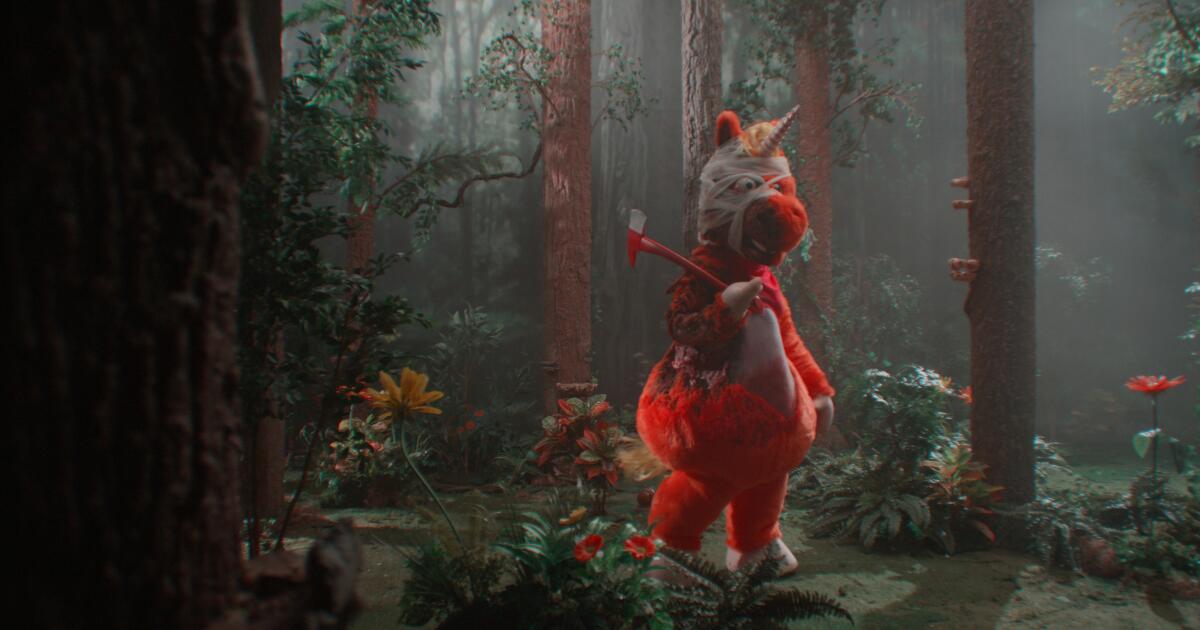
My Sundance has never been glamorous. I rarely have time to go to a party and when I do, it’s standing around on a wet carpet in my socks hoping to eat a scoop of chili. The one exception was the year I was on a short film jury that included actor Keegan-Michael Key, whom I ran into on Friday morning doing interviews for Casper Kelly’s colorful and quirky midnight movie “Buddy,” which is like a very special spree-killer episode of “Barney.” Key plays a giant orange unicorn who hosts a children’s TV show and forces the kids to hug him or die. It’s a tad thin compared with Kelly’s other stunningly bizarro projects (“Too Many Cooks,” “Adult Swim Yule Log”) that always add another destabilizing twist. But you sense subterranean levels of weirdness that hint that he’s already got ideas for a sequel.
Sundance is where starving artists level up. Just nine years ago, the documentary prankster John Wilson was here crashing on a couch and shooting a snarky short called “Escape From Park City” about his discomfort with its star-gazing and schmoozing. That trip tipped over a domino that, in a roundabout way, led to his brilliant HBO TV series, “How to With John Wilson,” and now he’s back to premiere his first full-length feature, “The History of Concrete.” (He said no one from the festival had yet to mention that short to his face.)
Essentially a long episode of his show, “The History of Concrete” follows Wilson’s zig-zagging curiosity about what’s right under our feet, from an analysis of chewing gum patterns on the sidewalk to a pilgrimage to the shortest street in America. Despite concrete’s omnipresence, he finds that it hasn’t been around very long, and yet, to our peril it’s already crumbling around us.
Along the way, Wilson takes Zoom meetings, unsuccessfully pitching this meta-doc to financiers, and, out of sardonic desperation, studying how to write a successful Hallmark movie. The overall idea is that our civic and artistic infrastructure is falling apart. Genius like his is the weeds wiggling through the cracks.


Charli XCX in the movie “The Moment.”
(Sundance Institute)
So many of this year’s films are confronting the relationship between cash and creativity, like video director Aidan Zamiri’s strobe-y and deliberately suffocating “The Moment,” which I’ll be reviewing in full when it comes out next week. The party-hearty British pop star Charli XCX plays an unflattering version of herself struggling to fend off a phalanx of producers, managers and record executives. Structurally, it’s a mockumentary. Tonally, it’s a horror movie about the death of an artist’s soul. Alexander Skarsgård is especially funny as a New Age-spouting concert documentary director who sucks up to the corporate overlords while breaking Charli’s spirit a bit more in every scene. He’s like Jigsaw with a manbun: a villain who preaches self-empowerment while shattering her to pieces.
In real life, Charli sounds certain that her Brat summer is over. She’s moved onto Park City winter, acting in two other films at the fest, including Araki’s “I Want Your Sex.” But now that season is shifting, too. “This movie is about the end of an era — and this is the end of an era,” she said, gesturing toward the Eccles audience.
“The Moment” harmonizes well with Joanna Natasegara’s “The Disciple,” which digs into the fraught backstory of the Wu-Tang Clan’s controversial seventh album, “Once Upon a Time in Shaolin.” Only one copy exists, which was auctioned off in 2015 to the soon-to-be disgraced hedge fund founder and pharmaceutical executive Martin Shkreli, who said he paid $2 million for it so he could impress his other rich friends. RZA and Wu-affiliate Cilvaringz wanted to up the value of art by treating a rap album like the Mona Lisa. Instead, the internet accused them of selling out to the devil.
Natasegara’s archival footage is head-spinning. I’d watch a whole documentary just on the night of the album’s listening party seen in the film, at which the RZA’s mentor, a real-live Shaolin monk, wowed the attendees by hoisting his leg straight over his head. “What a flex,” one of the revelers jokes. The documentary skips over mentioning that in October 2016, Shkreli tweeted that he’d leak the album if Donald Trump was elected president (he didn’t), but does get into how just months later, Shkreli was sentenced to seven years in prison for securities fraud. The Wu-Tang record was seized by the government, which sold it to an NFT group for double the money.
The album’s new owners hosted a listening party for us the day after the Sundance premiere. With our cellphones locked up in security pouches, we gathered around two expensive and strange-looking speakers that resembled ATMs to hear around 20 minutes of music. The album started with quiet wind and then turned into a tornado of thunder and sirens, swordplay and gunfire over big horns and a funky soul backbeat. I especially dug the title track, which felt like the soundtrack to a hero strutting into battle before frantically spiraling into a storm of violins. Somewhere in there, Cher sang vocals (we were told), although I didn’t recognize her distinctive yowl.
Most of us stood very still, as though afraid that if if we bobbed too much, we’d shake the music from our heads. But the folks in the back of the room had heard the record before and continued talking loudly, treating the party like a party. Sacrilegious, yes. But also an act of reclamation for art that just wants to be enjoyed.
People kept partying but I needed to hunt for the lost and found station, which had thoughtfully posted a picture of my mitten online. Ironically, I couldn’t find the office — no one, not even the information desk, knew where it was — but they very kindly walked my mitten over to me. Thank heavens, it was too soon to say goodbye. I’m not ready to end my own Park City winter era just yet.
Source link