
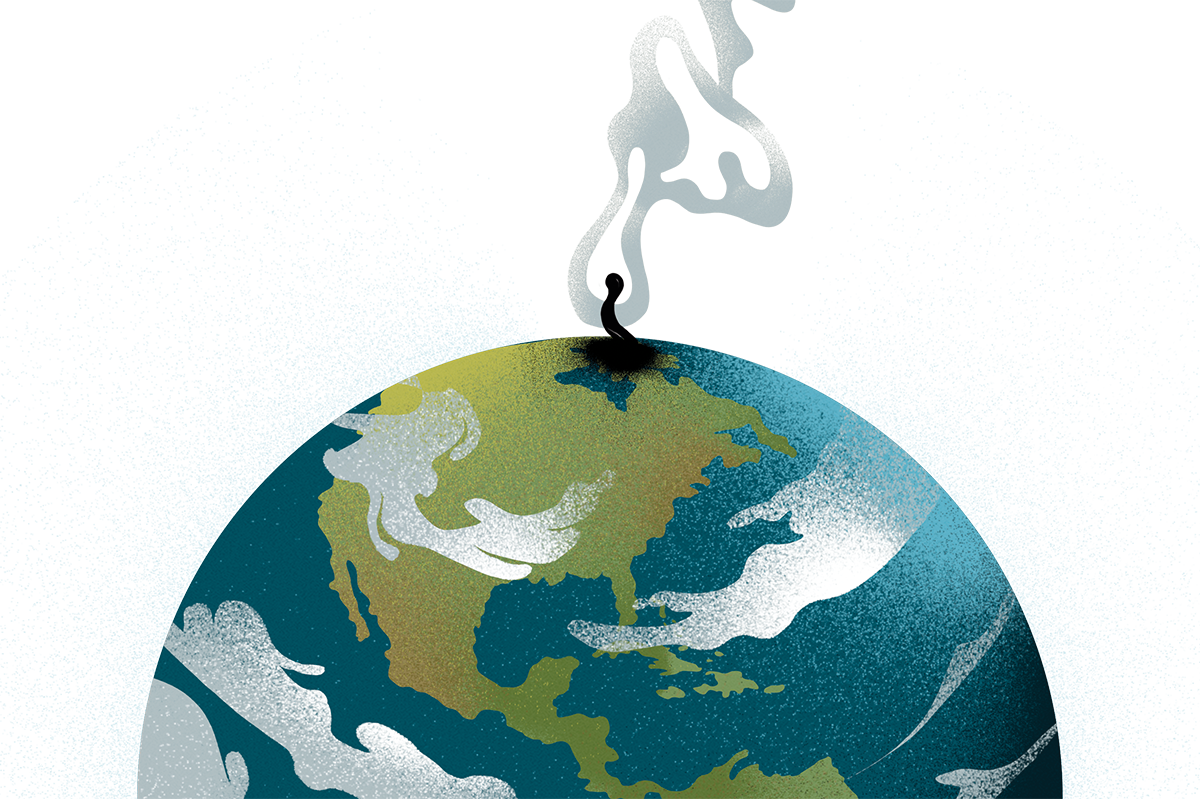
Finally, thankfully, the global warming craze is dying out. To paraphrase Monty Python, the climate parrot may still be nailed to its perch at the recent COP summit in Belém, Brazil – or at Harvard and on CNN – but elsewhere it’s dead. It’s gone to meet its maker, kicked the bucket, shuffled off this mortal coil, run down the curtain and joined the choir invisible. By failing to pledge a cut in fossil fuels, COP achieved less than nothing, the venue caught fire, the air-conditioning malfunctioned – and delegates were told on arrival not to flush toilet paper. Bill Gates’s recent apologia, in which he conceded that global warming “will not lead to humanity’s demise,” after he closed the policy and advocacy office of his climate philanthropy group is just the latest nail in the coffin.
In October, the Net Zero Banking Alliance shut down after JPMorgan Chase, Citigroup, Bank of America, Morgan Stanley, Wells Fargo and Goldman Sachs led a stampede of other banks out the door. Shell and BP have returned to being oil companies, to the delight of their shareholders. Ford is about to cease production of electric pickups that nobody wants. Hundreds of other companies are dropping their climate targets. Australia has backed out of hosting next year’s climate conference.
According to analysis by the Washington Post, it is not just Republicans who have given up on climate change: the Democratic party has stopped talking about it, hardly mentioning it during Kamala Harris’s campaign for president last year. The topic has dropped to the bottom half of a table of 23 concerns among Swedish youths. Even the European Parliament has voted to exempt many companies from reporting rules that require them to state how they are helping fight climate change.
It has been a long, lucrative ride. Predicting the eco-apocalypse has always been a profitable business, spawning subsidies, salaries, consulting fees, air miles, best-sellers and research grants. Different themes took turns as the scare du jour: overpopulation, oil spills, pollution, desertification, mass extinction, acid rain, the ozone layer, nuclear winter, falling sperm counts. Each faded as the evidence became more equivocal, the public grew bored or, in some cases, the problem was resolved by a change in the law or practice.
But no scare grew as big or lasted as long as global warming. I first wrote a doom-laden article for the Economist about carbon dioxide emissions trapping heat in the air in 1987, nearly 40 years ago. I soon realized the effect was real but the alarm was overdone, that feedback effects were exaggerated in the models. The greenhouse effect was likely to be a moderate inconvenience rather than an existential threat. For this blasphemy I was abused, canceled, blacklisted, called a “denier” and generally deemed evil. In 2010, in the pages of the Wall Street Journal I debated Gates, who poured scorn on my argument that global warming was not likely to be a catastrophe – so it is welcome to see him come round to my view.
The activists who took over the climate debate, often with minimal understanding of climate science, competed for attention by painting ever more catastrophic pictures of future global warming. They changed the name to “climate change” so they could blame it for blizzards as well as heat waves. Then they inflated the language to “climate emergency” and “climate crisis,” even as projections of future warming came down.
“I’m talking about the slaughter, death and starvation of six billion people this century. That’s what the science predicts,” said Roger Hallam, founder of Extinction Rebellion in 2019, though the science says no such thing. “A top climate scientist is warning that climate change will wipe out humanity unless we stop using fossil fuels over the next five years,” tweeted Greta Thunberg in 2018. Five years later she deleted her tweet and shortly after that decided that Palestine was a more promising way of staying in the limelight.
Scientists knew that pronouncements like this were nonsense but they turned a blind eye because the alarm kept the grant money coming. Journalists always love exaggeration. Capitalists were happy to cash in. Politicians welcomed the chance to blame others: if a wildfire or a flood devastates your town, point the finger at the changing climate rather than your own failure to prepare. Almost nobody had an incentive to downplay the alarm.
Unlike previous scares, climate fear has the valuable feature that it can always be presented in the future tense. No matter how mild the change in the weather proves to be today, you can always promise Armageddon tomorrow. So it was that for four long decades, climate-change alarm went on a long march through the institutions, capturing newsrooms, schoolrooms and boardrooms. By 2020 no meeting, even of a town council or a sports team, was complete without a hand-wringing discussion of carbon footprints. The other factor that kept the climate scare alive was that reducing emissions proved impossibly difficult. This was a feature, not a bug: if it had been easy, the green gravy train would have ground to a halt. Reducing sulfur emissions to stop acid rain proved fairly easy, as did banning chlorofluorocarbons to protect the ozone layer. But decade after decade, carbon dioxide emissions just kept on rising, no matter how much money and research was thrown at the problem. Cheers!
Switching to renewable energy made no difference, literally. Here’s the data: the world added 9,000 terawatt-hours per year of energy consumption from wind and solar in the past decade, but 13,000 from fossil fuels. Not that wind and solar save much carbon dioxide anyway, their machinery being made with coal and their intermittency being backed up by fossil fuels.
Despite trillions of dollars in subsidies, these two “unreliables” still provide just 6 percent of the world’s energy. Their low-density, high-cost, intermittent power output is of no use to data centers or electric grids, let alone transport and heating, and it effectively poisons the economics of building and running new nuclear and gas generation sites by preventing continuous operation. Quite why it became mandatory among those concerned about climate change to support these unreliables so obsessively is hard to fathom. Subsidy addiction has a lot to do with it, combined with a general ignorance of thermodynamics.
Now the climate scare is fading, a scramble for the exits is beginning among the big environmental groups. Donations are drying up. Some will switch seamlessly to trying to panic us about artificial intelligence; others will follow Gates and insist that they never said it was the end of the world, just a problem to be solved; a few will even try declaring victory, claiming unconvincingly that promises made at the Paris climate-change conference a decade ago have slowed emissions enough to save the planet.
Of course, Al Gore, the former vice-president who did more than anybody else to alarm the world about climate change and made a $300 million fortune from it, has been at the recent conference in the Brazilian jungle – the one where they felled a forest to build the access road. As he railed against Gates last week for abandoning the cause and accused him of being bullied by Donald Trump, he sounded like one of those Japanese soldiers emerging from the jungle who did not know World War Two was over.
Perhaps Gore might now regret his exaggerated preachings of hellfire and damnation. In his 2006 film An Inconvenient Truth, for which he jointly won a Nobel Prize, he predicted a sea-level rise of up to 20 feet “in the near future” – out by around 19 feet and nine inches. In 2009, he said there was a 75 percent chance all the ice in the Arctic Ocean would disappear by 2014. In that year there was 5 million square kilometers of the stuff at its lowest point – about the same as in 2009; this year there was 4.7 million square kilometers. At the film’s showing at the Sundance Festival, Gore said that unless drastic measures to reduce greenhouse gases were taken within ten years, the world would reach a point of no return. Yet here we are, 19 years later.
Gore is correct that fear of retribution from the Trump administration drives some of the corporate retreats. President Trump has already canceled $300 billion of green infrastructure funding and purged government websites of climate rhetoric. But even if the Republicans lose the White House in 2028, it will be hard to reinflate the climate balloon. The proportion of Americans greatly worried about climate change is dropping. If Trump takes America out of the 1992 treaty that set up the United Nations Framework Convention on Climate Change it would require an unlikely two-thirds vote of the Senate to rejoin.
Bjørn Lomborg, the Danish economist who is president of the Copenhagen Consensus and has fought a lonely battle against climate exaggeration for decades, recently explained the shift in public opinion: “The shrillness of climate doom also wears down voters. While climate is a real and man-made problem, constant end-of-the-world proclamations from media and campaigners massively overstate the situation.”
A key figure in the collapse of the climatocracy is Chris Wright, the pioneer of extracting shale gas by hydraulic fracturing who was appointed by Trump as Energy Secretary this year. Wright commissioned a review of climate science by five distinguished academics that set out just how non-frightening the facts of climate change are: slowly rising temperatures, mainly at night in winter and in the north, correspondingly less in daytime in summer and in the tropics where most people live, accompanied by a very slow rise in sea level showing no definite acceleration, minimal if any measurable change in the average frequency and ferocity of storms, droughts and floods – and record low levels of deaths from such causes. Plus a general increase in green vegetation, caused by the extra carbon dioxide.
Melissa, the category-5 hurricane that devastated Jamaica last month, killed around 50 people. In the past – before global warming – hurricanes like that killed tens if not hundreds of thousands. In total, weather events killed just 2,200 people globally in the first half of this year, a record low, whereas indoor air pollution caused by poor people cooking over wood fires because they lack access to gas and electricity kills three million a year. So yes, Gates, influenced by Lomborg and Wright, is correct to say that getting cheap, reliable, clean energy to the poor is by far the more urgent priority.
Sources tell me that Wright is treated like a rock star at international conferences: his fellow ministers, especially those from Africa and Asia, are thrilled to talk about the need to get energy to people instead of being hectored about emissions. Only a few western European ministers sneer, but even some of them (the British being an exception) quietly admit that they need to find a way to climb down off their green high horses.
Fortunately, they now have convenient cover for doing so: artificial intelligence. We would love to go on subsidizing wind and solar, say the Germans privately, but if we are to have data centers, we need lots more reliable and affordable power so we will now build gas – and maybe even some nuclear – turbines.
Likewise, throughout the tech world of the American west coast, emoting about climate suddenly seems like a luxury belief compared with the need to sign contracts with firm power suppliers, mostly burning natural gas – or get left behind in the AI race. The world’s gas glut is impossible to overstate: thanks to fracking, we have centuries’ worth of cheap gas. The tech bros are piling into nuclear, too, but that won’t address the needs for extra power until well into the next decade – and the need is now.
The climatastrophe has been a terrible mistake. It diverted attention from real environmental problems, cost a fortune, impoverished consumers, perpetuated poverty, frightened young people into infertility, wasted years of our time, undermined democracy and corrupted science. Time to bury the parrot.
This article was originally published in The Spectator’s December 8, 2025 World edition.
Source link
-

-
-

-
-


