Jake KwonSeoul correspondent

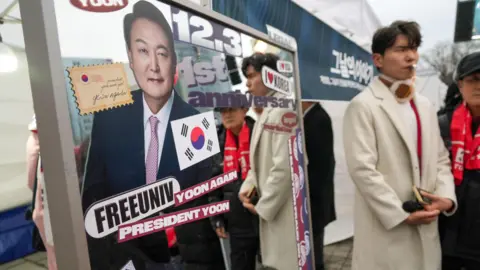
The line for a selfie with South Korea’s disgraced former President Yoon Suk Yeol stretched around Seoul’s iconic Gwanghwamun gate.
Except Yoon wasn’t there; it was just a picture of him.
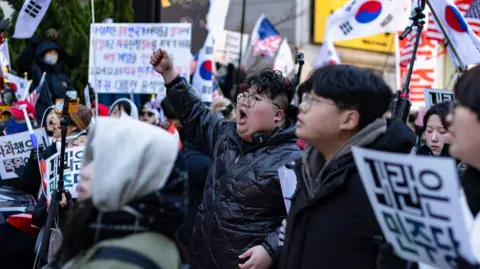
The real Yoon is in prison facing insurrection charges. But that didn’t matter to the thousands of excited young men and women who had joined the rally organised by right-wing youth group Freedom University.
Spearheaded by 24-year-old student Park Joon-young, Freedom University opposes what it sees as a status quo of corrupt, left-wing South Korean governments promising much but delivering little, especially for the nation’s youth.
And in Yoon, they have found an unlikely hero.
On the night of 3 December last year, Yoon, whose party had lost its majority in parliament, launched a desperate bid to reverse his fortunes by declaring martial law.
He ordered troops into the parliament and the national election commission, claiming, without offering any evidence, that the country was under threat from North Korean sympathisers and Chinese spies who were conspiring to steal elections.
Yoon’s move was defeated within hours, as furious South Koreans rallied. Thousands of citizens blocked the soldiers, and lawmakers made it inside the National Assembly – some even scaling the walls – to vote down the order.
Yoon was impeached soon after and is now on trial, facing the possibility of life in prison. The saga was considered his political death. But to some, it has also made him a martyr.


While he was never a popular president, and was especially unpopular among young South Koreans, Yoon has since his imprisonment become a symbol of rebellion for young people who have increasingly been feeling left behind.
“When Yoon was elected, I think it wasn’t so much that we were happy to see a right-wing candidate win. It was more that a left-wing candidate lost,” Mr Park told the BBC.
“Not many among the young people who are with us thought Yoon was doing well or that they liked Yoon when he was in power.”
But, he says, while declaring martial law, Yoon had called out the Democratic Party for “abusing its power, passing absurd bills and cutting budget for youth policy”.
“We saw that and now we are with him.”
‘Make Korea great again’
Hyung Ki-sang, a 28-year-old who has been attending pro-Yoon rallies since the martial law declaration, told the BBC that he has been feeling for years that no political party cared about him. After watching Yoon’s claim of rigged elections – as well as many YouTube videos purporting to show evidence – he joined his first pro-Yoon rally.
That was also organised by Freedom University.
The group mobilised in universities across the country last year to oppose Yoon’s impeachment, and has grown quickly, drawing thousands of attendees to their rallies with aggressive social media campaigns.
Freedom University’s founding philosophies are displayed prominently on banners and picket signs at its rallies: “Korea for Koreans,” “Chinese Communist Party out!”
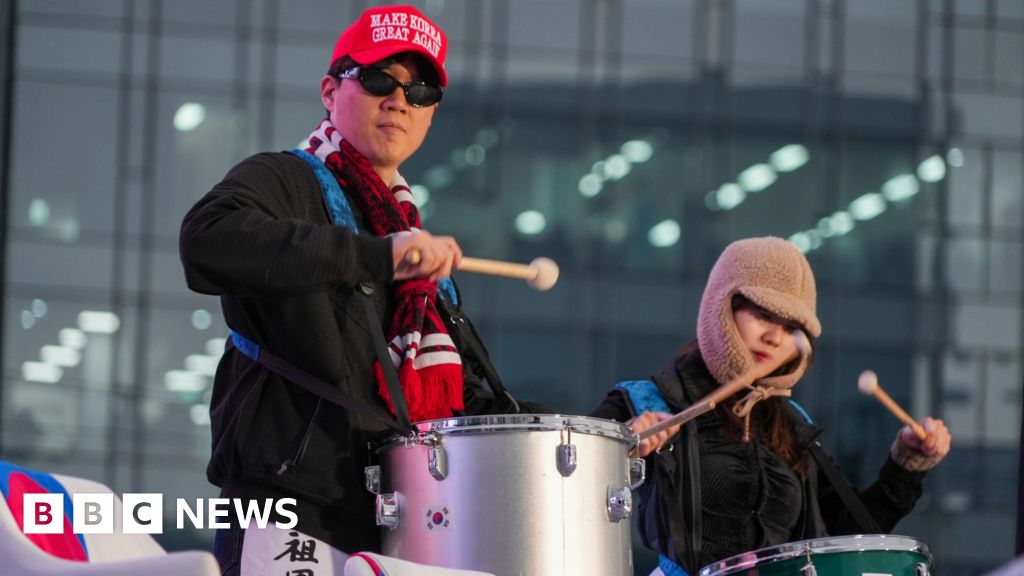
Many are also inspired by the American right’s Maga movement. “Make Korea Great Again” one sign read, while another said “We are Charlie Kirk” – a reference to the young Maga influencer who was assassinated in September.
And while the latest polling shows that only around 27% of the Korean public actually agree with their views on Yoon, their rise represents a deeper polarisation that is taking hold in South Korea.
The growth of a movement
Like many of Freedom University’s supporters, Mr Park says he first turned to the right by rebelling against what he saw as the prevailing influence of the left.
His father was the chief of a TV network that is often considered left-leaning, while his mother was an aide to left-wing former president Moon Jae-in. His mother and sister are outspoken feminists who had tried to “inject him” with their ideology, he told local media.
Mr Park says he began to question his family’s politics in the #MeToo era, and was soon exposed to right-wing views online.
For him, the American right is an inspiration.
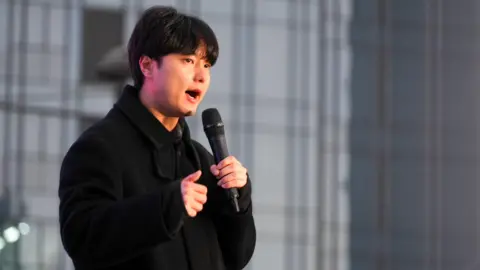
“I was often called extreme right and it is very easy to get cancelled in Korea. But in the US, it’s not like that. Charlie Kirk and Maga confidently delivered their message and spoke up,” he says. “We are trying to build the same type of platform where people can debate without fear.”
He has rejected allegations that he and his movement are “far right”.
He told the BBC that the most effective message for his group is the simplest one: “Korea is for Koreans.”
This is accompanied by a series of claims against Chinese immigrants – the most popular of which are unproven and disputed allegations of them stuffing ballots and attacking Koreans. The government has strongly refuted these.
The group also portrays President Lee Jae Myung’s efforts to thaw ties between Seoul and Beijing as proof that the current government is subservient to China.
Mr Park says he mostly uses social media platforms popular with young people to spread his message. He started with EveryTime, a Korean online forum exclusive to university students, but has since moved his focus to making short-form videos which have gone viral on Instagram, Threads, and YouTube.
The group then gained notoriety in September when it marched through Seoul’s Myeongdong neighbourhood, which is frequented by Chinese tourists and home to the Chinese embassy.
Their videos, where protesters chant anti-Chinese slurs, have gone viral enough that Lee has declared that disinformation and hate speech has reached a dangerous level, and directed his government to criminalise them.
But Freedom University’s message has proved effective in a country where Sinophobia is widespread and the population regularly ranks as one of the world’s least favourable towards China.
It has also resonated deeply with Korean youth, many of whom are disenchanted with the state of the economy and their future prospects.
Disenchanted youth
The latest national survey suggests young South Koreans are the most pessimistic about their country’s future.
Nearly 75% of them believe the economy is in poor shape, compared to their parents. Around 50% of that generation hold a positive view of the economy.
The country’s economy has grown only 1 to 2% since the pandemic – and with Trump’s trade war and growing Chinese competition, young South Koreans are feeling the squeeze.
Home ownership rates for younger generations are at an all-time low. And despite South Korea’s education level being one of the highest in the world, the median monthly income sits around $1,600 per month.
Youth psychiatrist and author Kim Hyun Soo says many of these youths hold a deep grudge against Lee’s Democratic Party, which has dominated politics for the past decade yet failed to deliver on its economic promises.
“[Lee’s party] had completely failed its housing policy,” Mr Kim says. “Their largest grievances are really the lack of housing and employment.”
The economic pinch, mixed with thriving reactionary online culture and tense gender dynamics, creates a fertile soil for groups like Park’s to recruit from.
They are also the least critical of Yoon’s martial law move – only half of those under 30 believe he is guilty of insurrection.
“The policies put forth by this government, they are absurd. They are not good for the youth. It’s so natural that the youth are speaking up now,” said 26-year-old Bae Jang-won, who spoke to the BBC at one of Freedom University’s rallies.

The psychiatrist, Mr Kim, says it is “imperative” that the youth are offered “new visions” to avoid deeper polarisation in the country: “We must show them that there’s hope.”
And in the absence of that, he warns that the youth will increasingly turn to movements like Freedom University.
Back at the rally, Kim Ji-min, 24, held up the “Korea for Koreans” sign next to his girlfriend, who waved a Korean flag. He said he joined the demonstration out of frustration that his country was going down the wrong path – his first time attending any kind of political event.
“I was nervous and scared at first. But it feels nice after seeing many other young and like-minded people,” he said.
Next to him, a girl, barely a teenager, picked up a sign that read “Never Surrender”.
Additional reporting by Leehyun Choi
Source link
-
-

-

-

-