

The Universe Is Expanding Too Fast and Scientists Can’t Explain Why
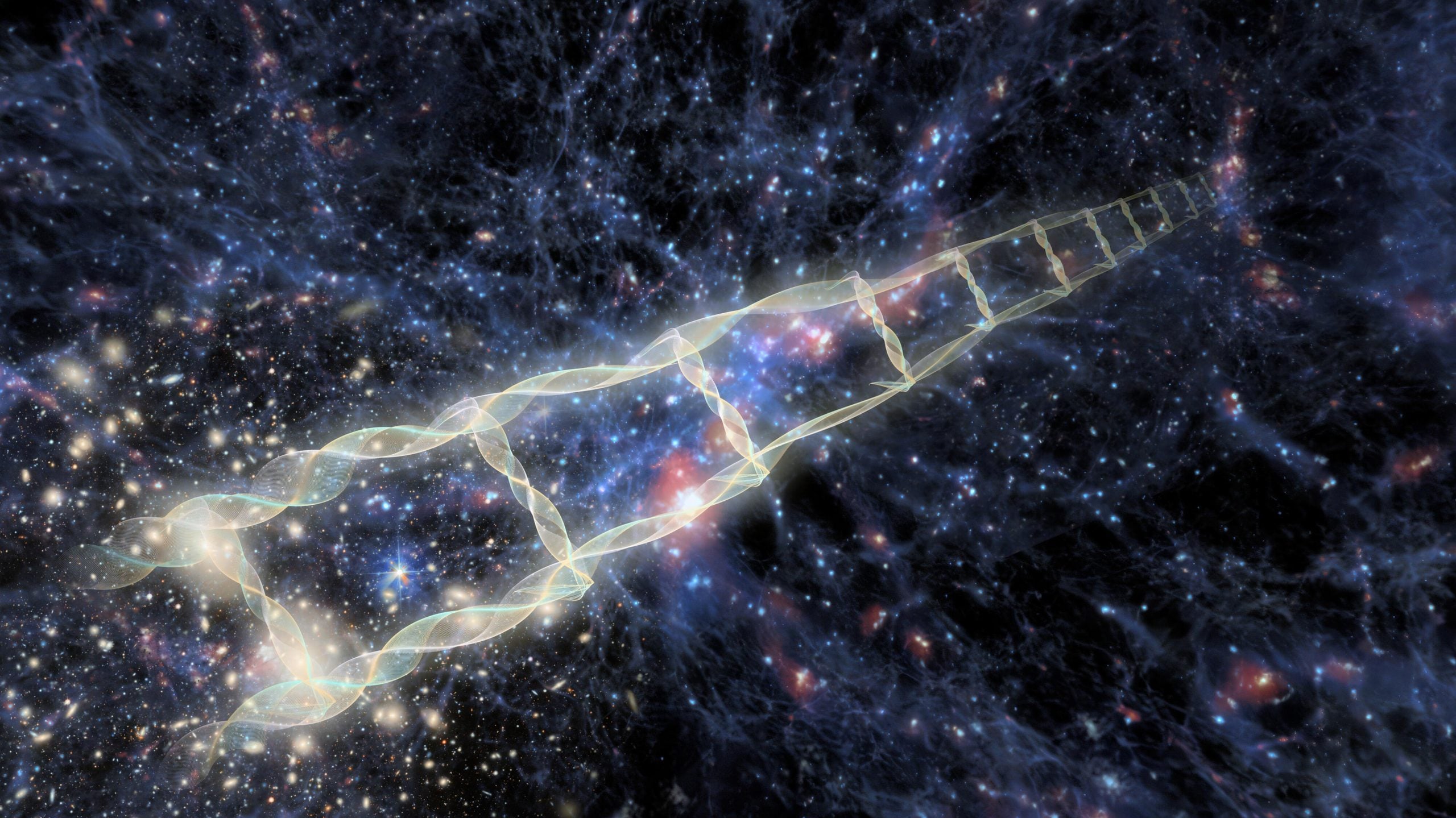
The most precise measurement yet shows the Universe is expanding faster than expected, deepening the Hubble tension. The result hints that something may be missing from our current understanding of the cosmos.
An international team of astronomers has produced one of the most accurate measurements so far of how quickly the nearby Universe is expanding. Rather than settling a long-standing debate, the new result intensifies one of the biggest unresolved problems in cosmology. The collaboration includes John Blakeslee of NSF NOIRLab, which is funded by the U.S. National Science Foundation, and draws on data from telescopes across two NSF NOIRLab Programs.
Two Competing Ways to Measure Cosmic Expansion
Researchers have traditionally used two very different methods to determine the Universe’s expansion rate. One focuses on nearby objects by measuring distances to stars and galaxies. The other looks back to the early Universe, using the cosmic microwave background to estimate what the expansion rate should be today under the standard model of cosmology.
In principle, both approaches should agree. In practice, they do not. Observations of the local Universe consistently point to a faster expansion rate — around 73 kilometers per second per megaparsec — while estimates based on the early Universe produce lower values, closer to 67 or 68. Even though the difference may seem small, it is too large to be explained by chance alone. This ongoing discrepancy, known as the Hubble tension, has now been confirmed by many independent studies using different techniques.
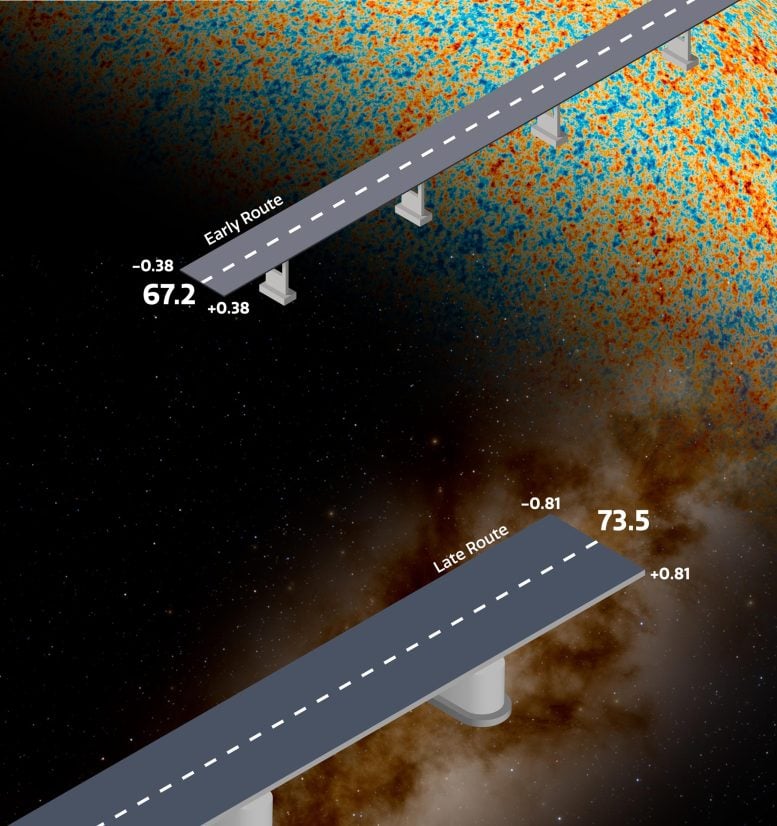
Currently, the best estimate for the Hubble constant based on measurements of the CMB is about 67.2 kilometers per second per megaparsec. In 2026, the H0 Distance Network (H0DN) Collaboration delivered the most precise direct measurement of the local Hubble constant to-date, reporting a value of 73.50 ± 0.81 kilometers per second per megaparsec, corresponding to a precision of just over 1%.
Credit: NOIRLab/NSF/AURA/J. da Silva/J. Pollard
A Unified Framework Improves Precision
To sharpen the measurement, astronomers combined decades of observations into a single, coordinated system. This effort, led by the H0 Distance Network (H0DN) Collaboration, produced the most precise direct measurement yet of the local expansion rate. In a paper published on 10 April in Astronomy & Astrophysics, the team reports a Hubble constant of 73.50 ± 0.81 kilometers per second per megaparsec, reaching a precision of just over 1%.
The study, “The Local Distance Network: a community consensus report on the measurement of the Hubble constant at ∼1% precision,” emerged from a large collaborative effort launched at the International Space Science Institute (ISSI) Breakthrough Workshop, “What’s under the H0od?” held at ISSI in Bern, Switzerland, in March 2025.
“This isn’t just a new value of the Hubble constant,” the collaboration notes, “it’s a community-built framework that brings decades of independent distance measurements together, transparently and accessibly.”
Contributions From NSF NOIRLab Observatories
NSF NOIRLab played a key role by providing both expertise and observational data. John Blakeslee, who is Director of Research and Science Services at NSF NOIRLab, is part of the collaboration. The analysis includes observations from NSF Cerro Tololo Inter-American Observatory (CTIO) in Chile and NSF Kitt Peak National Observatory (KPNO) in Arizona, both Programs of NSF NOIRLab. These datasets were combined with others from ground-based and space-based observatories, strengthening the reliability of the final result.
Building a “Distance Network” Across the Universe
Instead of relying on a single technique, the team created a “distance network” that connects several independent methods for measuring cosmic distances. These include Cepheid variable stars, red giant stars with known brightness, Type Ia supernovae, and certain types of galaxies.
This network allows scientists to cross-check results in multiple ways. If one method were flawed, removing it would significantly change the outcome. However, the results remained stable even when individual techniques were excluded. The strong agreement across methods suggests that the measured expansion rate is robust.
“This work effectively rules out explanations of the Hubble tension that rely on a single overlooked error in local distance measurements,” the authors conclude. “If the tension is real, as the growing body of evidence suggests, it may point to new physics beyond the standard cosmological model.”
What the Hubble Tension Means for Cosmology
The implications extend beyond measurement techniques. The slower expansion rate derived from the early Universe depends on the standard model of cosmology, which describes how the Universe has evolved since the Big Bang. If that model is incomplete — for example, if it does not fully capture the behavior of dark energy, unknown particles, or possible changes to gravity — its predictions for today’s expansion rate could be inaccurate.
This raises the possibility that the Hubble tension is not simply a measurement issue, but evidence that our current model of the Universe is missing a crucial piece.
Future Observations May Reveal the Answer
The newly developed distance network also provides a foundation for future research. By making their data and methods openly available, the collaboration has created a system that can be expanded as new observations come in. Upcoming observatories are expected to deliver even more precise measurements, helping scientists determine whether the discrepancy will eventually be resolved or continue to point toward new physics.
Reference: “The Local Distance Network: A community consensus report on the measurement of the Hubble constant at ∼1% precision” by Stefano Casertano, Gagandeep Anand, Richard I. Anderson, Rachael Beaton, Anupam Bhardwaj, John P. Blakeslee, Paula Boubel, Louise Breuval, Dillon Brout, Michele Cantiello, Mauricio Cruz Reyes, Geza Csörnyei, Thomas de Jaeger, Suhail Dhawan, Eleonora Di Valentino, Lluís Galbany, Héctor Gil-Marín, Dariusz Graczyk, Caroline Huang, Joseph B. Jensen, Pierre Kervella, Bruno Leibundgut, Bastian Lengen, Siyang Li, Lucas Macri, Emre Özülker, Dominic W. Pesce, Adam Riess, Martino Romaniello, Khaled Said, Nils Schöneberg, Dan Scolnic, Teresa Sicignano, Dorota M. Skowron, Syed A. Uddin, Licia Verde and Antonella Nota, 10 April 2026, Astronomy & Astrophysics.
DOI: 10.1051/0004-6361/202557993
The results are presented by the H0DN Collaboration.
NSF NOIRLab, the U.S. National Science Foundation center for ground-based optical-infrared astronomy, operates the International Gemini Observatory (a facility of NSF, NRC–Canada, ANID–Chile, MCTIC–Brazil, MINCyT–Argentina, and KASI–Republic of Korea), NSF Kitt Peak National Observatory (KPNO), NSF Cerro Tololo Inter-American Observatory (CTIO), the Community Science and Data Center (CSDC), and NSF–DOE Vera C. Rubin Observatory (in cooperation with DOE’s SLAC National Accelerator Laboratory). It is managed by the Association of Universities for Research in Astronomy (AURA) under a cooperative agreement with NSF and is headquartered in Tucson, Arizona.
The scientific community is honored to have the opportunity to conduct astronomical research on I’oligam Du’ag (Kitt Peak) in Arizona, on Maunakea in Hawai‘i, and on Cerro Tololo and Cerro Pachón in Chile. We recognize and acknowledge the very significant cultural role and reverence of I’oligam Du’ag to the Tohono O’odham Nation, and Maunakea to the Kanaka Maoli (Native Hawaiians) community.
Never miss a breakthrough: Join the SciTechDaily newsletter.
Follow us on Google and Google News.
Source link
