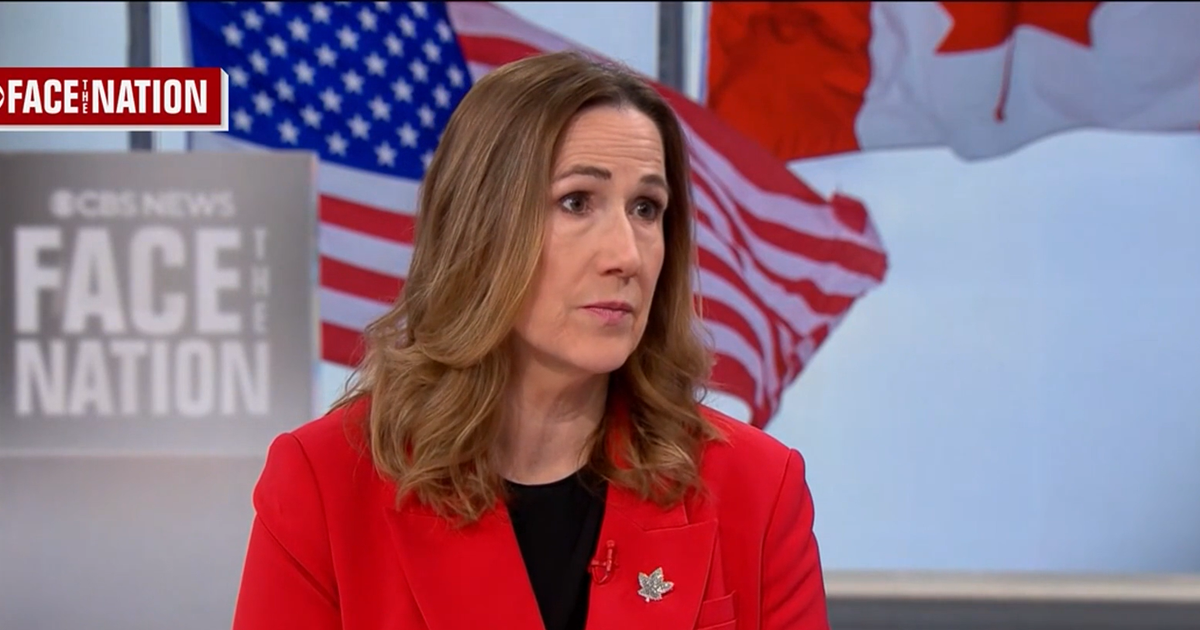
The following is the transcript of the interview with Kirsten Hillman, the Canadian ambassador to the U.S., that aired on “Face the Nation with Margaret Brennan” on Jan. 25, 2026.
This interview was recorded on Friday, Jan. 23, 2026.
MARGARET BRENNAN
So a lot is going on in the relationship between our two countries. We are so deeply integrated here on trade, you buy more from the U.S. than any other country. We have the world’s longest land border. We have shared defense interests through NATO, shared air defense with NORAD. Are we like in the middle of a divorce? Like, how do you describe the relationship?
AMB HILLMAN
I- I- we’re not in the middle of a divorce, but we are in the middle of a change. There’s no question about it. I think that we are finding ourselves, quite frankly, in- in a situation where some of the foundations that have governed our relationship for a long time, that you know, integrated supply chains are good, that working together on strategic issues is- are important, that looking out for each other in important ways is- is a number one priority. I think in some quarters, Canadians feel that those foundations are being tested. We will adapt. We will make it through, I have no doubt about that, but it’s yeah, it’s a complicated time.
MARGARET BRENNAN
Well, you know, Canada had agreed to join this Board of Peace that President Trump announced out at Davos, and then overnight Thursday, the president disinvited Canada. Is this kind of public snub interfering in the relationship, and- and what does that indicate to you about what this Board of Peace is that Canada had said it did want to be a part of?
AMB HILLMAN
So we had expressed an interest in the Board of Peace a number of weeks ago, and essentially, a Board of Peace that is seeking to find peace, in particular, in Gaza and stability, is something that Canada was very much supportive of. The- the parameters of that Board of Peace had just really started to come out and- and our government was considering it, but hadn’t- hadn’t really made a decision. But I think that- that honestly, I think that the most important thing to say here, from the perspective of Canada, is that we have always and will always be promoting peace and stability and human rights around the world. We’ll do it with our allies in various fora, at NATO, at the U.N. bilaterally with like minded countries. So we’re not going to change that and- and we will give it our all in- in any fora that- that is available to us.
MARGARET BRENNAN
It- It’s kind of now described as an alternative to the United Nations. Is that something you’re comfortable with?
AMB HILLMAN
Well, we are deep supporters of the United Nations. We feel that it’s, you know, it’s not perfect, no large institution is, but having a place where the whole world can get together and express their views on issues that are important to the globe is vital. And as I say, NATO is vital, and we work with our EU counterparts and EU-Canada, you know, security discussions and in- in various other configurations. So probably all of these different fora are- are essential. The Board of Peace has yet to be fully, I think, understood, and we’ll see- we’ll- we’ll see where that goes, but the outcomes are what matter to Canada.
MARGARET BRENNAN
So your prime minister gave a national address on Thursday, and I understand he denounced authoritarianism and exclusion. He did not mention President Trump by name, but he did rebuke the claim that Trump made at Davos, that Canada lives because of the United States. You’re talking about what people receive at home, everyone has local politics, so when something like that is said, do you fear that this is starting not just a spat, but this is like a generational split between our two countries, like, how are people receiving this at home?
AMB HILLMAN
Look, I think Canadians- Canadians know that Canada lives because of Canadians, because what Canadians do for Canada, and right now, that’s where we’re trying to focus our attention. By doing what- you know, focusing our attention on what we can control as a nation for ourselves and our own economy and our own security and our own relationships around the world. The United States is always going to be a vital partner. Geography, as you said in your opener, 5,500 miles of border, deep ties, millions of Canadians and Americans that work together every day, that- that you know, do research and study and have families across the border so that- that is there, and that is something that I actually think brings strength to the relationship at times where, you know, in other- at other levels, and maybe at the political level, it- it’s more complicated.
MARGARET BRENNAN
It’s very complicated. I mean, it- it’s almost unthinkable that a phrase like authoritarianism and exclusion that that could be thought to be referring to the leader of the president of the United States?
AMB HILLMAN
Well, I think that there are concerns globally for- by our government, that we have institutions and norms, rules that have governed our countries, yours, mine, and all like minded countries for generations that are really being tested, really being tested. And- and I think what matters is how we react in the face of these tests, and for us, for our country, for our prime minister, you know, there are important implications for our country. And he’s- he’s trying to articulate a vision. And I think he is articulating a very strong vision for how we must adapt. And again, it’s- it’s about being pragmatic and principled, and that’s- that’s what we’re going to continue to be.
MARGARET BRENNAN
You have had a long career here in the United States, deeply involved with trade in particular. You helped to negotiate that free trade deal known as USMCA during the first Trump administration. President Trump was asked about it, January 13. He said, I really don’t care in terms of renewing it, there’s no real advantage. We don’t need Canada products here. Is that free trade deal doomed?
AMB HILLMAN
No, it is not doomed. That is my view. All three countries, Canada, the U.S. and Mexico did broad consultations, national consultations, with their business communities in particular, on what- how that agreement works for them. And really without exception, the American comments back were sure we’d like to maybe update this or change this a little bit, but job number one is to do no harm to this agreement, which is the economic foundation of our continental partnership and leads to very important U.S. competitiveness, and Canadian and Mexican competitiveness vis-a-vis other parts of this world. So I think there’s- I think that we have to believe that our political leaders are going to be listening to the people in the constituencies for whom that instrument was drawn up, and they’re saying, this is vital to us, do no harm.
MARGARET BRENNAN
So do you think there’s a bilateral trade deal here? Is that what the Trump administration is going for, rather than the three way deal or–
AMB HILLMAN
I- you know, I think- I- I- we hear- we hear that sometimes, we hear different things. It is important to remember that even within that agreement, there are a lot of bilateral elements, but there is- there are advantages to doing things trilaterally. There’s a lot of supply chain movement that happens between our three countries. And if you, if you break it into two, you could have different rules and disconnects there that are inefficient for business. So we’re driven- look, Canada will be driven by what the best thing to do is, as I say, for the companies and constituencies that are relying on that agreement to create jobs.
MARGARET BRENNAN
Because you heard the commerce secretary say at Davos, you know, globalism isn’t working. I mean, these free trade deals are part of that globalism. And it was just a week ago, your prime minister was in Beijing, and he described Canada’s relationship with China as more predictable than its relationship with the United States. He really meant more predictable than the Trump administration’s United States.
AMB HILLMAN
Look, there’s no question that the last number of months have been unpredictable for us in our relationship with the United States. You know, we have a trade agreement that had us virtually tariff free between our two countries, and now we have very serious tariffs on steel, aluminum, autos, lumber, and that’s causing a lot of challenges within our country. There are people that are losing their jobs. There are industries that are being reoriented, and it’s very difficult. So that is seen as, yes, unpredictable.
MARGARET BRENNAN: But fortress North America had been an idea. I mean, the treasury secretary talked about it, that the United States, Mexico, Canada, we could stand up together, you know, have shared values, and stand up to China. That seems dead, if Canada is really describing a new alliance here with Beijing.
AMB HILLMAN: Well, I think- I think we have to put this in perspective. The- the agreement that we did with China a few weeks ago was a very focused and surgical agreement that was largely, or almost exclusively, designed to de-escalate some tariff escalation that had happened over the past year and a bit. So over the past year and a bit, China had put very punitive tariffs on Canadian agricultural products and fish and seafood, shutting Canadians out from one of their primary markets, if not for some of them, their primary market. And so we went to Beijing to re-establish market access for our farmers and our fishers. It’s exactly what the U.S. administration did in October when they re-established market access for U.S. soy farmers, and in exchange, rolled back some tariffs and fees. So this is a very pragmatic, very focused approach. I think it’s important to put it in context.
MARGARET BRENNAN: But even Ontario’s premier said this is letting Chinese “spy cars” into your country. I think he means electric vehicles that will be cheaply made in China. Are you worried about becoming too beholden to China and its cheap manufacturing?
AMB HILLMAN: No, we’re not, because, we- the- the auto side of this agreement was again to take us back to 2023, we had the importation of vehicles made in China. Many of those were Teslas, as a matter of fact, and we’ve gone back and stuck to the level of 2023 for those imports. So this isn’t a revolutionary new thing. This is really just trying to roll back or de-escalate what had been escalated over the past year and a bit.
MARGARET BRENNAN
Well, the treasury secretary is saying that Albertans are going to have a referendum on succeeding from Canada. He seems to be urging that. What do you make of this–
AMB HILLMAN: Well–
MARGARET BRENNAN: –and comments like that?
AMB HILLMAN: I think it’s important to let Albertans and Canadians manage their own very delicate domestic, you know, politics themselves. I think that that’s probably wise counsel. Having grown up in Alberta, you know, it’s a- it’s a- it’s a province that has lots of strong views about the way in which it interacts with the rest of the country, as do other parts of our nation. And those are important debates to be had, but they’re debates for our country to have within its own citizenry.
MARGARET BRENNAN: It seems to be stirring the pot there a bit, but I want to ask you what your prime minister said at Davos. He got a standing ovation for this speech. He described a ruptured global order, the end of a nice story, and the beginning of a new brutal reality, which he described as a predatory one. Take a listen.
[SOUND ON TAPE BEGINS]MARK CARNEY, PRIME MINISTER OF CANADA: Stop invoking rules-based international order as though it still functions as advertised. Call it what it is: a system of intensifying great power rivalry, where the most powerful pursue their interests using economic integration as coercion.
[SOUNDS ON TAPE ENDS]MARGARET BRENNAN: He said, if you’re not at the table, then you’re on the menu. What does this new world order look like?
AMB HILLMAN
Well, that’s a good question. I mean, I think he laid out in his- his discussion, his speech, his- his view of what is happening in our world. And it’s- it’s a world in which rules that governed every player in the globe, every country were maybe not perfectly abided by, as he said, maybe not always exactly exercised as one would hope, but still were sufficient to form the basis of the prosperity, the stability, the predictability that we all used to maximize peace and stability and- and maximize economic reality. So we’re moving away our economic benefits, and we’re moving away from that, and we have to- countries like ours, have to figure out what that means for us. I think that what it does mean for us is that we can’t walk away from our principles. We can’t walk away from our belief in rules that are to be abided by by everyone if they commit to them. But at the same time, we have to be pragmatic and we have to look inward to control what we can within our own economies to be as resilient as we possibly can within our own economies, and part of that means engaging pragmatically with a broad array of countries around the world, in trade agreements, in investment relationships and in partnerships.
MARGARET BRENNAN: Sounds like Canada is picking off our friends.
AMB HILLMAN: You know, I- no, I think Canada is trying to make sure that it is the most resilient it can be for our own benefit.
MARGARET BRENNAN: I’m being told that President Trump posted on social media just a few moments ago that Canada is against the Golden Dome over Greenland and has voted against it to choose to be closer to China. That’s how it was described to me. Yet President Trump had previously talked about Canada participating in this Golden Dome project, which isn’t yet built, but it’s supposed to be missile- layered missile defense, as I understand it. Do you know what he’s talking about, that Canada has rejected being involved?
AMB HILLMAN: No, I’m afraid I don’t, but what I can say about the Golden Dome is this, Canada is- is investing over $80 billion over the next five years in our defens-, in our defense systems, and a big part of that is Arctic defense. And a big part of our Arctic defense investments are something called over-the-horizon radar, which is a system that allows us to see the threats that are coming into the Arctic before they arrive. So that is part- and when we have talked to the president about protecting our hemisphere, we have talked about ways in which our different capabilities can work together so that we have eyes on the region and we cooperate in a way that protects both of our countries.
MARGARET BRENNAN: So the president has described that as Canada wanting to plug in to the system. As you understand it, that’s the better description, your own system that would coordinate?
AMB HILLMAN: Right. Much as we do across all sorts of defense systems, where we’re interoperable. We- we work together. We make our investments that make sense for Canada and defending our territory and defending our sovereignty, but we work with the Americans and- and other allies to maximize the benefits of those.
MARGARET BRENNAN: So in- in short, you do think there needs to be more focus on Arctic defense, but you’re on board to help do that?
AMB HILLMAN: We’re deeply committed to Arctic defense. Absolutely.
MARGARET BRENNAN: I need to ask you about NATO, because you’re also a partner at NATO. The only time that NATO’s Article 5 was ever invoked, and you know this, was after the 9/11 attacks on this country. That collective defense clause, an attack on one is an attack on all, meant that Europe and Canada, they sent troops right alongside American troops on the battlefield in Afghanistan. Here’s what President Trump said.
[SOUND ON TAPE BEGINS]PRESIDENT DONALD TRUMP: We’ve never needed them. We have never really asked anything of them. You know, they’ll say they sent some troops to Afghanistan, or this or that. And they did. They stayed a little back, little off the front lines.
[SOUNDS ON TAPE ENDS]MARGARET BRENNAN
He was speaking about all NATO troops. But we did check and about 40,000 Canadians deployed to Afghanistan between 2001 and 2014. 158 were killed, 635 wounded in action. What is a remark like that do to people at home?
AMB HILLMAN: You know, I think what’s most important is that we know what our Canadians have done, and I know that your American armed forces are deeply respectful and deeply appreciative of having stood side by side with Canadians in those very, very treacherous and difficult fights. We know that to be true. They know that to be true, and that’s what matters.
MARGARET BRENNAN: Ambassador, thank you for your time as it wraps up here in Washington.
AMB HILLMAN: Thank you for having me.
MARGARET BRENNAN: Great to have you. We’ll be back in a moment.
Source link