

Treasury secretary threatens sanctions on those who help Iran export oil
Treasury Secretary Scott Bessent wrote on X that, due to the ongoing U.S. blockade of Iranian ports, “in a matter of days, Kharg Island storage will be full and the fragile Iranian oil wells will be shut in.”
Kharg Island is a critical oil export terminal for Iran.
“Constraining Iran’s maritime trade directly targets the regime’s primary revenue lifelines,” Bessent said. “The US Treasury will continue to apply maximum pressure through Economic Fury to systematically degrade Tehran’s ability to generate, move, and repatriate funds.”
“Any person or vessel facilitating these flows—through covert trade and finance—risks exposure to U.S. sanctions,” he added.
On March 20, the Trump administration temporarily lifted sanctions on Iranian oil that is already at sea in an effort to ease worldwide gas prices. That waiver expired on Sunday.
Vance not traveling to Pakistan today
A White House official told reporters that Vice President JD Vance will not travel to Pakistan on Wednesday, following President Trump’s announcement that he is extending the ceasefire with Iran to allow it to “come up with a unified proposal.”
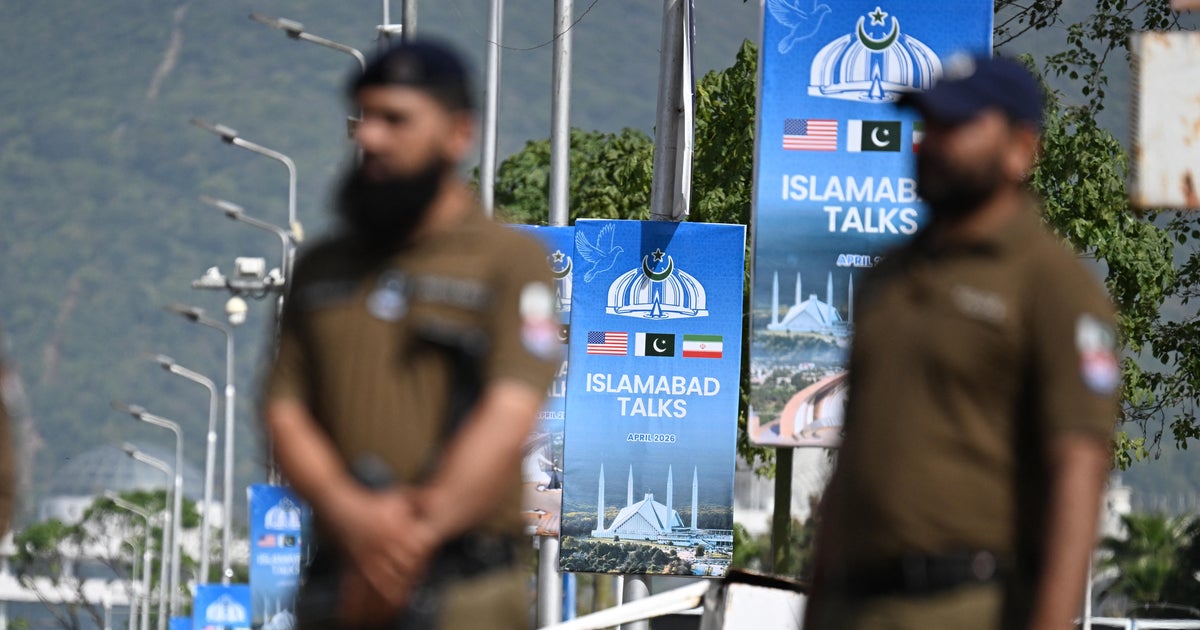
Vance is expected to lead the U.S. delegation in negotiations with Iran, which will be held in Pakistan’s capital of Islamabad, should talks resume.
“Any further updates on in-person meetings will be announced by the White House,” the official
House Armed Services Committee ranking member says Trump’s characterization of negotiations with Iran “not even close to true.”
Democratic Rep. Adam Smith, the ranking member of the House Armed Services Committee, told CBS News on Tuesday that President Trump’s characterizations about negotiations with Iran being close are “not even close to true.”
He said Americans should feel “concerned,” and that Mr. Trump’s statements could make talks more difficult.
His comments came after the committee was briefed by Pentagon and intelligence officials on the war in Iran, prior to the announcement of an extension of the ceasefire.
Smith said the briefing included officials from the Defense Intelligence Agency, the Joint Staff, and Daniel Zimmerman, assistant secretary of war for International Security Affairs. He described it as “an update on the whole process in the war and where it’s at.”
Smith said the administration is “being a little bit more transparent” compared to earlier briefings, but added, “they still don’t have a plan.”
Trump extends ceasefire with Iran
President Trump said Tuesday afternoon on Truth Social that he was extending the ceasefire, which had been set to expire in the coming hours.
“Based on the fact that the Government of Iran is seriously fractured, not unexpectedly so and, upon the request of Field Marshal Asim Munir, and Prime Minister Shehbaz Sharif, of Pakistan, we have been asked to hold our Attack on the Country of Iran until such time as their leaders and representatives can come up with a unified proposal,” Mr. Trump wrote. “I have therefore directed our Military to continue the Blockade and, in all other respects, remain ready and able, and will therefore extend the Ceasefire until such time as their proposal is submitted, and discussions are concluded, one way or the other.”
Iran has not publicly reacted to the president’s extension.
Iran calls for “immediate and unconditional release” of ship seized by U.S.
Iran’s mission to the U.N. said Tuesday it had sent a letter to the U.N. Security Council and the U.N. secretary-general demanding “a firm and unequivocal condemnation” of the U.S.’ seizure of an Iranian-flagged ship, “full accountability for those responsible, and the immediate and unconditional release of the vessel, its crew, and all those affected.”
President Trump announced Sunday that U.S. forces fired on and seized the Iranian-flagged cargo vessel Touska because it tried to bypass the U.S.’ blockade of Iranian ports.
Iran’s mission to the U.N. said the seizure “constitutes a grave breach of international law, a clear violation of the ceasefire, and an act of aggression marked by the hallmarks of piracy. Such reckless conduct directly endangers international navigation and undermines maritime safety and security.”
Lebanon foreign minister: Iran must be “held responsible” for Arab states’ economic losses amid Strait of Hormuz closure
Lebanon’s foreign minister said on X that during an emergency meeting of the Council of the League of Arab States, the participants “condemned Iran’s threats to close the Strait of Hormuz and stressed that Tehran must be held responsible for compensating the damage and economic losses caused by these threats.”
“The ministers also rejected and condemned Iran’s continued funding, arming, and mobilizing of militias loyal to it in several Arab countries, in ways that serve its own agenda at the expense of regional stability,” Youssef Raggi wrote. “We called on the UN Security Council to fully assume its responsibilities for maintaining peace and security at both the regional and international levels.”
Iran not backing down before ceasefire ends, criticizes U.S. for violating truce again
With apparently just hours to go before a two-week ceasefire ends between the U.S. and Iran, the country’s foreign minister is not backing down from accusations the U.S. has broken the ceasefire.
“Blockading Iranian ports is an act of war and thus a violation of the ceasefire,” Iranian Foreign Minister Seyed Abbas Araghchi said on X. “Striking a commercial vessel and taking its crew hostage is an even greater violation.”
Araghchi accused the U.S. of “bullying” Iran and said it “knows how to neutralize restrictions and “how to defend its interests.”
President Trump also accused Iran on Tuesday of violating the ceasefire “numerous times.”
U.S. announces sanctions against companies, people tied to Iranian weapons
The U.S. Treasury Department announced a new round of economic sanctions against several companies and individuals involved in aiding Iran with its development of attack drones or ballistic missiles.
Most of the individuals or companies are based in Iran, though there are other entities tied to Turkey and the United Arab Emirates.
“The Iranian regime must be held accountable for its extortion of global energy markets and indiscriminate targeting of civilians with missiles and drones,” Treasury Secretary Scott Bessent said in a statement. “Under President Trump’s leadership, as part of Economic Fury, Treasury will continue to follow the money and target the Iranian regime’s recklessness and those who enable it.”
Among those sanctioned on Tuesday was Mahan Air, a private airline based in Tehran, as well as the airline’s chairman and several members of its board of directors. Mahan Air was allegedly providing support to Iran’s Islamic Revolutionary Guard Corps-Qods Force.
Israel accuses Hezbollah of multiple violations of ceasefire
The Israeli army accused Hezbollah of two “blatant” violations of the ceasefire in Lebanon on Tuesday.
Israel said Hezbollah launched several rockets toward Israeli army forces south of the forward defense line in southern Lebanon on Tuesday evening. Israel responded by striking the launcher from which they were fired, the army said.
The Israeli army also said alerts issued in Kibbutz Yuval and Mevo Dotan, both in northern Israel, were not false alarms, contrary to unnamed reports, but were due to a drone being intercepted from Lebanon before it crossed into Israeli airspace.
Israel and Lebanon agreed to an uneasy truce for 10 days on April 16 at the urging of President Trump and the United States. Israel said it would still defend itself with attacks on Hezbollah when threatened.
Vance remains in Washington to join policy meetings at White House
Vice President JD Vance is participating in policy meetings at the White House today, a White House official confirmed.
President Trump on Monday said Vance was on his way to Islamabad for talks, although it became clear Monday that Vance was still in Washington. The president said Vance would join U.S. special envoy Steve Witkoff and Mr. Trump’s son-in-law Jared Kushner for talks in Pakistan. With the ceasefire deadline rapidly approaching, Iran has not yet publicly committed to continuing in-person negotiations.
The president on Tuesday told CNBC he expects the U.S. to continue bombing Iran when the ceasefire ends.
U.S. forces ordered 28 ships to turn around since start of blockade
U.S. Central Command said Tuesday that since the start of the U.S. blockade against ships entering or exiting Iranian ports, U.S. forces have directed 28 vessels to turn around or return to port.
A U.S. official wouldn’t say if any ships have entered Iranian ports, but said that if any ships have, the ships won’t make it past the blockade in the Gulf of Oman when they depart.
Pakistan still awaiting news on whether Iran will attend negotiations
As the two-week ceasefire between the U.S., Israel and Iran reaches its final hours, it’s still unclear whether Iranian officials will show up for negotiations in Islamabad.
The Pakistani information minister, Attaullah Tarar, said as of 7:30 p.m. Pakistani time (10:30 a.m. U.S. Eastern time), a “formal response from [the] Iranian side about confirmation of delegation to attend Islamabad Peace Talks is still awaited.”
However, Tarar did say Pakistani mediators were in “constant touch” with the Iranians and emphasized the talks were “critical.”
The ceasefire will end at 4:50 a.m. Pakistani time on Wednesday, according to Tarar, which would be 7:50 p.m. Tuesday night in Washington, D.C. However, the exact time seems to be under some debate, as President Trump said the ceasefire would end “Wednesday evening Washington time” in an interview on Monday.
In a bad sign for negotiations, Iranian President Masoud Pezeshkian criticized Mr. Trump and the negotiations in a post on X, writing, “The level of understanding and comprehension of the requesters from Iran regarding their presence in Islamabad is even lower than Trump’s level of understanding and comprehension…!”
Maersk advises ships to avoid Strait of Hormuz
Maersk, the second-largest container shipping company in the world, said on Tuesday the situation in the Strait of Hormuz was too dangerous and unstable for its ships to travel through.
“Volatility persists in the situation. In coordination with our security partners, we have assessed that as of now, transit through the Strait should be avoided,” the company said in a statement. “We will continue monitoring developments and provide updates as clarity improves.”
Ship traffic in the strait had come to a stop on Tuesday over the volatile situation. Data from the ship-tracking website MarineTraffic showed no vessels visible in the narrow waterway.
“Information is still scarce, and we are urgently seeking clarification,” Maersk said in the statement. “The situation remains deeply dynamic, with full maritime certainty not assured. The safety of our seafarers, vessels and cargo remains Maersk’s top priority.”
Ship traffic stalled in Strait of Hormuz after Iran says waterway completely “closed”
Vessels appeared to be avoiding the Strait of Hormuz on Tuesday after Iran said the passage was again completely closed “until further notice.”
Data from the ship-tracking website MarineTraffic showed no vessels visible in the narrow waterway. Several ships that had earlier been seen approaching Iran’s previously designated route for transit had stopped.
The data does not account for ships that have their automatic identification system transponders turned off.
Earlier, Iran’s semi-official Tasnim news agency, which is linked to the country’s powerful Revolutionary Guard Corps, said the Strait of Hormuz was again closed to all traffic after what it said was a “recent” U.S. or Israeli attack, without specifying.
Most of the traffic through the strait over the preceding 48 hours was vessels linked to Iran.
Despite the U.S. blockade of Iran’s ports and ships, Lloyd’s Intelligence said Monday that at least 12 vessels from Iran’s “dark fleet” of oil tankers had passed the blockade line since the U.S. Navy expanded its restrictions to include sanctioned vessels and those suspected of carrying contraband.
Iran’s military command chief says forces “ready to deliver a decisive response” to “any breach of commitments”
Maj. Gen. Ali Abdollahi, the head of Iran’s central military command, said in remarks conveyed by Iranian state media on Tuesday that Iranian forces “remain united and fully aligned with the directives of the Supreme Leader, ready to deliver firm, decisive, and immediate responses to enemy threats and actions.”
Abdollahi said Iran’s military “will not allow” President Trump to “exploit or fabricate false narratives about the battlefield situation, particularly regarding control of the Strait of Hormuz, and will appropriately respond to any breach of commitments.”
Top U.S. diplomat in Pakistan told by country’s deputy leader that U.S. and Iran should “consider extending” truce
U.S. Chargé d’Affaires Natalie Baker, who heads up the U.S. Embassy in Islamabad, met with Pakistani Deputy Prime Minister Ishaq Dar Tuesday to discuss diplomatic efforts to end the Iran war, which Pakistan has spearheaded for weeks.
Dar “underscored Pakistan’s consistent emphasis on dialogue and diplomacy as the only viable means to address challenges and achieve lasting regional peace and stability,” the Pakistani Ministry of Foreign Affairs said in a readout of the meeting posted on X. “He stressed the need for engagement between the United States and Iran, urged both sides to consider extending the ceasefire, and to give dialogue and diplomacy a chance.”
President Trump has indicated he does not want to extend the ceasefire, hoping instead for a permanent solution.
“I don’t want to do that. We don’t have that much time,” Mr. Trump told CNBC about extending the two-week ceasefire, which he has said will end Wednesday. “Iran can get themselves on a very good footing if they make a deal. They can make themselves into a strong nation again, a wonderful nation again.”
Baker thanked Pakistan for its “positive role in promoting peace and facilitating dialogue” with Iran, according to the Pakistani ministry’s readout.
Iranian military-linked news agency says Strait of Hormuz completely “closed until further notice”
Iran’s semi-official Tasnim news agency, which is linked with the country’s powerful Islamic Revolutionary Guard Corps, said Tuesday the Strait of Hormuz was again completely “closed until further notice,” tightening restrictions it had previously eased on account of a “recent attack by the US-Israeli enemy.”
Tasnim did not explain what the “recent attack” was, but the report came after U.S. forces fired on and seized an Iranian commercial vessel over the weekend in the Arabian Sea, as part of the ongoing U.S. naval blockade of Iranian ports and ships.
The U.S. military also said Tuesday it had interdicted another Iran-linked ship in a different area. The “stateless sanctioned M/T Tifani” crude oil tanker was intercepted and boarded in the Indo-Pacific Command’s area of responsibility, the Pentagon said.
“After the recent attack by the U.S.-Israeli enemy, a new water route had been designed for the controlled passage of commercial vessels. However, following the violation of the ceasefire, these channels have been declared closed until further notice,” Tasnim said, adding the closure would remain in effect “until the necessary guarantees are provided for the complete lifting of the naval blockade against Iran.”
Mossad chief reveals agent who worked on Iran operations was killed abroad
The head of Israel’s primary intelligence agency, the Mossad, has revealed an agent who worked on Iran operations was killed outside the country in 2023, according to Israeli media reports.
During a speech on Tuesday, David Barnea said agent “M” had a key role in laying the groundwork for the 2026 Iran war, but he gave no details of how or exactly where outside Israel he died, nor what mission he was on.
“The operations led by M combined creativity, cunning, and technology and significantly influenced the success of the campaign against Iran,” Barnea said at the ceremony.
Meanwhile, former Mossad chief Yossi Cohen cautioned Tuesday against relying on any possible agreement between Iran and the U.S. for Israel’s safety.
“We must not deceive ourselves,” he said at an event in Jerusalem. “The Iranians will continue to lie, and we must not trust them or rest on our laurels. No agreement and no ceasefire will change their fundamental ambitions.”
Trump calls on Iran leaders “who will soon be in negotiations with my representatives” to free women
President Trump reiterated his conviction on Tuesday that U.S.-Iran peace talks will soon be underway, sharing a post on his Truth Social network initially published by American pro-Israeli commentator Eyal Yakoby, who said Iran was set to execute eight women.
“To the Iranian leaders, who will soon be in negotiations with my representatives: I would greatly appreciate the release of these women. I am sure that they will respect the fact that you did so,” Mr. Trump said in his post. “Please do them no harm! Would be a great start to our negotiations!!!”
Yakoby’s post said Iran was “preparing to hang eight women,” and it included photos of the women purportedly facing execution.
CBS News has not confirmed the identity of the women or their status in Iran’s opaque judiciary system. Thousands of people, including many students, were arrested as Iranian authorities launched a brutal crackdown to quash massive anti-government protests early this year, and some have already been executed.
Trump says U.S. is open to providing financial lifeline to UAE amid ongoing war
Asked about the prospect of a currency swap with the United Arab Emirates to assist the Gulf nation if it’s needed, Mr. Trump said it was under consideration.
The president noted that the UAE has been hit by Iranian missiles repeatedly during the war and said he was surprised that the Emiratis might need a financial backstop, because “they are so rich.”
“You know they’re very good for this country,” Mr. Trump said of the UAE. “If I could help them I would. I mean we’re helping them much more with what we’re doing with the war.”
The president praised U.S. allies in the Persian Gulf, who he said are “much better allies than NATO.”
The Wall Street Journal reported Sunday that UAE Central Bank Gov. Khaled Mohamed Balama broached the idea of a currency-swap line with Treasury Secretary Scott Bessent and officials from the Federal Reserve and Treasury last week.
Trump says he was “a little surprised” that U.S. caught ship suspected to have come from China
The president told CNBC that the U.S. boarded and seized a cargo ship that had material that he believed came from China, though he wasn’t sure if that was accurate.
“We caught a ship yesterday that had some things on it, which wasn’t very nice, a gift from China, perhaps, I don’t know,” he said. “But I was a little surprised because I have a very good relationship and I thought I had an understanding with President Xi, but that’s all right. That’s the way war goes, right?”
The president announced Sunday that U.S. forces fired on and seized the Iranian-flagged cargo vessel Touska because it tried to bypass the U.S. blockade and ignored multiple warnings. It’s unclear whether Mr. Trump was referring to Touska in his call with CNBC.
The U.S. military said Tuesday that another Iran-linked vessel, which the Pentagon described as a “stateless sanctioned” ship, the oil tanker M/T Tifani, was interdicted in the Indo-Pacific Command area of responsibility.
Trump says he “expects to be bombing” again as two-week ceasefire nears its end
Asked by CNBC’s Joe Kernan whether he would extend the current ceasefire with Iran if peace talks do begin and make some progress, President Trump indicated Tuesday that he would not prefer that option.
“I don’t want to do that. We don’t have that much time,” he said, adding that there won’t be much time left for negotiating once U.S. and Iranian representatives arrive in Islamabad before the expiration of the ceasefire.
Iran has not yet committed to attending a second round of talks with the U.S. in Pakistan, but preparations have been underway for the arrival of delegations for days.
The president said Iran can “get themselves on very good footing” if its leaders reach a deal with the U.S.
Pressed again about what he would need in order to stave off a resumption of U.S. bombing, Mr. Trump told CNBC that he “expects to be bombing.”
“I think that’s a better attitude to go in with,” he said. “But we’re ready to go.”
Trump says “we’re going to end up with a great deal”
In a live phone interview with CNBC, President Trump expressed confidence Tuesday that his administration can reach a deal with Iran ahead of potential talks in Islamabad and the nearing expiration of the ceasefire.
It remains uncertain, though, whether the next round of discussions will be held. Mr. Trump said the Iranians “have no choice” but to send negotiators to Islamabad.
“We’re going to end up with a great deal. I think they have no choice,” he said.
Mr. Trump said the regime leading Iran is “much more rational,” reiterating his claim that it is a different regime, despite the current supreme leader being the son of the former head of the Islamic Republic.
The president said he believes the U.S. is in a “very strong negotiating position,” and he hailed the U.S. blockade of Iranian ports and vessels as a “tremendous success.”
Germany rejects calls for suspension of EU-Israel cooperation
Germany has dismissed calls to suspend the EU’s cooperation deal with Israel, despite rising anger over the war in Lebanon and the situation in the occupied Palestinian territories. Spain and Ireland had put the issue of halting the agreement back on the table at a meeting of EU foreign ministers in Luxembourg.
German Foreign Minister Johann Wadephul called the proposal “inappropriate,” saying at the start of the meeting: “We have to talk with Israel about the critical issues.”
“That has to be done in a critical, constructive dialogue with Israel. That is what we stand for,” Wadephul said.
Attitudes toward Israel among EU member states, already strained by Israel’s conduct in the war in Gaza, have hardened further amid the ongoing Israeli invasion of Lebanon and a new law passed on the death penalty for Palestinians in the occupied West Bank.
“We need to act. We need to make sure that our fundamental values are protected,” Irish foreign minister Helen McEntee said.
The EU last year put on the table a raft of potential measures to punish Israel, including cutting trade ties or sanctioning government ministers. So far, none of the steps have garnered enough support from member states to be enacted.
Suspending the entirety of the EU’s cooperation agreement, as Spain and Ireland are pushing for, would require unanimity among the bloc’s 27 countries, and would almost certainly be blocked by allies of Israel.
CBS/AFP
U.S. says forces interdicted, boarded sanctioned vessel linked to Iran
U.S. forces interdicted and boarded a “stateless sanctioned” oil tanker in the U.S. Indo-Pacific Command area of responsibility overnight, the Defense Department said.
The operation aboard the M/T Tifani was conducted “without incident,” it said.
“As we have made clear, we will pursue global maritime enforcement efforts to disrupt illicit networks and interdict sanctioned vessels providing material support to Iran — anywhere they operate,” the department said on X.
“International waters are not a refuge for sanctioned vessels,” it said. “The Department of War will continue to deny illicit actors and their vessels freedom of maneuver in the maritime domain.”
The ship, which tracking data show was last positioned Tuesday between Sri Lanka and Indonesia, is sanctioned for transporting Iranian oil and has been doing “dark” ship-to-ship transfers around Singapore, where it was headed. It claimed to be coming from China but its past track shows it was around the coast of Oman when the war began.
It claims to be sailing under the flag of Botswana, which is a landlocked country without a ship registry.
Trump accuses Iran of violating soon-to-expire ceasefire “numerous times”
President Trump hasn’t appeared to speak publicly for a couple days, relying instead on his Truth Social platform to deliver a steady volley of messages Monday about the ongoing standoff with Iran.
In his first message about the war on Tuesday, the president said simply: “Iran has Violated the Cease Fire numerous times!”
He posted the message, without any further context, one day before he says the ceasefire — which has halted U.S. attacks on Iran and Iran’s retaliatory fire at America’s Persian Gulf allies for two weeks — will expire.
Mr. Trump has warned that if Iran does not make a deal to end the war, he will order strikes to resume, and destroy all of Iran’s power plants and bridges.
Iran has accused the U.S. of violating the truce, too. It says the ongoing U.S. naval blockade of Iranian ports and vessels is a breach of the agreement, and it has thus far refused to commit to new peace talks while the blockade remains in place.
Greek firm warns ships of “fraudulent messages” offering safe Strait of Hormuz passage for cryptocurrency
The Greek maritime risk management firm MARISKS has warned mariners in the Middle East of fraudulent messages being issued to shipping companies offering vessels safe passage through the Strait of Hormuz in exchange for cryptocurrency, according to the Reuters news agency.
After a brief reopening of the vital waterway, Iran reimposed restrictions on vessels transiting the strait in response to the U.S. naval blockade of its own ships and ports over the weekend. As of now, Iran demands that any commercial vessel seeking passage do so in direct coordination with its military authorities, and that it use a designated route that passes close to its Larak Island in the far north of the narrow strait.
MARISKS issued an alert to shipowners on Monday warning that unknown actors claiming to represent Iranian authorities were sending some shipping companies messages demanding fees payable in cryptocurrencies such as Bitcoin for permission to transit the strait.
“These specific messages are a scam,” and not actually sent by Iranian authorities, the firm warned.
Reuters said there was no comment from Tehran about the messages, noting that hundreds of ships, with about 20,000 seafarers on board, remained stranded in the Gulf as of Tuesday.
CBS News has seen the gridlock first-hand. Journalists are not meant to be on the waters of the strait, so correspondent Imtiaz Tyab and producer Sohel Uddin posed as tourists to get a short journey into the choked waterway on a pleasure boat.
They saw dozens of cargo ships and tankers, all of which have sat idle for weeks, waiting and hoping for passage through the strait.
Iranian state TV says nobody sent to Pakistan yet, participation in talks requires change in U.S. “behavior”
Iranian state TV on Tuesday rejected reports suggesting a lower-level preliminary delegation had arrived in Pakistan’s capital ahead of possible peace talks with Trump administration officials.
“Since Saturday, numerous reports have circulated about the ‘departure’ or ‘arrival’ of an Iranian delegation to Pakistan, and even announcements of the meeting time as ‘Monday afternoon’ or ‘Tuesday morning’ by international and regional media — all of which are inaccurate,” the state TV broadcast said.
The report then reiterated a remark by the speaker of Iran’s parliament, Mohammad-Bagher Ghalibaf, who said Monday: “We do not accept negotiations under the shadow of threats.”
“Continuing participation in the talks depends on a change in the behavior and positions of the Americans,” the state TV report said.
Aamir QURESHI/AFP/Getty
Trump says recovering Iran’s uranium will be “long and difficult process”
President Trump said late Monday that obtaining uranium from Iran would be “long” and “difficult” in the aftermath of last year’s U.S. strikes on Tehran’s nuclear sites.
“Operation Midnight Hammer was a complete and total obliteration of the Nuclear Dust sites in Iran,” he wrote on his Truth Social platform, adding: “Therefore, digging it out will be a long and difficult process.”
Mr. Trump regularly uses the term “nuclear dust” to refer to Iran’s stock of enriched uranium, which the United States accuses Iran of hoarding in order to use in a nuclear bomb. But he has also sometimes used it to refer to material left over from U.S. strikes on Iran’s nuclear facilities in June last year.
Mr. Trump has said Iran’s stockpile of enriched uranium will ultimately be transferred to U.S. territory, despite Iran’s foreign ministry disputing any such plans.
Israeli officials say Tehran had stepped up efforts to acquire a nuclear weapon since the end of the 12-day war last June, which was launched by Israel and included U.S. bombings of three nuclear facilities, including an enrichment plant.
Trump warns Iran will “see problems like they’ve never seen before” if they don’t negotiate
Speaking on the John Fredericks radio show, President Trump predicted Monday that Iran will negotiate with the U.S., but “if they don’t, they’re going to see problems like they’ve never seen before.”
He also reiterated that he believes the Iran war is “very close to being over.”
Mr. Trump has said his Vice President JD Vance, senior envoy Steve Witkoff and son-in-law Jared Kushner will travel to Pakistan for another possible round of U.S.-Iran peace talks, as a two-week ceasefire between the two countries is set to expire this week. It’s not clear whether Iran plans to send a delegation to Islamabad.
Iran’s parliament speaker casts more doubt on further negotiations with U.S.
Iran’s parliament speaker, Mohammad-Bagher Ghalibaf, cast further doubt on future negotiations with the U.S. on Monday, saying: “We do not accept negotiations under the shadow of threats.”
“Trump, by imposing a siege and violating the ceasefire, seeks to turn this negotiating table — in his own imagination — into a table of surrender or to justify renewed warmongering,” Ghalibaf said on X.
“In the past two weeks, we have prepared to reveal new cards on the battlefield.”
Ghalibaf was among the Iranian officials who met with Vice President JD Vance, President Trump’s son-in-law Jared Kushner, and special envoy Steve Witkoff earlier this month for direct talks in Pakistan that did not result in a breakthrough.
How Trump’s messaging on Iran has shifted since saying they “agreed to everything”
In less than 48 hours this weekend, President Trump went from saying Iran has “agreed to everything,” including working with the U.S. to remove its enriched uranium, to warning that if Iran doesn’t sign a U.S.-backed deal, the “whole country is getting blown up.”
The president’s rapid shifts in messaging, expressed in phone calls with individual reporters and on Truth Social, come as the two-week ceasefire in the war with Iran enters its final days, and as the state of negotiations with Iran is uncertain.
Read more here.
Trump says “time is not my adversary” in reaching a deal with Iran
Only a day after threatening that Iran would be “getting blown up” unless the regime signed a U.S.-backed deal, the president on Monday said he’s in no rush to reach an agreement with Tehran.
“The Democrats are doing everything possible to hurt the very strong position we are in with respect to Iran,” Mr. Trump wrote on Truth Social, noting that Democrats “like to say that I promised 6 weeks to defeat Iran.”
The president insisted that from a military standpoint, it was “far faster” than six weeks to defeat Iran. Still, he said, “I’m not going to let them rush the United States into making a deal that is not as good as it could have been.”
“I read the Fake News saying that I am under ‘pressure’ to make a Deal,” he wrote. “THIS IS NOT TRUE! I am under no pressure whatsoever, although, it will all happen, relatively quickly! Time is not my adversary, the only thing that matters is that we finally, after 47 years, straighten out the MESS that other Presidents let happen because they didn’t have the Courage or Foresight to do what had to be done with respect to Iran.”
Source link
