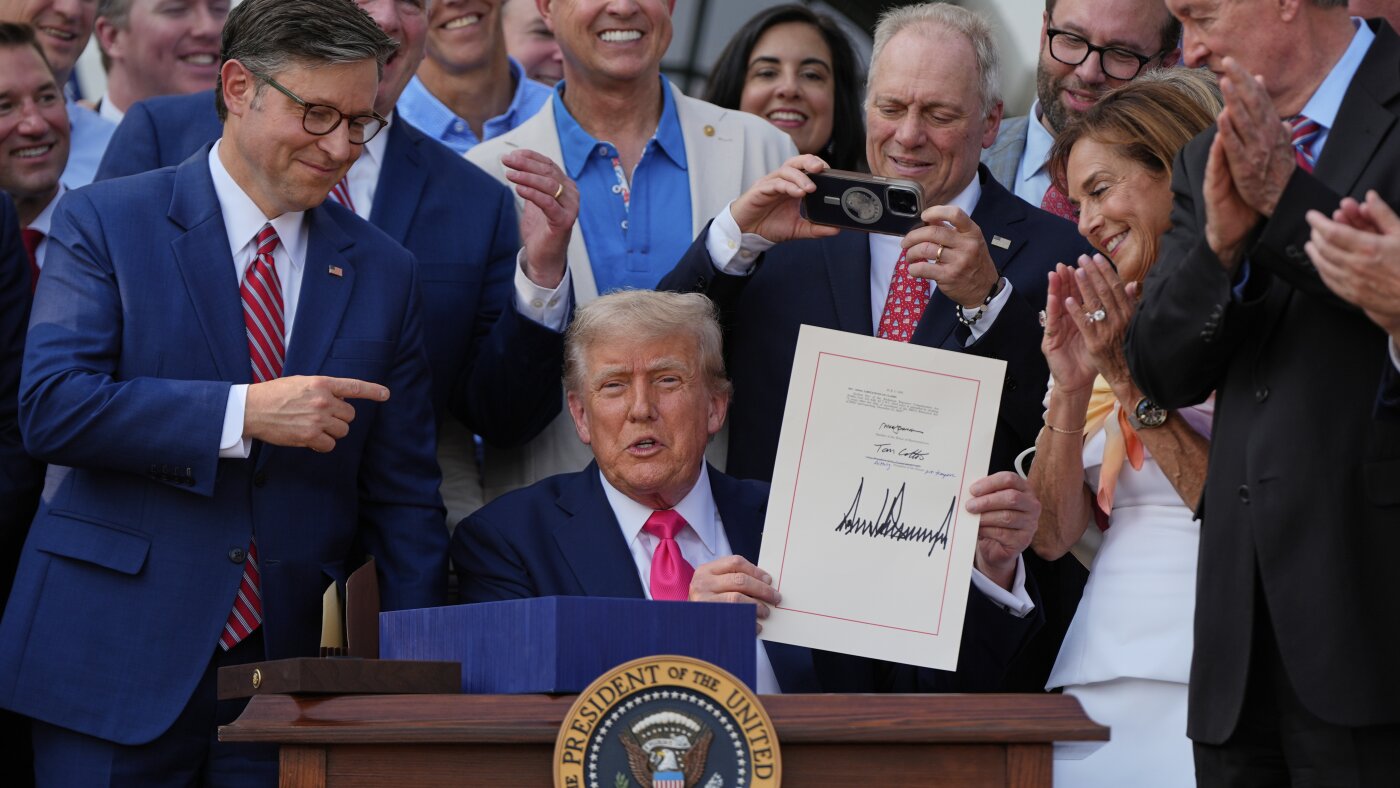
President Donald Trump has leaned into his presidential clemency powers much more aggressively in his second term –in fact, he’s pardoned one woman twice.
Trump granted a slew of pardons on Friday, including one for Adriana Camberos, who was convicted for a second time after Trump commuted her sentence during his first term. The latest pardon was for a 2024 conviction related to a scheme the Justice Department said involved deception in her resale of wholesale groceries and other goods. Camberos’ 2021 pardon centered around unrelated fraud.
While the move falls squarely within presidential clemency powers, it is unusual.
“A president absolutely does have the power to grant the same person two different pardons on two different cases, even if they’re sequential. The pardon power itself is essentially unlimited,” said CNN’s senior legal analyst Elie Honig.
While rare, Jeffrey Crouch, an associate professor at American University, pointed out that Trump, during his first term, “granted a form of clemency twice to the same person.”
There are two forms of clemency available to a president: a pardon and a commutation, both of which only apply to federal charges. A pardon fully erases a federal conviction while a commutation lessens the sentence.
“He commuted Roger Stone’s prison sentence in July 2020 and then granted him a full pardon in December 2020,” Crouch told CNN in an email. “And he commuted current Pardon Czar Alice Marie Johnson’s prison sentence in June 2018 and then granted her a full pardon in August 2020.”
Last year, Trump issued a second pardon to Dan Wilson, a militia member involved in the January 6, 2021, Capitol riot, covering separate firearm offenses that were not included in Trump’s initial sweeping pardon of January 6 rioters. The White House said the gun charges were ultimately related to the January 6 investigation.
More broadly, the acts of clemency for Camberos – pardoned for two unrelated crimes years apart – underscore an emboldened Trump who has escalated his use of clemency, far outpacing his first term and even his most recent predecessors. One year into his second term, Trump has issued roughly 1,609 pardons and clemencies, compared to 148 in four years during his first term.
Setting aside the approximately 1,500 January 6-related pardons, Trump has still granted a stunning 100 times more clemencies than he did at this point in his first term (just one in 2017).
Former President Joe Biden did not issue any pardons or clemency grants during his first year in office. But over the course of his presidency, Biden granted roughly 80 individual pardons, according to the Department of Justice, and granted a record 4,245 commutations, according to Pew Research Center. A large portion of those addressed non-violent drug-related offenses.
Trump has used his pardon power much more liberally than Biden – nearly 21 times as many pardons. Former President Barack Obama granted 212 pardons over his two full terms, according to the Justice Department’s official clemency records. While Obama issued more individual pardons than Trump did during his first term, Trump’s second-term actions, particularly the sweeping pardons tied to January 6, dramatically expand his overall use of the pardon power, surpassing Obama’s.
“It is unusual historically to see pardons granted this early and this frequently in a presidency,” Honig said. “Most presidents tend to wait until the very end of their presidencies, often, often granting the bulk of their pardons on their last day in office. Donald Trump is just granting pardons on a rolling basis.”
Doing so “might be actually a credit to him because it shows that he’s willing to take on whatever political consequences come with it,” Honig added. “You know, it’s always been seen as a little bit of a sneaking-out-the-door type phenomenon to drop your pardons on the last day.”
One of the key officials leading the way for Trump has felt the firsthand impact of the president’s clemency. Trump named Alice Marie Johnson as White House pardon czar – a first-of-its-kind role – in February.
Johnson, a first-time nonviolent drug offender, served 21 years of a life sentence after she was convicted on drug-related charges. Trump commuted her sentence in 2018 and in 2020 granted her a full pardon. Johnson emerged as a top criminal justice reform advocate, and became close with the president’s daughter and former adviser, Ivanka Trump.
“You’ve been an inspiration to people and we’re going to be listening to your recommendation on pardons,” Trump told Johnson at a Black History Month event at the White House announcing her appointment.
He continued: “You’re going to find people just like you. … You’re going to look and you’re going to make recommendations, and I’ll follow those recommendations, ok, for pardons.”
January 6 rioters, political allies and donors
Guided by Johnson in close coordination with the Department of Justice and White House counsel’s office, Trump’s second-term pardons have fallen into a few key categories.
There’s the January 6 pardons, granted on Inauguration Day, and in a category of their own. Trump issued a “full, complete and unconditional pardon” to nearly every person who was convicted of attacking the US Capitol on January 6, 2021, marking the end of a sweeping four-year Justice Department probe. That included Enrique Tarrio, the leader of the far-right Proud Boys, who was convicted of seditious conspiracy and sentenced to 22 years in prison, along with members of other far-right extremist groups like the Oath Keepers and those who violently attacked police officers.
Then there are other actions Trump’s taken to go after what has called injustice and politically-motivated persecutions.
In November, Trump pardoned a long list of political allies who supported or were involved in plans to overturn the 2020 presidential election, including former Trump lawyers Rudy Giuliani, Sidney Powell and former chief of staff Mark Meadows, among dozens of others. It was framed, according to Justice Department pardon attorney Ed Martin, as “(ending) a grave national injustice.”
And the president granted clemency to Mark Bashaw, an officer who formerly served at the Army Public Health Center and was convicted by a special court-martial of violating lawful orders to comply with Covid-19 mitigation measures, per the Army Times.
Then there are the clemency actions that have shown a pattern of rewarding individuals with close ties to financing Trump’s political orbit.
For example, a family member of Julio Herrera Velutini, who received a pardon from Trump on Friday related to misdemeanor charges, has close financial ties to Trump-related political entities. Herrera’s daughter, Isabela Herrera, has donated millions of dollars to the Trump-aligned Super PAC, MAGA Inc., according to campaign finance filings.
There was also a pardon for Trevor Milton, the CEO of now-defunct hydrogen and electric truck firm Nikola, which the president said was in part because he believed Milton was persecuted for supporting Trump’s political ambitions. Milton and his wife notably donated more than $1.8 million to a Trump re-election campaign fund, according to public records.
Some of Trump’s actions have focused on tech and cryptocurrency deregulation. Trump, a former crypto skeptic who did a 180 on the alternative financial assets while running for a second term, has pledged to make the US the “crypto capital of the planet.”
Trump pardoned Binance founder Changpeng Zhao, who pleaded guilty to a money laundering charge in 2023 – a prosecution that press secretary Karoline Leavitt said was part of the Biden administration’s “war on cryptocurrency.” The Trump family has also established direct financial links to Binance through its crypto empire.
He also granted a pardon to Ross William Ulbricht, the founder of the Silk Road dark web marketplace, who had been serving a life sentence on charges related to the e-commerce site that the Justice Department had once described as “the most sophisticated and extensive criminal marketplace on the Internet today.”
And Trump pardoned a trio of founders of cryptocurrency exchange BitMEX: Arthur Hayes, Ben Delo, and Samuel Reed.
There’s also been a pattern of clemencies granted to political leaders and other VIPs.
Trump pardoned the former Illinois Gov. Rod Blagojevich, who was sent to prison on corruption charges surrounding his time in office. Blagojevich appeared on Trump’s reality show, “The Celebrity Apprentice,” in 2010.
Another contestant from that season, baseball legend Darryl Strawberry, received a pardon for a 1995 tax evasion charge.
There was a pardon for the billionaire British investor Joe Lewis, the former owner of Tottenham Hotspur, who had pleaded guilty to conspiracy to commit securities fraud. And clemency for former New York congressman Michael Grimm, who served seven months in prison for tax evasion a decade ago.
In one of his more controversial moves, Trump pardoned former Honduran President Juan Orlando Hernández, who had been convicted on drug trafficking. Trump received bipartisan criticism for the action, which some lawmakers said was at odds with his administration’s efforts to take aim at drug cartels. But Trump cast Hernández’s conviction as a “Biden horrible witch hunt.”
Trump on Friday pardoned former Puerto Rico Gov. Wanda Vázquez, who pleaded guilty to a campaign finance violation last summer. Vázquez, along with two co-defendants whom Trump also pardoned, was facing time behind bars after the Justice Department brought bribery charges connected to the financing of her 2020 campaign.
CNN’s Kevin Liptak and Marshall Cohen contributed to this report.
This story has been updated with additional details.
-
-
-
-

-