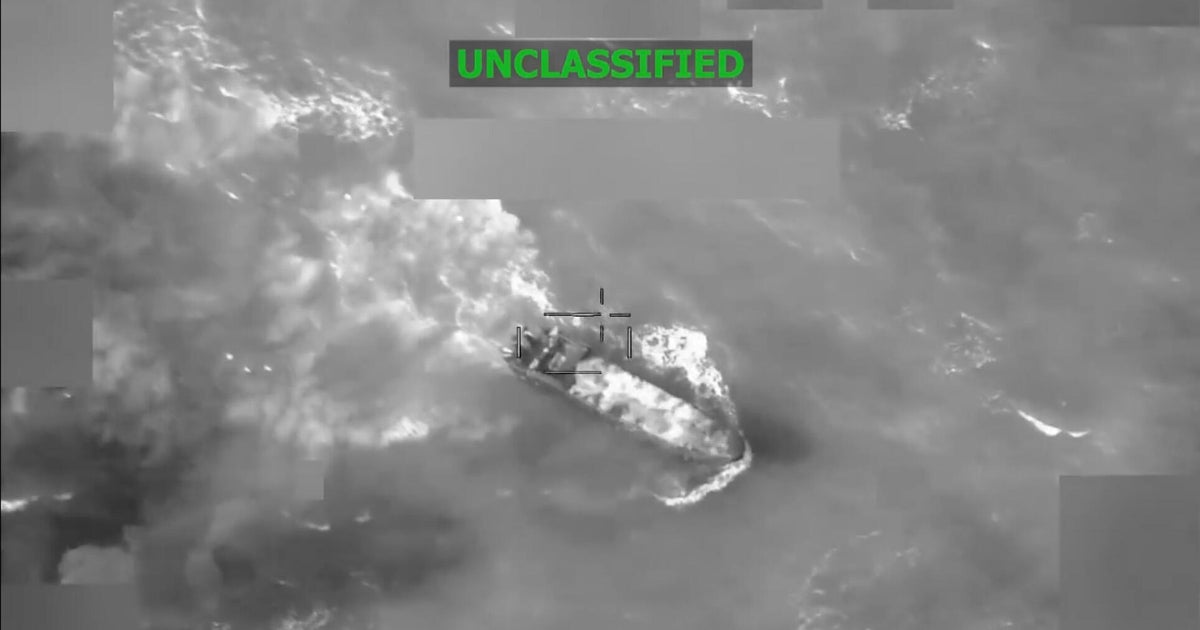
Washington — Scrutiny over the Trump administration’s strikes on alleged drug smuggling boats has intensified following the revelation that the first U.S. attack on such a vessel involved at least two strikes, according to a Washington Post report. It said that after a first strike left two survivors, a subsequent strike killed them. A U.S. official confirms a total of four missiles were used.
The Post also reported that Hegseth gave a verbal order to “kill everybody” in the Sept. 2 strike in the Caribbean Sea, though Hegseth has not confirmed this. He told reporters Tuesday that he did not see survivors in the live video he viewed and was not in the room when Navy Adm. Frank “Mitch” Bradley, the commander overseeing the operation, ordered a second strike. Bradley, according to the report, was complying with Hegseth’s directive as two survivors clung to the wreckage.
White House press secretary Karoline Leavitt on Monday first confirmed a second strike on the boat was directed by Bradley, who, she said, “worked well within his authority and the law … to ensure the boat was destroyed and the threat of narco-terrorists to the United States was completely eliminated.” Hegseth authorized Bradley to conduct the strikes, Leavitt said, though she denied that the defense secretary had given the order to kill them all.
President Trump said Sunday he “wouldn’t have wanted” the second strike and added that Hegseth had told him “he did not order the death of those two men.” Mr. Trump made similar comments on Tuesday, telling reporters that he did not have all the information about the second strike.
Since the first strike on Sept. 2, the U.S. has carried out another 20 attacks through Nov. 15, killing more than 80 people the Trump administration alleges have been trafficking drugs in the Caribbean and eastern Pacific Ocean.
Analysis from The Free Press: Killing Narco Speedboat Survivors is a War Crime
Members of Congress — mostly Democrats — were already raising questions about the legality of the strikes and warned that a continued campaign against alleged drug smugglers in the region could escalate into war with Venezuela. The Post’s report has further fueled debate about whether the U.S. is committing war crimes.
In a notification to Congress in mid-September, the Trump administration said the U.S. is in a “non-international armed conflict” with drug cartels it has designated as terrorist organizations. The drugs smuggled by these cartels kill tens of thousands of Americans each year and constitute an “armed attack” against U.S. citizens, according to the White House.
“We have legal authority. We’re allowed to do that,” Mr. Trump told reporters on Oct. 22. “They killed 300,000 people last year. Drugs, these drugs coming in. They killed 300,000 Americans last year, and that gives you legal authority.”
But the opinion from the Justice Department’s Office of Legal Counsel justifying the strikes remains classified. A group of Senate Democrats asked for an “expeditious declassification” of the legal opinion in a letter last week to Hegseth and Attorney General Pam Bondi.
“Few decisions are more consequential for a democracy than the use of lethal force,” they wrote. “We therefore believe that the declassification and public release of this important document would enhance transparency in the use of deadly force by our nation’s military and is necessary to ensure Congress and the American people are fully informed of the legal justification supporting these strikes.”
Consent from Congress
Legal experts and lawmakers critical of the strikes have argued that the military action targeting the suspected drug smuggling boats was already legally dubious before the recent revelations because the president lacked the authority to carry them out.
Under the War Powers Resolution of 1973, the president is required to consult Congress “in every possible instance” before introducing armed forces into hostilities, unless there has been a declaration of war or other congressional authorization.
In emergency situations, the administration must report to Congress within 48 hours and cease hostilities within 60 days, absent congressional authorization. The 60-day deadline expired a month ago.
The law was enacted in response to the Vietnam War as a check on the president’s power to wage war without the consent of Congress.
When asked in early November whether the administration planned to seek congressional authorization, a senior administration official replied that the 1973 resolution “has been understood to apply to placing U.S. servicemembers in harm’s way.”
The official suggested that the attacks pose no threat to service members, since the strikes have been largely carried out by drones launched from naval vessels “at distances too far away for the crews of the targeted vessels to endanger American personnel.” The official added that the administration does not consider the strikes against the alleged drug traffickers as “hostilities.”
Congress has not authorized the use of military force against Venezuela. Republicans have largely asserted that the president is acting under his Article II constitutional authority, and Senate Republicans have twice blocked bipartisan efforts aimed at preventing Mr. Trump from continuing military action in the region without congressional approval.
But the new details about the Sept. 2 strike appear to have shifted some opinions. The Republican-led Senate and House Armed Services committees have opened bipartisan investigations into the circumstances of the first attack.
“Nothing magic about calling something a terrorist organization,” says former military prosecutor
The Trump administration’s claim of a “non-international armed conflict” is also flawed, experts say, because drug cartels are not considered organized armed groups under the law of armed conflict.
“There is no international armed conflict because, inter alia, there are neither hostilities between States nor the requisite degree of State control over alleged drug cartels operating the boats. And there is no non-international armed conflict, both because the cartels concerned do not qualify as organized armed groups in the [law of armed conflict] sense, and because there were no hostilities between the United States and the cartels on Sept. 2, let alone hostilities that would reach the requisite level of intensity to cross the armed conflict threshold,” legal experts Michael Schmitt, Ryan Goodman and Tess Bridgeman wrote in a Dec. 1 piece published by Just Security.
Designating drug cartels as terrorist organizations also does not give the administration authority to use military force in the way that it has, said Brian Finucane, a senior adviser with the International Crisis Group and a former State Department lawyer.
“They don’t have military hierarchies, don’t have the capability to engage in combat operations, and so it’s absurd to claim that the U.S. is somehow in an armed conflict with them,” Finucane said.
Victor Hansen, a former military prosecutor and law professor at New England Law Boston, said drug cartels would still be subject to civilian law even with the terrorist group designation.
“There’s nothing magic about calling something a terrorist organization that then gives the president the authority to respond militarily,” Hansen said.
Trump “wants it both ways,” expert says
The Trump administration’s characterization of the strikes as an “armed conflict” imposes additional duties and responsibilities on how the strikes are carried out, according to Hansen.
If the strikes have not already crossed a legal line, it’s possible the alleged intentional killing of defenseless survivors may have.
The Geneva Conventions, which are the core of the law of armed conflict, prohibit targeting civilians or members of the armed forces who are defenseless. The international treaties, which were adopted in 1949, also require the wounded to be “collected and cared for.”
The Defense Department’s Law of War Manual says, “it is also prohibited to conduct hostilities on the basis that there shall be no survivors, or to threaten the adversary with the denial of quarter.” The rule applies “during non-international armed conflict.”
“The president, he wants it both ways. He wants to call it an armed conflict, but then he doesn’t even want to follow the rules of the armed conflict,” Hansen said.
Still, a change in protocol was implemented after the Sept. 2 strike to emphasize rescuing any survivors, the Post reported.
Two men who survived a strike in the Caribbean on Oct. 16 were rescued by the U.S. Navy and repatriated to their countries of origin — Ecuador and Colombia. The strikes on Oct. 27 in the Pacific left one survivor, and Mexico led the search effort, but it suspended its search after four days, according to media reports.
The second strike and what laws may have been broken
There’s growing debate about whether the follow-up strike that allegedly killed two survivors is a war crime.
Congressional Democrats have said that if the reporting is accurate, the action does constitute a war crime. Republican Rep. Mike Turner of Ohio, a member of the House Armed Services Committee, told “Face the Nation” on Sunday that it would be “an illegal act” that is “completely outside of anything that has been discussed with Congress.”
“I think there’s a broad consensus that it’s illegal to kill people who are clinging to wreckage,” GOP Sen. Rand Paul of Kentucky told reporters Tuesday.
Lawmakers and military experts say that the next question is what laws may have been broken, and that largely depends on the laws governing the strikes.
“If we’re not in an armed conflict to begin with, then the whole paradigm, the legal paradigm of the laws that govern an armed conflict, don’t apply,” Hansen said. “So what does apply? Well, domestic law. Then, it’s murder under domestic law because you can’t kill somebody — even if you think they’re a criminal — without adjudication.”
“Arguably, no order to kill them is legal,” Hansen added. “Because under domestic law, we don’t kill people without bringing them to trial and giving them due process.”
Finucane also believes the strikes would fall under domestic military law.
“Murder on the high seas is implicated, conspiracy to commit murder outside of the United States, then murder is also an offense under the Uniform Code of Military Justice,” he said.
If the operation is an armed conflict, as the Trump administration suggests, the actions could constitute a war crime.
“Orders to ‘kill everybody,’ which can reasonably be regarded as an order to give ‘no quarter,’ and to ‘double-tap’ a target in order to kill survivors, are clearly illegal under international law,” a group of former military lawyers outlined in an assessment Saturday. “In short, they are war crimes.”
Former Defense Secretary Leon Panetta called the second strike a war crime in a CBS News interview on Monday.
“The basic rules of war that are involved here make very clear that you do not strike wounded people in the water in order to kill them. You basically then are responsible to try to make sure you do everything to try to protect their lives at that point. And that is the concern right now, whether or not this really violated the rules of war and constituted a criminal act.”
In a Cabinet meeting on Tuesday, Hegseth said the U.S. has “only just begun striking narco-boats and putting narco-terrorists at the bottom of the ocean.” He noted a recent pause in strikes, explaining that “it’s hard to find boats to strike right now.”
“Deterrence has to matter,” he said. “Not arrest and hand over and then do it again, the rinse-and-repeat approach of previous administrations.”
Source link
-

-

-

-

-