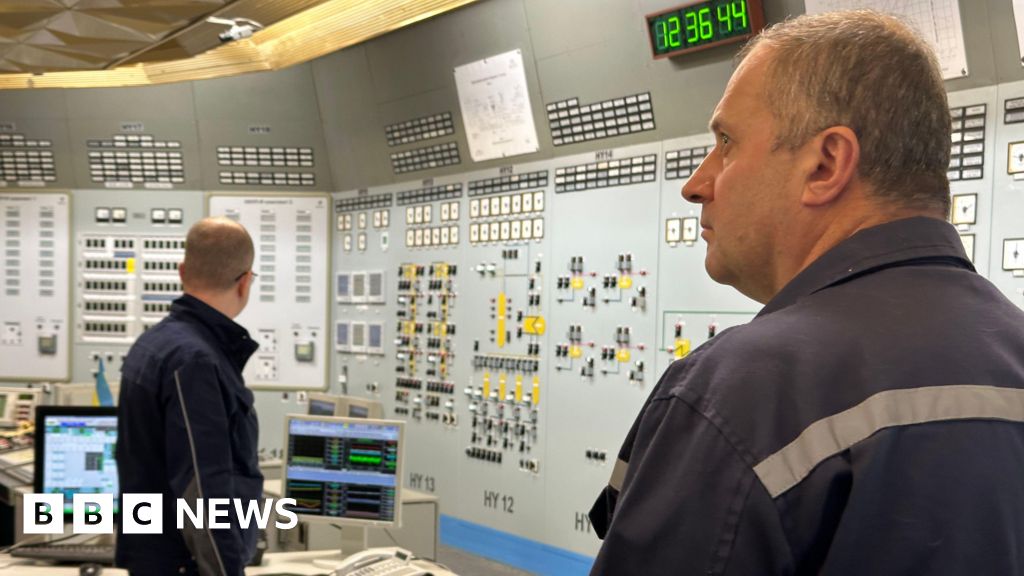
Wrye DaviesKhmelnytsky nuclear plant, western Ukraine

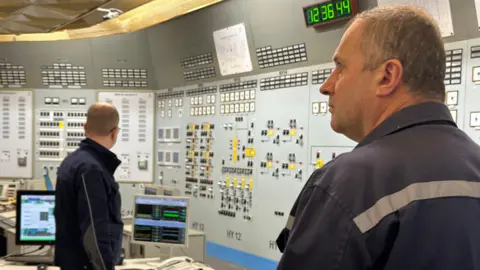
A handful of technicians closely monitor a wall of screens and dial in the control room at the Khmelnytsky nuclear plant – a vast facility in western Ukraine that’s now vital to Ukraine’s energy grid and its war effort.
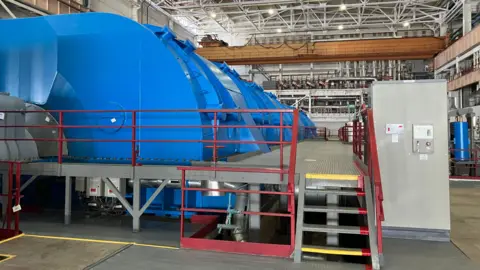
Ukraine is facing an acute energy crisis after months of relentless Russian attacks on its infrastructure. At least 60% of the country’s electricity comes from the giant turbine halls at Khmelnytskyi and two other nuclear plants.
Showing me around is Pavlo Kovtonyuk, the head of Energoatom – Ukraine’s National Nuclear Energy Company. All these installations, he says, are under the very real threat of attack from Russia.
“At present, Russia is trying to attack substations that connect nuclear power plants to the grid, to shut down nuclear energy,” he tells me.
“This is nuclear terrorism, because the connection between the systems and the nuclear power plant is what ensures their safe and reliable operation.”
Nuclear power stations are secure and sensitive installations where access to those not directly involved in their operation is heavily restricted. The BBC was given rare access to the plant to see how Ukraine is coping with Russia’s intense attacks.
Under nightly attack from hundreds of missiles and drones, Ukraine accuses Russia of targeting its critical energy infrastructure. President Volodymyr Zelensky says Moscow is deliberately exploiting the ferociously cold winter, leaving tens of thousands of people across Ukraine without power, heating or running water.
Most of the country’s conventional power plants have been hit or damaged in Russian airstrikes and that is why nuclear power plants like Khmelnytskyi are now providing most of the country’s energy needs.
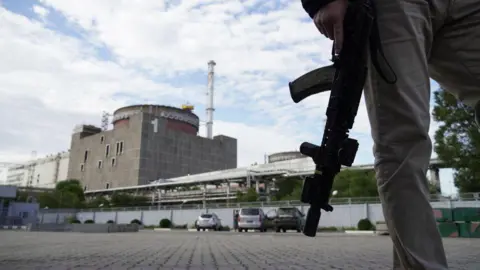
But Ukraine’s biggest power plant, on the southern stretch of the Dnipro River near Zaporizhzhia, has been controlled by Russia since the start of the war.
Not only is it the biggest in Ukraine, it is also the largest nuclear power station in Europe, able to generate enough electricity to supply a country the size of Portugal. But Zaporizhzhia is now in “dormant” mode, not generating electricity and with Russian technicians and troops in charge of the plant.
That’s why the future of the Zaporizhzhia site is one of the most critical points of any possible future peace deal between Ukraine and Russia. Recent reports suggest Ukraine wants to control the plant 50/50 with the US, with half the energy coming to them and the other half distributed by the US as it sees fit – perhaps even to Russia.
On our tour of the Khmelnytskyi complex we met some staff, now employed here, who were working at Zaporizhzhia when Russia attacked on the night of 3 March 2022. Among them were Dariia Zhurba, a technician at the plant, and her engineer husband, Ihor.
“It was scary. It was really frightening when they occupied. We were at home that night,” Dariia told me.




“We heard explosions, shooting… so we hid in our corridor, as the gunfire and explosions continued,” said her husband. “In the morning, we realised we were occupied.”
The couple continued to work at the plant for a few weeks until things became “unbearable”, as the Russians gradually took control of the operation.
They were eventually able to leave, via occupied Ukraine, Russia, Belarus and Poland on a journey where everything they had, including their phones and possessions, were first of all scrutinised by their Russian captors.
“They checked everything in our phones, connected them to special devices so they could search our contacts, all social media, even the things we’d ‘liked’,” said Dariia, now happy to be living in a small modular home provided by the Swedish government next to her new workplace.
“They even interrogated us about who are relatives were, who had served in the Ukrainian army and who didn’t.”
They escaped Zaporizhzhia. Others, less fortunate, did not.
“We know cases where people were taken to the ‘basement’ where they were interrogated and things like that,” says Ihor.
“Basement” is often a reference to where people in the occupied territories were tortured.
“There were also cases when other people were taken and then went missing,” Ihor told me with a shrug of his shoulders. “I knew some of them – not close friends, but we worked at the same station.”
We’ve also been in touch with Ukrainian workers, still working at the Zaporizhzhia plant under Russian direction and control.
Speaking over encrypted social media they paint a picture of a chaotic environment where “maintenance work on the equipment is practically not happening”. Russian soldiers are present and military equipment is also being stored at the Zaporizhzhia complex, said our sources.
Of most concern to plant workers, Energoatom managers and – ultimately – the wider world, is what happens if, as Moscow insists, the Zaporizhzhia nuclear plant remains under Russian control in the event of a ceasefire agreement.
Although the plant is not currently operational, its nuclear reactors still need to be maintained and cooled to prevent overheating and radiation levels rising.
However, electrical substations that provide power to the plant, to help with cooling, have been damaged by the war. Also, Energoatom officials say, ponds that supply water for the cooling process have sometimes been allowed to run dangerously low by the Russians.
Furthermore, four of Zaporizhzhia’s energy blocks use American-made fuel systems – a transition begun by Ukraine in previous years. Yet Russian technicians are not trained nor would they able to operate those systems in the event of the plant being restarted, say Ukrainian officials.
The head of Russia’s Rosatom nuclear agency, Alexei Likhachev, insists Russia is maintaining the plant, adding that under Russia law no other operator is entitled to run it: “It is currently ensuring the plant’s safe operation under the most difficult combat conditions.”
It is important to point out that officials from the International Atomic Energy Agency (IAEA) do, on occasion, cross into Russian-occupied territory to inspect the Zaporizhzhia plant. Under the protection of temporary ceasefires, the IAEA says it also supervises repair work to damaged power lines and the maintenance of critical cooling systems.
In a statement released last week, the IAEA said it had sent a team from Vienna to the site to check on the latest repair works.
“A deterioration of Ukraine’s power grid from persistent military activity has direct implications on the nuclear safety of its nuclear facilities,” said Director General Rafael Grossi in the statement. “The IAEA will, as a priority, continue to assess the functionality of these critical substations.”
Ukrainian officials, though, say Russia is dangerously neglecting the site and say a repeat of the Chernobyl nuclear disaster is a real threat.
On 26 April 1986 a reactor at the Chernobyl nuclear plant in northern Ukraine exploded after a test went wrong. The disaster spread nuclear contaminants across Europe, and authorities have since built a giant dome to try to contain radioactive materials there.
“In my view, it could be much worse than Chernobyl, because at Chernobyl there was an explosion of a single reactor unit with fuel,” says Energoatom director Pavlo Kovtonyuk.
The director is measured in his words because it a frightening prospect, adding “If Russia brings the situation to the point of core melting and melting of fuel in the spent fuel pools, the contamination could be greater [than Chernobyl].”
“It would not be explosive, and it could be stretched out over time, but the contamination could be greater!”
It is a sobering thought on which to end our visit to Khmelnytskyi and it is obvious to see why the immediate and long-term future of the Zaporizhzhia nuclear complex is such a contentious issue.
There is evidence that Russia has already begun to build power lines away from Zaporizhzhia in the direction of occupied territories and Russia itself, in the event of the plant being restarted to generate electricity, under Moscow’s control.
That simply cannot be allowed to happen, say Ukrainian leaders and nuclear officials.
Not only is Ukraine’s own energy matrix and needs dependent on the Zaporizhzhia plant, but a nuclear accident along the lines predicted by some experts would have implications and repercussions far beyond these borders.
Additional reporting by Firle Davies and Anastasia Levchenko.
Source link
-

-

-

-

-