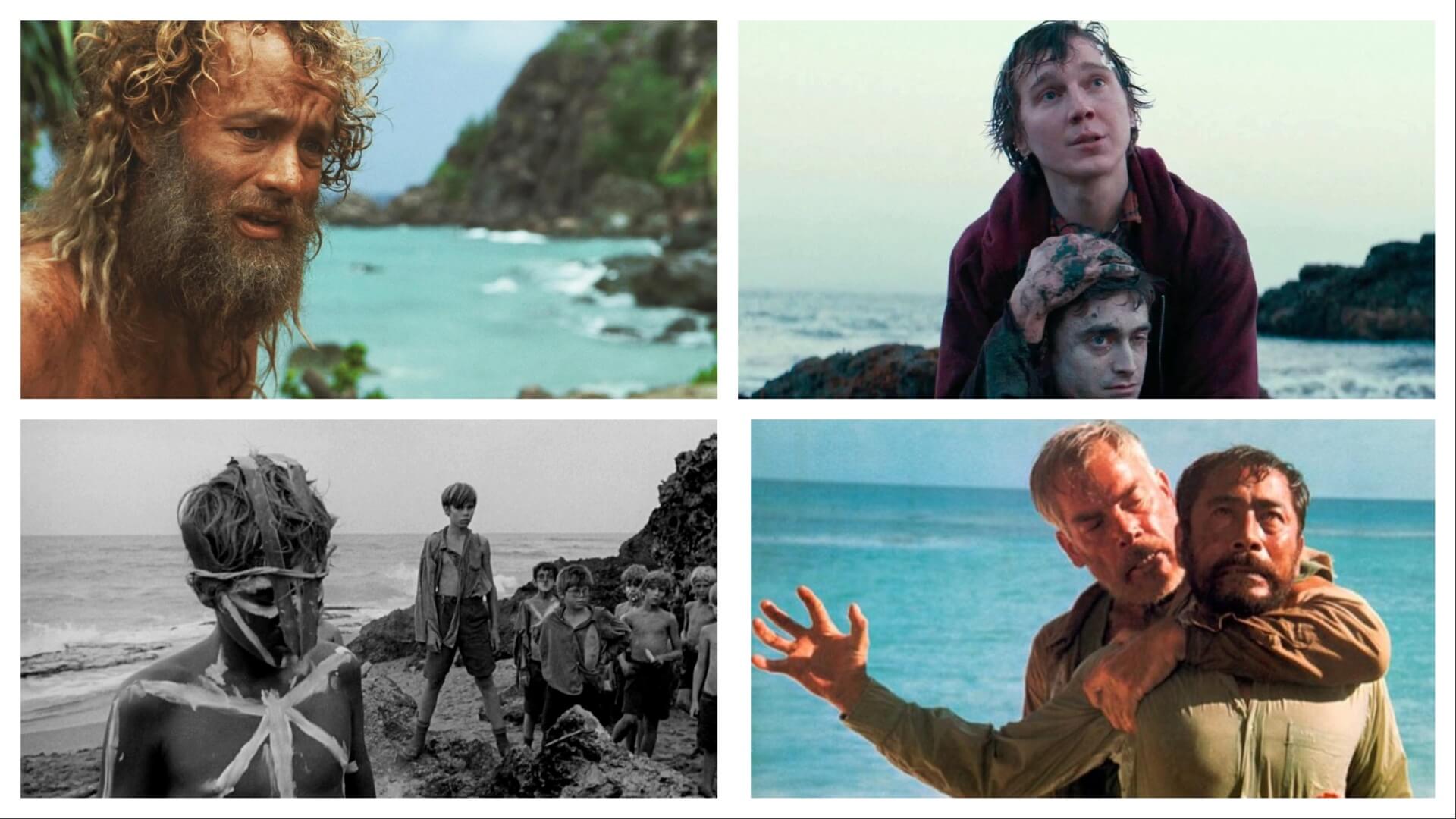
One of the only things that hasn’t changed in the last century of cinema is film’s fascination with being marooned on a deserted island. The last five years alone have seen the release of Triangle Of Sadness, Eden, and this month’s Send Help, but the tradition goes back to the silent era, which saw the earliest adaptations of Robinson Crusoe and The Swiss Family Robinson. Despite the vast transformations in technology and culture since then, the basic beats of desert island movies have remained the same. There’s the dramatic arrival on the island. The search for food, water, and shelter. If enough people have been marooned, the building of something like a society. Often, the descent into lunacy, spurred by thirst, hunger, isolation, and/or existential despair. Finally, if they’re lucky, rescue.
But within this classic framework, filmmakers have been able to find surprising variety in both tone and substance, using the same setting to plumb the depths of the human condition. Using desert island movies from across the last century, we’ve constructed a comprehensive guide to cinematic island life.
Arrival
The most common cause of arrival on desert islands, by far, is shipwreck. In 1932’s The Most Dangerous Game, the nefarious Count Zaroff (Leslie Banks) uses poorly placed landing lights to crash the boats of Bob (Joel McCrea) and Eve (Fay Wray) so he can hunt them for sport. More frequently, there’s a simple malfunction, which means that the only option for survival is to leap into a lifeboat and hope for the best.
Often these wrecks have already happened before the film has started, and we join our castaways floating at sea, or even already on the island. Other movies take their chance on a big action set piece—the otherwise unremarkable 1957 film Sea Wife has Titanic-level aspirations, and that same year’s The Admirable Crichton finds a good balance between satire and drama for its pivotal sequence. (And while it’s not technically the scene that wrecks the ship, the vomit-drenched storm is certainly memorable in Triangle Of Sadness.) If the shipwrecked are lucky, the sinking ship may run aground and prove a vital source for supplies.
The next most frequent creator of castaways is the plane crash. 1970’s Lost Flight was originally filmed as a pilot for a proto-Lost: After a passenger plane crashes near a deserted island, the disparate survivors, led by a stubbornly charismatic Lloyd Bridges, have to make the best of it. Although the series was never picked up, its TV-scale budget still paid for a joltingly impressive crash sequence.
Harrison Ford’s Quinn crashes his small plane in Six Days, Seven Nights, stranding himself and passenger/love interest Robin (Anne Heche). The opening credits in the 1963 Lord Of The Flies shows its plane crash in a succession of still images. In SOS Pacific, the poor passengers survive a plane crash, only to discover that the island they’ve crashed on is about to be blown up by an atom bomb. When it comes down to the plane crash sequences themselves, however, there is no superior to Cast Away, which hurls Chuck (Tom Hanks) onto his island in an unforgettably visceral and harrowing sequence. As far as unique and memorable crashes go, points to Mysterious Island; when almost everyone gets stranded via a shipwreck or a downed plane, the whimsicality of a hot air balloon crash sure does stand out.
Supplies
Some castaways have it easy. In both the 1940 and 1960 adaptations of The Swiss Family Robinson, the family is shipwrecked while en route to start a new life in New Guinea. As such, all their worldly positions are aboard the ship, which has the decency to a) run aground within a swimmable distance and b) not sink until the Robinsons have been able to retrieve everything they could ever want. These guys have everything. Beds! Gold! A piano! No wonder it doesn’t take them long to build one of the best treehouses the movies have ever seen.
Still lucky, but in a decidedly different way, is the shipwrecked Hank (Paul Dano) in Swiss Army Man. He’s lost all hope and is about to hang himself when the rotted corpse of Manny (Daniel Radcliffe) washes up on shore. That doesn’t seem like a blessing, until it’s revealed that Manny can vomit fresh water and, via the propulsive power of his farts, function as a jet ski. For a corpse, he also happens to be a decent conversationalist.
Taking things down a notch is Cast Away. A FedEx worker, Chuck was on a work trip when his plane went down, and packages slowly wash up on the beach over his first few days on the island. Despite initially hoping to deliver them, eventually desperation pushes him to tear all but one open. Inside, he finds a divorce certificate, a flashlight, video tapes, a dress, ice skates, and a volleyball. For such an eclectic collection, he’s able to make use of almost everything—most of all the volleyball.
So what’s on the menu? Wild pigs often run rampant throughout these islands, and film castaways don’t typically take very long to start becoming spear-fishing experts. Coconuts, bananas, and various other fruits are usually abundant (though as the young pair in The Blue Lagoon learn, they aren’t all edible), and giant turtles are also a common cuisine. Less common: In Six Days, Seven Nights, the lead pair chow down on peacock.
If there are other groups around, stealing their supplies is also a possibility. A tense sequence in the WWII-set Heaven Knows, Mr. Allison sees Robert Mitchum’s GI raid the stores of the occupying Japanese army. In Eden, the decision to steal from a family’s stock of canned goods sets in motion a dramatic chain of events that ends in murder. It’s a lot less risky to rely on your own supply. If you’re there long enough, like 1954’s Robinson Crusoe, you could even bake bread in a handmade oven!
(Re)building society
While not a concern of some desert island movies, if enough people are stranded together, inevitably they start to replicate—or pervert—the societal structures of the mainland. Even in Battle Royale, which takes place over just three days, the kids kidnapped from their school bus and forced to kill each other start to branch off into factions.
A more classical example of island society-building is The Admirable Crichton, based on a play by Peter Pan author J.M Barrie. A Lord (Cecil Parker) is shipwrecked along with his daughters, their suitors, a maid (Diane Cilento), and a butler, Crichton (Kenneth More). Because Crichton is the only one who actually knows how to do anything practical, he ends up becoming the group’s leader—and, after a two-year time jump, king. Then a boat goes by, and the gang are returned to Britain, where their past class positions are restored. Though unhappy, Crichton handles his unjust demotion with grace.
Such magnanimity is not to be found in Triangle Of Sadness, which tells a similar story of class upheaval. Yaya (Charlbi Dean), Carl (Harris Dickinson), and other monied passengers of a fancy yacht are marooned after it’s attacked by pirates. The sole castaway with any survival skills is Abigail (Dolly de Leon), the yacht’s “toilet manager.” She keeps them all fed, but in return reigns over them like a benevolent despot, even eliciting sexual favors from Carl in return for extra resources. In the final minutes of the film, she and Yaya go on a hike, and discover there’s been a luxury resort on the island the whole time. When we last see them, Abigail is holding a giant rock above Yaya’s head, so desperate to maintain her newfound power. Even more brutal are the schoolboys in Lord Of The Flies. They quickly assign a leader in an admirably democratic way, but after that, all bets are off, and the boys become feral—branching off and turning violent as the internecine feuds start to accrue a body count.
Despite their fair share of drama, things go better for the more community-inclined castaways of Lost Flight—though one must feel sorry for the sole survivor with any medical knowledge, who’s only a student doctor. He has to save a child with a rupturing appendix and a woman who’d been chased off a cliff, deliver a baby, and patch up a gunshot wound. Who knows what else he’d have had to face if that failed pilot had gone to series?
In Eden (which is based on real events), the island inhabitants are not actually castaways. They’ve arrived intentionally, drawn by the allure of Dr. Friedrich Ritter’s (Jude Law) anti-bourgeois philosophy. The problem is, he had no desire to start a colony, and so he immediately begins trying to sabotage the new lives of his eager acolytes. And things get messier still when The Baroness (Ana de Armas) shows up, along with her male harem. While there’s plenty of space on their island, the mounting chaos soon becomes claustrophobic as the islanders start killing each other off.
The leads in the 1960 Japanese film The Naked Island aren’t castaways either, but a family who have chosen to live and farm on a deserted island a small boat journey from the nearest town. There, they make multiple strenuous trips a day transporting fresh water, as well as taking their oldest son to and from school. The family is a closed unit, with only the slightest to do with the rest of society. Yet when their son dies, his class and his teachers make the journey to their island for the funeral ceremony. Where the stubborn persistence of community in the harshest and most tragic of circumstances is a threat in most of these films, here it’s deeply moving.
Isolation
The traumatic experience of being one of the few survivors of a plane crash or a shipwreck would be enough to send anyone over the edge. But when the initial emergency has passed, and the reality of isolation (and dehydration, and starvation) has kicked in, few remain lucid. Cast Away is a prime example, as Chuck’s dwindling sanity results in him developing a famously close bond with a volleyball.
More classical still are the various adaptations of Robinson Crusoe, which all (with the exception of the cheery 1953 gender-flipped version) pivot to some degree around Crusoe’s lack of sanity. Man Friday, where the tale is told from the perspective of Crusoe’s rescuee/friend/servant/captive Friday, is perhaps the best illustration. As played by Richard Roundtree just two years after making the last of the original Shaft trilogy, Friday is the epitome of smart, sunny cool—and Peter O’Toole’s Crusoe could not be further from it. Although sometimes it seems the two are on the brink of forming a genuine friendship (including in a delightfully strange musical sequence where they invent hang-gliding), Crusoe’s deranged inability to see Friday as a true equal leads to his own demise.
A stronger bond is formed in Hell In The Pacific, though it takes quite some time. Lee Marvin and Toshiro Mifune play an American and a Japanese soldier, stranded together on an island during the peak of WWII. In the largely dialogue-free first half, the two circle each other warily, stealing resources, growing increasingly paranoid and weak from thirst and hunger. Eventually, they become friends, and the film argues that war is the true lunacy.
A particularly uncomfortable example of sanity loss is found in The Savage Is Loose. John (George C. Scott) and Maida (Trish Van de Vere) have been marooned on an island with their son (John David Carson) since he was a baby. As he grows, he develops an unhealthy attraction to his mother, the only woman he has ever known. Scott took out a full page newspaper ad offering to reimburse the ticket price of anyone who didn’t enjoy his sophomore directorial effort, and indeed, the sensational subject matter is mostly treated with surprising sensitivity. Mostly.
Another twist awaits on Sweetheart‘s island. Jen (Kiersey Clemons) at first thinks she’s the sole survivor from her group on the island, and proves formidable when it comes to both feeding and sheltering herself—and staving off the sea monster that comes aground every night to pillage for food. Her boyfriend (Emory Cohen) and another woman (Hanna Mangan-Lawrence) wash up later, and when she tells them about the monster, they think she’s gone mad from the days in isolation. Guess who gets eaten soon after?
Then there’s the Doctor Moreau subgenre, where heroes stumble onto the island home of a mad scientist. In three different tellings of the H.G. Wells story, Charles Laughton, Burt Lancaster, and Marlon Brando play a eugenicist who’s dedicated his life to melding animals and humans. These kinds of films run the gamut from skin-crawlingly creepy to nonsensically deranged. But that’s nothing compared to Attack Of The Crab Monsters. Research scientists studying the effects of nuclear fallout on an island’s creatures are killed one by one by, well, crab monsters. Then their brains are subsumed into the creatures, eventually resulting in one enormous crab with a human consciousness that looks like this, and says things like, “You have wounded me, so I must grow a new claw!” It’s B-movie legend Roger Corman at his best.
Rescue
In some instances, castaways manage to save themselves. Quinn and Robin rebuild their plane in Six Days, Seven Nights, thanks to an enormous deus ex machina: the discovery of a different plane wreck that happens to have the parts they need. Swiss Army Man’s flatulent corpse, meanwhile, is able to propel Hank to the mainland.
For the most part though, castaways are buffeted by the turbulent tides of fate. They washed up on the island, so they know it’s possible for others to do the same. A boat will come, all they have to do is wait—and make sure they have a huge signal fire ready to light for when the time comes. Sometimes, this works. Some adults arrive to stop the madness in Lord Of The Flies, after two of the boys have already died. Deborah Kerr and Robert Mitchum are picked up by the marines at the end of Heaven Knows, Mr. Allison. Boats arrive for Robinson Crusoe in both the 1954 and 1997 movies; in the first he’s been waiting for 28 years, and in the second, only six. The castaways are picked up in The Admirable Crichton and Swept Away, although by that point they’d become rather fond of island life.
Usually, however, they aren’t lucky enough to have a rescue boat float right past. Often, they have to build a raft, and fling themselves into the open ocean, with the meager hope of making it either to the mainland or a bigger boat. On occasion, as with Cast Away, the raft will float by a vessel in the nick of time. But it’s not a guarantee, as the young couple in Blue Lagoon discovers. In Hell In The Pacific, the two soldiers reach a bigger, more resource-rich island, yet their fate remains ambiguous. Jen defeats the monster in Sweetheart, but she’s still stuck. In the desert island movie, neither a happy ending—or any ending at all—is guaranteed.
Lessons from the islands
The way desert island movies underline the fundamental helplessness of human beings is what has made them so perversely and perennially intriguing. Although the premise is a trope, there’s still something refreshing about how it strips us down to our bare natures: creatures who need food, water, and shelter, and then who must wait and see what the universe has in store. That waiting would be dead air in most films, but in desert island movies, it’s often the meat of the story. With no distractions, what would life look like?
While the idea of calm blue seas, sandy beaches, and a retreat from the real world seems like it should be an attractive one, few of these films make being a castaway look particularly aspirational. A handful of islanders are content to stay put as the credits roll, but their number is dwarfed by those who risk their lives for a slight chance of making it back to civilization.
There’s also a nihilism to the way these uninhabited islands become blank slates upon which civilization can start again; an acknowledgment that something’s gone wrong along the way, and we’re in need of a do-over. In the bleakest of cases, the Lords Of The Flies and the Edens, the castaways rapidly shine a dire light on humanity. But even in the less extreme examples, these movies reveal a social pessimism. The detente between the American and Japanese soldiers doesn’t hold in Hell In The Pacific. The class system reasserts itself in The Admirable Crichton. Crusoe just can’t manage to see Friday as an equal in Man Friday.
Yet there’s a more generous reading of what these films tell us about ourselves: People need people. Although after years on the island, Chuck has become a survival expert in Cast Away, with no one to talk to but Wilson, he doesn’t think his life isn’t worth living. In the 1949 Blue Lagoon and both The Swiss Family Robinsons, despite enviable set-ups, sons are set back into the world to give future generations the chance of a more fulfilling life. You can make the best of a desert island, perhaps even for years, but the siren song of the mainland is hard to resist.
It’s these factors that have made desert island movies a consistent cinematic presence despite shifting social tides—they let us live out our self-sufficient dreams of getting away from it all, while ultimately making our home lives look pretty appealing.
Source link
-

-

-

-

-