
Few Utahns have witnessed the effects of withdrawing transgender kids’ access to care as Collin Kuhn, a clinical child and adolescent psychologist who specializes in helping their clients navigate challenges and questions related to gender.
The difference between receiving care and not receiving care, they said, is “night and day.”
“All of a sudden, socially, their world opens up,” Kuhn said of transgender clients after they start hormone therapy — treatment that, Kuhn added, doesn’t start until the client has met with them or another mental health professional for a year or longer. “They’re not just isolating and sitting in their rooms behind a screen.”
Kuhn, who has traversed their own yearslong journey of coming out as nonbinary and transmasculine, then receiving care they described as lifesaving to transition to a body they feel comfortable in, said they have about five dozen clients, most of whom are in their teens or early twenties.
But in 2023, Utah lawmakers passed what they referred to as a “moratorium” on gender-affirming care for transgender youth, then-state Sen. Mike Kennedy’s SB16. The bill’s GOP proponents, at the time, repeatedly insisted they were concerned for minors’ health and safety. So as part of the law, the Legislature commissioned an in-depth review of all research into the effects of hormone treatments.
Kennedy, a physician who is now a congressman, did not respond to a request for comment on the evidence review’s findings and its reception among lawmakers.
(Bethany Baker | The Salt Lake Tribune) Dr. Collin Kuhn, a therapist who works with transgender kids, sits in her office in Salt Lake City on Monday, Dec. 8, 2025.
As the Republican supermajority now moves toward permanently banning such care in Utah, lawmakers continue to sidestep public dialogue about the results of that research — which concluded that gender-affirming care for minors with gender dysphoria is largely found to result in positive outcomes and reduce the likelihood of suicide.
Records obtained by The Salt Lake Tribune indicate legislative staff aiding the Health and Human Services Interim Committee initially planned on lawmakers discussing the review’s findings after the report’s delivery last May.
In a statement to The Tribune, a spokesperson for House Speaker Mike Schultz, R-Hooper, said, “Speaker Schultz has been clear in his view that minors should not be subject to irreversible medical decisions.”
“Kids should not be transitioning. Period. End of story. Minors should not be transitioning. Period. End of story,” Schultz told Deseret news earlier this month.
A spokesperson for Senate President Stuart Adams, R-Layton, declined to comment and pointed to remarks Adams made while speaking with reporters on the first day of the session, in which he said senators will weigh the House proposal to permanently ban care when it arrives in their chamber.
The move to push for a permanent ban coincides with repeated efforts by President Donald Trump’s administration to completely cut off transgender youth’s access to gender-affirming care. Most recently, Health Secretary Robert F. Kennedy Jr. threatened to withhold federal funds from health facilities that provide gender-affirming care to minors.
Over the course of its six public hearings held across several months last year, the chairs of the Health and Human Services Committee never included a presentation or discussion of the Legislature-ordered report in an agenda. Links to the University of Utah’s Drug Regimen Review Center’s work and a subsequent report offering recommendations for possible policy changes by the state’s Department of Health and Human Services were instead tucked into a May meeting outline.
There was no explicit reference to the documents in the May 21 hearing — two days after the research was delivered to legislators — only comments from a policy analyst notifying the public that reports legally required to be submitted to the Legislature are posted on the committee’s website. Lawmakers did not publicly acknowledge the documents until The Tribune reported on them the next day.
A draft “2025 HHS Interim Study Map” compiled by a legislative policy analyst, and obtained by The Tribune through a Government Records Access and Management Act request, included a list of topics to be discussed over the next year. Below that was a tentative agenda for the committee’s May meeting, with 20 minutes allotted for the “Transgender report” and DHHS listed as a possible presenter.
Staffers emailed that document to lawmakers chairing the committee, Sen. Keith Grover, R-Provo, and Rep. Bridger Bolinder, R-Grantsville, on April 18. Rep. Katy Hall, R-South Ogden, replaced Bolinder as the House chair ahead of the committee’s August meeting.
“Please review this document at your earliest convenience and let us know if you would like to make any changes at this time,” they wrote in the email. “We can always modify the list as issues come up throughout interim.”
A fiscal analysis of the 2023 bill estimated taxpayers would spend more than $100,000 on the evidence review.
A spokesperson for DHHS said it would be difficult to calculate the total cost of the research, because it was performed under a broader contract the agency has with the Drug Regimen Review Center. Under an April 2023 contract, the department provided to The Tribune, the center was given a $150,000 budget for the project’s direct expenses.
Neither Grover, Bolinder nor Hall responded to questions sent by The Tribune.
In a joint statement in May, Bolinder and Hall said, “Young kids and teenagers should not be making life-altering medical decisions based on weak evidence. … Simply put, the science isn’t there, the risks are real, and the public is with us. We intend to keep the moratorium in place.”
Gov. Spencer Cox said at a June news conference that he felt Utah’s limits on access to gender-affirming care are “probably in the right place right now,” adding, “There doesn’t seem to be an appetite to readdress it. I think things have shifted significantly over the past couple years.”
After The Tribune contacted the Drug Regimen Review Center with questions about lawmakers’ responses to its work, a spokesperson for University of Utah Health responded with a statement standing by the findings that hormone treatments are safe and effective for transgender youth with gender dysphoria.
(Trent Nelson | The Salt Lake Tribune) House Speaker Mike Schultz, R-Hooper, and Senate President J. Stuart Adams, R-Layton, in the House Chamber at the Utah Capitol in Salt Lake City on Tuesday, Jan. 20, 2026.
‘The harm of being six-feet under’
SB16’s so-called moratorium on gender-affirming care for transgender youth prohibited surgically changing a transgender minor’s sex characteristics (such procedures were already extremely rare), and barred prescribing puberty blockers or hormone replacement therapy to Utahns under 18 who were not diagnosed with gender dysphoria prior to the bill being signed into law.
Gender-affirming hormone treatments to alleviate mental health challenges like those faced by that client are effective and carry little risk, the experts contracted by the state to conduct the medical evidence review found.
As the Drug Regimen Review Center compiled its thousand-page report, it sifted through 277 studies — which included more than 28,000 pediatric patients around the world — that met its standards for consideration.
“After having spent many months searching for, reading, and evaluating the available literature, it was impossible for us to avoid drawing some high-level conclusions,” the review says.
“Namely,” they wrote, “the consensus of the evidence supports that the treatments are effective in terms of mental health, psychosocial outcomes, and the induction of body changes consistent with the affirmed gender in pediatric [gender dysphoria] patients. The evidence also supports that the treatments are safe in terms of changes to bone density, cardiovascular risk factors, metabolic changes, and cancer.”
The pharmacists who read the research and wrote the review added, in their opinion, there is no evidence to justify policies that prevent access to gender-affirming care for transgender minors.
In a more limited analysis of research assessing the long-term effects of hormone treatment which was included at the end of the review, the Drug Regimen Review Center concluded, “Overall, there were positive mental health and psychosocial functioning outcomes. … Patients that were seen at the gender clinic before the age of 18 had a lower risk of suicide compared to those referred as an adult.”
In the absence of a public hearing or discussion, it’s difficult to know how many state lawmakers have privately read the report they requested and whether they considered its findings ahead of proposing additional bills this year.
Schultz, Kennedy and Hall all reportedly told Deseret news that they agree with an assessment “debunking” the Drug Regimen Review Center’s conclusions by the conservative lobbying group Do No Harm.
Do No Harm does not disclose the majority of its donors, but according to the most recent returns the group filed with the IRS, in 2024, it received grants from the Christian right-leaning Family Policy Foundation and The Heritage Foundation.
Written by two of the organization’s employees, Do No Harm’s report recommended lawmakers instead rely on another review published in May by the U.S. Department of Health and Human Services.
(Rick Egan | The Salt Lake Tribune) Rep. Jennifer Dailey-Provost, D-Salt Lake City, makes a comment during the rules and general oversight committee on Thursday, Sept. 25, 2025.
Among the four Democrats on the 19-member Health and Human Services Interim Committee last year was Rep. Jennifer Dailey-Provost of Salt Lake City, who also works as a public health researcher and instructor at the University of Utah.
“My first thought was: I wonder if they’re actually even going to acknowledge this,” Dailey-Provost said of her GOP colleagues, remembering the first time she read the evidence review, “because as a researcher, I’ve said a million times, we all love data until it tells a story we don’t want to hear.”
Dailey-Provost has voted against every piece of legislation she has seen aimed at restricting transgender Utahns’ rights. But as one of just 14 Democrats in the 75-member House of Representatives, she said in an interview that she struggles with the question of how to best advocate for transgender youth.
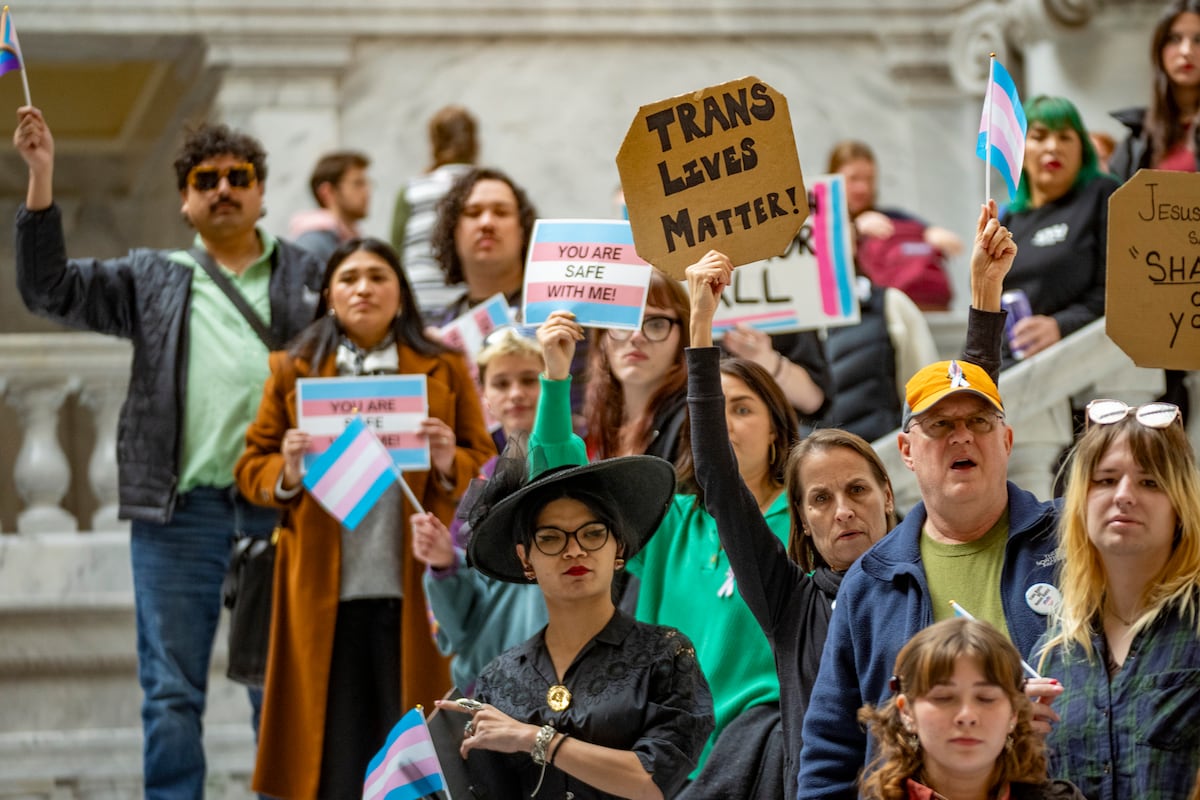
(Rick Egan | The Salt Lake Tribune) Transgender rights protesters walk around in the Capitol rotunda on Wednesday, Jan. 21, 2026.
Lawmakers have passed laws limiting transgender people’s ability to access care for four consecutive years, and the most acute effects of those measures are experienced by young people. Each time one of those bills is weighed, transgender Utahns form lines that often stretch outside the doors of committee rooms to testify on how the proposed policy would make their lives more difficult.
“Say we had heard that [evidence review] as a study item — 20 kids come up and bare their souls and beg for compassion and are told, ‘No,’” Dailey-Provost said.
“The thing that is hardest for me, that is most sensitive for me,” she continued, “is that every time we run these bills, these kids — these vulnerable kids — hear adults railing against their health care. And it’s important to look at this from a legislative standpoint, but how much do we have to put these kids through this trauma of hearing lawmakers declare that their health care doesn’t matter?”
At least half of the people who see Kuhn, they estimated, are affected by SB16’s restrictions. In the aftermath of the law’s passage, some of Kuhn’s clients’ families decided to move away from Utah, while others are making regular trips out of state to receive care
Because SB16 left some room for minors already receiving gender-affirming care to continue treatment, Kuhn said, “We do still have a handful of kids that are getting their treatment here.”
Traveling causes parents to miss work, and children to miss school, and part of Kuhn’s job is helping families procure the accommodations necessary from educators to make that possible — a compromise schools aren’t always willing to make, even when treatment is necessary to address suicidality.
“We’re actually trying to save her life at this moment,” Kuhn said, reflecting on their experience helping one client, “I don’t give a s— if she didn’t do her homework last week. That is not our priority right now.”
As part of Utah’s 2023 Student Health and Risk Prevention survey, approximately a quarter of transgender students polled reported attempting suicide at some point during the previous year. About 61% said they had seriously considered it, compared to 18% of their peers. Utah did not publish information specific to transgender students’ well-being in its 2025 survey report.
“I just don’t get how people can’t see what harm is being done,” Kuhn said. “Somehow they think the harm is if we have hormones — how about the harm of being six feet under?”
(Bethany Baker | The Salt Lake Tribune) Dr. Collin Kuhn, a therapist who works with transgender kids, discusses how Utah children and their families are affected by the legislative inaction following the May 2024 release of a Utah legislature-commissioned evidence review on gender-affirming care for transgender youth, at her office in Salt Lake City on Monday, Dec. 8, 2025.
‘No intention of actually using the data’
Utah’s DHHS declined in its May report following the evidence review to take a position on what lawmakers should do next. It did, however, offer recommendations as to the policies the Legislature should put in place if it were to lift the moratorium.
Those included creating a “hormonal transgender treatment board” that would provide care guidelines; limiting providers delivering care to “demonstrated experts” and requiring that treatment be overseen by an interdisciplinary team of physicians and mental health professionals; and implementing an “explicit informed consent” process.
A week into the 2026 legislative session, lawmakers are proposing further limiting the ability to seek gender-affirming treatment not just for transgender youth, but for transgender adults, too.
A new bill from Rep. Rex Shipp, R-Cedar City, would impose more permanent restrictions on transgender youth access to hormone therapy. HB174 would include limited exceptions for minors already receiving that care: They can continue treatment with their parents’ permission, if they are at least 17 years old and have been receiving treatment for at least two years, or if they will turn 18 within six months of the bill taking effect.
Rep. Nicholeen Peck, a Tooele Republican, is proposing in HB193 prohibiting public money from going toward any transgender hormone therapy or sex characteristic surgical procedures — similar to a bill Peck unsuccessfully introduced last year.
If passed, it would effectively ban government workers insured by their employer from using that coverage for gender-affirming care, block Medicaid recipients from treatment and could close one of the largest transgender health programs in the state at the University of Utah.
Sen. Nate Blouin, a Salt Lake City Democrat, says he plans to introduce a bill to end the gender-affirming care ban as he mounts a congressional run. Blouin said he opened a bill file when the evidence review was published “because it was clear it was going to be ignored.”
That the Legislature has not yet publicly weighed the medical evidence review and plans to ban gender-affirming care for youth in spite of it “signifies what we already knew,” said Kuhn, who has repeatedly testified in front of lawmakers on how devastating its restrictions on the transgender community can be.
“They have no intention of actually using the data,” they continued. “They just keep punting with the line and pushing it back and back. They knew what DHHS would say — everybody, including myself, told them, and they’ve [listened but] always been unwilling [to hear].”
Note to readers • This story is available to Salt Lake Tribune subscribers only. Thank you for supporting local journalism.
news/politics/2026/01/27/transgender-health-care-utah-gop/”>Source link
-

-

-

-

-


