
KATHMANDU: The guest, wearing his trademark red bandana, fumbles through his bag and produces a transparent container the size of his palm. It is filled three-quarters with a brown, viscous liquid, topped off with a bright yellow cap – the color signifying caution.
“Now this looks like store-bought honey because there’s a label there,” teases Will Sonbuchner, creator and host of Best Ever Food Review Show. “What that truly is, I transferred the honey to this grocery store bottle so if I went through customs, I wouldn’t have any issues.”
“Good move,” the host, Joe Rogan, the comedian and sports commentator, responds.
Honey becomes “mad” when it contains grayanotoxins, a class of compounds naturally present in nectar that bees collect from rhododendrons, the national flower of Nepal. In a now-viral clip with 15 million views, the two influential creators try mad honey in front of the camera, as Sonbuchner, also known as Sonny Side, reads out texts his brother in Minnesota sent him while he was on his own trip.
“So my brother woke up feeling hungover the next day, he felt stiff,” describes Sonbuchner to a giggling and dazed Rogan. “So your next question might be, ‘why the fuck do people wanna take this?’ I don’t know. I couldn’t figure it out.”
Photo Courtesy: Medicinal Mad Honey
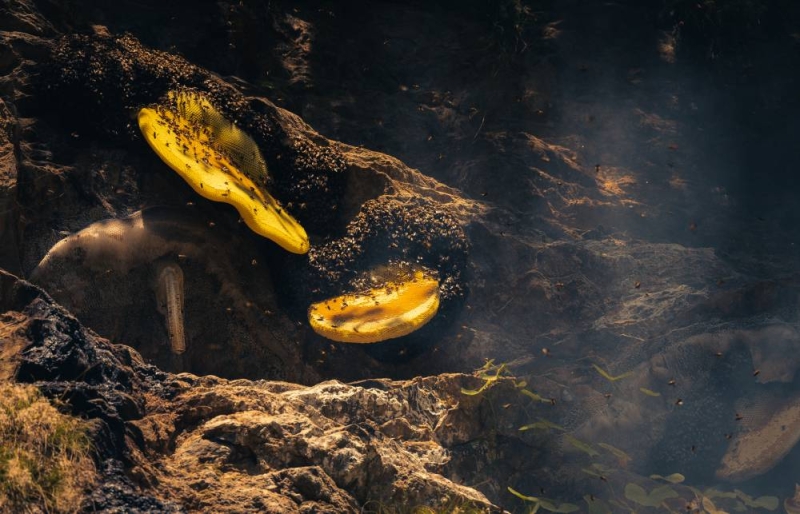
In an unlikely twist, mad honey is also known as bheer maha in Nepal, meaning “cliff honey”. Guarded with traditional knowledge, the honey is a precious gift in ceremonies and an offering in rituals. Among Indigenous Himalayan communities – the Gurung, Kulung, Thakali, Rai, and Lhopa – medicinal mad honey use grew alongside tribal hunting traditions. It is valued as a natural remedy for pain, inflammation, weak immunity, and digestive issues rather than as a hallucinogen or sexual stimulant. At higher doses, however, the same compounds can produce well-documented toxic neurological and cardiovascular effects.
Media outlets like Vice have produced documentaries on mad honey hunting. On popular streaming platforms, mad honey videos highlight hallucinations and the peril Gurung harvesters face on giant cliffs to collect it.
The Nepalese Honey That Makes People Hallucinate
As the use of mad honey for a recreational high is on the rise, driven by social media hype rather than science, so are cases of mad honey disease, emerging from regions that historically never reported such cases.
As Rogan would later recall to Oscar-winning actor Matthew McConaughey on The Joe Rogan Experience,
“I took it at the beginning of the podcast. I go, ‘How much is a large dose?’ And [Sonbuchner’s] like, ‘you take like a half a teaspoon.’ I was like, ‘Ah, fuck it,’ and I just took a whole big teaspoon of it. (In fact, Sonbuchner recommended Rogan to take a whole teaspoon, but Rogan opted for only half of that.)
“About 20 minutes in, I’m like ‘oh, okay, this is a new one.’ I’m like, ‘This is crazy. This is honey? Do I put this in your tea? Like what’s going on in Nepal?’
“It wasn’t like, I was out of my head and didn’t know what to do. I was completely functional. Yeah, but it was like bizarre, that this isn’t honey.”


Photo Courtesy: Medicinal Mad Honey
Sellers caution that grayanotoxin levels in the harvested honey could vary by season, and most batches are untested for potency. In fact, there are reports of people being hospitalized after consuming as little as two teaspoons. (Sonbuchner did not respond to The Xylom’s written interview request. The Xylom was unable to reach Joe Rogan or his publicist for comment.)
Yet, with little to no guidance from regulatory authorities, reports of sobering stories of medical emergencies remain hidden in journals.
Mad Honey’s Long, Bewildering History
In the summer of 2024, Sajjad Ahmed Khan, a physician at Nepal’s Birat Medical College, encountered an unusual case. A 60-year-old man arrived at the emergency ward dizzy, disoriented, and nauseated, with nosebleeds and head trauma from a fall. “He had a persistent cough and kept complaining about constant headaches and dizziness,” recalls Khan.


Photo Courtesy: Medicinal Mad Honey
His blood pressure dropped to dangerously low levels. His heart beat plummeted to 40 beats per minute – well below the normal adult heartbeat of 60–100. Khan’s team rushed in and administered emergency medicine. After several tense hours, the patient’s vitals began to recover.
Khan immediately recognized the cause. “It was a case of mad honey disease,” Khan, who has co-authored a study on the disease, says.
The elderly man had been on hypertension medication for several years. He had a persistent cough that got worse over time. On the recommendation of a traditional healer, he had consumed alcohol along with locally harvested honey that was 2–3 years old. Taking mad honey and alcohol while on hypertension medicine could have triggered the extreme symptoms.
Most of the patients Khan sees come from Indigenous communities who rely on traditional medicine. Even then, mad honey poisoning cases have appeared sparingly. “I have monitored four or five hospitalized cases in the past six months,” Khan says.
For as long as “mad honey” has been known to humankind, stories of poisoning – intentional or not – have followed.


Photo Courtesy: Medicinal Mad Honey
One of the earliest records of mad honey use dates back nearly 2,100 years to the Third Mithridatic War (73–63 BC), when the Roman army, headed by the celebrated commander Pompey the Great, advanced into modern-day Türkiye on a quest to conquer Asia Minor. (The Black Sea region of Türkiye is the other major producer of mad honey.)
Standing in the way of Rome’s expansion was King Mithridates Eupator VI of Pontus, renowned for his knowledge of pharmacology.
“In fact, he had a reputation as a poisoner. He would regularly take sub-lethal doses of various poisons to immunize himself,” says Matthew D. Turner, an emergency medicine expert at the Hershey Penn State Medical Center, who has documented a detailed account of this war.
King Mithridates devised a trap with the help of a mountain tribe, who placed bowls of mad honey along the paths where Roman troops were expected to march. The soldiers consumed it and soon became violently ill before collapsing. The king’s troops easily defeated the disoriented soldiers.
Although Romans eventually conquered Mithridates, this chemical ambush remains one of the earliest recorded instances of mad honey being used as a war weapon.


Photo Courtesy: Medicinal Mad Honey
For a long time, researchers struggled to understand the role of grayanotoxin in rhododendrons. In a research study, Philip Stevenson and his team, working at the Royal Botanic Gardens Kew in the U.K., found that high levels of the compound in the leaves kept thrips away, while low levels allowed the insects to feast on them. His team further confirmed the presence of grayanotoxin in the nectar of rhododendron.
When the researchers fed the compound to the common honeybee from the British Isles, Apis mellifera mellifera, it didn’t survive. Even the wild species Andrena scotica couldn’t survive the poisonous effect of grayanotoxin. But bumblebees – slow-flying bees known for their deep buzz – were not.
Stevenson’s team hypothesized that rhododendrons may be using grayanotoxin to filter out smaller, less effective pollinators. Although their studies are focused on the U.K., Stevenson believes that the same mechanism likely operates in bees in Türkiye and Nepal.
“Mad honey [collected from] Türkiye is produced by Apis mellifera caucasica, which appears to be adapted to these toxins. In Nepal, the species that is producing this honey is the larger honeybee species, Apis laboriosa, a native species which has [adapted to the toxin] over many, many millennia,” he says.

Photo Courtesy: Medicinal Mad Honey
On the other hand, the toxic effects of grayanotoxin have been studied through decades of research. In 1925, German scientist Otto Tunmann isolated it from tannin and glucose extracted from a rhododendron. Since then, researchers have identified more than 25 forms of grayanotoxin in rhododendrons – describing poisoning mechanisms, isolating various versions, and even synthesizing them entirely in the lab.
Research explains the neurological impacts of grayanotoxin on the human body. Normally, when a nerve cell fires, its sodium channels open briefly to let sodium ions rush in, then shut so the cell can reset for the next signal. But when grayanotoxin is consumed, it prevents these sodium channels from closing, so the nerve cell cannot return to its resting state. Locked in constant excitation, it can’t reset – explaining why Khan’s patient was so disoriented. Worse, the open gates let in too much calcium into the cells, disrupting muscle and heart function.
Mad honey poisoning had been generally rare in the U.S., the late anthropologist Vaughn Bryant noted in a 2019 interview, because rhododendrons – one of the largest genera of flowering plants and a nectar source of mad honey – are not abundant here. But after a late cold snap, when most flowers die off, and only rhododendrons remain, bees sometimes produce concentrated mad honey – mostly in the Appalachian Mountains.
In one such case during the American Civil War, Union troops in the mountains of the Northeast discovered beehives and feasted on the honey. “They became sick and disoriented, much like the Roman troops centuries earlier in Türkiye,” wrote Bryant.
But what about the accidental – or deliberate – consumption of packaged mad honey products? Take Tony Cirigliano, 51, of Fremont, Michigan, for example. He ordered a regular honey bottle from an e-commerce portal in the fall of 2022, having heard of its health benefits.
“I had bought some raw honey before, so I reordered it,” Cirigliano recalls. This bottle looked identical to the one he’d bought earlier. He began taking it regularly – until one day, his body reacted weirdly.
“I started having heart palpitations, felt really terrible, and couldn’t speak clearly,” he says.
Several weeks after he first consumed the honey, Cirigliano found himself at the cusp of a psychotic break. He called 911 and asked for police protection, saying people wanted to erase him from the face of the earth. Then he disappeared with his family, leaving their phones behind so they couldn’t be tracked. After a few days, when his wife realized his mental state was deteriorating, they returned and sought help.
Although Cirigliano had reportedly been diagnosed with an anxiety disorder almost 25 years ago, on confidential medical records that Cirigliano shared with The Xylom, his healthcare provider notes that “his psychosis was triggered by the over-consumption of mad honey, which contained brain-altering neurotoxins.”
While Cirigliano didn’t pursue lab testing because it was exorbitant, it is unclear why anyone would undersell mad honey at the price of regular honey. Experts argue that while agitation and confusion progressing to coma are common in grayanotoxin poisoning, long-term delusions – extending to days or weeks – are rare. But Cirigliano is not alone.
In 2018, a 52-year-old woman from an Indigenous Gurung community in Nepal reportedly had visual hallucinations after consuming four tablespoons of wild red honey. She talked of sighting a female god and a wild beast in her home that no one else in her family saw. During the episode, family members saw her murmuring incomprehensible words, perhaps under the influence of hallucination. The woman had no medical or psychiatric history.
It is a matter of future studies if it is a case of grayanotoxin involved in triggering paranoia, too.

Photo Courtesy: Medicinal Mad Honey
A Food Safety Conundrum
In the 2009 film Sherlock Holmes, the antagonist Lord Henry Blackwood fakes his hanging with the help of police officers. When Watson finds no pulse, Blackwood is declared dead. Holmes then uncovers a hidden lab run by Blackwood’s associates, who had extracted toxins from rhododendron and tested them on frogs to find a dose that could temporarily slow the heartbeat.
“It is an interesting cultural reference and actually very accurate because consuming grayanotoxin is not just about the bad experience or psychotropic experience,” Stevenson says, “it is simply about taking enough to get to a point of apoptosis, where the heart [beat] is almost undetectable.”
Mad honey harvesting is legal in Nepal, and no specific regulations label it as a distinct product. Traditional harvesting practices of Indigenous communities are permitted and carried out in community-managed forests in the highlands; harvesting mad honey in national parks and protected regions requires formal permits. But across the world, mad honey is challenging regulatory bodies.
South Korea banned mad honey in 2005. Yet cases of mad honey intoxication have been reported because of illegal imports and Korean travellers bringing it from Nepal. The European Commission sought scientific opinion from the European Food Safety Authority (EFSA) in 2023 over certain honeys on the EU market that could cause grayanotoxin poisoning in humans.
“The researchers wanted to determine the need for additional risk management….to ensure a high level of public health protection,” says Francesca Baldinelli, scientific officer and spokesperson for the EFSA. Their detailed study found that 15.3 micrograms of grayanotoxin per kilogram of body weight was linked to reduced heart rate in mice. For an adult human, this dose translates roughly to the weight of a single poppy seed.
Since there have been no long-term studies, the EFSA could not establish a safe level for chronic exposure. However, they agreed on a baseline threshold: honey containing less than 0.05 mg of grayanotoxin per kilogram is considered safe for all age groups against short-term poisoning.
Baldinelli notes that people with cardiovascular conditions, especially those taking medicine that lowers blood pressure or slows heart rate, like the 60-year-old man that Khan treated, are also at risk of adverse effects from grayanotoxin.
While grayanotoxins are included in the Bad Bug Book, published by the Center for Food Safety and Applied Nutrition of the U.S. Food and Drug Administration (FDA), there are currently no regulations, mandatory standards, or guidance in the U.S. regarding the consumption of mad honey. U.S. Health and Human Services Secretary Robert F. Kennedy Jr., who himself appeared on The Joe Rogan Experience to promote various public health conspiracy theories while running for U.S. President in 2024, has publicly discussed his past use of psychedelics and offered support to green-light psychedelic therapy.
However, unlike his European counterparts, Kennedy and his staff have not sought scientific opinion on the safe use of mad honey; instead, in 2025, Kennedy’s advancement of his MAHA agenda led to the resignation of Jim Jones, the Deputy Commissioner for Human Foods at the FDA, the disbandment of the National Advisory Committee on Microbiological Criteria for Foods, and a historic low in American inspections of foreign food facilities.


Photo Courtesy: Medicinal Mad Honey
Ecosystem at Risk
The maddening craze for mad honey is already creating ripples in the ecosystem. But “presenting the cliff honey as just a psychoactive drug to get high is not only misleading marketing, but also at some level disrespectful to the Indigenous community, who have used it for centuries for many other purposes too,” says Rashmi Kandel, of Medicinal Mad Honey, a Himalayan honey dealer based in Kathmandu, whose team collects medicinal mad honey from 84 honey-hunting communities across Nepal.
She adds that historically, these high-risk harvests carried deep cultural significance to the Indigenous people. But rising demand, driven in part by online hype and influencer culture, has led to premature harvesting, raising concerns about the sustainability of the practice.
As tourists flock to Nepal to witness honey hunting, hunters sometimes harvest immature hives to meet the soaring demand – a practice that kills young bees and weakens dwindling colonies.
“Six years ago, the places where we used to have 20–25 hives now barely hold one or two,” says Kandel.
Considering the threats, would we lose mad honey before we understand it?
Just like Atropa belladonna – once allegedly consumed by witches but now used to extract atropine, which is used to dilate pupils during eye exams and as an antidote for certain poisonings – mad honey might have some potential too.
Because mad honey selectively impacts some bees and not others, researchers are intrigued to explore if grayanotoxin can be used as a plant-based pesticide in controlled farming settings, according to Stevenson.
“The fact of the matter is, grayanotoxins [in their raw form] are best known for potentially killing you, so best avoid [them]. But there is always going to be a part of our community that wishes to understand and test those limits,” Stevenson says.
The Himalayan tribes who defied death to scale cliffs thousands of feet above sea level could never have imagined that their prized mad honey would one day go viral. Not for culture or health, but for a trip so high, one flies too close to the sun.
This story is produced by The Xylom, a nonprofit news outlet covering global health and environmental disparities, and co-published by The Himalayan Times. This story was supported by The Ferriss – UC Berkeley Psychedelic Journalism Fellowship.
Source link
-

-
-

-

-


