

Why Ukraine needs Russia’s terminal defeat – not just deterrence
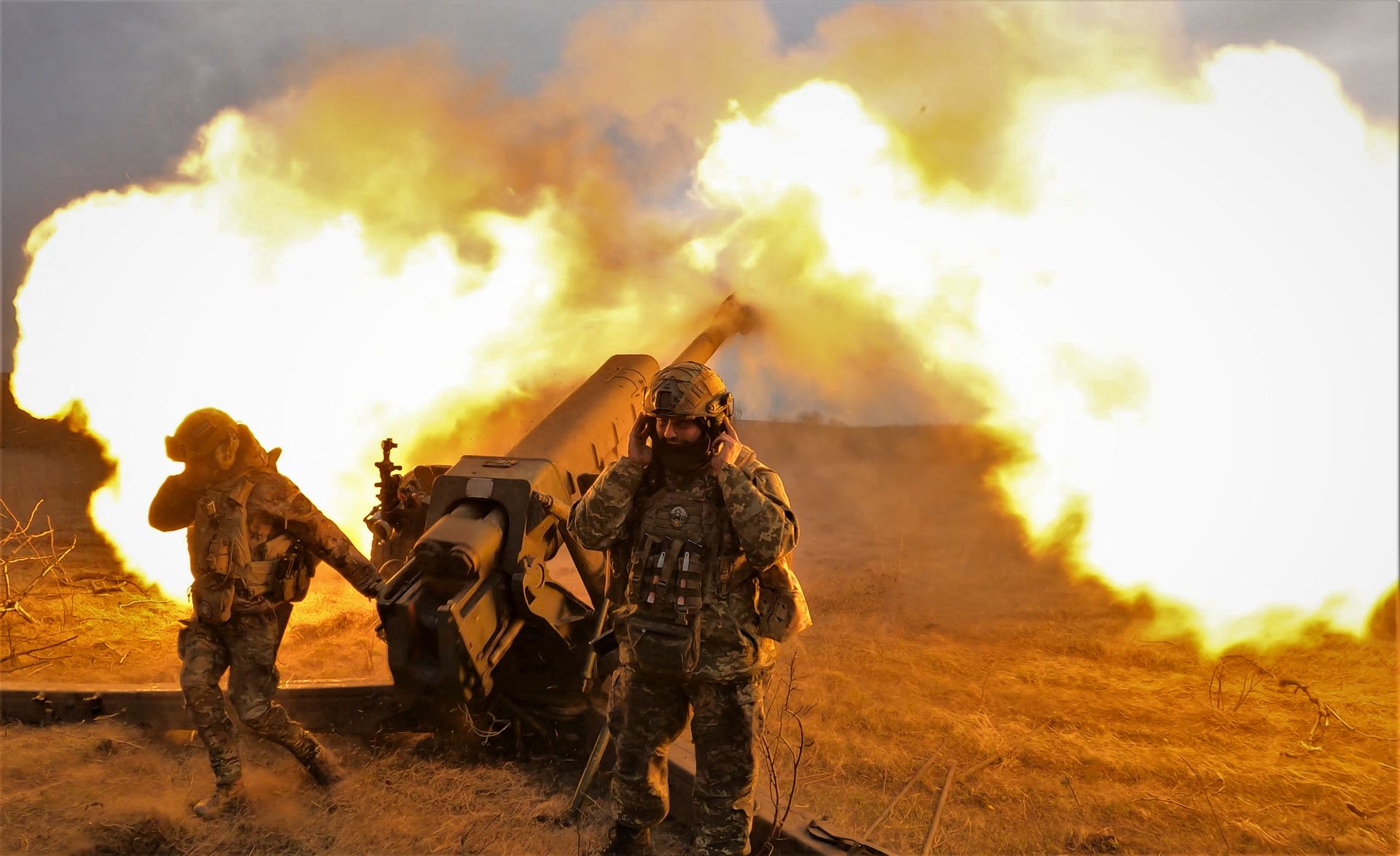
A frame from a video shows Ukrainian servicemen firing a D-30 howitzer toward Russian positions near Bakhmut, Donetsk Oblast, Ukraine, on March 21, 2023. (Sergey Shestak/AFP/Getty Images)
Five years into the full-scale conflict, it has become clear that the model of strategic deterrence – the “steel porcupine” that Ursula von der Leyen often invokes when speaking about Ukraine – offers no guarantee of resilience and long-term peace.
The “steel porcupine” model assumes that, given Russia’s significant resource advantage, Ukraine’s only realistic strategy is to build a defense so strong that continued aggression becomes prohibitively costly for Russia.
However, as of 2026, this model is insufficient on its own.
It obscures the reality that Ukraine is being steadily drained of its resources while defending itself and Europe. In a technological war, even a robust defense gradually deteriorates under the pressure of drone-powered high-precision kill-webs and constant attacks, especially when one has to fight against a resource-abundant state.
The theory of “functional defeat” also seems unlikely to produce meaningful results on its own. This approach aims to create conditions in which an adversary, though still militarily capable, loses the ability to deploy that capability effectively.
Ukraine demonstrated this strategy in the Black Sea in 2023 and 2024, successfully constraining Russia’s freedom of maneuver without destroying its fleet outright. Yet replicating this success in other domains has proven difficult, and as of 2026, no clear path to doing so has emerged.
At the Sahaidachnyi Security Center, we believe that a decisive victory means depriving Russia of the mere ability to wage war. This is what we call a “terminal defeat,” and here is how it can be achieved.
This model rests on two interrelated vectors.
The first is the termination vector: identifying and systematically exploiting critical vulnerabilities within the Russian Federation to produce cascading, irreversible effects at the strategic level.
This is fundamentally different from occasional strikes on infrastructure that can later be repaired. Instead, it means applying sustained pressure across Russia’s economy, technology base, and public perception in ways that cause lasting, hard-to-reverse damage — gradually eroding both its capacity to sustain the war and the broader functioning of the state.
Ukraine is already scaling up deep strikes, but more is needed. Beyond ongoing military efforts, Ukraine should build dedicated teams to map systemic weaknesses and anticipate the downstream effects, not just the immediate impact of any given action.
It should also continue developing next-generation deep-strike capabilities through autonomy and swarm technologies, actively supporting its burgeoning military tech.
If the goal is the definitive elimination of the threat posed by Russia, this reshapes the logic of the second vector — deterrence and defense, too. In this model, defense is no longer an end in itself. Its purpose is to hold the line and limit losses while buying time for efforts that weaken Russia at a deeper level.
This means keeping the front stable and, above all, protecting Ukrainian soldiers — accepting that occupied territories can be reclaimed later, once Russia’s war-making capacity begins to break down.
Rather than sustaining a fragile defense indefinitely, the priority is holding out for a defined period while concentrating resources where they matter most, and ensuring that Russia bleeds personnel and equipment faster than it can replace them.
However, this approach must account for two significant risks.
Russia may shift toward remote strike tactics. They may reduce ground assaults while continuously targeting Ukrainian forces with artillery, loitering munitions, and drones.
Alternatively, it may opt for general or renewed partial mobilization. Manpower shortages remain a bottleneck for Russia but are partly artificial, constrained by Russia’s self-imposed “special military operation” framework and the Kremlin’s fear of social backlash.
Addressing these risks requires two things. First, far greater protection for soldiers’ lives, both on the front line and immediately behind it, given the extreme lethality of a battlefield that is monitored by constant surveillance and precision strikes.
Second, Ukraine must expand its capacity to strike and suppress advancing forces at a distance, so that even a substantially larger Russian force can be effectively contained.
This change in strategy demands accelerated doctrinal, organizational, and personnel reforms — above all, the rapid robotization of front-line combat.
The current plan to expand Unmanned Systems Forces to 5% of total force strength is just a floor, and if the Ukrainian command wants to achieve genuine strategic risk control, it may require pushing that share to 10% or even 20%, with deep integration across all military branches.
Combined with engineering fortifications and a unified kill-web, this would enable the creation of an unmanned exclusion zone along the contact line and the Russian border.
Ukraine also needs a clearer strategic framework for air defense, ideally with a differentiated threat assessment that weighs actual damage, scaling potential, and cost-effective countermeasures.
Drone classes such as the Shahed, Geran, and Gerbera represent the most acute strategic threat: they are far cheaper than missiles, already inflict serious infrastructure damage, and are steadily improving in precision. Anti-drone air defense must therefore be the priority.

This does not diminish the importance of countering missile threats, particularly ballistic ones, where viable solutions remain scarce. PAC-3 MSE interceptors for Patriot systems are currently the only truly effective option, and global supply falls well short of what Russia’s capabilities demand.
Ukraine must therefore operate under conditions of persistent scarcity. While efforts to secure additional interceptors continue, a longer-term response should include developing a domestic or joint European analog to the Patriot system, which is unlikely to happen in the near future. The remaining viable option is a sustained program to relocate critical infrastructure underground.
Ultimately, victory — if the term is to retain any meaning — requires eliminating the very source of the threat. Strategic success, however uncertain, is only possible by operating simultaneously along both tracks: containment and elimination. Neither can function without the other.
Editor’s note: The opinions expressed in the op-ed section are those of the authors and do not purport to reflect the views of the Kyiv Independent.
read also
Exclusive: Here’s why Trump’s envoys aren’t going to Ukraine
U.S. President Donald Trump’s envoys, Steve Witkoff and Jared Kushner, are not rushing to visit Kyiv as concerns grow in Washington that renewed engagement in Ukraine peace talks may again produce no tangible results, the Kyiv Independent has learned. The hesitation comes despite months of internal discussions about a possible trip that would mark their first visit to Ukraine, even as both envoys have already traveled repeatedly to Moscow for meetings with Vladimir Putin. “They’ve promised (to

US to delay arms shipments to Europe, potentially affecting Ukraine, FT reports
Several sources told the Financial Times that the United States has informed the United Kingdom, Poland, Lithuania and Estonia that there will be long delays, with two sources also mentioning possible delays to Asia.
‘New level’ Ukraine strikes cost Russia $7 billion in oil revenue in 2026, Zelensky says
President Volodymyr Zelensky said Ukraine plans to further expand its long-range strike capabilities.
Source link
