Many animated films have a timeless quality and are fondly reflected on by generations to come. Even if the animation is outdated or certain visual effects have a cheesy look to them, the storytelling and characters are strong enough to compel audiences to overlook certain undesirable aspects.
However, some moments in these films, minor and major, are just plain cringeworthy and reveal some of the more problematic trends of the time they were made in. Many of these films feature jokes and innuendos that may have been deemed appropriate at the time of their release but could be considered offensive by today’s standards.
The Last Unicorn Is a Scary and Surreal Experience
The Last Unicorn is a unique film that has plenty of positive elements. The film’s gorgeous animation and stellar voice cast, including acclaimed actress Mia Farrow and Broadway legend Angela Lansbury, make it a truly special experience, separating the film from other animated features of the time. Like many films for younger audiences during the ’80s, however, The Last Unicorn contains many sequences that feel surprisingly dark for a children’s film.
There are scenes in which a living Douglas Fir with a large bosom smothers another character, and a creepy-looking skull is obsessed with the taste of wine. These two moments are plenty suggestive and feel like they would be better suited for adult media. What is especially memorable about the film is the terrifying Red Bull, who traps the rest of the unicorns in the sea. The antagonist’s violence and evil actions are more than enough to strike genuine fear into young viewers, making The Last Unicorn an animated film to watch with caution for more anxious viewers.
Lady and the Tramp Contains Two Offensive Villainous Characters

Lady and the Tramp is remembered within the Disney canon as an endearing animated classic film about two dogs from different worlds who fall in love. The film’s striking animation and heartwarming story, as well as iconic moments like the spaghetti dinner scene, capture what made Disney so special at the time. Still, the cozy film isn’t safe from harmful stereotypes that pervaded Disney at the time.
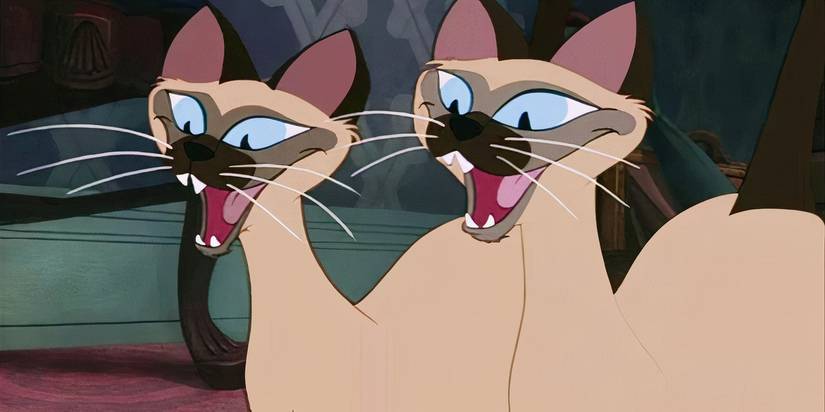
Lady and the Tramp doesn’t have an explicit villain like its contemporaries, but two antagonists are decently memorable, and not in a positive way. The musical number “The Siamese Cat Song” introduces the mild-mannered Lady to the Siamese twin cats, who are depicted with slanted eyes, evoking imagery that is insensitive towards Asian culture. Their song also includes musical influences that are heard within Asian regions, such as a gong and chimes.
The Aristocats Includes an Embarrassing Racial Stereotype


The Aristocats is remembered as one of the better films of the Disney Dark Age, which lasted from 1970 to 1988, but that doesn’t mean it’s safe from eye-roll-inducing moments. Much of the film is charming due to its magnetic characters, especially Thomas O’Malley, the carefree alley cat who helps Duchess and her children find their way home. During the number “Ev’rybody Wants to Be a Cat,” an extremely racist moment interrupts the jazzy romp.
One cat named Shun Gon plays a piano with chopsticks and sings the lyrics “Shanghai, Hong Kong, egg foo young. Fortune cookie always wrong.” If this disjointed amalgamation of words meant to evoke imagery of Asian culture wasn’t offensive enough, Sun Gon is drawn as a stereotypical Asian caricature with slanted eyes and buck teeth. He also has a heavy accent and is clearly meant to be laughed at by audiences. Though it’s a brief scene, it stands out in an extremely negative way.
Fire and Ice Is Extremely Sexual and Features Stereotypical Depictions


Though this animated movie is rated R, there’s still plenty of content that probably shouldn’t have been included. Several shots linger on Princess Teegra’s conventionally attractive physique, showing her breasts and buttocks in scenes that are clearly meant to entice male viewers. Though the princess is shown to be resilient, consistently trying to escape her captors, this oversexualization is too prominent to go unnoticed.
Fire and Ice also implements a group of “savages” as antagonists who kidnap the princess and subject her to humiliation and degradation. This group appears human but is strictly depicted as savages and has significantly darker complexions than many of the heroes. It’s unfortunate that these are major components of the film, as Frank Frazetta’s fantastical art style and Ralph Bakshi’s signature direction are sights to behold. Fire and Ice, like many of Bakshi’s films, possesses an impressive artistic quality but is plagued by numerous moments that can be critiqued in modern contexts.
Pinocchio Has Many Deeply Disturbing Scenes


Walt Disney Animation Studios showed audiences they weren’t afraid to go down darker routes with their stories as Snow White and the Seven Dwarfs showcases many scary moments, including Snow White’s descent into the forest and the Evil Queen’s brutally dark death. Disney’s second film, Pinocchio, took things a step further with its unnerving material as the wooden protagonist finds himself in a nightmarish trap on Pleasure Island.
Led by the evil Coachman, he encourages young boys to indulge in their wildest fantasies before they are ultimately turned into donkeys and sold into slavery. The image of children being transformed into animals against their will, stripped of all their autonomy, is beyond horrific. Luckily, Pinocchio is able to escape, but many boys don’t make it out, implying that there are many donkeys out there forced to work in deplorable conditions that were once human children.

A film that’s advertised in its 4k restoration as “louder and nastier than ever,” Heavy Metal combined loud rock music, endless sexual references and science fiction to create an animated film that pandered to traditionally masculine interests. While some regard the film as a cult classic, many acknowledge the gratuitous violence and sexual exploitation that involve women. The film’s main heroine, Taarna, who is featured on the poster, is a strong, undaunted warrior, but she’s still reduced to wearing a tight leather outfit and is subject to objectification.
Taarna doesn’t even speak, which can be interpreted as a positive representation of those with mutism, but it’s likely that this wasn’t the intention of the filmmakers. In addition to the blatant misogyny, much of the film’s animation is outdated in retrospect. The early use of CGI is notable, but it didn’t blend entirely well in certain sequences. Today, the film is primarily remembered by millennials as a film they saw when they were definitely too young to watch it.
Fritz the Cat Set Out to be Nothing but Inappropriate

Known as the first feature-length animated film in the U.S. to receive an NC-17 or X rating, Fritz the Cat is a satirical and deeply explicit period piece that perfectly encapsulates the issues of the late 1960s and early 1970s. Premiering in 1972 and directed by alternative animation pioneer Ralph Bakshi, Fritz the Cat made lots of headlines for its inclusion of sex, drugs, and violence. These conventions were not associated with animation at the time, and some saw the film as an affront to animation, even though it performed exponentially well at the box office.
While the social commentary in Fritz the Cat is relevant, even to this day, some are bothered by Fritz’s pretentious, somewhat perverted disposition. The crow characters in the film are also meant to represent Black characters and are drawn with lacking prominent facial features, with yellow-glowing eyes and off-white teeth being the only differentiation from their ink-black bodies. For a film as outrageous and boundary-pushing as Fritz the Cat, a more sensitive design for the crows might’ve been better.
Dumbo Is an Inspiring Story but Features an Appalling Amount of Racism

Racism was ubiquitous throughout Disney films in the ’40s, as multiple films featured deeply troubling representations of all sorts of cultures. Of all the racial groups that were targeted in these offensive moments, Black people were at the center of some of Disney’s most atrocious handling of the nuance of race. This is evident in Dumbo which features the “Song of the Roustabouts.”
The song follows faceless Black workers who set up the tents for the circus. With lyrics as horrific as “We work all day, we work all night. We never learned to read or write,” this song is undoubtedly one of Disney’s worst. The much more upbeat “When I See an Elephant Fly” is one of Disney’s most controversial animated segments and contributes to the film’s rampant racism, as the crows speak in African American Vernacular English (AAVE). The lead crow is named Jim Crow, who is reminiscent of the segregationist Jim Crow laws of the late 19th century and early 20th century, and is voiced by white actor Cliff Edwards, which is extremely inappropriate.

Ralph Bakshi had a knack for portraying the undesirable traits of American society, even in his fantasy and sci-fi films. Hey Good Lookin’ is a lot less fantastical with its setting, taking place in 1950s Brooklyn and centering around two rival gangs. The film was advertised as bringing audiences “the outrageous ’50s the way they really were,” contradicting many older Americans’ viewpoint that this period was “a simpler time.”
Aside from various sexual references and violence, the film features racial and homophobic slurs. Racist stereotypes are also present throughout the film. Though this is an accurate reflection of how pervasive racism was in the 1950s, as well as the hypersexualization of women, these moments can make the film difficult to watch. The film can be commended for attempting to dissect the discriminatory norms of the ’50s, but quite a few scenes just haven’t aged well.
Peter Pan Is Full of Racism and Sexism

Of all of Disney’s Golden Age animated films, Peter Pan easily takes the top spot as the most insensitive. Even before Neverland is reached, Peter makes a few sexist comments towards Wendy, telling her to “get on with it” when asking her to sew his shadow back to him and then blurting out that girls talk too much, even when Wendy is doing him a huge favor. Captain Hook also engages in a decent amount of sexism when he plans to weaponize Tinkerbell’s love for Peter, saying, “A jealous female can be tricked into anything.”
The film’s racial and cultural portrayals are even more abhorrent. The Native Americans are depicted as barbaric, slow-talking, subhuman individuals, which is extremely disrespectful to a community whose history has been erased by colonialism. Tiger Lily’s presence serves as a sexual threat to Wendy, as well as being the only female Native American character who’s drawn like the white characters, as if saying that, because of her beauty, she’s more similar to Peter and the white lost boys rather than her own people. Though Peter Pan is full of nostalgia and childhood fantasy, these details just would not fly today.
Source link