

AI Cybersecurity in 2026: How Autonomous AI Agents Are Transforming Digital Security, Zero Trust, and Enterprise Defense
How AI-Native Security Systems, Zero Trust Architecture, and Autonomous Defense Platforms Are Reshaping Enterprise Cybersecurity
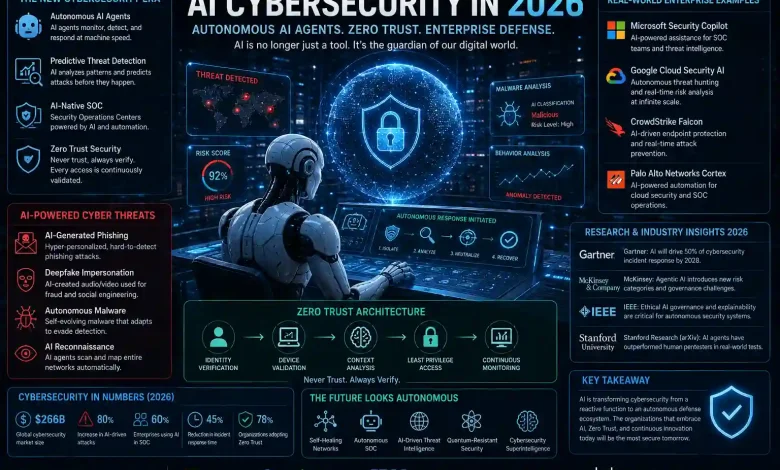
AI Cybersecurity in 2026: How Autonomous AI Agents Are Transforming Digital Security, Zero Trust, and Enterprise Defense
2026 Executive Summary: The global cybersecurity industry is experiencing a seismic disruption. We have moved from human-centric, reactive defense to autonomous operational layers. AI no longer just alerts us to threats—it predicts, hunts, and neutralizes them at machine speed.
The global cybersecurity industry in 2026 is experiencing one of the most significant technological disruptions in modern enterprise history because artificial intelligence is fundamentally reshaping how organizations defend infrastructure, identify vulnerabilities, manage digital identities, automate threat response, protect cloud environments, and secure increasingly interconnected enterprise ecosystems operating across distributed digital environments.
For decades, cybersecurity strategies relied heavily on human analysts manually reviewing alerts, monitoring network logs, identifying malicious behavior, conducting penetration testing, investigating anomalies, and responding to cyber incidents through reactive workflows that were often too slow to handle rapidly evolving digital threats. However, the rise of autonomous AI agents, AI-native Security Operations Centers (SOC), intelligent anomaly detection systems, machine-speed threat analytics, and predictive cybersecurity infrastructure has introduced a new operational paradigm where AI increasingly functions not merely as a software tool but as an autonomous operational layer capable of continuously defending digital infrastructure at massive scale.
Cybersecurity has become one of the most strategically important enterprise technology sectors in the world because modern civilization itself increasingly depends on interconnected digital infrastructure involving cloud computing platforms, financial systems, healthcare networks, AI ecosystems, telecommunications infrastructure, industrial control systems, government services, remote work environments, and global supply-chain operations. As organizations become increasingly dependent on digital systems, cyberattacks simultaneously become more sophisticated through the use of AI-generated phishing systems, autonomous malware, machine-generated exploit discovery, synthetic media manipulation, deepfake impersonation, and intelligent social engineering operations powered by generative AI models.
🔥 Industry Insight: Gartner 2026 Forecast
According to Gartner strategic technology reports, AI-native cybersecurity systems, autonomous AI agents, AI governance frameworks, and preemptive cyber defense architectures represent some of the defining enterprise technology priorities of 2026. Gartner predicts that AI applications will eventually drive a substantial portion of enterprise cybersecurity incident response operations as organizations integrate AI-driven security infrastructure into core operational systems.
At the same time, major technology companies including Google, Microsoft, OpenAI, Anthropic, IBM, Palo Alto Networks, CrowdStrike, Cisco, and Amazon Web Services are investing billions of dollars into AI-native cybersecurity infrastructure because the future of enterprise defense increasingly depends on intelligent systems capable of operating autonomously across massive digital ecosystems. McKinsey research similarly emphasizes that agentic AI introduces entirely new categories of cybersecurity risk because autonomous systems increasingly behave as “digital insiders” capable of interacting dynamically with enterprise infrastructure.
This article provides a comprehensive research-oriented analysis of how AI cybersecurity, autonomous AI agents, Zero Trust architecture, AI-native enterprise defense systems, cyber warfare, agentic AI governance, quantum security, and intelligent digital defense ecosystems are transforming cybersecurity in 2026.
The Evolution of Cybersecurity: From Reactive Defense to Autonomous AI Security Systems
The historical evolution of cybersecurity can be understood as a progressive transition from static reactive defense systems toward intelligent adaptive operational ecosystems capable of autonomous reasoning, predictive analysis, and continuous machine-speed response. Early cybersecurity systems focused primarily on perimeter-based defense involving firewalls, antivirus software, password authentication systems, intrusion-detection signatures, and manually configured security policies. These systems operated effectively during earlier internet eras because digital infrastructure was relatively centralized and cyber threats were comparatively simplistic.
However, modern enterprise ecosystems are dramatically more complex because organizations increasingly operate across:
- multi-cloud infrastructure
- hybrid work environments
- SaaS ecosystems
- mobile platforms
- Internet of Things (IoT)
- API-driven architectures
- AI-native applications
- distributed global networks
Traditional cybersecurity operations centers historically depended heavily on human analysts manually reviewing enormous quantities of alerts generated by SIEM platforms and monitoring systems. This approach created severe operational bottlenecks because enterprise environments now generate billions of security events that exceed human analytical capacity.
Modern AI-native cybersecurity platforms fundamentally change this operational model because autonomous AI agents increasingly perform:
- Continuous Anomaly Detection: Spotting patterns invisible to rule-based systems.
- Behavioral Analytics: Profiling “normal” vs “abnormal” user/agent behavior.
- Autonomous Incident Response: Quarantining threats without human intervention.
- Machine-Speed Threat Intelligence: Digesting global threat data in milliseconds.
- Predictive Attack Detection: Identifying moves before the adversary completes them.
According to McKinsey and Gartner reports, organizations are rapidly transitioning from experimental AI deployments toward AI-native operational ecosystems where autonomous systems increasingly manage significant portions of enterprise cybersecurity infrastructure.
Editor’s Note: Readers interested in broader AI ecosystem transformations can also explore The Future of AI Search in 2026, which explains how Agentic AI is reshaping digital infrastructure, SEO, and search engines.
What Are Autonomous AI Security Agents?
Autonomous AI security agents represent one of the most important technological developments in modern cybersecurity because they function as intelligent operational systems capable of independently monitoring enterprise environments, analyzing anomalies, reasoning through complex attack patterns, orchestrating defensive workflows, invoking security tools, and executing remediation strategies with minimal human supervision.
Traditional security automation systems generally operated through predefined workflows based on static rule sets. Modern AI agents differ fundamentally because they increasingly use:
- large language models (LLMs)
- machine learning (ML)
- multi-agent coordination (Agentic Swarms)
- contextual memory and adaptive reasoning
Recent research from Stanford-affiliated researchers published on arXiv demonstrated that advanced AI agents recently outperformed many cybersecurity professionals during real-world penetration-testing environments involving thousands of enterprise systems. The ARTEMIS multi-agent framework discovered vulnerabilities with performance comparable to top human participants while operating at dramatically lower operational cost. This research is significant because it demonstrates that AI systems are increasingly capable of executing highly technical cybersecurity operations previously requiring experienced penetration testers and security engineers.
AI vs Human Hackers: The Emerging Cybersecurity Arms Race
The rise of AI cybersecurity has created an increasingly sophisticated technological arms race because both defenders and attackers now deploy autonomous AI systems to gain strategic operational advantages. Historically, cyberattacks depended heavily on human expertise involving manual reconnaissance, exploit development, phishing campaigns, malware deployment, credential theft, and persistence strategies. However, generative AI dramatically increases attack scalability because modern AI systems can autonomously generate highly convincing social-engineering campaigns, adaptive malware, synthetic media impersonation systems, and machine-generated reconnaissance operations.
⚠️ AI-Powered Attacks
- Deepfake Impersonation (CEO Fraud)
- Autonomous Malware Mutation
- Voice-Cloning Fraud Systems
- Machine-Generated Exploit Discovery
🛡️ AI-Powered Defense
- Real-time Anomaly Detection
- Automated Threat Containment
- Context-Aware Risk Analysis
- Adaptive Response Orchestration
The cybersecurity battlefield therefore increasingly resembles AI versus AI. Research on AI-driven cybersecurity threats highlights that AI introduces new attack categories involving deepfakes, automated malware, adversarial AI manipulation, and AI-powered social engineering. Researchers emphasize that future defense systems must become increasingly explainable, adaptive, and interdisciplinary to maintain digital trust.
Zero Trust Architecture and AI-Native Enterprise Security
Zero Trust architecture has become one of the foundational cybersecurity models of 2026 because traditional perimeter-based security frameworks no longer adequately protect distributed enterprise ecosystems operating across cloud infrastructure, remote work systems, AI-native applications, SaaS environments, and API-driven architectures.
Zero Trust fundamentally changes cybersecurity philosophy through the principle: “Never trust, always verify.”
How to Use ChatGPT for Students
Modern AI-native Zero Trust ecosystems increasingly combine continuous authentication, identity verification, and behavioral analytics. Cisco AI Defense, for example, now focuses heavily on securing AI agents, models, and AI application lifecycles through continuous vulnerability testing and runtime guardrails designed specifically for agentic AI systems.
Enterprise AI Cybersecurity Platforms in 2026
Microsoft Security Copilot
Microsoft Security Copilot integrates generative AI directly into enterprise SOC environments, enabling security teams to investigate incidents, summarize vulnerabilities, and generate remediation recommendations using natural-language interfaces.
Google Cloud Security AI
At Google Cloud Next 2026, the company introduced multiple autonomous security agents capable of threat hunting and large-scale incident analysis. Google reported that its AI-driven triage agent processed millions of alerts while dramatically reducing analysis timelines.
Compare AI Systems: Readers interested in broader AI comparisons can explore our guide on ChatGPT vs Claude vs Perplexity, which compares major AI systems increasingly shaping enterprise infrastructure.
AI Governance, Enterprise Risk, and Security Challenges
ChatGPT vs Claude vs Perplexity
Research from McKinsey highlights that security and risk concerns remain the largest barrier preventing organizations from fully scaling agentic AI systems. Organizations increasingly worry about AI hallucinations, privilege escalation, and memory poisoning.
Critical AI Risks in 2026:
- Prompt Injection
- Memory Poisoning
- Tool Exploitation
- Cascading Agent Failures
- Supply-Chain Attacks
- Excessive Agency
KPMG recently developed enterprise governance frameworks involving AI kill-switch mechanisms, runtime oversight systems, and traceability frameworks designed specifically to prevent autonomous AI agents from operating outside approved boundaries.
Indian Cybersecurity Firms and AI-Powered Defense
Indian cybersecurity companies increasingly deploy autonomous AI agents capable of dramatically reducing incident-response timelines. According to The Economic Times, Indian cybersecurity firms are integrating AI systems that reduce vulnerability remediation timelines from days to hours. This expansion makes AI-native security infrastructure critically important for enterprise resilience and national digital security in India’s booming digital economy.
Quantum Computing and Post-Quantum Cybersecurity
Quantum systems could theoretically break many current cryptographic standards like RSA. This creates increasing demand for post-quantum cryptography (PQC) and quantum-resistant algorithms. Gartner identifies post-quantum cybersecurity among the defining enterprise security priorities of the coming decade.
AI Security Tools Comparison (2026)
| Platform | Enterprise Focus | AI Capability | Security Specialization |
|---|---|---|---|
| Microsoft Security Copilot | Enterprise operations | Generative workflows | Incident investigation |
| Google Cloud Security AI | Cloud infrastructure | Autonomous AI agents | Threat hunting |
| CrowdStrike Falcon | Enterprise defense | Behavioral AI | Threat detection |
| Cisco AI Defense | AI-native systems | Lifecycle security | AI governance |
The Future of AI Cybersecurity
Future developments may include fully autonomous SOC environments, self-healing enterprise networks, and AI-driven digital identity systems. The long-term winners will be organizations capable of combining AI automation with strong human oversight and explainability.
Explore More: Students and professionals can explore How to Use ChatGPT for Students and Best AI Tools for Students for practical AI workflow examples.
The Future of AI Search in 2026
Conclusion
AI cybersecurity represents one of the most important technological transformations of the modern digital era because autonomous AI systems increasingly operate as the operational intelligence layer defending our digital civilization. Organizations capable of building trustworthy, explainable, and AI-native cybersecurity ecosystems will likely dominate the next generation of enterprise infrastructure.
Frequently Asked Questions (FAQ)
1. What are Autonomous AI Security Agents?
They are intelligent software systems that independently monitor networks, identify threats, and execute remediation workflows without human intervention.
2. How does AI improve Zero Trust Architecture?
AI enables real-time, continuous authentication by analyzing behavioral patterns and context, rather than relying on one-time logins.
3. What is the “AI versus AI” arms race?
It refers to the dynamic where cybercriminals use AI to launch sophisticated attacks, and security teams use AI to defend against them.
