
Haas, J. The Anthropology of War (Cambridge Univ. Press, 1990).
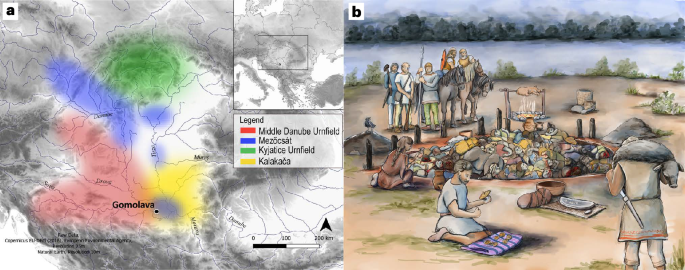
Molloy, B., Bruyère, C. & Jovanović, D. in Rethinking Migrations in Late Prehistoric Eurasia (eds Fernández-Götz, M. et al.) 142–169 (British Academy, 2022); https://doi.org/10.5871/bacad/9780197267356.003.0007
Milner, G. R. Trouble in paradise. Legacy review of: War before civilization. By Lawrence H.Keeley, New York, NY: Oxford University Press. 1996. xiv + 245 pp. ISBN: 0-19-509112-4 (hardback). Am. J. Biol. Anthropol. https://doi.org/10.1002/ajpa.24924 (2024).
Koziol, K. M. Shattered mirrors: gender, age, and Westernized interpretations of war (and violence) in the past. In Bioarchaeology of Women and Children in Times of War (eds Martin, D.L. & Tegtmeyer C) 15–26 (Springer, 2017).
Brukner, B. Naselje Vinčanske grupe na Gomolavi (neolitski i ranoeneolitski sloj). Izveštaj sa iskopavanja 1967–1976, Rad Vojvođanskih Muzeja 26, 5–55 (1980).
Molloy, B. et al. Resilience, innovation and collapse of settlement networks in later Bronze Age Europe: new survey data from the southern Carpathian Basin. PLoS ONE 18, e0288750 (2023).
Google Scholar
Tasić, N. An Early Iron Age collective tomb at Gomolava. Archaeologia Iugoslavica XIII 27–37 (1972).
Medović, P. & Medović, I. Gradina na Bosutu: naselje starijeg gvozdenog doba (Ildiko Medovic, 2012).
Gamba, C. et al. Genome flux and stasis in a five millennium transect of European prehistory. Nat. Commun. 5, 5257 (2014).
Google Scholar
Metzner-Nebelsick, C. The first evidence for mounted nomads between the Caucasus and central Europe in the early 1st millennium BC. In Crossing Boundaries – Mounted Nomads in Central Europe, Their Eastern Roots and Connections; Tagungen des Landesmuseums für Vorgeschichte Halle (eds Meller, H. & Daim, F.) 125–149 (2022).
Mirazón Lahr, M. et al. Inter-group violence among early Holocene hunter-gatherers of West Turkana, Kenya. Nature 529, 394–398 (2016).
Google Scholar
Meyer, C. Early massacres: mass violence in Neolithic Europe. In The Cambridge World History of Violence (eds Fagan, G. G. et al.) 299–319 (Cambridge Univ. Press, 2020).
Fibiger, L., Ahlström, T., Meyer, C. & Smith, M. Conflict, violence, and warfare among early farmers in Northwestern Europe. Proc. Natl Acad. Sci. USA 120, e2209481119 (2023).
Google Scholar
Molloy, B. & Horn, C. Weapons, warriors and warfare in Bronze Age Europe. In The Cambridge World History of Violence (eds Fagan, G. G. et al.) 117–141 (Cambridge Univ. Press, 2020).
Horn, C. Trouble in paradise?—Violent conflict in funnel-beaker societies. Oxf. J. Archaeol. 40, 43–64 (2021).
Google Scholar
Brinker, U. et al. Die menschlichen Skelettreste aus dem Tollensetal: Ein Vorbericht. Tod im Tollensetal-Forschungen zu den Hinterlassenschaften eines bronzezeitlichen Gewaltkonfliktes in Mecklenburg-Vorpommern. Teil 1, 191–208 (2014).
Redfern, R. Gendered violence in Iron Age and Roman Britain. In The Cambridge World History of Violence (eds Fagan, G. G. et al.) 320–341 (Cambridge Univ. Press, 2020).
Király, A., Sebők, K., Zoffmann, Z. K., Kovács, G. & Müller-Scheeßel, N. in Irreguläre Bestattungen in der Urgeschichte: Norm, Ritual, Strafe (ed. Müller-Scheeßel, N.) 307–326 (Dr. Rudolf Habelt GmbH, 2013).
Keeley, L. H. War Before Civilization (OUP USA, 1996).
Martin, D. L. & Tegtmeyer, C. Bioarchaeology of Women and Children in Times of War: Case Studies from the Americas (Springer, 2017).
Waddington, C. et al. Excavations at Fin Cop, Derbyshire: an Iron Age Hillfort in conflict?. Archaeol. J. 169, 159–236 (2012).
Google Scholar
Farkas, G. & Marcsik, A. Das Sammelgrab von Gomolava (Jugoslavien) aus der Urzeit. Anthropologie 14, 93–96 (1976).
Zoffmann, Z. K. Anthropologische Charakteristik der Bevölkerung der Frûheisen zeitlichen Bosut-Kultur Aufgrund des Kollektivgrabes von Gomolava. Balcanica XXVIII 249–258 (1997).
Baten J, S. R. H. in The Backbone of Europe: Health, Diet, Work and Violence over Two Millennia. Cambridge Studies in Biological and Evolutionary Anthropology (eds Steckel R. H. et al.) 300–324 (Cambridge Univ. Press, 2018).
Fibiger, L. Misplaced childhood? In The Routledge Handbook of the Bioarchaeology of Human Conflict (eds Knüsel, C. & Smith, M.) 127–145 (Routledge, 2014).
Ortner, D. J. Identification of Pathological Conditions in Human Skeletal Remains (Academic Press, 2003).
Fibiger, L., Ahlström, T., Bennike, P. & Schulting, R. J. Patterns of violence-related skull trauma in Neolithic Southern Scandinavia. Am. J. Phys. Anthropol. 150, 190–202 (2013).
Google Scholar
Caballero, M. et al. Crossover interference and sex-specific genetic maps shape identical by descent sharing in close relatives. PLoS Genet. 15, e1007979 (2019).
Google Scholar
Gelabert, P. et al. Social and genetic diversity in first farmers of central Europe. Nat. Hum. Behav. https://doi.org/10.1038/s41562-024-02034-z (2024).
Novak, M. et al. Genome-wide analysis of nearly all the victims of a 6200 year old massacre. PLoS ONE 16, e0247332 (2021).
Google Scholar
Schroeder, H. et al. Unraveling ancestry, kinship, and violence in a Late Neolithic mass grave. Proc. Natl Acad. Sci. USA 116, 10705–10710 (2019).
Google Scholar
Furholt, M. Translocal communities—exploring mobility and migration in sedentary societies of the European Neolithic and Early Bronze Age. Praehist. Z. 92, 304–321 (2018).
Google Scholar
Metzner-Nebelsick, C. in Rethinking Migrations in Late Prehistoric Eurasia (eds Fernández-Götz, M. et al.) 209–233 (Oxford Univ. Press, 2023).
Bruyère, C. et al. Trade, recycling and mixing in local metal management strategies of the later Bronze Age south Carpathian Basin: lead isotope and chemical analyses of hoarded metalwork. J. Archaeol. Sci. 164, 105957 (2024).
Google Scholar
Giblin, J. Isotope Analysis on the Great Hungarian Plain: An Exploration of Mobility and Subsistence Strategies from the Neolithic to the Copper Age (Archaeolingua, 2020); https://www.archaeolingua.hu/book/isotope-analysis-great-hungarian-plain-exploration-mobility-and-subsistence-strategies
Cavazzuti, C. et al. Human mobility in a Bronze Age Vatya ‘urnfield’ and the life history of a high-status woman. PLoS ONE 16, e0254360 (2021).
Google Scholar
Maier, R. et al. On the limits of fitting complex models of population history to F-statistics. eLife 12, e85492 (2023).
Google Scholar
Allentoft, M. E. et al. Population genomics of Bronze Age Eurasia. Nature 522, 167–172 (2015).
Google Scholar
Freilich, S. et al. Reconstructing genetic histories and social organisation in Neolithic and Bronze Age Croatia. Sci. Rep. 11, 16729 (2021).
Google Scholar
Brück, J. Ancient DNA, kinship and relational identities in Bronze Age Britain. Antiquity 95, 228–237 (2021).
Google Scholar
Driessen, J. in An Archaeology of Forced Migration: Crisis-Induced mobility and the Collapse of the 13th c. BCE Eastern Mediterranean 19–24 (Presses Universitaires de Louvain, 2018).
Linduff, K. M. & Rubinson, K. S. Are All Warriors Male?: Gender Roles on the Ancient Eurasian Steppe (AltaMira Press, 2008).
Pope, R. E. Gender and society. In The Oxford Handbook of the European Iron Age (eds Haselgrove, C. et al.) 1049–1078 (Oxford University Press, 2017).
Karmebäck, V. N., Wairore, J. N., Jirström, M. & Nyberg, G. Assessing gender roles in a changing landscape: diversified agro-pastoralism in drylands of West Pokot, Kenya. Pastoralism 5, 1–8 (2015).
Google Scholar
Diversity of thought and data enrich archaeology. Nat. Hum. Behav. 8, 183–184 (2024).
Fontijn, D. Economies of Destruction: How the Systematic Destruction of Valuables Created Value in Bronze Age Europe, c. 2300–500 BC (Routledge, 2019).
Janković, I., Balen, J., Potrebica, H., Ahern, J. C. M. & Novak, M. Mass violence in Copper Age Europe: the massacre burial site from Potočani, Croatia. Am. J. Phys. Anthropol. 176, 474–485 (2021).
Google Scholar
Cameron, C. M. Captives and culture change. Curr. Anthropol. 52, 169–209 (2011).
Google Scholar
Martin, D. L. Hard times in dry lands: making meaning of violence in the ancient southwest. J. Anthropol. Res. 72, 1–23 (2016).
Google Scholar
Greene, J. A. & Scott, D. D. Finding Sand Creek: History, Archeology, and the 1864 Massacre Site (Univ. Oklahoma Press, 2004).
Redfern, R. Iron Age ‘predatory landscapes’: a bioarchaeological and funerary exploration of captivity and enslavement in Britain. Cam. Archaeol. J. 30, 531–554 (2020).
Google Scholar
Jans, M. M. E., Nielsen-Marsh, C. M., Smith, C. I., Collins, M. J. & Kars, H. Characterisation of microbial attack on archaeological bone. J. Archaeol. Sci. 31, 87–95 (2004).
Google Scholar
Millard, A. R. in Handbook of Archaeological Sciences (eds Brothwell, D. R. & Pollard, A. M.) 637–647 (Wiley, 2001).
Buikstra, J. & Ubelaker, D. Standards for data collection from human skeletal remains. Arkansas archaeological survey research series (1994).
Mitchell, P. D. & Brickley, M. Updated Guidelines to the Standards for Recording Human Remains (Chartered Institute for Archaeologists, 2017).
Rogers, J. & Waldron, T. A Field Guide to Joint Disease in Archaeology (John Wiley & Sons, 1995).
King, T., Humphrey, L. T. & Hillson, S. Linear enamel hypoplasias as indicators of systemic physiological stress: evidence from two known age-at-death and sex populations from postmedieval London. Am. J. Phys. Anthropol. 128, 547–559 (2005).
Google Scholar
Lewis, J. E. Identifying sword marks on bone: criteria for distinguishing between cut marks made by different classes of bladed weapons. J. Archaeol. Sci. 35, 2001–2008 (2008).
Google Scholar
Brock, F., Higham, T., Ditchfield, P. & Ramsey, C. B. Current pretreatment methods for AMS radiocarbon dating at the Oxford Radiocarbon Accelerator Unit (ORAU). Radiocarbon 52, 103–112 (2010).
Google Scholar
Dee, M. & Bronk Ramsey, C. Refinement of graphite target production at ORAU. Nucl. Instrum. Methods Phys. Res. B 172, 449–453 (2000).
Google Scholar
Stuiver, M. & Polach, H. A. Discussion reporting of 14C data. Radiocarbon 19, 355–363 (1977).
Google Scholar
Wood, R. E., Bronk Ramsey, C. & Higham, T. F. G. Refining background corrections for radiocarbon dating of bone collagen at ORAU. Radiocarbon 52, 600–611 (2010).
Google Scholar
Shaw, B. et al. Antibody-based sex determination of human skeletal remains. iScience 26, 108191 (2023).
Google Scholar
Stewart, N. A., Gerlach, R. F., Gowland, R. L., Gron, K. J. & Montgomery, J. Sex determination of human remains from peptides in tooth enamel. Proc. Natl Acad. Sci. USA 114, 13649–13654 (2017).
Google Scholar
Laffoon, J. E., Davies, G. R., Hoogland, M. L. P. & Hofman, C. L. Spatial variation of biologically available strontium isotopes (87Sr/86Sr) in an archipelagic setting: a case study from the Caribbean. J. Archaeol. Sci. 39, 2371–2384 (2012).
Google Scholar
Kootker, L. M., van Lanen, R. J., Kars, H. & Davies, G. R. Strontium isoscapes in The Netherlands. Spatial variations in 87Sr/86Sr as a proxy for palaeomobility. J. Archaeol. Sci. Rep. 6, 1–13 (2016).
Tuross, N., Fogel, M. L. & Hare, P. E. Variability in the preservation of the isotopic composition of collagen from fossil bone. Geochim. Cosmochim. Acta 52, 929–935 (1988).
Google Scholar
Qi, H., Coplen, T. B., Geilmann, H., Brand, W. A. & Böhlke, J. K. Two new organic reference materials for delta13C and delta15N measurements and a new value for the delta13C of NBS 22 oil. Rapid Commun. Mass Spectrom. 17, 2483–2487 (2003).
Google Scholar
Pinhasi, R. et al. Optimal ancient DNA yields from the inner ear part of the human petrous bone. PLoS ONE 10, e0129102 (2015).
Google Scholar
Rohland, N. & Hofreiter, M. Ancient DNA extraction from bones and teeth. Nat. Protoc. 2, 1756–1762 (2007).
Google Scholar
Damgaard, P. B. et al. Improving access to endogenous DNA in ancient bones and teeth. Sci. Rep. 5, 11184 (2015).
Google Scholar
Rohland, N., Harney, E., Mallick, S., Nordenfelt, S. & Reich, D. Partial uracil–DNA–glycosylase treatment for screening of ancient DNA. Philos. Trans. R. Soc. Lond. B 370, 20130624 (2015).
Google Scholar
Fellows Yates, J. A. et al. Reproducible, portable, and efficient ancient genome reconstruction with nf-core/eager. PeerJ 9, e10947 (2021).
Google Scholar
Schubert, M., Lindgreen, S. & Orlando, L. AdapterRemoval v2: rapid adapter trimming, identification, and read merging. BMC Res. Notes 9, 88 (2016).
Google Scholar
Li, H. & Durbin, R. Fast and accurate short read alignment with Burrows-Wheeler transform. Bioinformatics 25, 1754–1760 (2009).
Google Scholar
Neukamm, J., Peltzer, A. & Nieselt, K. DamageProfiler: fast damage pattern calculation for ancient DNA. Bioinformatics https://doi.org/10.1093/bioinformatics/btab190 (2021).
Google Scholar
Huang, Y. & Ringbauer, H. hapCon: estimating contamination of ancient genomes by copying from reference haplotypes. Bioinformatics https://doi.org/10.1093/bioinformatics/btac390 (2022).
Google Scholar
Fu, Q. et al. A revised timescale for human evolution based on ancient mitochondrial genomes. Curr. Biol. 23, 553–559 (2013).
Google Scholar
Rubinacci, S., Ribeiro, D. M., Hofmeister, R. J. & Delaneau, O. Efficient phasing and imputation of low-coverage sequencing data using large reference panels. Nat. Genet. 53, 120–126 (2021).
Google Scholar
Auton, A. & Salcedo, T. in Assessing Rare Variation in Complex Traits: Design and Analysis of Genetic Studies (eds Zeggini, E. & Morris, A.) 71–85 (Springer, 2015).
Sousa da Mota, B. et al. Imputation of ancient human genomes. Nat. Commun. 14, 3660 (2023).
Google Scholar
Anastasiadou, K. et al. Detection of chromosomal aneuploidy in ancient genomes. Commun. Biol. 7, 14 (2024).
Google Scholar
Weissensteiner, H. et al. HaploGrep 2: mitochondrial haplogroup classification in the era of high-throughput sequencing. Nucleic Acids Res. 44, W58–W63 (2016).
Google Scholar
Weissensteiner, H. et al. Contamination detection in sequencing studies using the mitochondrial phylogeny. Genome Res. https://doi.org/10.1101/gr.256545.119 (2021).
Google Scholar
Ralf, A., Montiel González, D., Zhong, K. & Kayser, M. Yleaf: software for human Y-chromosomal haplogroup inference from next-generation sequencing data. Mol. Biol. Evol. 35, 1291–1294 (2018).
Google Scholar
Waples, R. K., Albrechtsen, A. & Moltke, I. Allele frequency-free inference of close familial relationships from genotypes or low-depth sequencing data. Mol. Ecol. 28, 35–48 (2019).
Google Scholar
Korneliussen, T. S. & Moltke, I. NgsRelate: a software tool for estimating pairwise relatedness from next-generation sequencing data. Bioinformatics 31, 4009–4011 (2015).
Google Scholar
Rohrlach, A. B. et al. BREADR: an R Package for the Bayesian estimation of genetic relatedness from low-coverage genotype data. J. Open Source Softw. 10, 7916 (2025).
Google Scholar
Purcell, S. et al. PLINK: a tool set for whole-genome association and population-based linkage analyses. Am. J. Hum. Genet. 81, 559–575 (2007).
Google Scholar
Ceballos, F. C., Hazelhurst, S. & Ramsay, M. Assessing runs of Homozygosity: a comparison of SNP Array and whole genome sequence low coverage data. BMC Genomics 19, 106 (2018).
Google Scholar
Ringbauer, H. et al. Accurate detection of identity-by-descent segments in human ancient DNA. Nat. Genet. 56, 143–151 (2024).
Google Scholar
Fernandes, D. M. et al. A genetic history of the pre-contact Caribbean. Nature 590, 103–110 (2021).
Google Scholar
Fournier, R., Tsangalidou, Z., Reich, D. & Palamara, P. F. Haplotype-based inference of recent effective population size in modern and ancient DNA samples. Nat. Commun. 14, 7945 (2023).
Google Scholar
Pankratov, V. et al. Differences in local population history at the finest level: the case of the Estonian population. Eur. J. Hum. Genet. 28, 1580–1591 (2020).
Google Scholar
Mallick, S. et al. The Allen Ancient DNA Resource (AADR): a curated compendium of ancient human genomes. Sci. Data 11, 182 (2024).
Google Scholar
Gerber, D. et al. Interdisciplinary analyses of Bronze Age communities from Western Hungary Reveal complex population histories. Mol. Biol. Evol. 40, (2023).
Davidson, R. et al. Allelic bias when performing in-solution enrichment of ancient human DNA. Mol. Ecol. Resour. 23, 1823–1840 (2023).
Google Scholar
Rohland, N. et al. Three assays for in-solution enrichment of ancient human DNA at more than a million SNPs. Genome Res. 32, 2068–2078 (2022).
Google Scholar
Patterson, N. et al. Ancient admixture in human history. Genetics 192, 1065–1093 (2012).
Google Scholar
Parks, D. H. et al. GTDB: an ongoing census of bacterial and archaeal diversity through a phylogenetically consistent, rank normalized and complete genome-based taxonomy. Nucleic Acids Res. 50, D785–D794 (2022).
Google Scholar
Nayfach, S. et al. CheckV assesses the quality and completeness of metagenome-assembled viral genomes. Nat. Biotechnol. 39, 578–585 (2021).
Google Scholar
Langmead, B. & Salzberg, S. L. Fast gapped-read alignment with Bowtie 2. Nat. Methods 9, 357–359 (2012).
Google Scholar
Michelsen, C. et al. metaDMG—a fast and accurate ancient DNA damage toolkit for metagenomic data. Preprint at bioRxiv https://doi.org/10.1101/2022.12.06.519264 (2022).
Sikora, M. et al. The spatiotemporal distribution of human pathogens in ancient Eurasia. Nature 643, 1011–1019 (2025).
Google Scholar
Balliana, E., Aramendía, M., Resano, M., Barbante, C. & Vanhaecke, F. Copper and tin isotopic analysis of ancient bronzes for archaeological investigation: development and validation of a suitable analytical methodology. Anal. Bioanal. Chem. 405, 2973–2986 (2013).
Google Scholar
Source link
-
-
-
-

-


